
Write a SaaS Positioning Statement in One Session With Claude
Your sales calls describe the product four ways. Write one positioning statement with Claude in a single session, and carry it everywhere.
 Sharné McDonaldWith
 Vlad Shvets
On this page
Empact Newsletter
One email a month on what is working in AI search and SaaS go-to-market.
Listen to ten of your own sales calls and count the ways your team describes the product. Each description sends a buyer to different rivals, and so to a different price. A buyer who hears “board portal” prices you against enterprise software. One who hears “the Notion for your board” prices you against a tool they already pay for.
Positioning used to settle this through weeks of workshops, mostly spent reading competitors and drafting options. Claude now does both in minutes of model time, so the drafting fits one working session and the room spends that session choosing. You finish with a positioning statement and a one-page document naming the four places it goes next.
Every prompt and answer below comes from one session we ran on Boardwrit, a company written for this page. It is an early-stage SaaS that drafts startup board packs, with no ties to us or to any company named here, and Claude’s part took about six minutes 1. What Claude needs is mostly in your call recordings and your inbox already:
This page stops at the statement and where it goes. The messaging framework and the homepage copy come after it.
Empact Partners turns the different ways a SaaS team describes its product into one positioning and messaging framework, built with that team. The five blocks below are the order we work in, with Claude doing the reading.
Read the Alternatives Before You Write a Word
Positioning written from memory describes the market as it looked when the founder last checked. Start from what the alternatives say today, in their own words, including what a small buyer does instead of buying anything.
Step 1: Give Claude Your Material and the Alternatives’ Homepages
Open a new chat in Claude, paste the prompt below and your material after it. Change the company name and the addresses to yours. Our workshop method reads roughly ten to twelve alternatives, direct and indirect, and stops there, because more turns the session into a research project. Ours read nine:
I'm the founder of Boardwrit. Everything about us is below. Today we're writing our positioning, one block at a time, and you'll draft options for each block from my material while I choose.

Before any of that, read the homepages of the alternatives a buyer weighs us against. Seven are direct competitors. Two are what small boards use instead of buying anything.

Direct:
https://www.diligent.com/
https://www.onboardmeetings.com/
https://www.boardeffect.com/
https://boardable.com/
https://www.boardpro.com/
https://www.azeusconvene.com/
https://www.govenda.com/
Indirect:
https://workspace.google.com/products/drive/
https://www.notion.com/

Read only each homepage. For each one, give me one row in a table: the company, what its headline says it is (its category, in its own words), who it says it is for, its main promise, and any price shown on the homepage. Quote the page where you can. If a page doesn't load, write "didn't load" in that row instead of guessing.

Under the table, two sentences: which category words the direct competitors share, and what the indirect alternatives have that we don't.

My material:
Claude tried the nine pages in about a minute, and eight loaded. Here is its table, cut to the two columns that matter most:
Scroll horizontally to see all columns when the table is wider than this page.
| Alternative | What its homepage says it is | Who it says it is for |
|---|---|---|
| Diligent | “The leading AI platform for GRC” | Practitioners up to the board, and “From Series A to IPO” |
| OnBoard | “Board Management Software & Board Portal” | CEOs, board administrators, directors, general counsels |
| BoardEffect | “Board Portal Management Software” | “Mission-driven organizations” |
| Boardable | “Board management software built for nonprofits” | Nonprofits |
| BoardPro | “Board management software” | “SMEs and non-profits” |
| Azeus Convene | Didn’t load | Didn’t load |
| Govenda | “Board Management Software” | Governance teams, directors and CEOs |
| Google Drive | Cloud storage, to “store all of your files in one place” | Any team |
| Notion | “A shared brain for your team and agents” | Any team |
Three things in that table shape what follows. Five of the six direct rivals that loaded say “board management” or “board portal” in a headline or title, so buyers know the category’s name. Diligent courts companies from their first big round up to their initial public offering, “From Series A to IPO” 6. And no homepage shows a price.
One page refused Claude. Azeus Convene answered its request with an error, and the row says “didn’t load” because the prompt told it not to guess. The same page opened in an ordinary browser, so when this happens, copy the headline and the line under it into the chat yourself. A table with a gap is better than a table with a guess.
Two product marketers in r/ProductMarketing describe the same rule: the alternatives include whatever your customers did before you existed.
Tips from Reddit
On finding the real alternatives
A key piece is knowing if your product didn't exist what would customers use instead.
Pay very close attention to their pain points. Ask questions like before you had us, how’d you do it?
Draft the Purpose and Choose the Category
Purpose and category come first because every later block leans on them. A differentiator only means something against the rivals your category puts you beside, and a target market only makes sense once you know what you are selling it.
Step 2: Pick a Purpose From Three Candidates
Ask for candidates, never for the answer, and make each one point at a line in your material so you can see what it rests on:
Block 1, purpose. Using only my material, draft three candidate purpose statements: why Boardwrit exists, beyond the product and beyond making money. One sentence each. Under each one, quote the line from my material it rests on. No superlatives.Claude came back with three, each tied to a customer’s own words:
Scroll horizontally to see all columns when the table is wider than this page.
| Candidate purpose | The line it rests on |
|---|---|
| A. Boardwrit exists so that startup leaders can spend their board time deciding what to say instead of putting the material together. | “Now it takes a day, and most of that day is me deciding what to say about churn.” |
| B. Boardwrit exists to make answering to a board a steady routine in a startup’s life rather than a recurring scramble. | “Board meetings went from a scramble to a routine.” |
| C. Boardwrit exists so that a startup can readily show what its board decided and agreed when someone needs to check. | “I exported four quarters of minutes and consents in about ten minutes.” |
We chose A, because it names what the founder gets back, and a customer said it unprompted. C describes a reason to buy rather than a reason to exist, so it moved to the differentiators. Claude flagged a gap too: the material never says why the founder started the company. The room can fix that in one sentence.
Step 3: Weigh the Three Category Paths, Then Read the Prices
A category is where a buyer files you, and our method chooses it from three paths. You can create a new category, narrow a known one with a qualifier, or take a known category exactly as buyers use it. Ask for one candidate on each path, with the rivals each would put you beside:
A. C is a reason to buy, so we'll keep it for the differentiators.

Block 2, category. Draft one candidate for each of the three paths:
(a) create a new category,
(b) modify an existing category by adding a qualifier to it,
(c) compete inside an existing category as it stands.
For each: the category name, which companies from the table a buyer would then compare us with, what that comparison does to the price a buyer expects from us at $149 a month (use only the table and my material, and say "unknown" where they don't tell you), and the biggest risk. Then tell me in three sentences which path you'd pick for a company at our stage, and why.
Claude offered “board pack automation” as the new category, “board management software for startups” as the qualifier and plain “board management software” as the third path, and picked the qualifier. Every price line came back “unknown”, because no homepage shows a price. One more prompt sent it to the pricing pages:
Before I choose: the category decides what a buyer expects to pay, so "unknown" isn't good enough. Find the pricing page of each company in the table (follow the Pricing link from its homepage) and give me one row each: the lowest published price, what it covers (per board, per user, per month or per year), and "no published price" where the page only asks you to contact sales. Quote the page. Then redo the price line for each of the three paths with what you found.Four of the six direct rivals that loaded publish no price. Diligent offers “a package tailored to your organization’s size and stage of growth”, and OnBoard, BoardEffect and Govenda send you to sales. Boardable starts at $20.99 per user a month in the first year, billed annually. BoardPro charges $1,650 a year per board, for any number of users 2 3 7 8 9.
Check the currency on every row before anyone compares them. Google’s pricing page answered our session in Chilean pesos, because of where the session ran, and Claude went to Google’s help pages for the US dollar price 5.
Now set those prices beside the three paths. A new category puts Boardwrit next to Google Drive and Notion. The qualifier puts it next to the board tools that sell to startups, and the plain category next to every board tool, nonprofit ones included:
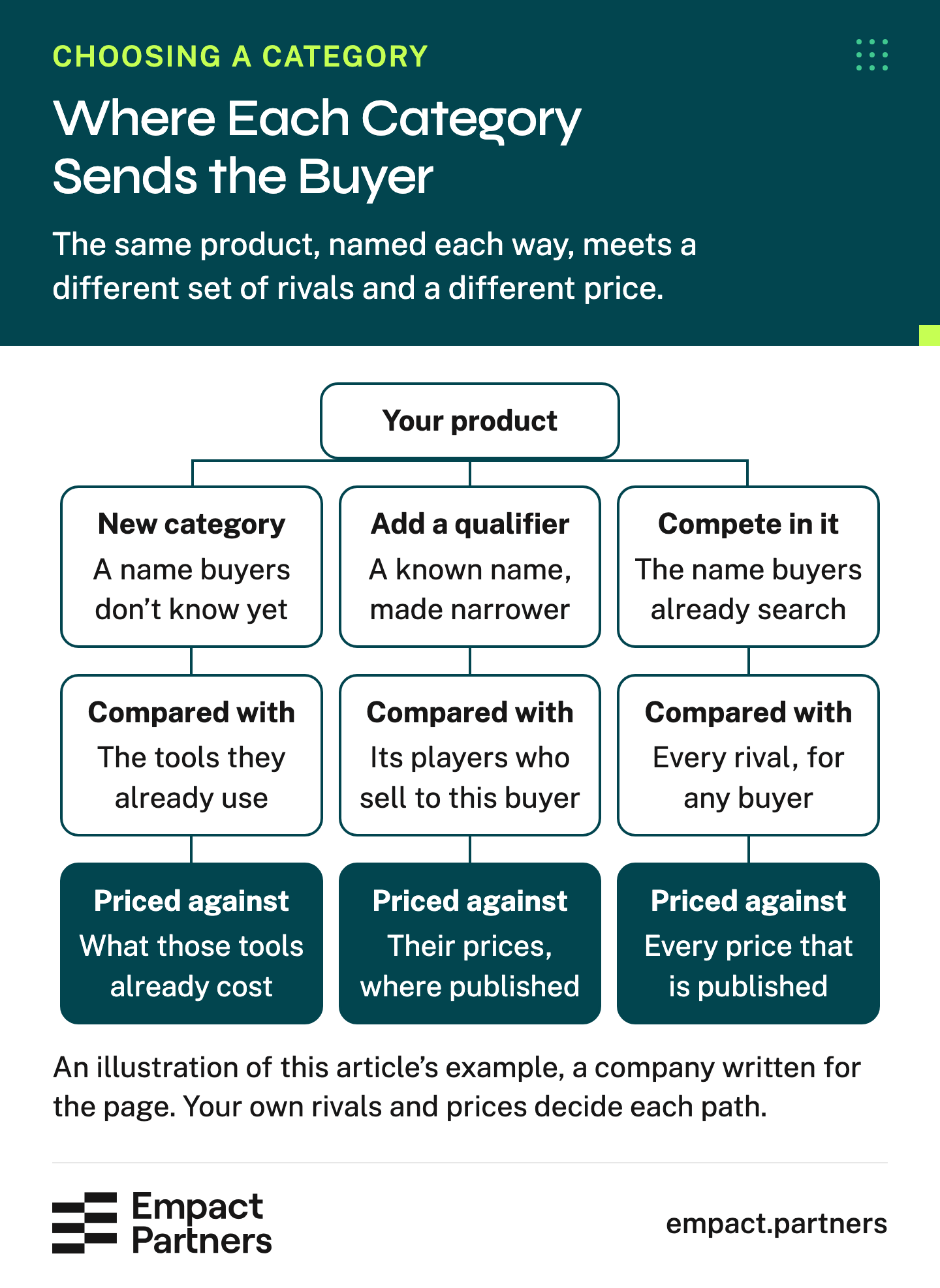
The category you write down decides which price a buyer holds yours against.
In dollars, for a board of six people at each vendor’s lowest published plan, the gap looks like this 4 12:
What Six People Pay a Year at Each Tool’s Lowest Published Plan
Read 25 Nov 2026. Diligent, OnBoard, BoardEffect and Govenda publish no price.
US dollars a year
View the data
| Label | Value |
|---|---|
| Google Workspace Business Starter | 504 |
| Notion Plus | 720 |
| Boardable Essentials, first year | 1511 |
| BoardPro Essentials, one board | 1650 |
On the first path, Boardwrit’s $1,490 a year sits next to Google Workspace and Notion, at $504 and $720 for six people, seats a startup already pays for. On the qualifier path, the same $1,490 sits just under the two board tools that publish a price. The third path adds every rival under the name, nonprofit tools priced per user included.
We chose the qualifier, board management software for startups. Buyers already search for the category, its published prices make $149 a month look reasonable, and the qualifier keeps out the nonprofits that churned. Diligent’s reach into Series A is the risk, so Boardwrit has to show what Diligent’s pages don’t: a deck drafted from the startup’s own Stripe and HubSpot numbers.
This is the block I would give most of the session to:
The category is the block founders try to rush, because it feels like a naming exercise. It decides which tab a buyer opens next to yours, and that tab sets the price before your sales team has said a word. I would rather spend half the session there than on the wording of the statement.
 Sharné McDonald on LinkedInOpens in a new tab
Narrow the Differentiators and the Target Market
With the category chosen, the rivals are fixed, and every remaining block gets measured against them.
Step 4: Keep Only the Differentiators You Can Prove
A differentiator is a reason to pick you over the alternatives in your table, and our method looks for three to five. Ask Claude to tie each one to your material and check it against the homepages it already read:
(b), board management software for startups.

Block 3, differentiators. Give me three to five reasons Boardwrit solves the problem better than the alternatives in the table. Each one must rest on a line in my material: quote it. Then check each against the homepages you read and mark any reason a competitor already claims in similar words, with the quote. Leave out anything I can't prove today.
It found three, and a rival already claimed each one in some form:
Scroll horizontally to see all columns when the table is wider than this page.
| Reason | Proof in the material | A rival’s homepage says | Our call |
|---|---|---|---|
| Drafts the board pack from Stripe, HubSpot and a metrics spreadsheet | “Now it takes a day” | BoardPro: “the board pack builds itself” | Kept, with the data sources named up front |
| Shows who hasn’t signed a written consent | “I could see exactly who hadn’t signed” | Boardable: “Request and track signatures” | Moved to the deck as proof |
| Exports the board record for due diligence | “I exported four quarters of minutes and consents in about ten minutes” | OnBoard: “keep clean records for audits” | Kept, with diligence as the point |
Boardwrit ended with two, under our usual three, and we left it there. A rival claims the signature feature in nearly the same words, and a third differentiator that a rival can sign is padding. The other two survive because the rivals’ wording is broader than Boardwrit’s proof.
Two of Claude’s habits are worth copying. It dropped anything the material didn’t support, such as a phone-friendly pack resting on one investor’s remark. And it said plainly that “not found” on a homepage doesn’t mean a rival lacks the feature. Before your deck says “only”, someone has to try the rival’s product.
A homepage read gives you one page per rival. When one rival keeps winning your lost deals, our Competitor Messaging Teardown compares up to eight pages of your site with theirs on claims, proof and tone, and emails you a response plan. A run is free. For our brand partners, the full agent checks that rival’s main pages for anything new they claim or offer:
Step 5: Write the Target Market as Checks a Rep Can Run
The initial target market sits well below everyone who could use the product. Make it narrow enough that you could name the next twenty customers, and ask for it as criteria a salesperson can check before a first call:
Keep 1 and 3 as differentiators, with 1 in the lead. Number 2 stays as proof in the deck, since Boardable claims it in nearly the same words.

Block 4, initial target market. Narrow it until I could name our next 20 customers. Write it as criteria a salesperson could check before a first call, and next to each criterion say whether my material supports it or it's your guess. Then name who we should turn away for now, from the deals we lost.
Claude came back with eight criteria and marked how much of each our material supports:
Scroll horizontally to see all columns when the table is wider than this page.
| Criterion | What the material says about it |
|---|---|
| Venture-backed startup | Supported |
| Raised a Series A, not yet a Series B | Partly supported |
| Series A closed six to eighteen months ago | A guess, so we struck it |
| Four to seven directors | Mostly a guess |
| Reports from Stripe, HubSpot or both | Partly supported |
| The contact is the CEO, COO or CFO | Supported |
| No SOC 2 Type II or auditor checklist required today | Supported, by one lost deal |
| Directors not tied to another portal through the lead investor | Supported, by one lost deal |
The supported rows are the ones to trust, and the guessed ones stay hypotheses. We struck the third because it shrank the pool before anything was tested. Claude’s best suggestion was to check every criterion against the 41 companies that already pay: if most of them fail one, the criterion is wrong.
Claude also read the lost deals as buyers to turn away for now: a company whose lawyer requires a SOC 2 Type II security audit, three-person seed boards content with a shared drive, and directors who want the portal their investor’s other companies use. Saying no in the CRM is cheaper than losing them on a third call.
Write the Statement and Test It on a Customer
The four blocks are chosen. Now they go into one sentence, and the sentence gets tested against the way a customer talks.
Step 6: Fill In the Template, Then Pick a Functional Headline
We write the statement from a fill-in template, and Claude fills it with the blocks you chose:
Keep it, minus criterion 3: it's a guess and it shrinks the pool before we've tested anything.

Block 5, the statement. Fill in this template with the blocks we chose:
For [target customer] who [need], [product] is a [category] that [key benefit]. Unlike [main alternative], we [differentiator].
Give me two versions. Then give me three taglines for the homepage headline, and label each one functional (says what it does) or emotional (says what it means).
Version A, the one we chose, as Claude wrote it:
For CEOs, COOs and CFOs at venture-backed Series A companies with four to seven directors who need to produce a quarterly board pack without losing days to assembly, Boardwrit is board management software for startups that gives them a draft to edit, so their time goes into deciding what to say. Unlike building the pack by hand, we draft it from the tools you already report from, including Stripe, HubSpot and your metrics spreadsheet.It is long, and that is fine, because the statement is for your team. The homepage gets a tagline, and Claude labelled each of its three:
Scroll horizontally to see all columns when the table is wider than this page.
| Tagline | Kind |
|---|---|
| Your board pack, drafted from Stripe, HubSpot and your metrics spreadsheet | Functional |
| Spend your board time deciding what to say | Emotional |
| Meet diligence with your board history in hand | Emotional |
Lead with the functional line while the company is young. A stranger needs to know what Boardwrit does before caring what it means, and its old headline, “The modern board platform for ambitious teams”, says neither. The emotional line comes once buyers know the name. Claude chose the functional line too, noting that no rival homepage names its data sources.
Step 7: Run the Bar Test
The bar test asks what a happy customer would tell a friend about you, unprompted. Words that never come out of a customer’s mouth won’t be repeated from your homepage either:
Version A, and the first tagline.

Now the bar test. Picture one of the happy customers in my notes at dinner with another founder. Nobody asked about board software. Write the two or three sentences they would say about Boardwrit, unprompted, in their own words. Then compare them with Version A: which words from the statement would they actually say, and which would they never say out loud?
Claude picked the Series A fintech CEO from our notes and wrote, marked as imagined: “I used to lose the last week of every quarter to the board deck. Now we use this thing, Boardwrit, that drafts it from our numbers, and it takes me a day.”
Then Claude checked the statement word by word:
Scroll horizontally to see all columns when the table is wider than this page.
| Words in the statement | Would the customer say them at dinner? |
|---|---|
| “deciding what to say” | Yes, nearly word for word |
| “board pack” | Probably not: they say “board deck” |
| “Stripe, HubSpot and your metrics spreadsheet” | Only if asked how |
| “board management software for startups” | Never |
| “CEOs, COOs and CFOs at venture-backed Series A companies” | Never, because it is a sales filter |
The second row changed the homepage. The customers say “deck”, the founder’s call notes say “deck”, and the statement said “pack”. So the headline became “Your board deck, drafted from Stripe, HubSpot and your metrics spreadsheet”.
Claude added one condition, and we would add it too. Ask five customers how they would describe you to another founder, and write down their exact words, before the change ships. To try a new line on buyers first, start with these message testing tools.
This is also the step where a statement drafted with AI earns the team’s trust or loses it. Two product marketers in the same thread name both risks:
Tips from Reddit
On positioning the team will use
I see AI make a lot of mistakes based on public information, and absolutely wouldn't trust it to come up with field-ready positioning and messaging.
I did not talk to customers myself first and interview them. But even if I had, it might’ve been hard to get sales and leadership to accept the results.
That is why the session runs on your customers’ words, with the people who sell in the room. Claude reads and drafts, and the sellers can push back on any word before it reaches a call.
Carry the Statement Into the Four Places Buyers Meet It
A statement kept in a document changes nothing a buyer sees. It has to reach four places: the About page, the sales deck, the CRM fields that qualify a lead, and the category you pick on the software directories.
Step 8: Put It on One Page With the Four Places It Goes
Ask for all four in the same chat, on one page your team can share:
Agreed: "board deck" on the homepage, and we'll ask five customers the question before we ship it.

Now put everything on one page I can share with the team. Include: the five blocks as we chose them, the alternatives table cut to the ones that matter, the bar-test line, and four short sections for where this goes next:
1. the first paragraph of our About page,
2. the positioning slide in our sales deck (headline and three bullets),
3. the fields our CRM needs so a rep can qualify a lead against our target market,
4. the category we should choose on G2 and Capterra, and why.
Keep it to one page.
The page came back with the five blocks on top, four alternatives with their prices, and this for the four places:
Where Boardwrit’s statement went next
- About page. The purpose sentence first, then what the product does, then six people, founded in 2025, 41 paying companies.
- Sales deck. The board deck headline over three customer lines as proof, the consents among them.
- CRM fields. One field per target-market criterion, each allowed to read “unknown” until a rep confirms it.
- G2 and Capterra. Board Management Software, with “for startups” in the profile text.
The directory row is where the qualifier meets a rule. G2 files each product by what the software does, so “for startups” can never be a category there 10. Capterra uses the same name, Board Management Software 11. Pick the category your buyers filter on, and put the qualifier in the profile’s first line, where the buyer who filtered reads it.
The CRM row is the one teams skip, and it is where the target market starts doing work. A rep who records director count and reporting tools before a first call sees which leads fall outside the target, and the guessed criteria get tested on real leads.
The one page is also where the messaging framework starts: the lines your writers, sellers and AI tools work from, in your buyers’ words. My playbook walks through building it:
In our Brand Marketing work, we build the framework with your own people and the outsiders who know your buyers best, so it sounds like them. We would start with your call recordings and lost deals, because the competing descriptions and the buyers to turn away are already there. If your sellers and your lost deals disagree about who you are, that disagreement is where I would start with you. The work includes:
What the positioning work includes
- An audit and a roadmap, before any page is rewritten
- A named senior GTM consultant on every call
- Your purpose, category, differentiators and target market worked out with your team
- A messaging framework built from how your buyers talk
- The new positioning on your homepage, your About page, your deck and your directory profiles
What this session can’t tell you is whether buyers believe the statement. That shows up in the calls that follow: the phrases your reps stop having to explain, and the deals that stop stalling on a comparison you never meant to invite.
Frequently Asked Questions
How long does it take to write a SaaS positioning statement?
The drafts and the choices fit one working session when Claude does the reading. In our run Claude’s share was about six minutes across nine prompts, and the rest went on choosing. Checking the words with customers and carrying them into the About page, the deck and the CRM take longer, because each has an owner who makes the edit.
Who should be in the room for a positioning session?
The founder, whoever sells and whoever writes the website. Sellers know which descriptions win on calls, and the site owner lives with the words afterwards. Keep it small enough that every choice gets made in the room, and send the one page to everyone else when it is done. Sellers quietly stop using a statement they never chose.
What should we give Claude before the session starts?
Your customers’ words, as plain text: call notes, emails, review lines, the reasons behind your last few lost deals, your current headline and your price. Add how each seller describes the product, word for word. Ask Claude to draft only from what you give it, and check that it did, because a session fed on marketing copy comes back with marketing copy.
What is the difference between a positioning statement, a tagline and a purpose statement?
A purpose statement says why the company exists beyond the product. A positioning statement is an internal sentence naming who it is for, what they need, the category, the benefit, the main alternative and the difference. A tagline is the public line on your homepage, functional or emotional. Your team works from the statement, and buyers read the tagline.
Can Claude or ChatGPT write our positioning for us?
It can draft every block from your material and read your competitors’ pages faster than anyone on your team. It can’t choose for you. In our run Claude marked its guesses, dropped unsupported claims and recommended a path, and each call still needed a founder to accept or overrule it. Give it your customers’ words, ask for candidates, and keep the choosing in the room.
Should a startup create a new category or join an existing one?
A new category gives you a name nobody else owns. Buyers then compare you with whatever they use today, often a tool they already pay for, and teaching the name takes years. Joining a category as it stands puts you beside every player in it. Adding a qualifier borrows a known category’s awareness and narrows the field, which is why it won in our run.
How many differentiators should a positioning statement have?
Our method looks for three to five, and we would rather keep two true ones than pad the set. Test each candidate against your rivals’ own pages: if a competitor already claims it in similar words, it is proof for the deck, not a differentiator. Each one should rest on something a customer said or a fact you can show today.
How narrow should the initial target market be?
Narrow enough that you could name your next twenty customers. Write it as criteria a rep can check before the first call, such as funding stage, board size, the tools they report from and who the contact is. Then test it against the customers who already pay you. If most of them fail one criterion, change the criterion.
Should the homepage headline repeat the positioning statement?
No. The statement is long because it carries the target, the category and the alternative, and it is written for your team. The headline is one line for a stranger. While the company is young, make it the functional line, what the product does, and save the emotional line for when buyers already know the name.
Which category should we choose on G2 and Capterra?
The category your buyers filter on, named for what the software does. G2 categorizes products by their functionality, not by who uses them, so a qualifier such as “for startups” belongs in the first line of your profile. Choose the same category on every directory, so buyers and AI engines that read those pages see one consistent answer.
How do we know the positioning is working?
Before it ships, run the bar test: ask five happy customers how they would describe you to another founder, and compare their words with your statement. After it ships, watch your calls and deals. Reps stop explaining what the product is, fewer deals stall on the wrong comparison, and more of your leads match the target market.
When should we redo our positioning?
When prospects keep turning you down for the same reason, when a new rival changes what buyers compare you with, or when you move to a bigger buyer than the one you wrote it for. A rebrand starts from the same blocks, which is why planning a SaaS rebrand begins with positioning rather than a logo. Otherwise, check it whenever your lost deals change shape.
Sources (12)
- Empact Partners, "the Claude session behind this page (nine prompts, Boardwrit), 25 November 2026" (2026)Empact Partners' own data↩1
- Boardable, "Plans" (2026)↩1read 25 November 2026.
- BoardPro, "Pricing" (2026)↩1read 25 November 2026.
- Notion, "Pricing" (2026)↩1read 25 November 2026.
- Google Workspace Help, "Compare Flexible and Annual/Fixed-Term payment plans" (2026)↩1read 25 November 2026.
- Diligent, "Homepage" (2026)↩1and “Pricing”, read 25 November 2026.
- OnBoard, "Pricing" (2026)↩1read 25 November 2026.
- BoardEffect, "Pricing" (2026)↩1read 25 November 2026.
- Govenda, "Pricing" (2026)↩1read 25 November 2026.
- G2, "Categorization methodology" (2026)↩1read 25 November 2026.
- Capterra, "Best Board Management Software" (2026)↩1read 25 November 2026.
- Empact Partners, "yearly cost for six people at each tool’s lowest published plan, computed from sources 2 to 5, 25 November 2026" (2026)Empact Partners' own data↩1↩2
Keep reading
Brand Marketing How To Build A Messaging Framework Your Team Keeps Using
Keep your SaaS messaging consistent across your website and sales deck, with clear ownership, approved changes and an AI review agent.

Brand Marketing Community Marketing for SaaS: Beyond the Slack Channel
Find out whether your SaaS community helps renewals and sales, who acts on what members ask, and where buyers talk outside it.

Brand Marketing Creative SaaS: Choose Your Segment Before Spending More
Lessons from creative software for choosing a buyer segment, testing your product’s fit and deciding where to spend next.