


Google sent 89.94% of the clicks that search engines handed to websites in September 2026,1 about its share in 2009. If your organic graph has fallen for six months and you have ruled out a penalty, a broken template and decaying posts, the traffic did not leave for Bing.
The traffic went into answers. In the answers our sister company Qvery collected for software companies this year, 65% of Google AI Mode’s cited answers quoted a Reddit thread, a YouTube video or another social post.2 SEO did not die. The search box multiplied.
Empact Partners is a go-to-market consultancy working inside B2B software companies’ marketing teams, and we run SEO for the multiplied box as Search Everywhere Optimization: the site, the links and the mentions, planned for every surface where a buyer asks. That’s what we do. Let’s chat.
SEO Did Not Die, the Search Box Multiplied
Search Everywhere Optimization is still SEO. The letters stayed and the scope moved: the job used to be ranking one site on one search engine, and now it is being found wherever a buyer types the question. The name describes a decision about where you work, which is why it is worth having.
Each of the main boxes has disclosed its own size:
Searches, monthly users and weekly users are three different counts, so they never add up to one market. They do not need to. Each is a place where your buyers ask, and each answers differently.
The multiplying box is also why your organic traffic is dropping with nothing broken. The engine you optimized for now answers part of the question on its own page, and part of your audience asks somewhere else, so the same rankings carry fewer visits.
At Empact Partners an SEO partnership opens with an audit, and its first output is that list of boxes: which surfaces the partner’s buyers search on, and which pages the AI engines quote when they answer the partner’s category. The site, the links and the community work get planned against that list rather than a keyword sheet.
An AI Engine Writes the Answer a Search Engine Used to List
Classic search matched the words you typed against an index and handed back ranked pages. AI search reads the question, fetches pages on its own and writes an answer with a few sources under it.
Google calls AI Mode’s version query fan-out: the question is broken into subtopics and a batch of searches runs at once on the user’s behalf.6 The other differences follow from that one.
| Classic search | AI search | |
|---|---|---|
| What the buyer types | Keywords: short phrases, often two or three words | Queries: whole questions, with the constraints written in |
| How retrieval works | The phrase is matched against an index and pages are ranked | The question is split into sub-questions, many searches run at once, and passages are read and combined |
| What comes back | A ranked list of links | One written answer with a handful of cited sources |
| What you win | A position for a page | A mention of your brand or a citation of your page, inside the answer |
| Where the evidence comes from | Your own pages and the links pointing at them | Every page the engine reads: your site, Reddit threads, YouTube, review sites, listicles, publications |
| What the buyer does next | Clicks a result to read it | Reads the answer and clicks far less often |
| How stable it is | The same list for days | A different answer from one run to the next |
| How you measure it | Rank, impressions and clicks | The share of answers that name you, and the pages they cite |
Google has measured the top row itself. The average AI Mode search is triple the length of a traditional Search query,4 because people type the whole problem instead of a phrase.
Pew Research Center watched 900 US adults search Google for a month in 2025, and the shape of the question decided whether an answer replaced the list. Only 8% of one- or two-word searches got an AI summary, against 53% of searches of ten words or more.7
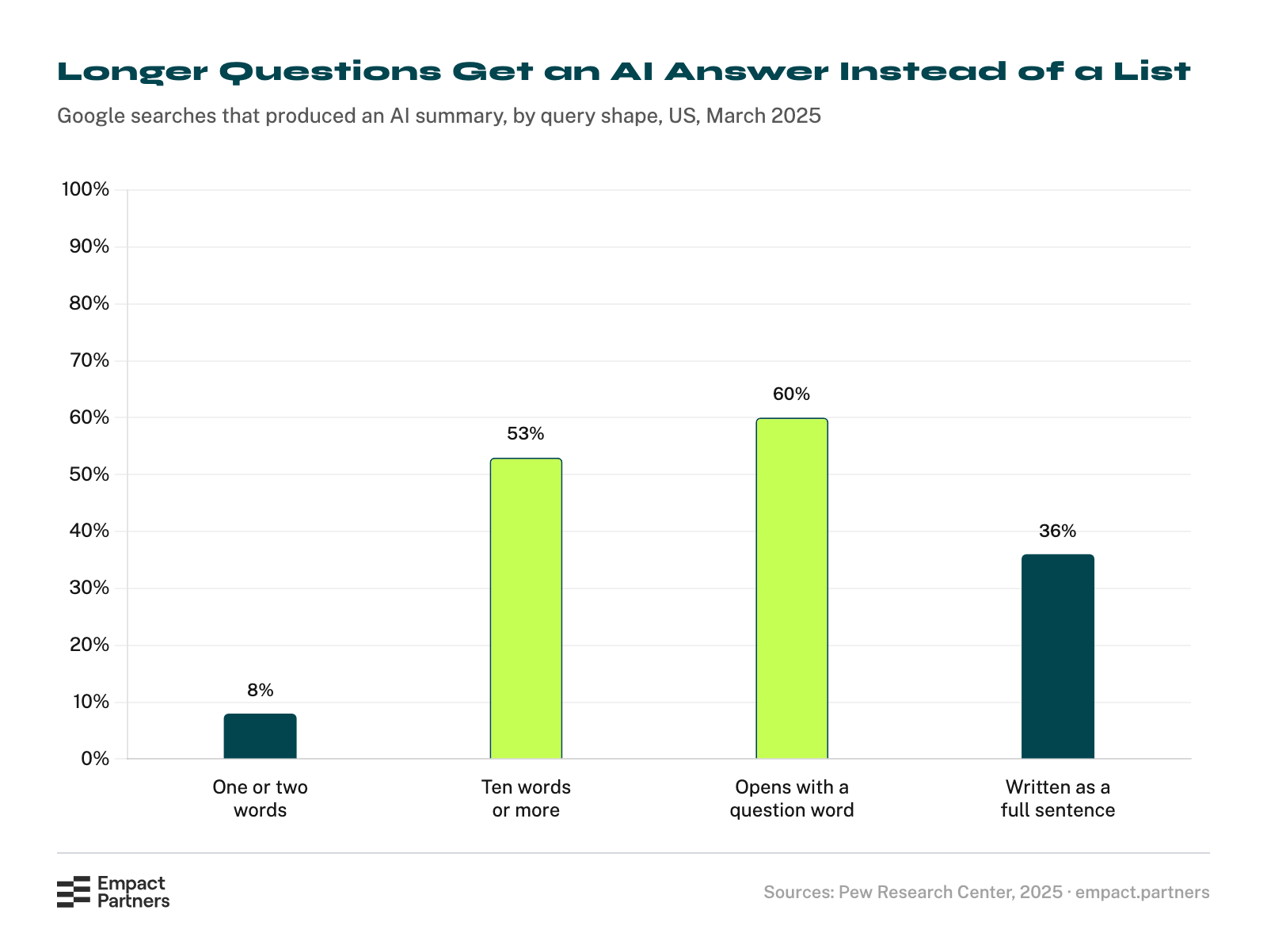
Across all of their searches the summary appeared on 18% of them,7 which sounds small until you see whose searches it hits. A buyer comparing software does not type two words. They type the whole problem, and that is the search most likely to come back as an answer.

.png)
AI engine optimization is the part of this we have specialized in. We run it as Generative Engine Optimization, GEO for short: getting a brand named and its pages cited when an AI engine answers the category’s questions.
GEO sits inside Search Everywhere Optimization rather than beside it, because ChatGPT and Google AI Mode read the same web Google ranks, each in its own way.
Highlights
The classic box held its size, the answer moved onto Google’s own page and into new boxes beside it, and those answers are written from pages that live on other people’s platforms. Each source measures a different box with a different ruler, which is why their numbers disagree, and the disagreement is the box multiplying.
StatCounter Says Google Still Sends Nine in Ten Search Clicks
StatCounter counts a search when someone clicks from a results page through to a site carrying its tracking code, so its share is a share of clicks sent, not of searches typed. On that ruler the box Google owns has barely moved:
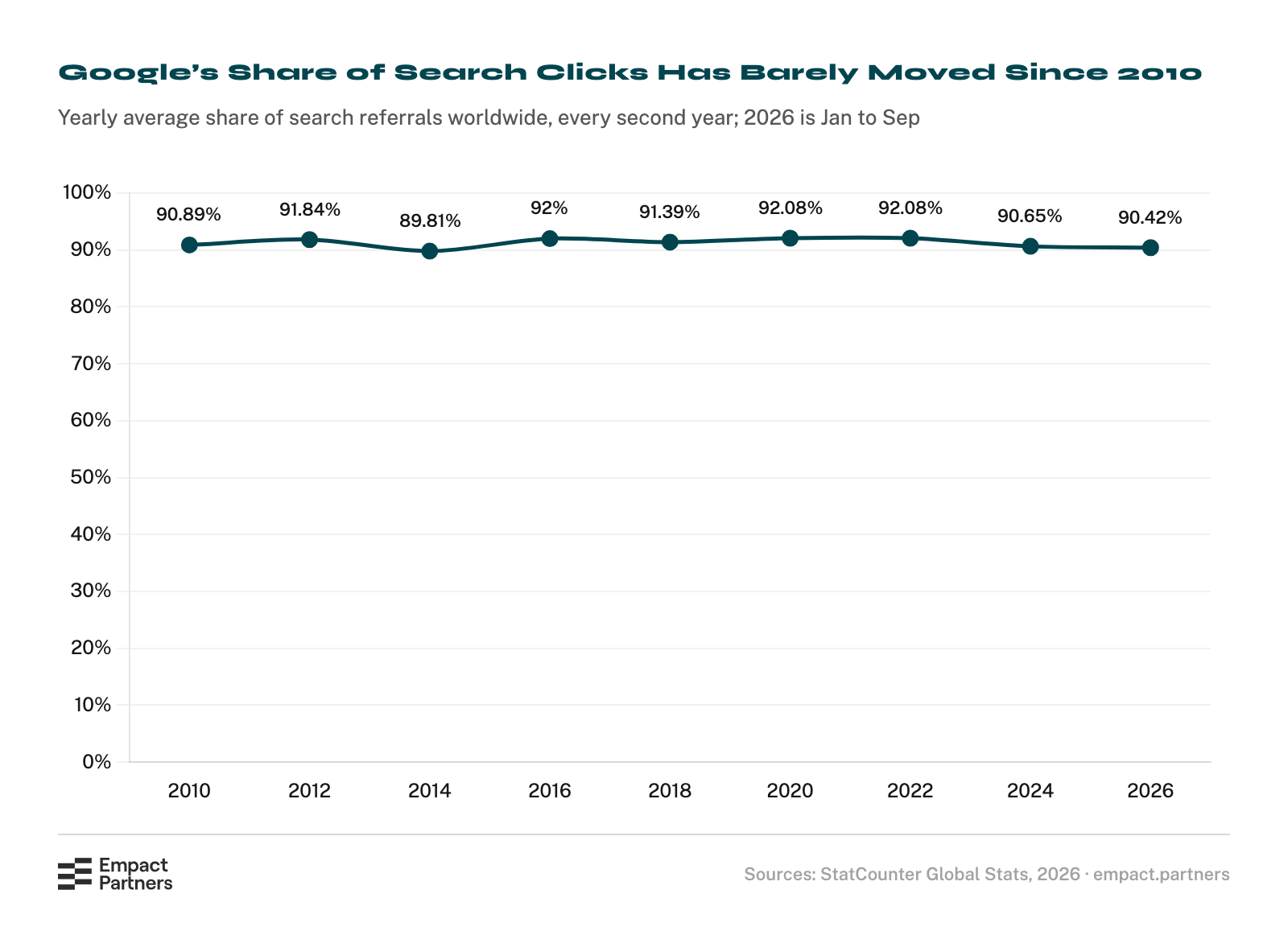
Datos, which reads a US desktop panel rather than referrals, lands in the same place: Google held between 92.4% and 94.0% of desktop search among the traditional engines through the second quarter of 2026.11
Two rulers, one answer. The search engine box did not shrink and Google did not lose it. What changed is how much of the buyer’s question that box still handles.
So the classic work still compounds. We grew Linearity’s monthly organic traffic from 0 to 250K+ sessions, and flair’s by 1600% in three years, carried by over 500 links at DR 40 or above.12 Both results sit on the FAIR VC case study, and both are Google results first. Search Everywhere Optimization keeps that work and adds the boxes beside it.
Count Every Search Box and Google Falls to 73.7%
SparkToro and the clickstream company Datos asked the wider question in 2026: if ChatGPT counts as search, why not YouTube, Amazon or Reddit? They counted every search and AI prompt session a US desktop panel ran across 41 sites in the last quarter of 2025, and Google’s share fell to 73.7%.8
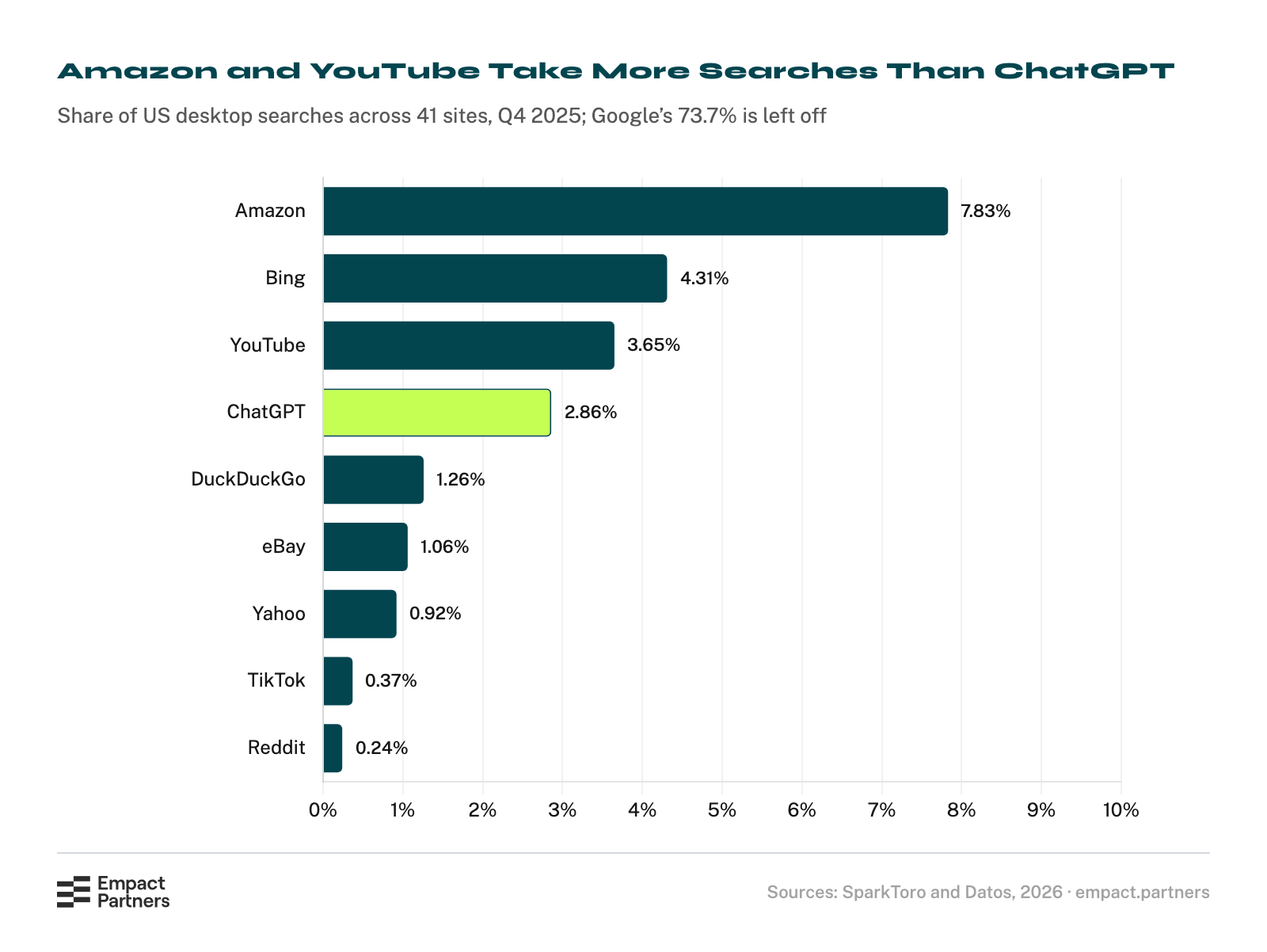
The study covers desktops only and its 41 sites were chosen by hand, so read it as a floor on how wide the box is. The direction is what matters for a budget: on the ruler that counts every box, the store and the video site take more searches than the chatbot everyone is planning for.
Reddit is the odd one out at 0.24%, and SparkToro reads it as people searching Reddit through Google rather than through Reddit’s own search bar. Reddit’s own search is growing all the same: over 80 million people searched directly on Reddit every week at the end of 2025, up from 60 million a year earlier.13
What young buyers say about TikTok
The line everyone repeats comes from 2022. Prabhakar Raghavan, then running Google’s Knowledge and Information organization, said Google’s studies found something like almost 40% of young people looking for a place for lunch go to TikTok or Instagram instead of Google.14
Adobe Express surveyed 807 US consumers in January 2026, about 120 of them Gen Z, and the current picture splits usage from preference:
Usage is real and preference is thin. For a B2B software buyer the box that matters is rarely TikTok and almost always Reddit and the review sites, and that is the call the audit makes for each partner before any budget moves.
The Clicks Went Into the Answer on Google’s Own Page
Pew Research Center’s study is the closest thing to watching over the buyer’s shoulder: the full browsing history of 900 US adults through March 2025, every Google search and what they did next. When an AI summary sat on the results page, the visit went differently:
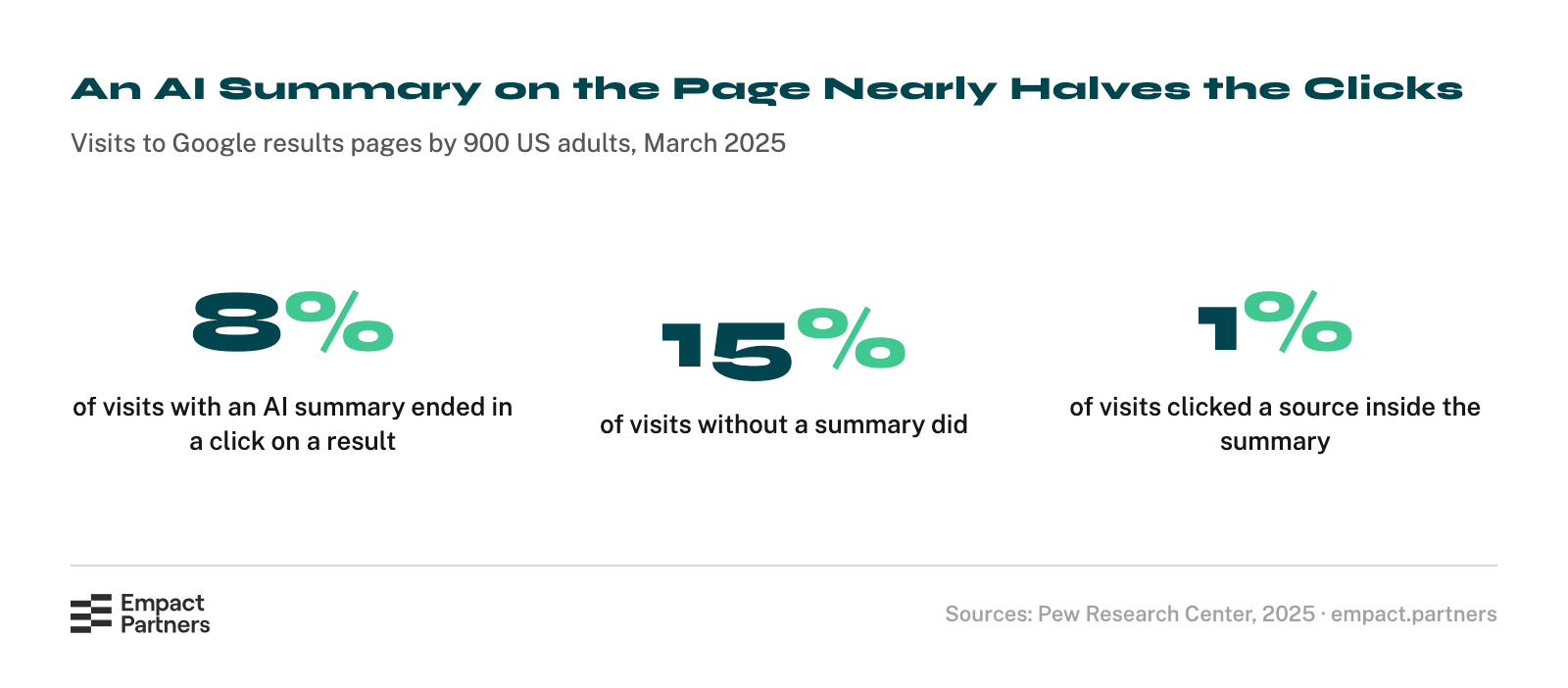
With a summary on the page, people rarely clicked through to anything, and almost never to the summary’s own sources.7 Google’s own numbers fill in the other half.
Google conceded in court that US search queries rose 1.5 to 2% after AI Overviews launched.9 More searches and fewer clicks per search is the six-month graph on your dashboard, drawn by the same Google.
.png)
The Assistants Are a New Box, Big and Not Yet Mostly Search
The best count of the assistants sits in a federal court’s remedies opinion in United States v. Google, where Google’s own estimate of its rivals’ daily queries entered the record as a finding. As of 28 March 2025:
Taken on different dates and in different units, the two counts still give an order of magnitude. Google’s disclosure of more than 5 trillion searches a year works out to about 13.7 billion a day, and ChatGPT’s 1.2 billion is less than a tenth of that.3
A ChatGPT query is not yet a search, either. OpenAI’s economists and Harvard’s David Deming classified a year of consumer use and found that Seeking Information, which they call “a very close substitute for web search,” grew from 14% to 24% of messages between July 2024 and July 2025.10
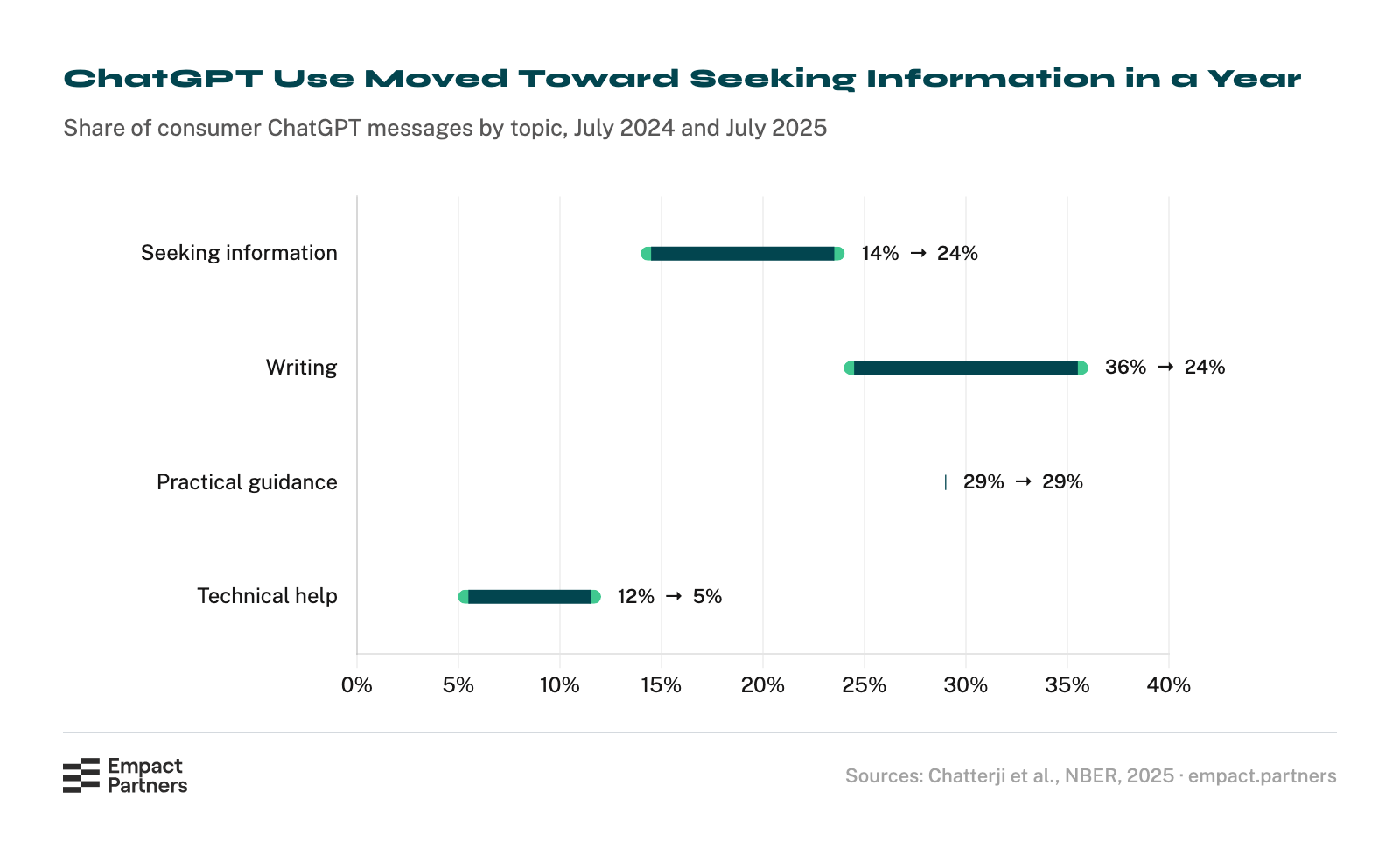
On a desktop panel the assistants are still small beside search. Datos measured AI tools at 1.83% of US desktop activity in the second quarter of 2026, up from 1.37% a year earlier, against 10.52% for traditional search engines.11
The first crack showed up in a court transcript. Apple’s Eddy Cue testified in 2025 that Google searches in Safari had declined for the first time in 22 years, and the court recorded it while finding that the assistants have not replaced search engines.9
Gartner had predicted in February 2024 that traditional search engine volume would drop 25% by 2026.16 What the measurements show so far is a new box growing beside a search engine box that held its size.
The AI Answers Are Built From the Other Boxes
Here is where the boxes meet. In the answers Qvery collected for 28 software companies between 5 January and 23 August 2026, this is what ChatGPT and Google AI Mode cited:2
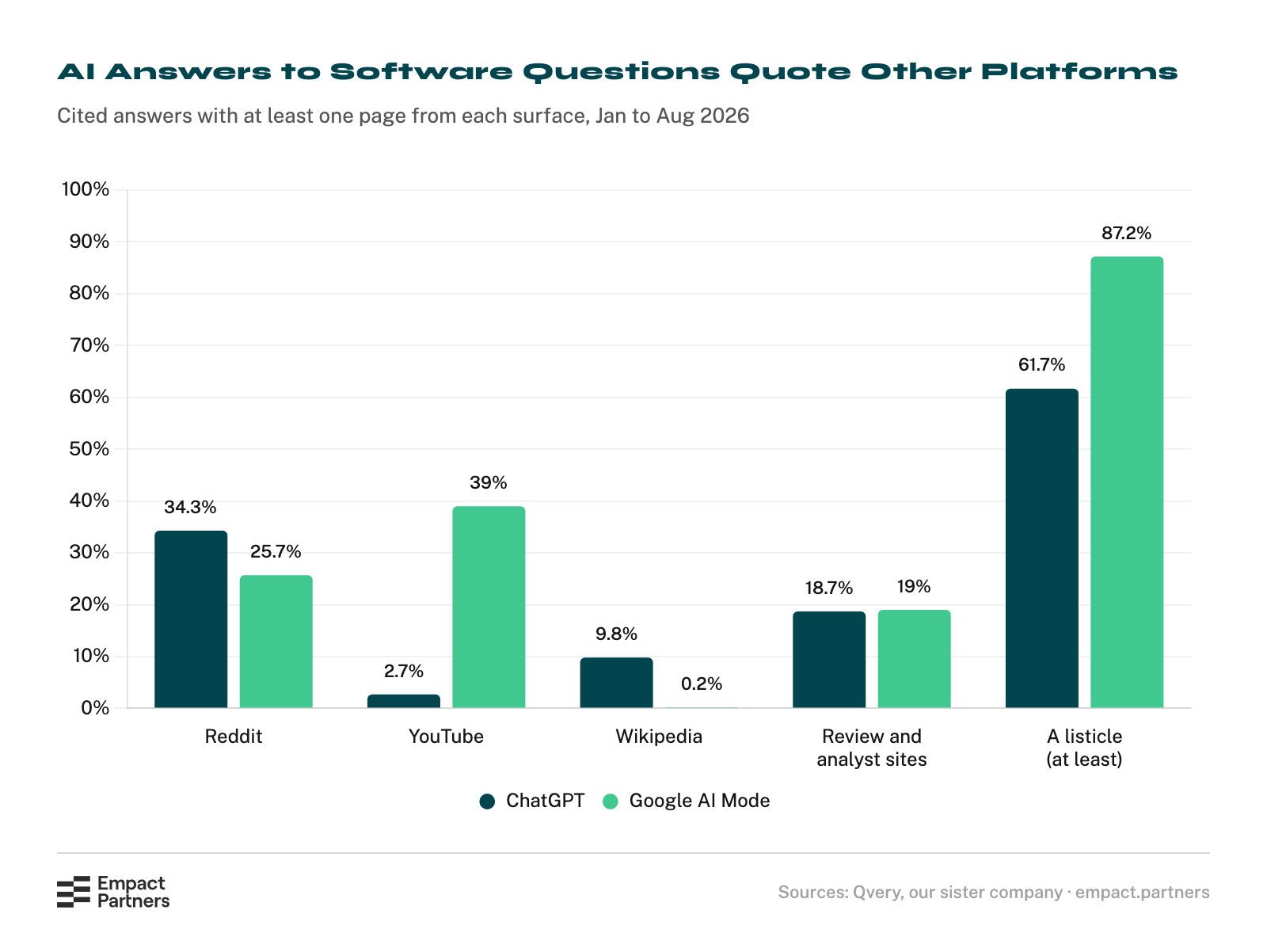
Behind those figures sit 413,276 answers and 5.8 million citations, each cited page classed by the site it sits on.2 Qvery is ours, so weigh the numbers accordingly, and the Sources entry gives the population and the window so you can check them.
As a share of all citations, those surfaces are small: 8.55% of ChatGPT’s citations and 12.28% of Google AI Mode’s, the rest going to vendors’ sites, publications and documentation.2 They turn up in most answers anyway: Reddit, YouTube and the other social pages reach 65% of Google AI Mode’s cited answers and 42.8% of ChatGPT’s.2
Qvery’s published research, across everything it tracks, points the same way:
Pew saw the same three platforms on Google’s own AI summaries, where Wikipedia, YouTube and Reddit made up 15% of the sources cited and 17% of the sources in ordinary results.7
The places people search outside Google are the places the answers quote, and Reddit is the one we have run longest as work. In three months of Reddit threads for KKday, the program drew 3,208,973 views and 60+ explicit KKday mentions.20
The listicle number is why Existing Article Outreach exists. EAO gets a partner’s product into the software listicles that already rank on Google and already get cited in the answers.
Watch Which Boxes Your Buyers Use Before You Move the Budget
SEO did not die, the box multiplied, and the budget now follows the boxes your buyers use. Watch one number per box:
In practice a Search Everywhere Optimization partnership with us opens with an audit that names the boxes, then runs two or three workstreams at once: the site and its links for Google, outreach and review profiles for the listicles, Reddit for the communities. A named consultant owns it, Qvery measures it, and the horizon is quarters.
What this evidence cannot settle is the phone. SparkToro and Datos measure desktops only, so the boxes outside Google are counted here without mobile, and no published study at its origin covers them yet.
If your organic graph is falling and your buyers are asking engines that quote threads, videos and listicles you are not in, book a call with me, and let’s see whether we could work together.
Sources
- StatCounter Global Stats, “Search Engine Market Share Worldwide”, all platforms, monthly, January 2009 to September 2026, read 7 October 2026.
- Qvery, our sister company: every source cited in 413,276 ChatGPT and Google AI Mode answers collected for 28 software companies’ tracked query sets, 5 January to 23 August 2026, each cited page classed by its site for this article, read 7 October 2026.
- Google, “AI, personalization and the future of shopping”, The Keyword, 2025.
- Google, “How AI Mode is changing the way people search in the U.S.”, The Keyword, 2026.
- OpenAI, “Scaling AI for everyone”, 2026.
- Google, “AI Mode in Google Search: Updates from Google I/O 2025”, The Keyword, 2025.
- Pew Research Center, “Google users are less likely to click on links when an AI summary appears in the results”, 2025.
- SparkToro and Datos, “New Research: Search Happens Everywhere; an Analysis of 41 Websites with Significant Search Activity”, 2026.
- United States District Court for the District of Columbia, United States v. Google LLC, No. 1:20-cv-03010, Memorandum Opinion on remedies, ECF No. 1436, findings of fact 60, 63 and 64, 2025.
- Chatterji, Cunningham, Deming, Hitzig, Ong, Shan and Wadman, “How People Use ChatGPT”, NBER Working Paper 34255, 2025.
- Datos, “State of Search Q2 2026: Behaviors, Trends, and Clicks Across the US & Europe”, preview edition, 2026.
- Empact Partners, FAIR VC partnership case study (Linearity and flair), read 7 October 2026.
- Reddit, Inc., “Q4 2025 Letter to Shareholders”, 2026.
- TechCrunch, “Google exec suggests Instagram and TikTok are eating into Google’s core products, Search and Maps”, 2022.
- Adobe Express, “Using TikTok as a search engine: Consumer and business perspectives”, 2026.
- Gartner, “Gartner Predicts Search Engine Volume Will Drop 25% by 2026, Due to AI Chatbots and Other Virtual Agents”, 2024.
- Qvery, “Reddit Is the Most Important Website for AI Search Visibility”, 2026.
- Qvery, “Social Media in AI Search: ChatGPT vs Google AI Mode”, 2026.
- Qvery, “Wikipedia AI Citations: ChatGPT’s Favorite Source That Google AI Ignores”, 2026.
- Empact Partners, KKday Reddit case study, read 7 October 2026.


