Which Unlinked Brand Mentions to Turn Into Links First
Pages name your product without a link. Pick which editors to ask first by what AI answers cite and where the link would send a reader.
 Heather HollandWith
 Vlad Shvets
On this page
Empact Newsletter
One email a month on what is working in AI search and SaaS go-to-market.
An alert, an SEO tool or a free finder hands you pages that name your product and never link to it. Each one looks like an easy link, because the writer already chose to mention you. Write to all of them and a week goes on outreach, along with the patience of every editor who hears from you.
Empact Partners finds the pages AI answers keep citing and gets SaaS products named on them, the work we call Mention Building. A page that already names you is the cheapest of those to work on, if the answers read it.
A news story that named you this week goes first, because it goes stale fast. For the rest of the pile, most teams go by Domain Rating or by date. We order it by two checks the pile can’t show you, and a page gets the first request only when it passes both:
Ask first only where
- ChatGPT, Google AI Mode or Claude cites the page when your buyers ask their questions
- Your own site has a live page that says what the editor quoted
We ran both checks on 25 November on a pile of our own. Our weekly alerts had flagged those pages five days earlier for naming MarketSplash and Hutte, two of our ventures, with no link. Two turned out to link to us already, once we could read them. No answer we asked cited any of the rest, and every MarketSplash page pointed at something MarketSplash no longer publishes. Nobody got an email from us, and what we found to fix was on our own site.
Plan on a few hours for a pile of a dozen pages, most of it spent asking the engines. Only the last of these comes from someone else:
This page orders pages you already hold. It doesn’t find new mentions, and it doesn’t weigh a mention against a backlink.
Check Which Mentions Still Need a Link
A pile of unlinked pages starts going stale the day it arrives. Writers add links, sites move pages, and a page your alert never opened may never have been unlinked at all.
If you hold no such pages yet, our Unlinked Mentions Finder builds the starting pile. Pages that name you without linking to your website reach your work email, each with a draft request, and contact routes are included where shown. The report is free, and it previews the agent our partners get in full:
Step 1: Open each page and look for the link
Open every page in a browser and find the sentence that names you. Then look through the page’s links for your domain, in the text and in any sources or references at the foot of the page. Copy the sentence exactly, mark whether a link to your site sits anywhere on the page, and date the row.
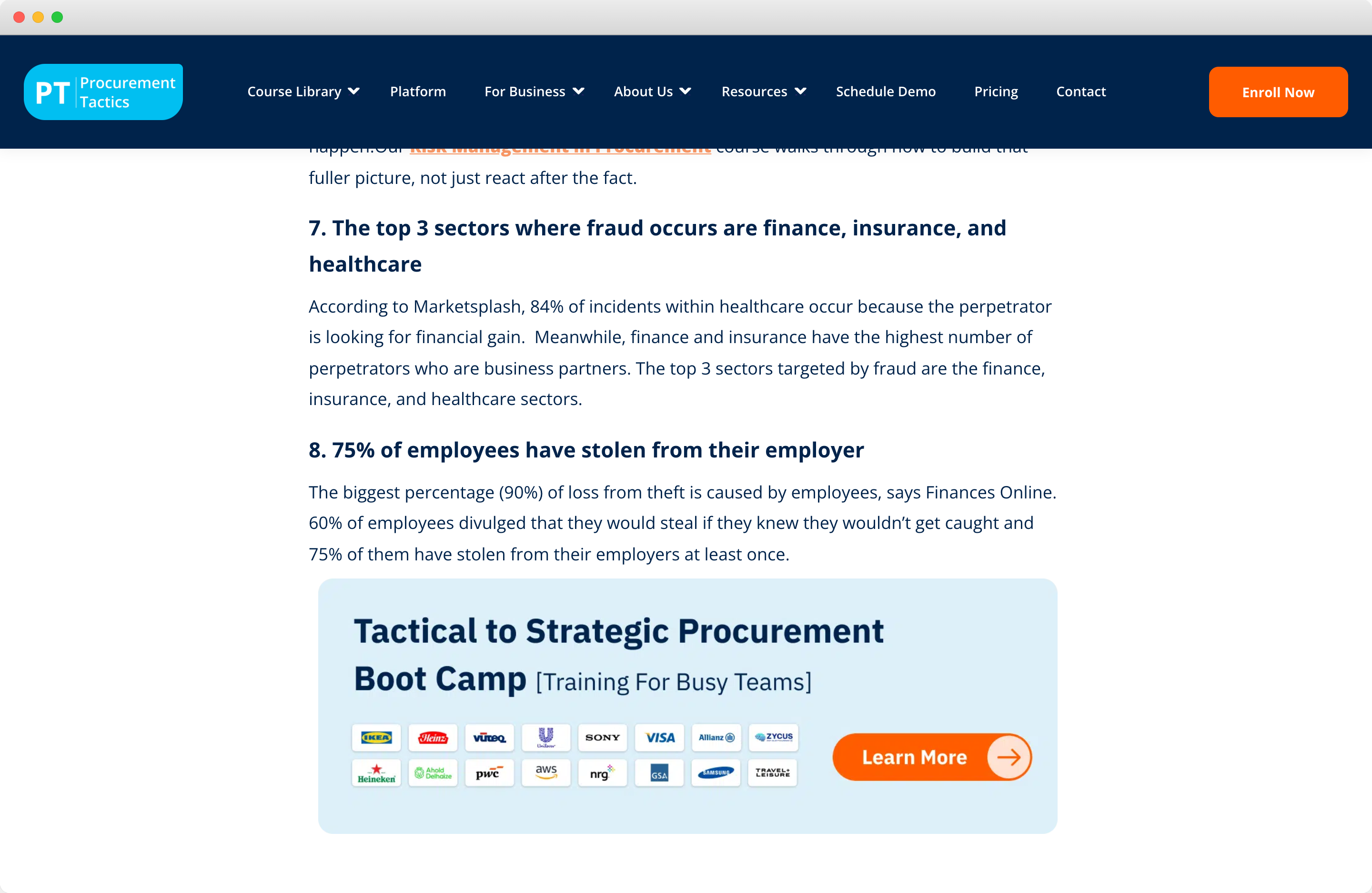
Procurement Tactics’ fraud statistics page shows the plain case, a figure credited to MarketSplash with no link:
A quick read of the page’s code misses some of them. Five of our eleven failed it: two timed out, two turned our script away and one drew its text in the browser. A tool that renders the page read all five, and two had a link after all, in a journal’s references and on a statistics page, and the alert had marked both unverified five days earlier.
The common objection holds that nearly every brand mention already carries a link, so chasing the unlinked ones is busywork. For our own alert week it was mostly right. More pages named us with a link than without, and the pile shrank again by 25 November. Count your linked pages before you plan the work, because the pile you act on is smaller than the alert suggests.
Find the Pages the Answers Read
A page that still names you without a link is worth an email only if buyers meet it. The AI answers they read show their sources, so that is where we look.
Step 2: Ask your buyers’ questions three times in each engine
Take each page on your sheet and write the question its reader was asking when they found it. Add the questions buyers ask when they compare products like yours. Ask every question in ChatGPT, Google AI Mode and Claude, and save the sources each answer cites. Then ask again, twice, because a page cited in one round can be gone in the next.
For MarketSplash, a publication, the buyer questions are the statistics questions its readers search, such as “What is the average ROI of marketing automation?” For Hutte, they are the questions a Salesforce team asks before it picks a release tool, such as “What are the best alternatives to Copado?” We asked ten of the first kind and five of the second.
We ran ChatGPT and Google AI Mode through a data vendor that reads the engines’ public pages, three rounds each, and Claude with web search on, two rounds. Asking by hand in a private window works too, as long as every round is asked the same way. Two practitioners put that discipline plainly:
Tips from Reddit
On asking the engines for real
Are you doing this on the same computer? Logged out of your AIs? In a private browser?
Re-run a couple of times. Answers vary per session, so one screenshot is an anecdote, not a measurement.
Step 3: Match the cited pages to your pages, then read them for your name
Put every cited address against your sheet and mark each page of yours that appears, by engine and by round. A page cited in more than one round, or by more than one engine, goes to the top. A page cited once is a maybe. A page no answer cited this week may still turn up in a later round.
Then open the cited pages themselves and search each one for your name. Your alerts only know the pages they happened to catch, and a cited page can name you without ever reaching an alert.
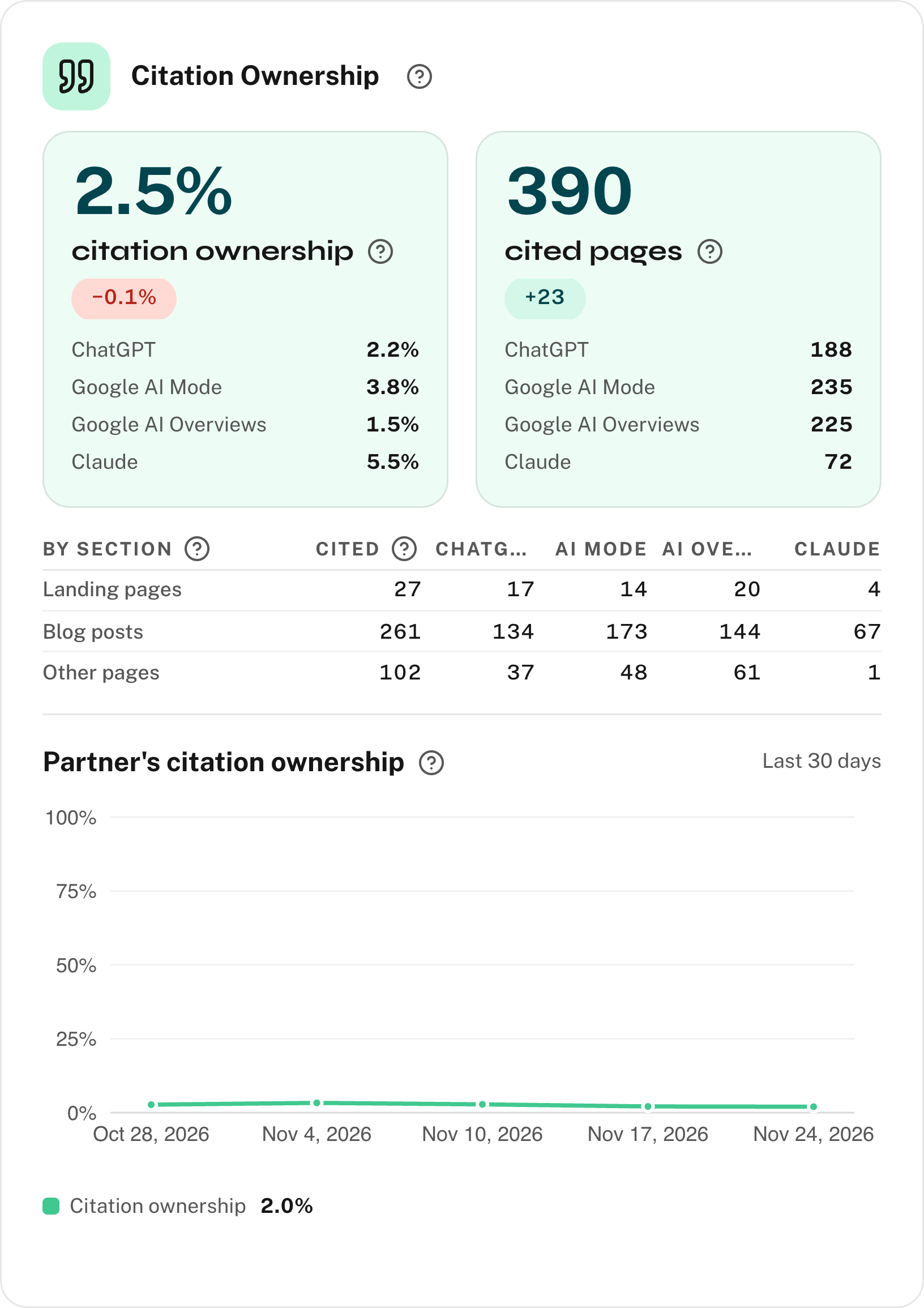
The Empact Panel, our own build that puts a partner’s buyer questions to the three engines every week and keeps each answer with its sources, shows how much of that citing happens off a partner’s own site. For this partner, almost all of it:
On our pile the match came back empty. Across all three engines and every round, no answer cited any of the nine pages, and none of the cited pages we could open named MarketSplash 2.
Hutte’s own questions turned up a page no alert had flagged. Clientell’s roundup of Copado alternatives was cited by ChatGPT in two rounds and by Google AI Mode in one, and it names Hutte. It describes Hutte’s per-user pricing and month-long trial the way Hutte’s own pricing page does, and links to that page, so it needs nothing from us.
Two practitioners describe the same pair of checks, how often a page comes back and whether your name is inside it:
Tips from Reddit
What practitioners check before writing to an editor
before chasing a page, check if it shows up for more than one prompt and more than one engine. a lot of cited pages are one-offs that rotate out next week. the ones that keep coming back are the only ones worth the effort
the harder and more useful check is whether your brand appears inside the URLs the AI actually cites as sources, because that's where citation influence compounds.
Decide Where Each Link Would Send a Reader
A cited page is still only worth a request if the link would take its reader somewhere useful. So we pick the page to link before we write a word of the email. If we can’t say in a sentence what the reader gets from that link, the request waits.
Step 4: Open the page a link would send each reader to
For every row, open the page on your own site that the link would point to, and look for the thing the editor quoted. A statistic needs the page that states it, with its source. A product mention needs the page for the feature the article describes, because a homepage link leaves the reader searching.
Our pile fell apart at this step. Six of the seven MarketSplash pages quote a figure, and we searched the visible text of every page in MarketSplash’s sitemap for each one. None carries any of them. The seventh, a podcast’s episode notes, cites a MarketSplash article that now redirects to a tag page. A link from any of them would send the editor’s reader to a page that doesn’t say what the editor told them it says.
A request is only as good as the page it sends the reader to. When our own page has stopped saying what the editor quoted, the link would hand their reader a dead end, so the fix starts on our side or the row leaves the queue.
 Heather Holland on LinkedInOpens in a new tab
Hutte’s two pages on the pile pass this step, since the statistics page they name still exists. They fail on something the page itself shows, which the next step catches.
Step 5: Give every row one decision
Now each row gets one decision, read off the two checks and the page itself:
Scroll horizontally to see all columns when the table is wider than this page.
| Decision | When it fits |
|---|---|
| Ask now | An answer cites the page, it names you without a link, and your page says what it quotes |
| Fix your page first | An answer cites the page, but your page no longer says what the editor quoted, and you can put a sourced version back |
| Wait and recheck | No answer cites the page yet, and your page would serve its reader |
| Leave it | It already links, it links none of its sources, or no answer cites it and no page of yours says what it quotes |
Our own pile, every row decided on 25 November:
Scroll horizontally to see all columns when the table is wider than this page.
| The page, and what it says about us | Decision, and why |
|---|---|
| Procurement Tactics’ fraud statistics: a healthcare fraud figure, “According to Marketsplash” | Leave it: not cited, figure gone from our site |
| DemandSage’s cybersecurity statistics: 2022 cryptojacking figures, “Source: Marketsplash.” | Leave it: not cited, figures gone from our site |
| A marketing firm’s post on nurturing leads: a marketing automation return, “According to MarketSplash” | Leave it: not cited, figure gone from our site |
| A WWD fashion story: the industry’s size, “as cited by MarketSplash” | Leave it: not cited, figure gone from our site |
| A Great British Life photography competition: photos per phone, “recent data from marketsplash.com” | Leave it: not cited, figure gone from our site |
| Shiksha’s social media platforms: businesses on Facebook Messenger, “(MarketSplash)” | Leave it: not cited, figure gone from our site |
| She Builds podcast episode notes: a 2021 MarketSplash article in its references | Leave it: not cited, article redirects to a tag page |
| Two TechNeeds articles: hutte.io printed as plain text among their sources | Leave it: not cited, no source on the page is linked |
| A HortTechnology journal article: marketsplash.com in its references | Linked now |
| EnterpriseAppsToday’s Among Us statistics: MarketSplash as a source | Linked now |
No page reached ask now. Writing to the whole pile would have meant nine requests, and seven of them would have asked editors to link pages that no longer say what they wrote.
Write the Request Around the Editor’s Reader
The rows that reach ask now get a short email, and every line of it is about the editor’s reader.
Step 6: Write the request from the editor’s own sentence
No row of ours reached this step, so what follows is a template for the rows that do, never an email we sent. The editor’s own sentence shows you read the page. The link names the page that answers what their reader wants next. When the page describes your product wrongly, put the fix in the same email, with the page that shows it.
Subject: Your post on [topic] mentions [Product]

Hi [first name],

Your post "[article title]" says: "[the sentence that names us, copied exactly as the page prints it]"

Thank you for including us. Readers who want [what that sentence promises them] will find it here: [the page on our site that says it]

[Only if the page describes us wrongly: One detail has changed since you wrote it. [The fix, and the page that shows it.]]

Would you add that link to the mention?

[Your name]
[Your role, your company]
Before anyone presses send, the row should pass a last read:
Before the request goes out
- An answer cited the page, and the sheet says which engine and which round
- The sentence matches the page word for word
- The link opens a live page that says what the editor quoted
- The email asks for one link and names no tactic
- Any fix comes with the page that proves it
- Nobody on your team has written to this editor about it before
Getting the link added, and pointed at the page a reader wants next, is what Gabby Saayman’s playbook walks through from here:
What Changes When an Editor Adds the Link
A yes from an editor changes the page. Whether it changes anything a buyer reads in an answer is a separate question, and the sheet should keep the two apart.
Step 7: Rerun the same questions after the edit
When an editor adds the link, check the live page for it. Then ask the same questions in the same three engines and record three things in separate columns. Does the page link to you? Does the answer cite the page? Does the answer cite your own site? They move separately, and a sheet that merges them reports a win when nothing in the answer changed.
Two practitioners make the same rerun a habit:
Tips from Reddit
On checking whether an edit moved anything
Run the same prompts before and after each placement, and the outreach that never moves the answer stops eating your week.
To check if it stuck, just rerun the same prompt in chatgpt or perplexity a week later and log it
Our run shows how far apart they sit. Clientell’s roundup names Hutte and links to its pricing page, and three answers cited that roundup. None of the three named Hutte 2. Only the last check, an answer citing your own site, is the one OpenAI counts.
Business Hub, OpenAI’s dashboard for a business that claims its profile, shows insights on mentions and website clicks. Its help center says that for an online business “a mention counts when ChatGPT references the business’s website. The brand name alone doesn’t count.” 1
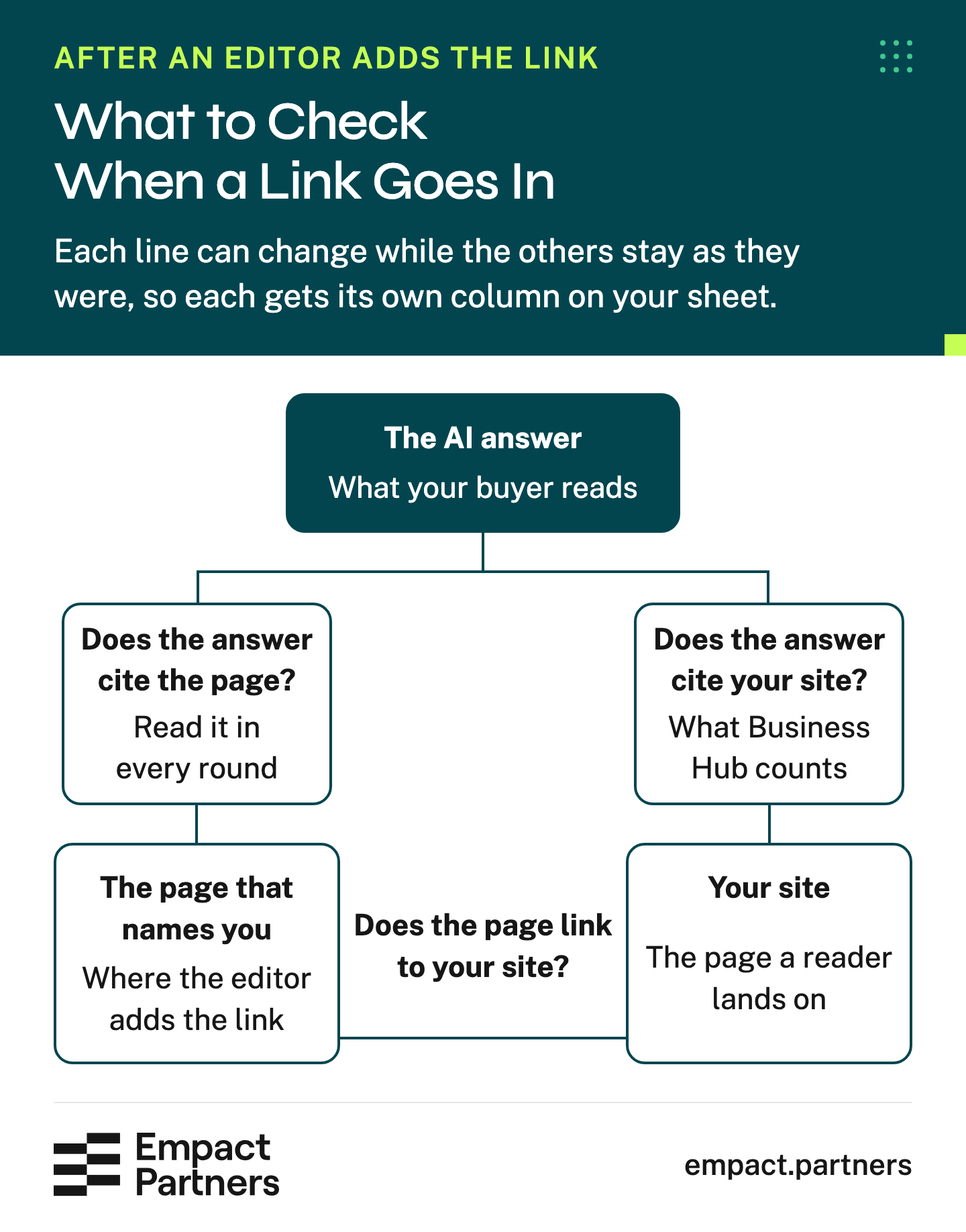
That rule is about ChatGPT’s answer, and a link on the page that names you is a separate thing. By it, only one of the two ChatGPT answers that named Hutte in our run would count, the one that cited hutte.io itself. So we never count a recovered link as an AI win. Engines read your name on a page with or without the link, and we judge each link by the visits it sends from that page.
A link on the page that names you and a mention in the answer are separate results.
Empact Partners would start a pile like yours where the answers already point: the cited pages the Panel shows for your buyers, and any page on your own site that has stopped saying what editors quote. The agent behind our finder spots new mentions every week, and a news story goes first, because it goes stale fast.
A consultant then asks whoever wrote or edits each article for a link to the page its readers need next, with any fix in the same email. The work covers:
Mention Building with Empact Partners
- It opens with an audit and a roadmap
- One senior GTM consultant, named from the start, who owns the work and is on the calls
- The pages your buyers’ answers cite, read from the Empact Panel
- New mentions of you spotted every week, news stories first
- A request to each editor for the page their readers need next, with any fix in the same email
- Reports on visibility and citations that stay with you, every recommendation carrying its first step
Frequently Asked Questions
Does a mention without a link count in ChatGPT’s Business Hub?
Not for an online business. OpenAI’s help center says a mention counts when ChatGPT references the business’s website, and the brand name alone doesn’t count. That rule describes ChatGPT’s answer. A link added to the page that named you doesn’t by itself make ChatGPT reference your site.
Treat the dashboard as one more column in the queue and never as its goal. The help center itself warns that its counts may be incomplete, and that a blank metric doesn’t necessarily mean zero activity.
Will a link on the source page change what AI answers say about us?
Nothing in our run says it will. Three answers cited a roundup that names Hutte and links to it, and none of them named Hutte. Engines read your name on a page whether or not it carries a link. Rerun the same questions after an edit and record the answer apart from the link, so any change you report is one you can point to.
What if only one engine cites the page?
A page only one engine cites still goes ahead of the pages no engine cites, and the sheet says which engine it was. ChatGPT, Google AI Mode and Claude don’t read the same sources, and the Panel card in Step 3 shows each engine giving a partner’s own pages a different share. A page that ChatGPT alone keeps citing is still worth the email for the buyers who ask ChatGPT.
How many rounds before we call a page uncited?
We ran three rounds in ChatGPT and Google AI Mode and two in Claude, all on one day. That is enough to order this week’s queue and too little to rule a page out for good. Keep the questions on the sheet and ask them again when you next work the queue, because a page missing today can turn up in next month’s answers.
Where should the link point?
To the page that answers what the editor’s sentence raises. A statistic needs the page that states it, with its source. A feature mention needs that feature’s page. A homepage leaves the reader searching, and a page that no longer says what the editor quoted does worse, so check the destination before you write a word.
Should we ask when the page quotes a figure we no longer publish?
Not until your own page says it again. If the figure still holds and you can source it, put it back on a live page with its source, then ask for the link to that page. If it no longer holds, the row leaves the queue. Asking an editor to link a page that contradicts their sentence costs you that editor.
What if the page links to us, but to the wrong page?
Then it isn’t an unlinked mention, and the request is a correction. Point the editor to the page their reader needs and say what changed. The same goes for a page that describes your product wrongly: put the fix in the same email as any link request, with the page that shows it.
What about Reddit threads and podcasts that name us?
Leave Reddit alone. Many communities ban links, and a URL can get a comment removed, so a Reddit mention without a link is usually that way on purpose. Podcast pages can be edited like articles, but check the destination first. The episode notes on our pile cited a MarketSplash article that now redirects to a tag page.
Does a news article that named us yesterday wait for the answers?
No. A news story goes first, because it goes stale fast and its writer still remembers it. The queue here is for the older pile, where nobody is waiting on you and the answers can decide who hears from you first.
What should we do when the queue comes back empty?
Look at why. No page marked ask now can mean the pages that name you already link, that no answer reads them, or that your own pages stopped saying what editors quote. Ours was the last two, so the next move sits with MarketSplash, putting a sourced figure back on a live page or letting the row go, and the questions stay on the sheet for the next round.
If your brand is rarely named at all, the job is a different one, getting into the articles the answers cite.
Can we use the engines’ APIs instead of asking by hand?
You can, but the answers can differ from what a buyer sees in the app, so read the public surfaces where you can. We used a data vendor that reads ChatGPT’s and Google AI Mode’s public pages, and asked Claude with web search on. Whichever route you pick, keep it the same from round to round, or the rounds stop being comparable.
Do we need paid tools for this?
No. Free accounts in ChatGPT, Google AI Mode and Claude, a private window and a sheet will run the whole queue. Paid tools save time on the asking and the reading, and they matter more once the pile runs past a few dozen pages and every one needs three rounds in three engines. Our free Unlinked Mentions Finder builds the starting pile, pages that name you without linking to your website, each with a draft request.
Sources (2)
- OpenAI Help Center, "Setting up your business on ChatGPT" (2026)↩1read 25 November 2026.
- Empact Partners, "unlinked-mention run on pages naming MarketSplash and Hutte, ChatGPT, Google AI Mode and Claude, 25 November 2026" (2026)Empact Partners' own data↩1↩2
Keep reading
Mention Building How to Find the Software Roundups AI Engines Cite
Find the roundups AI answers cite, check whether they name your SaaS product, and choose which editors to approach.

Mention Building How To Earn Mentions When Your Site Has A Low Domain Rating
Get named in best-of listicles AI answers cite when editors reject your rating: offers they value, limits set early, your side delivered.

Mention Building Mentions vs Backlinks: Where Should Your SaaS Budget Go?
Audit every page that names, links to or is cited for your brand, then put next quarter’s mention and link money where the gaps are.