39 Vendor Website AI Citation Statistics
39 figures on how often AI answers cite a software vendor’s own site, which of its pages they pick, and where that leaves the budget.
 Shanal GovenderWith
 Vlad Shvets
On this page
- Highlights
- Software Buyers Now Build Shortlists in AI Chatbots
- When the Question Is About One Business, Its Own Site Carries the Answer
- In Software, a Vendor’s Own Site Holds a Few Percent of AI Citations
- A ChatGPT Answer Cites About Three Vendors’ Sites at Once
- The Vendor Page an AI Answer Cites Depends on the Engine
- Most AI Answers About Price Cite Someone Else First
- When an AI Answer Names a Vendor, It Usually Cites the Vendor’s Site
- Where the AI Search Budget Goes After the Website
- Frequently Asked Questions
Empact Newsletter
One email a month on what is working in AI search and SaaS go-to-market.
In a software category, close to half of what ChatGPT cites sits on vendors’ own websites, and each vendor gets a sliver of it. Across the 12 software categories our Empact Panel tracks every week, vendor sites took 47.3% of ChatGPT’s citations in the median category (the middle of the 12), and a single vendor’s own site took 3.4%.1 A budget spent only on your website is chasing a share that small.
Keep your site current and easy for an engine to quote, because it is the page an answer cites once it names you. Spend the rest on the pages those answers cite about your category, which mostly sit on other people’s sites. The figures below run from the open web to software, engine by engine, and on to which vendor pages get cited at all.
Empact Partners measures that split between a company’s own site and everyone else’s before any AI search visibility work for SaaS companies, the work of getting their products named in ChatGPT and Google AI Mode answers. It shows where to start.
Highlights
- 47.3% of ChatGPT’s citations went to vendor sites in the median software category, and 34.5% of Google AI Mode’s.1
- 3.4% for a single vendor, the median share of ChatGPT’s citations on one vendor’s own site, against 3.6% on AI Mode.1
- 8.9% for the most-cited vendor, the vendor site ChatGPT cited most in each category, and 7.1% on AI Mode.1
- 37.2% of vendor citations on ChatGPT landed on homepages, while AI Mode put 33.6% on blog posts and guides.1
- 7.9% to 16.4% of ChatGPT’s citation weight for 15 large SaaS brands sat on their own pages.2
- 54% of software buyers name AI chatbots among what shapes their shortlist, and 36% name vendor sites.3
- 12% of pricing answers cited the company’s own pricing page first, across the Cloud 100.4
- 91.4% of ChatGPT answers that name the vendor also cite its site, against 60% on AI Mode.1
Vendors as a group get plenty of citations, and each one gets very few. Your site gets cited mostly in answers that already name you, and most of what those answers cite sits on pages you do not own.
Software Buyers Now Build Shortlists in AI Chatbots
G2, which sells to software vendors, surveyed 1,076 people who make or shape B2B software purchases in March 2026, in three regions from North America to Asia-Pacific. Their answers put the chatbot at the start of the purchase:3
- 51% start their research with a chatbot more often than with Google.3
- 69% chose a different vendor than they first planned because of what a chatbot told them.3
- 54% name AI chatbots among the sources that shape their shortlist, more than name any other source.3
A vendor’s own site still shapes the shortlist for about a third of these buyers. It ties with market research firms and sits behind the chatbot and the review sites a chatbot reads. Here is everything the buyers named:
What B2B Buyers Say Shapes Their Software Shortlist
G2 survey of 1,076 B2B software decision makers, March 2026, more than one answer allowed
View the data
| Label | Value |
|---|---|
| AI chatbots | 54% |
| Software review sites | 43% |
| Market research firms | 36% |
| Vendor sites | 36% |
| Peers and colleagues | 33% |
| Independent forums | 30% |
| Thought leadership | 28% |
| Internal supplier portals | 20% |
| Vendor salespeople | 19% |
So the shortlist often forms before a buyer opens your site, from whatever the answer read. What a budget has to settle is how much of that reading happens on your own pages.
When the Question Is About One Business, Its Own Site Carries the Answer
Some AI answers do lean on the business’s own site, when the question is about a single business. Yext, which sells listings software to companies with shopfronts, counted 155.5 million AI citations for local questions in early 2026. Brand websites took 48.8% of the citations from OpenAI’s models, 52% from Gemini, 50.9% from Perplexity and 42.6% from Anthropic’s Claude.5
A question about a dentist’s opening hours has one right page, and it belongs to the dentist. The same pull shows at the top of ChatGPT’s citations across every topic. Ahrefs, which sells SEO software, sorted the 1,000 pages ChatGPT cited most in September 2025:6
- 23.8% were homepages or landing pages, second only to Wikipedia at 29.7%.6
- 1.9% were blog posts or articles.6
When ChatGPT’s most-cited pages come from a company, they are mostly homepages and landing pages. A company’s blog post rarely makes that top 1,000, however good it is.
Even a search for your own brand now gets an answer built partly from other people’s pages. Ahrefs found AI Overviews on 82.91% of branded searches on US desktop on 29 September 2026. In its sample of 100 large brands, 76.2% sat above the brand’s own site and 71.9% cited Wikipedia.7 So what other sites say about you gets read even when the buyer typed your name.
A software buying question is rarely about one business. It names a category, and a dozen vendors could answer it, which is where each vendor’s share starts to shrink.
In Software, a Vendor’s Own Site Holds a Few Percent of AI Citations
Aleyda Solis is an independent SEO consultant. She measured 15 large SaaS brands in three US categories (CRM and sales, work collaboration, and accounting and finance) with Semrush’s data on what ChatGPT and Google AI Mode cite. She published the study in July 2026 and reports each source’s share of citations as Semrush weights them, which she calls citation weight.2
Other people’s pages carried 84% to 93% of that weight in every category, on both engines. The brands’ own pages carried the rest:
Owned Pages’ Share of AI Citations for 15 SaaS Brands
Aleyda Solis, Semrush citation weight, three US software subverticals, July 2026
View the data
| Label | ChatGPT | Google AI Mode |
|---|---|---|
| CRM and sales | 7.9% | 6.6% |
| Collaboration | 8.1% | 7.8% |
| Accounting and finance | 16.4% | 15.9% |
Accounting and finance brands carry twice the owned share, which Solis puts down to support and tax pages that answer a question directly. Elsewhere, brands as large as any in software sat between 6.6% and 8.1%. On ChatGPT, other vendors’ sites were the largest kind of outside source she could classify, 25.4% of the sources, against 16.1% on AI Mode.2
Our own count runs the same test one category at a time. The Empact Panel is software we built to ask ChatGPT, Google AI Mode and Claude each partner’s buyer questions every week, storing each answer along with every page it cites. We took the panels of 12 partners who sell software, with 40,936 questions that name no brand.1
Between 12 October and 27 November 2026 they gave 226,556 answers each from ChatGPT and AI Mode. We sorted every cited page by whose site it sits on: the panel’s own vendor, one of the 1,074 rivals the panels follow, or anyone else. Claude stays out, since its Panel rows hold every page its search looked at, not just the cited ones. Set side by side, vendor sites and one vendor’s own site look like this:
A single vendor’s own site is a small part of that vendor share. On Google AI Mode the medians were 34.5% for vendor sites and 3.6% for the one vendor.1 Even the vendor ChatGPT cited most in each category held 8.9% of its citations in the median category, and 7.1% on AI Mode.1 So even the most-cited site in a typical category leaves nine citations in ten to others.
The range across the 12 categories is wide for the field and narrow for any one vendor:
The Range Across 12 Software Categories, ChatGPT
Empact Panel, share of ChatGPT’s citations, lowest to highest category, Oct to Nov 2026
View the data
| Label | Range |
|---|---|
| All vendor sites | 36% to 66% |
| The most-cited vendor site | 2.7% to 11.9% |
| The vendor’s own site | 0% to 10.6% |
In 8 of the 12 categories the vendor’s own site held under 5% of ChatGPT’s citations, and in 7 of the 12 on AI Mode.1 The median rival held 0.3% of ChatGPT’s citations and 0.1% of AI Mode’s.1 In a crowded category no vendor’s site gets a big share, the leaders included.
AI Mode is less even. The vendor it cited most held anywhere from 1.4% to 22.9% of its citations, so in a few categories one site does pull ahead on Google.1
One partner’s Panel shows what a sliver looks like over a quarter, engine by engine and week by week:
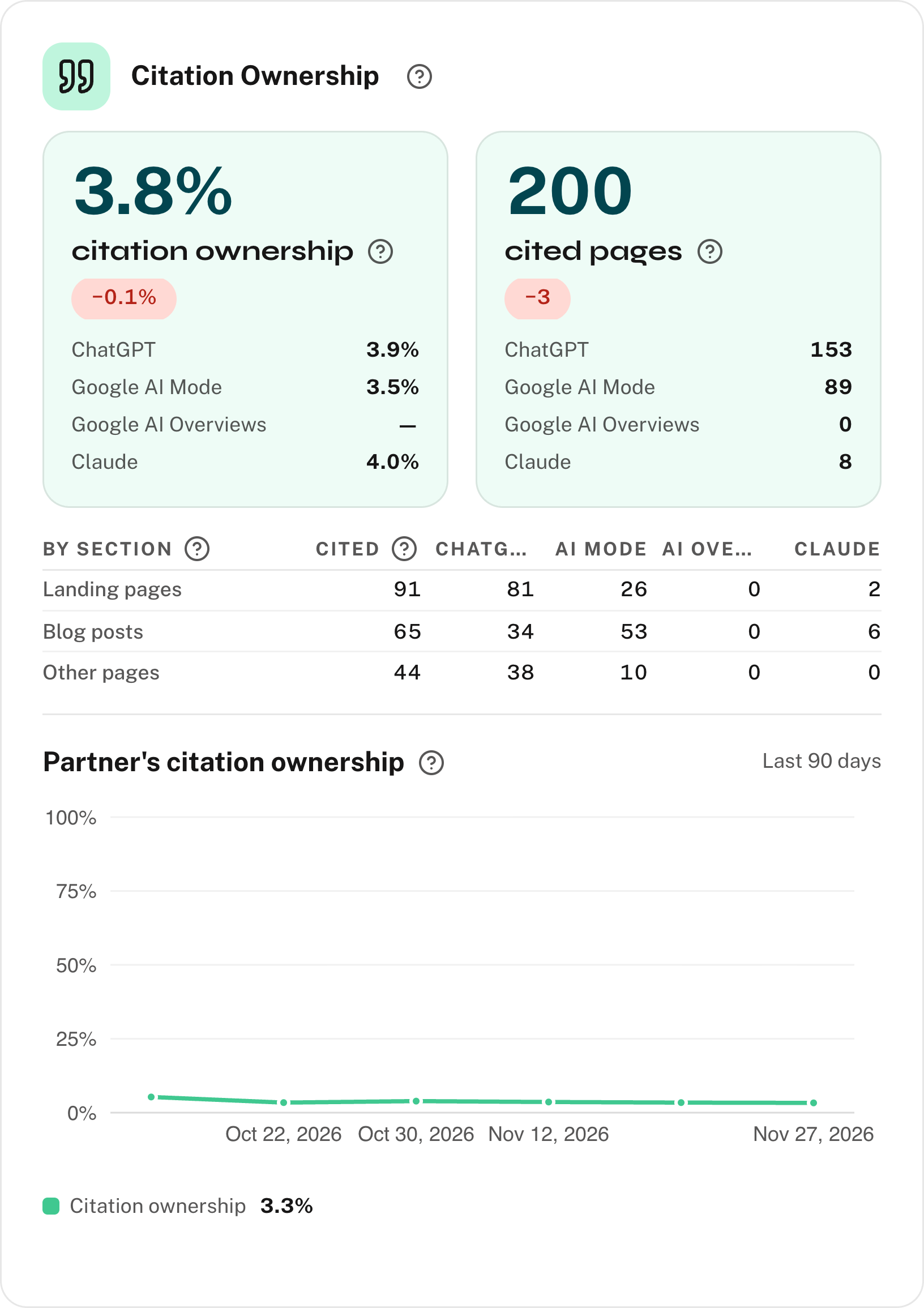
That partner has 200 pages the engines cite, so the engines can read its site. For every question they also cite rivals’ sites, review sites, roundups and articles, and together those outnumber the partner’s own pages many times over.
A SaaS site can be the best in its category and still hold a few percent of what ChatGPT cites, because the engine is answering a question about the whole category. Judge the site by whether an answer quotes it correctly when it names you. Judge the rest of the AI search budget by whether you get named.
 Shanal Govender on LinkedInOpens in a new tab
A ChatGPT Answer Cites About Three Vendors’ Sites at Once
The sliver comes from how each answer is built. A ChatGPT answer to a software question cited 8.4 pages in the median category, and an answer that cited any vendor sites cited 3.2 different ones.1 Google AI Mode cites fewer pages, 2.8 an answer, and 1.5 vendor sites when it cites any.1
In all, 86.7% of ChatGPT answers cite at least one vendor site, and 16.5% cite a given vendor’s own site.1 On AI Mode the two figures are 56.6% and 9%.1 Your site appears in about one answer in six, and an answer that cites vendors cites about three of them. Each category has dozens of tracked vendors competing for those few places, which is why the median rival’s share rounds to almost nothing.
The pages worth winning are the roundups and reviews that answer your buyers’ questions without naming you. The playbook below shows how to find those pages and which of them to approach first.
The Vendor Page an AI Answer Cites Depends on the Engine
When an answer does cite a vendor’s site, the two engines reach for different pages. We sorted every vendor-site citation on the Panel by the kind of page its address points to, and checked 160 of them by hand against the page title. Of those, 152 matched. Here is the split by kind of page:
Which Vendor Pages ChatGPT and AI Mode Cite
Empact Panel, share of vendor-site citations, ChatGPT then Google AI Mode, 12 categories
View the data
| Label | ChatGPT | Google AI Mode |
|---|---|---|
| Homepage | 37.2% | 10% |
| Product and feature pages | 15% | 12.6% |
| Help and docs | 13.8% | 10.2% |
| Blog posts and guides | 9.3% | 33.6% |
| Pricing pages | 5.7% | 5.2% |
| Comparison pages | 1.1% | 4.6% |
| Case studies | 0.2% | 0.2% |
ChatGPT cites a vendor’s homepage in 37.2% of its vendor citations, and AI Mode in 10%. AI Mode puts 33.6% on blog posts and guides, ChatGPT 9.3%.1 So the page you polish for one engine is often not the page the other one quotes.
Product and feature pages took 15% on ChatGPT and 12.6% on AI Mode, help and docs 13.8% and 10.2%.1 Comparison pages took 4.6% on AI Mode and 1.1% on ChatGPT, and case studies took 0.2% on both, so a case study’s job stays with your sales team.1
Ahrefs looked at ChatGPT alone and counted prompts rather than citations. Across 250 prompts asking which software is best for a job, it recorded which of a recommended brand’s own pages ChatGPT cited, by the share of prompts where each appeared:8
- 37.2% general landing pages, the own page ChatGPT cited most often.8
- 34% self-published listicles, the brand’s own best-of post.
- 15.6% the homepage, and 7.6% documentation.
- 0.4% product pages.
Solis found the same split between the engines across her 15 brands. Corporate homepages carried 13.7% to 16.9% of the owned citation weight on ChatGPT and 0.4% to 4% on AI Mode. Editorial pages and guides carried 25% to 34.9% on AI Mode and 15.5% to 24.9% on ChatGPT.2
Help and documentation was the steadiest. It never fell below 10% on either engine, at 19.7% to 26.6% on ChatGPT and 14.8% to 17.1% on AI Mode.2 That makes help docs the one owned page worth keeping current for both engines at once.
The pages to keep current differ by engine. For ChatGPT it is your homepage and the landing pages under it, read as the company’s own word on what it sells. For AI Mode it is the guides and help pages that answer one task well. Those are the pages to keep current, because they are what an answer quotes once you are in it.
Most AI Answers About Price Cite Someone Else First
Pricing is where you would expect the vendor’s page to win, since nobody else can state the price. Profound, which sells AI visibility software, tested 7,675 answers from six AI engines to pricing questions about the Cloud 100, a ranking of top private cloud companies, in July and August 2026. The results ran in Kyle Poyar’s Growth Unhinged newsletter, which Profound sponsors:4
The outside sources cited most were Vendr, a pricing data and negotiation company, in 18.7% of runs, Reddit in 18.6% and G2 in 15.9%.4 And 57 of the 77 public pricing pages were fully readable by AI crawlers, so the other 20 were partly hidden from the engines asked about them.4
So your own pricing page reaches about half of the answers about your price, and leads one in eight. The outside pages cited most are a marketplace, Reddit and a review site, so what they say about your pricing often reaches buyers before your page does. Our Panel puts pricing pages at 5.7% of ChatGPT’s vendor-site citations and 5.2% of AI Mode’s.1
When an AI Answer Names a Vendor, It Usually Cites the Vendor’s Site
The website earns its place in one measurable way. When ChatGPT named the vendor a panel is built around, 91.4% of those answers cited a page on its site in the median category, and 60% did on AI Mode.1 The rest of those AI Mode answers named the vendor and cited none of its pages, a gap we measured for every tracked brand in our brand mentions without links statistics.
Your site, then, is what an answer usually quotes when it names you. It is also one input among many, since in a software category more than half of the citations sit on pages no tracked vendor owns. The pages an answer can cite come from three places:
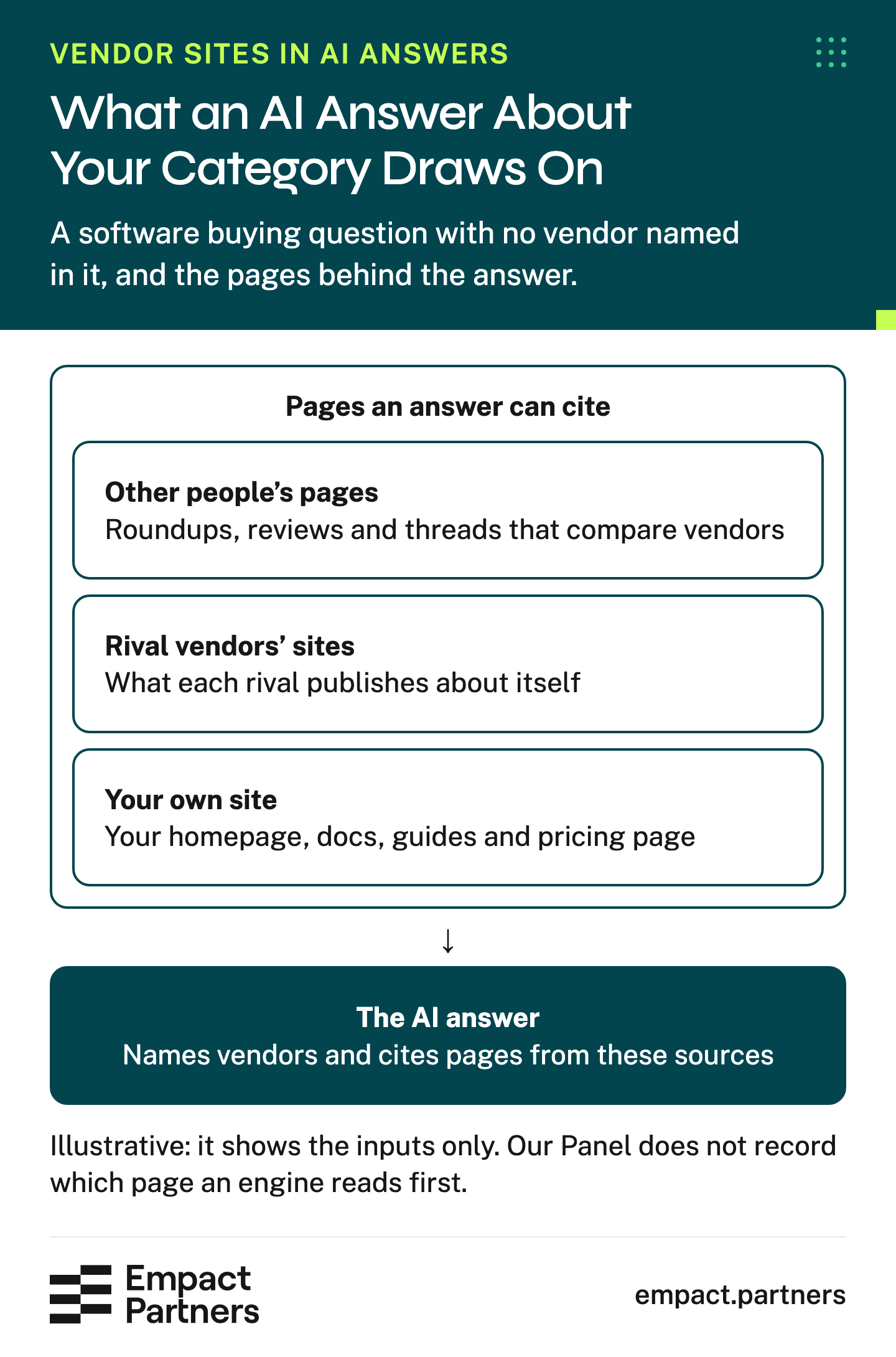
Your website alone cannot carry AI search work, then. The pages that compare vendors, and the pages rivals publish about themselves, carry most of what the engines cite about your category.
Most of what ChatGPT cites about your category was written by someone other than you.
In budget terms, keep the site readable and current, and put the rest on the pages written about your category.
Before a team rewrites its homepage again for ChatGPT, I’d check whether the answers that name it already quote that homepage correctly. If they do, the rewrite is finished work, and the open question is which roundups and reviews in the category leave the product out.
Shanal Govender on LinkedInOpens in a new tabWhere the AI Search Budget Goes After the Website
In a category like the ones above, Empact Partners would put your buyers’ questions into the Panel first, one full set per type of buyer, and score ChatGPT and Google AI Mode apart. In our Generative Engine Optimization workstream, the work then starts on whichever pages your category’s answers lean on most. Where those are vendors’ own pages, we make your site simple for both engines to read and quote.
Where they are listicles, we write to each editor of a listicle the answers keep citing, with a case for adding your product. Where they are Reddit threads, we help in the threads your buyers read and mention your product only where it fits the answer.
You get a weekly report of what the engines cite for your category, and we plan the work in quarters, because answers take months to change. Before any of that, the site has to pass these checks:
- Readable without scripts: prices, plans and product copy in the page’s HTML (the code a crawler reads before any script runs), so a crawler that skips JavaScript still sees them.
- A current homepage: what you sell, to whom, under your product’s real names, since ChatGPT cites homepages more than any other vendor page.
- Help docs in public: documentation and help pages open to crawlers, the vendor pages both engines keep citing.
- Guides that answer one task: the blog posts and guides AI Mode cites from vendor sites more than anything else.
- A pricing page with numbers: published prices, or plans described in plain words, so the answer has your version beside a marketplace’s and Reddit’s.
The AI Citation Gap Report shows, for your category, which cited pages cover your rivals and skip your product. It is free, and our partners get the same agent run across all the buyer questions we follow for them:
Watch one number while you shift the budget: how many of your category’s answers name you, on each engine. Your site’s share of the citations will stay small whatever you spend on it, since the median vendor sat at 3.4% on ChatGPT. Judge the off-site work by how often you get named.
Frequently Asked Questions
How often does ChatGPT cite a software vendor’s own website?
In about one software buying answer in six. Across the 12 software categories on our Empact Panel, 16.5% of ChatGPT answers cited the vendor’s own site in the median category, against 9% on Google AI Mode.
Vendor sites as a group appear in most ChatGPT answers, but each answer spreads them across two or three companies. If your own number sits far below that, check first that the engines can read your pages.
What share of AI citations goes to a vendor’s own site?
A few percent in a crowded software category. On our Panel the median vendor’s own site held 3.4% of ChatGPT’s citations and 3.6% of AI Mode’s.
Aleyda Solis found 7.9% to 16.4% of ChatGPT’s citation weight on the own pages of 15 large SaaS brands, the higher end in accounting and finance. A business with one shopfront sees far more, because a question about it has one obvious source. In software, the share rises mainly when your help docs or guides answer a question no rival page answers as well.
Which pages on a SaaS website do AI engines cite most?
ChatGPT leans on homepages, then product pages and help docs. Google AI Mode leans on blog posts and guides, and cites homepages far less.
Pricing pages draw about 5% of vendor-site citations on both engines, comparison pages draw more on AI Mode than on ChatGPT, and case studies almost never appear. Update the pages your buyers’ engine prefers first, then the rest. If you do not know which engine your buyers use, ask them on the signup form.
Does my pricing page get cited when buyers ask about price?
Often, but rarely as the lead source. In Profound’s test of 7,675 pricing answers about the Cloud 100, the company’s own pricing page appeared in 46% of answers and came first in 12%, more often on ChatGPT.
Make sure your prices are in the page’s HTML, since 20 of the 77 public pricing pages hid part of them from crawlers. Then read what Vendr, Reddit and G2 say about your price.
Should we rebuild our website for AI search?
Rebuild what stops the engines from reading or quoting you correctly: text that only appears after JavaScript runs, an out-of-date homepage, help docs behind a login, prices in an image.
Past that, a better site changes a small share of what an answer cites. The money that changes whether you are named belongs on the listicles, review sites and threads that answer for your category.
Why do AI answers cite my competitors’ sites instead of mine?
Because each answer picks a few vendors out of many. A ChatGPT answer that cites vendor sites cites about three, out of the dozens of vendors a category holds, so most vendors miss most answers. The vendors cited are usually the ones the answer already decided to name. Look for the cited pages that compare your rivals and skip you, because that is where the gap sits.
Do AI Overviews cite my site when people search for my brand?
Partly, and they now sit above it. Ahrefs found an AI Overview on 82.91% of US desktop results for branded searches on 29 September 2026. In its sample of 100 large brands, three Overviews in four took the top position over the brand’s own result, and Wikipedia was cited in 71.9% of them.
Keep your About page, product names and Wikipedia facts consistent, because the Overview blends them into one paragraph a buyer reads before your link.
How do we measure how often AI engines cite our own site?
Put the questions your buyers ask to each engine on a schedule and keep every cited page. Count two things per engine: the answers that cite a page on your domain, and your share of all citations. One run is not enough, because answers shift from week to week.
We keep this count every week for each partner in the Empact Panel, on ChatGPT, Google AI Mode and Claude, and read each engine on its own.
Are comparison pages on our own site worth building for AI search?
More for Google AI Mode than for ChatGPT. Comparison and alternatives pages drew 4.6% of AI Mode’s vendor-site citations on our Panel, against 1.1% of ChatGPT’s. Solis found comparisons near 7% of owned citation weight on AI Mode. Write them so a buyer could trust them. A rival’s comparison page is one you cannot change, so yours is the version of the comparison you control.
Does an AI citation send the buyer to the page that was cited?
Often not. Solis found that 42.7% of AI-referred visits to CRM and sales brands landed on pages the engines had not cited, 67.3% for collaboration tools and 22.4% for finance brands. Judge a cited page by whether the answer quotes it correctly. Judge a landing page by what visitors do there, whichever engine sent them.
How long does off-site work take to change what AI answers say about us?
Expect it to take months. A listicle editor has to agree to add you, the page has to be read again, and the answers have to start citing it, which happens on the engines’ schedule. We plan AI search work in quarters, measure it every week, and judge it by whether more of your category’s answers name you.
Sources (8)
- Empact Partners, "Empact Panel, 12 software partner panels" (2026)Empact Partners' own data↩1↩2↩3↩4↩5↩6↩7↩8↩9↩10↩11↩12↩13↩14↩15↩16↩17↩18↩19↩20↩21↩22↩23↩24226,556 answers each from ChatGPT and Google AI Mode to 40,936 questions naming no brand, weekly collections from 12 October to 27 November 2026; read on 28 November 2026.
- Aleyda Solis, "What It Takes for SaaS Brands to Win in AI Search: 5 Data-Backed Findings and Actions" (2026)↩1↩2↩3↩4↩5↩616 July 2026; read on 28 November 2026.
- G2, "2026 AI Search Insight Report" (2026)↩1↩2↩3↩4↩5↩6of March 2026; read on 28 November 2026.
- Kyle Poyar with Nikolas Laskaris of Profound, Growth Unhinged, "What AI agents really think about your pricing" (2026)↩1↩2↩3↩4↩52 September 2026; read on 28 November 2026.
- Yext Research, "AI Citation Behavior Across Models: Consistent Source Preferences Across a Growing AI Landscape" (2026)↩1data from the first quarter of 2026; read on 28 November 2026.
- Ahrefs, Louise Linehan, "67% of ChatGPT’s Top 1,000 Citations Are Off-Limits to Marketers (+ More Findings)" (2025)↩1↩2↩328 October 2025; read on 28 November 2026.
- Ahrefs, "AI Overviews Currently Appear for 83% of Branded Searches" (2026)↩12 October 2026; read on 28 November 2026.
- Ahrefs, Glen Allsopp, "Do Self-Promotional ‘Best’ Lists Boost ChatGPT Visibility?" (2025)↩1↩24 December 2025; read on 28 November 2026.
Keep reading
Statistics 48 AI Search Citation Statistics
See which pages AI answers cite, why your own site is only part of the picture, and where to focus your SaaS visibility budget.

Statistics 40 YouTube AI Citation Statistics
40 figures on how often ChatGPT, Google AI Mode and Claude cite YouTube for software buyers, and whose videos they pick.

Statistics 46 Unlinked Brand Mention Statistics
46 figures on how often AI answers name a SaaS brand without linking its site, what they cite instead, and why the mention still counts.