67 AI Usage Statistics
67 figures on how many people, workers and companies use AI, read for SaaS teams whose buyers already ask AI first.
 Shanal GovenderWith
 Vlad Shvets
On this page
Empact Newsletter
One email a month on what is working in AI search and SaaS go-to-market.
62% of U.S. adults aged 18 to 64 used generative AI by May 2026.1 Most go-to-market plans still treat AI as something buyers will get to one day. On these numbers, most of them already have.
The companies they work for are moving more slowly. Only 16% of U.S. employees use AI at work every day,2 and 20.0% of EU companies with ten or more staff use any AI technology at all.3 These are different measures, but every one puts companies below people, so plan for buyers who may be further along than their own employers.
This page keeps four counts apart, because each answers a different question. One counts adults, one workers on the job, one companies, and the last what the AI platforms see people doing. The last section adds our own count of what a buyer gets back when they ask an AI engine about software.
Highlights
- 62% of U.S. adults aged 18 to 64 used generative AI in May 2026, up from 45% in August 2024.1
- 16% of U.S. employees use AI at work every day, and 32% use it a few times a week or more.2
- 20.0% of EU companies with ten or more staff used an AI technology in 2025.3 In the United States, 19.8% of businesses did by May 2026.4
- 18.8% of the world’s working-age population used generative AI in June 2026, by Microsoft’s estimate.5
- 88.7% of ChatGPT answers to software buyers’ unbranded questions named at least one tracked vendor in the median of the 13 software categories our Empact Panel follows, and 93.5% on Google AI Mode.6
Read together, most adults now use AI in some form, much of it outside work. Companies are a step behind them. Integration is spreading, but daily use, a clear plan and any measured return are still the exception at work.
I work at Empact Partners, where we build AI agents that take repeat work off SaaS sales and marketing teams. The figures below show why so many teams already have the habit and not yet the agents.
How Many Adults Use AI
The St. Louis Fed has asked U.S. adults about generative AI every few months since August 2024. Its survey covers people aged 18 to 64, and here is what it found:
- 54.6% of adults used generative AI in August 2025, ten points more than a year earlier.7
- 62% by May 2026, in the latest wave the Fed has published.1
- 48.7% of adults used it outside work in August 2025, up from 36.0% a year before.7
- Three years after launch, the personal computer had reached 19.7% of adults and the internet 30.1%. Generative AI was at 54.6% at the same point.7
So a buyer who has never used an AI tool is now in the minority. A plan that still treats AI users as a niche of early adopters is out of date, because users became the majority in 2025.
Pew asks a narrower question, about chatbots like ChatGPT, Gemini and Copilot, and gets a lower number. In its February 2026 survey, 51% of U.S. adults said they do not use chatbots at all, and 24% use one daily.8 The two surveys ask different things, so read them side by side and never average them. ChatGPT alone shows how fast the chatbot habit grew:
U.S. Adults Who Have Used ChatGPT, 2023 to 2026
Pew Research Center surveys of U.S. adults, the latest fielded in February 2026
View the data
| Label | Value |
|---|---|
| 2023 | 18% |
| 2024 | 23% |
| 2025 | 34% |
| 2026 | 44% |
Use of ChatGPT more than doubled between 2023 and 2026, from 18% of adults to 44%.8 It splits sharply by age. 57% of adults under 50 use it, against 28% of those 50 and older. So the younger half of any buying committee is the half most likely to use it.
Europe measured the same habit for the first time in 2025. Eurostat’s household survey of about 330,000 people found 32.7% of people aged 16 to 74 had used generative AI tools in the previous three months.3 That average hides a steep fall with age, from 63.8% of people aged 16 to 24 to 6.5% of those aged 65 to 74:
Europeans Who Used Generative AI Tools, by Age
Eurostat household survey, EU, 2025, share who used one in the previous three months
View the data
| Label | Value |
|---|---|
| 16 to 24 | 63.8% |
| 25 to 34 | 50.7% |
| 35 to 44 | 39% |
| 45 to 54 | 28.4% |
| 55 to 64 | 16.5% |
| 65 to 74 | 6.5% |
50.7% of people aged 25 to 34 used generative AI, and 39.0% of those aged 35 to 44.3 So among working-age Europeans under 45, use runs well above the headline.
Education splits it too: 48.7% of people with a high level of formal education used these tools, against 22.4% with little or none.3 And among everyone who used them, 46.1% did so for work, while 76.8% used them for private reasons. So for most users, AI is a private tool first and a work tool second.
Most adults now use AI somewhere in their week, and much of that use happens away from work. So I would assume a buyer may run part of their research on your category through a chat window before anyone at your company hears from them. Find out what that window says about you before you plan the next campaign.
 Shanal Govender on LinkedInOpens in a new tab
How Many Workers Use AI on the Job
Worker surveys disagree more than any other kind, because each asks a different question. Here are four, with what each one counts:
Scroll horizontally to see all columns when the table is wider than this page.
| Survey | Who it asks | What counts as use | Latest share |
|---|---|---|---|
| St. Louis Fed | U.S. workers aged 18 to 64 | Used generative AI for their job | 45%, May 2026 |
| Gallup | U.S. employees | Uses AI in their role a few times a year or more | 53%, August 2026 |
| Pew Research Center | Employed U.S. adults | Uses chatbots for tasks at work | 38%, February 2026 |
| Pew Research Center | U.S. workers | Says at least some of their work is done with AI | 21%, September 2025 |
The answers run from 21% to 53%, so any single share of workers using AI is really a choice of question.1289 The trend inside one survey is steadier. The Fed counted 33% of workers using AI for their jobs in August 2024, 37.4% in August 2025 and 45% by May 2026.71
How often they use it splits the answer again. Gallup’s August 2026 survey of U.S. employees found:
- 53% of employees use AI in their role at least a few times a year.2
- 32% use it a few times a week or more.2
- 16% use it every day.2
So weekly use is now common at work, while daily use is still the exception. A buyer who uses AI a few times a week has the habit to ask it about vendors, whether or not their team’s work has changed.
Depth is where the numbers get small. Pew found 21% of workers say at least some of their work is done with AI.9 65% use it little or not at all, and only 2% say it does all or most of their work. So for most workers AI helps with a task here and there. The Fed’s occupation data shows the same thing from the other side:
AI has reached more than 80% of occupations, with at least one worker in five using it on the job.1 Yet in most jobs it is still a minority habit, and fewer than 3% of tasks are done with AI by most of the people who perform them. That means AI use at work is wide and shallow. AI is present in most kinds of work and central to almost none of it.
Industry decides a lot of it. Gallup’s industry data for August 2026 shows how many employees use AI at work a few times a week or more, sector by sector:
Employees Using AI a Few Times a Week or More, by Industry
Gallup, U.S. employees, August 2026 (Q3)
View the data
| Label | Value |
|---|---|
| Technology | 67% |
| Finance | 54% |
| Professional services | 46% |
| College or university | 43% |
| Healthcare | 31% |
| K-12 education | 29% |
| Community and social services | 29% |
| Manufacturing | 28% |
| Government | 28% |
| Retail | 25% |
67% in technology use it that often, against 25% in retail.10 Professional services sits at 46%. If your buyers work in software, finance or professional services, plan as if they use AI every week. If they run stores, plants or public offices, most of them do not.
Country matters as much as sector. Among the seven countries the Fed has surveyed the same way, 43.0% of U.S. workers used AI for their jobs in January and February 2026, against 36.3% in the U.K. and 25.6% in Italy.11 So a team selling into Italy should not plan around the habits it sees in its American buyers.
Inside each workplace, seniority and education split it again:
- 57% of leaders in remote-capable jobs use AI frequently, against 46% of individual contributors.12
- 49% of remote-capable employees use it frequently, against 22% of those whose jobs need them on site.12
- 28% of workers with a bachelor’s degree say AI does some of their work, against 16% without one.9
So in desk jobs, the more senior person in a buying decision is the likelier AI user.
Occupations built around sensitive records use far less AI than their tasks would suggest. Medical secretaries and administrative assistants use it at 16.8%, against 61% predicted from what their work involves.1 The Fed points to privacy rules and the cost of errors on tasks like theirs, so expect slower adoption wherever your buyer handles regulated records.
Gallup asked workplace AI users in mid-2026 what they use it for, then asked frequent users where their time went:
- 51% of AI users write or edit with it, and 49% use it for search or research.13
- Coding and automation are each cited by 16% of AI users.13
- 52% of frequent users spend less time gathering information since they started, and 47% less time writing.12
So when your buyer uses AI at work, they are most likely looking things up and writing things down. A question about which vendor to pick is one more lookup.
The 53% figure makes AI at work sound settled, and the 2% who say AI does most of their work show how far it still has to go. For a seller, the light and frequent use is the part that matters. A buyer does not need AI to run their job before they ask it which vendors to look at.
Shanal Govender on LinkedInOpens in a new tabHow Many Companies Use AI
Company surveys are the low half of the picture. Eurostat counts European companies with ten or more staff and asks whether they use any of eight AI technologies, from text analysis to machine learning.3 Its 2025 results:
- 20.0% of EU companies used at least one AI technology, up from 13.5% in 2024.3
- 55.0% of large companies used one, against 17.0% of small ones.3
- 42.0% in Denmark, the highest share in the EU, against 5.2% in Romania.14
Every size of company grew in a year, and the large ones grew fastest:
EU Companies Using AI, by Size, 2024 and 2025
Eurostat, enterprises with 10 or more employees using at least one AI technology
View the data
| Label | 2024 | 2025 |
|---|---|---|
| Small (10 to 49) | 11.2% | 17% |
| Medium (50 to 249) | 21% | 30.4% |
| Large (250 or more) | 41.2% | 55% |
The gap between large and small companies widened in 2025. So the smaller your buyer’s company, the likelier it runs no AI at all, whatever its people do on their phones.
The U.S. Census Bureau asks American businesses a broader question, whether they use AI in any of their business functions.4 As of early May 2026:
- 19.8% of U.S. businesses used AI.4
- 37% of businesses with 250 or more employees did.4
- 39.7% in information, the highest sector, against around 14% in retail.4
These figures count businesses, so they never sit beside the adult figures as one number. Read next to the adult and worker figures, they point the same way. Each puts the share of people using AI well above the share of companies.
Employees can see their companies moving, slowly. Gallup’s workplace surveys found:
- 49% of U.S. employees say their organization has integrated AI tools, up from 38% a year earlier.2
- 26% of employees say it has given them a clear plan for AI.2
- 14% strongly agree that AI has changed how work gets done, among those whose company has implemented it.2
So by employees’ own account, AI has reached many more workplaces than a plan for using it has.
Executives describe the same stall from the top. In McKinsey’s 2026 survey, nearly nine in ten respondents said their organization uses AI regularly in at least one function. But 44 percent said it is scaling across the organization, and 37 percent reported any effect on operating profit, the same share as a year earlier.15 So more companies are scaling AI without seeing more of it in their profit.
Respondents from organizations with more than $1 billion in revenue were far likelier to be scaling AI agents, 40 percent against 22 percent at smaller ones. In McKinsey’s sample, most organizations use AI and fewer than four in ten see it in operating profit. For a seller, that means the buyer across the table may well have the tools and still be looking for the return.
Why companies that want AI hold back
Eurostat also asked why companies that had considered AI did not use it. Only 14.2% of non-users had considered it at all.3 Among those that had:
- 70.3% lacked the relevant expertise.3
- 53.6% were unclear about the legal consequences.3
- 52.7% feared breaking data protection and privacy rules.3
- 17.8% thought AI was not useful for their business.3
Not finding AI useful was the least common reason, at 17.8%. The common ones were expertise, legal clarity and data protection, and buying more software answers none of them on its own. A worker can start with a chatbot today. A company has to clear a few checks before an agent runs, and each check needs an owner:
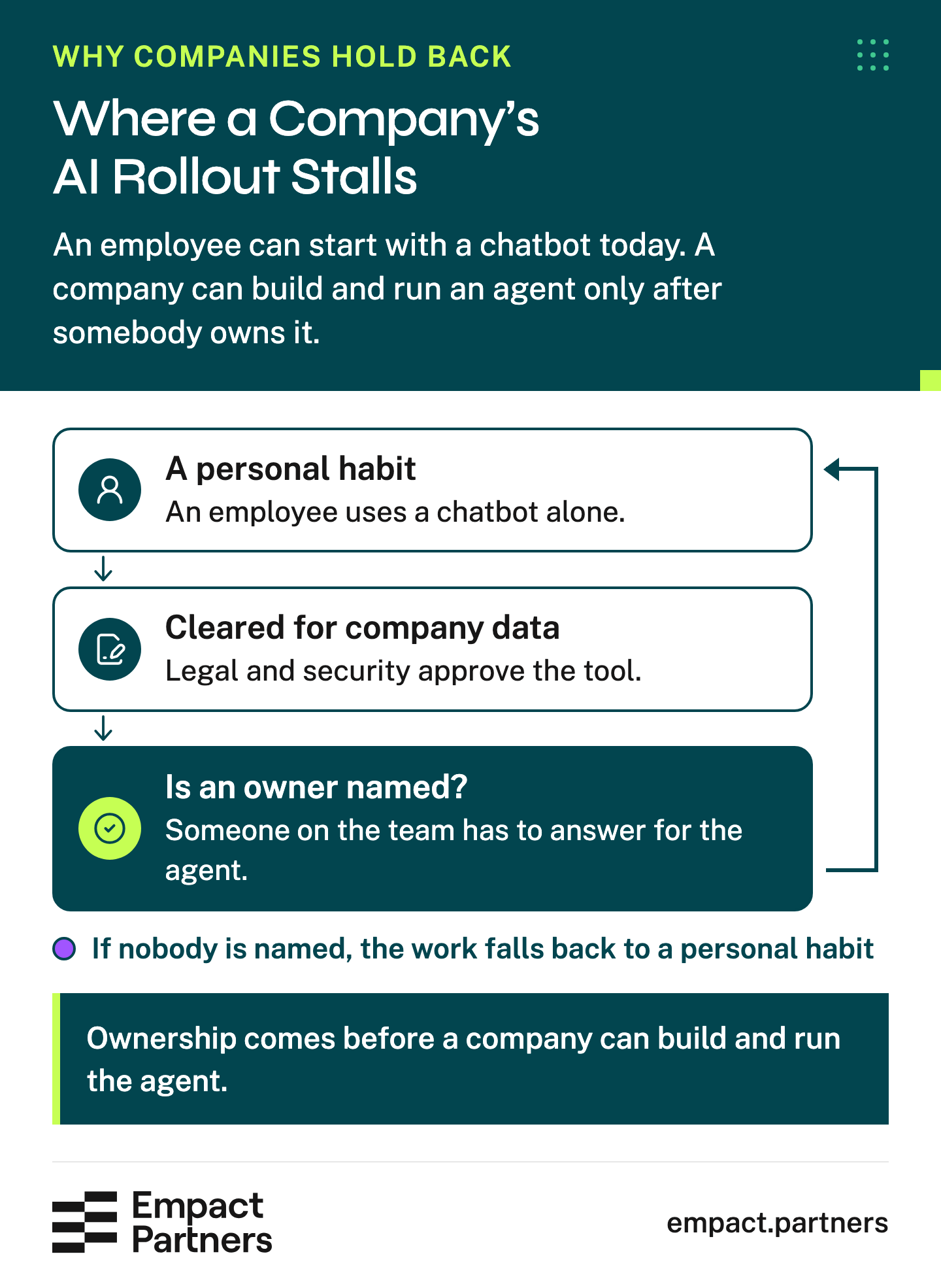
Each check needs someone inside the company to answer it, so a habit that spread one person at a time stalls at the first question nobody owns. Practitioners on Reddit describe what helped adoption where they work:
Tips from Reddit
How teams got past the checks
When a department head identifies a specific bottleneck and uses AI to solve it, adoption happens much faster.
There is a team who test any new AI thing before wider rollout.
if a team adopts AI but its overall function does not align with the organization’s broader strategic goals, the adoption of AI alone does not necessarily create business value.
When 70.3% of the companies that considered AI and held back say they lacked the expertise, I would start with ownership. Give one person one agent to make work from start to finish, with its inputs, its checks and their name next to what it produces. That is a smaller job than an AI strategy, and it tells you quickly whether the agent saves anyone time.
Shanal Govender on LinkedInOpens in a new tabIf your own marketing team is where this gap sits, the playbook below takes one recurring campaign and moves it onto AI agents your team runs itself:
What the AI Platforms See People Doing
The platforms count use from their own logs. Their logs show what people ask for once they are inside the product. OpenAI and the Harvard economist David Deming analyzed 1.5 million ChatGPT conversations for a 2025 working paper:16
- 700 million weekly users at the time of the study.16
- Approximately 70% of use on consumer plans was not related to work.16
- 49% of messages asked for advice or information, against 40% asking it to do a task.16
- Three-quarters of conversations were about practical guidance, seeking information or writing.16
Most ChatGPT use is a person asking it something, so a question about which software to buy is ordinary use for it.
Anthropic’s index of Claude conversations, from February 2026, shows a different crowd. Tasks tied to computer and mathematical jobs make up 35% of conversations in the Claude app, and personal use rose from 35% to 42% in three months.17 Each assistant has its own users, so the first answer a buyer gets depends on which one they opened.
Usage logs also show how far AI has reached in each country. Microsoft estimates it from its own product data, adjusted for device share, internet access and population.5 In June 2026, 18.8% of the world’s working-age population used generative AI, with wide gaps between countries:
Scroll horizontally to see all columns when the table is wider than this page.
| Economy | Working-age population using generative AI, Q2 2026 |
|---|---|
| United Arab Emirates | 73.3% |
| Singapore | 64.3% |
| Ireland | 49.9% |
| United Kingdom | 43.7% |
| United States | 33.0% |
| Germany | 32.3% |
| World | 18.8% |
The United States ranks 21st by this measure, below Ireland and the United Kingdom.5 The Global North sits at 28.8% against 16.2% in the Global South. Microsoft says its figure will rise once it adds newer AI tools to the count, so use it to compare countries and never to size a market.
What Buyers Get Back When They Ask AI About Software
None of the surveys above says what happens when a buyer asks. Our Empact Panel measures that part. It runs a partner’s unbranded buyer questions through Claude, ChatGPT and Google AI Mode once a week and stores what each engine says.
For this page we read the latest weeks for 13 of our partners in software categories, on ChatGPT and Google AI Mode.6 What came back:
- 88.7% of ChatGPT answers named at least one vendor the panel tracks, against 93.5% on AI Mode, in the median panel.6
- In the median panel, an answer that named vendors named 4 of them.6
- The panel’s own company appeared in anywhere from 0.1% to 44.2% of ChatGPT answers, depending on the category.6
Across the 13 panels, each computed on its own, the range looks like this:
How Often AI Answers to Buyer Questions Name Vendors
Lowest and highest of 13 Empact Panels in software categories, Oct to Nov 2026
names any vendor73.1% to 96.5%
names any vendor77.7% to 97.6%
names the panel's company0.1% to 44.2%
names the panel's company0% to 51.6%
View the data
| Label | Range |
|---|---|
| ChatGPT: names any vendor | 73.1% to 96.5% |
| AI Mode: names any vendor | 77.7% to 97.6% |
| ChatGPT: names the panel's company | 0.1% to 44.2% |
| AI Mode: names the panel's company | 0% to 51.6% |
So a buyer who asks an AI engine about software almost always leaves with names, a median of four. Whether yours is among them ranges from almost never to about half the time. Nothing in the surveys above tells you which end of that range you sit at. One category’s leaders over the last 30 days show how the shortlist concentrates:
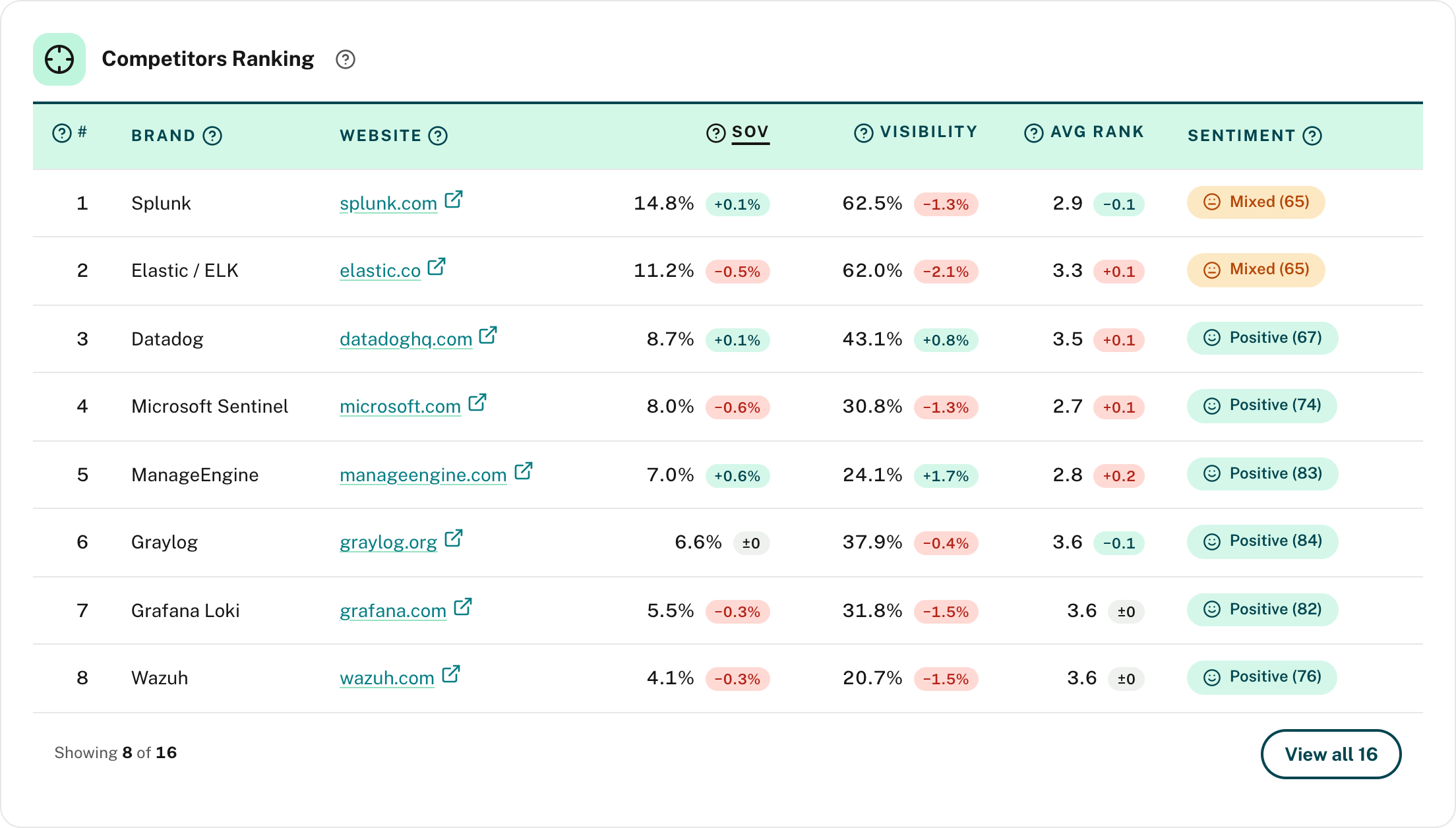
Two vendors sit in most of those answers in that category, and the rest appear far less often, all before your sales team knows the deal exists.
If an AI answer names your rivals and leaves you out, your buyer’s shortlist was written without you.
What This Means for Your Marketing and Sales Team
Our take is that a SaaS team should plan as if every buyer has already asked an AI engine about its category. It should also stop waiting for its own company to catch up before it moves repeat work from a chatbot one person opens to agents the team runs.
When we build agents for a SaaS team, we start from the gap on this page: people who already use AI, and a company that has not yet put it to work.
Our consultants map where the team’s hours go, then we build agents for the work that repeats, inside the tools the team already uses. Each agent has a named owner on your team, because ownership is the check most rollouts stall at. We also train your people and rebuild their workflows around the agents. In a sales and marketing team, that means jobs like these:
- Researching the companies your reps are about to contact
- Enriching leads in the CRM you already run
- Drafting follow-ups for someone on your team to check
- Updating the CRM for your reps
- The weekly report, put together by an agent instead of a person
The quickest way to find your first agent is to start from one task. Name one routine task and our AI Agent Blueprint drafts the agent for it. It shows who checks the agent’s output, what a single run would cost and the hours it hands back. For partners, we then build that agent in full and run it, so the plan is a free preview of the real thing:
Every survey on this page will publish a new edition, and none of them will measure your category. Two numbers matter more to your plan than the next edition. One is how often the answers your buyers already get name you. The other is how many of your own team’s weekly hours an agent could take over.
Frequently Asked Questions
What percentage of people use AI?
The share depends on the survey and the place. In the United States, the St. Louis Fed counted 62% of adults aged 18 to 64 using generative AI in May 2026. Pew, which asks only about chatbots, found that 51% of adults never use one.
In the EU, a third of people aged 16 to 74 had used a generative AI tool in a three-month window in 2025. Worldwide, Microsoft puts the figure at 18.8% of the working-age population. Each counts a different group with a different question, so compare like with like.
How many workers use AI at work?
Somewhere between one worker in five and one in two, depending on what the survey asks. Gallup’s broadest measure, any use a few times a year, reaches 53% of U.S. employees. The Fed’s question about using generative AI for the job reaches 45%, and Pew’s stricter question, whether AI does some of your work, reaches 21%.
Daily use is the rare part: 16% of U.S. employees in Gallup’s August 2026 survey. For a plan, the daily and weekly numbers say more than the headline.
How many companies use AI?
About one in five, in Europe and in the United States, on official counts. Eurostat measured 20.0% of EU companies with ten or more staff in 2025, and the Census Bureau 19.8% of American businesses in May 2026.
Size changes the answer. More than half of large European companies use AI, and 37% of U.S. businesses with 250 or more staff. Executive surveys report higher shares: in McKinsey’s 2026 survey, nearly nine in ten respondents said their organization uses AI regularly in at least one function.
Why do AI usage surveys disagree so much?
Surveys ask different people different questions over different windows. One asks whether you used generative AI at all, another whether you use a chatbot, another whether AI does part of your work. Some count adults, some employees, some businesses, and Microsoft estimates from its own product data.
Surveys also revise themselves. The St. Louis Fed reweighted its 2024 results after testing found the order of its questions had undercounted use. Keep every figure next to its population and its question, and never average two surveys.
Which industries use AI the most?
Technology, by a wide margin. In Gallup’s August 2026 data, two in three technology employees use AI at least a few times a week, followed by finance at 54% and professional services at 46%. Retail, manufacturing and government sit between 25% and 28%.
The Census Bureau finds the same order among businesses, with the information sector at 39.7% against 19.8% nationally. If you sell to software or finance teams, treat your buyers as weekly users.
What do people use AI for at work?
Mostly reading and writing. Among U.S. workplace AI users, Gallup counts writing and editing as the most common use and search or research a close second, with coding and automation far behind.
On consumer ChatGPT plans, where most use is outside work, about half of messages ask for advice or information. Frequent users told Gallup their saved time comes from gathering information and drafting, while time with colleagues and in meetings mostly stays the same.
Do software buyers ask AI which vendors to consider?
Research is one of the main things people use AI for at work, and Gallup ranks search or research second among workplace uses. When the question is about software, the answer usually hands the buyer names.
In our Empact Panel, 88.7% of ChatGPT answers to software buyers’ unbranded questions named at least one vendor in the median category, and 93.5% on Google AI Mode. In the median panel, those answers named four vendors. Whether your product is among those names is something no survey can tell you. It takes asking your buyers’ questions every week and reading the answers.
Why do companies lag behind their own employees on AI?
An employee can start in a minute and a company cannot. Among EU companies that considered AI and held back, 70.3% cited a lack of expertise, 53.6% unclear legal consequences and 52.7% worries about data protection. In the United States, only 26% of employees say their employer has shared a clear AI plan.
A person needs a login. A company needs approved tools, safe access to its own data, an owner for each agent and a check on whether it worked.
Which countries use AI the most?
For people, the United Arab Emirates and Singapore lead Microsoft’s ranking, at 73.3% and 64.3% of the working-age population, with Ireland, France and Norway next. For workers, the St. Louis Fed found the United States ahead of the six European countries it surveyed.
For companies, Denmark, Finland and Sweden lead the EU at 35% or more, while Romania, Poland and Bulgaria sit below 9%. The three rankings measure different things, so a country can lead one and trail another, as the United States does.
Should we build AI agents or work on AI visibility first?
Visibility work and agents close different halves of the gap on this page. Visibility matters because your buyers already ask AI engines about your category. Agents matter because your own team probably still uses AI one person at a time.
Measure both before choosing: how often the answers your buyers get name you, and which weekly tasks cost your team the most hours. If buyers rarely see you named, start with visibility. If the answers already name you and your team is buried in repeat work, start with agents.
Sources (17)
- Federal Reserve Bank of St. Louis, "What Work Does Generative AI Do?" (2026)↩1↩2↩3↩4↩5↩6↩7↩8On the Economy, 1 September 2026, Real-Time Population Survey of U.S. adults aged 18 to 64, waves from August 2024 to May 2026. Read 23 November 2026.
- Gallup, "AI in the Workplace" (2026)↩1↩2↩3↩4↩5↩6↩7↩8↩9indicator, data as of August 2026, U.S. employees on the Gallup Panel. Read 23 November 2026.
- Eurostat, "The use of artificial intelligence technologies in the European Union: Key results, 2026 edition" (2025)↩1↩2↩3↩4↩5↩6↩7↩8↩9↩10↩11↩12↩13↩14↩15statistical report KS-01-26-009, Figures 1, 13, 14 and 15 and Table 7, 2025 surveys of enterprises and households. Read 23 November 2026.
- U.S. Census Bureau, "Large Firms With at Least 20 Employees Biggest AI Users" (2026)↩1↩2↩3↩4↩5America Counts, 26 May 2026, Business Trends and Outlook Survey, 14 December 2025 to 3 May 2026. Read 23 November 2026.
- Microsoft AI Economy Institute, "Global AI Diffusion report, Q2 2026" (2026)↩1↩2↩3published 21 September 2026, estimates for 147 economies from aggregated Microsoft telemetry. Read 23 November 2026.
- Empact Partners, "our Empact Panel run for this article" (2026)Empact Partners' own data↩1↩2↩3↩4↩5↩6the Panels of 13 active partners in software categories, each panel’s latest weekly collections between 19 October and 23 November 2026, ChatGPT and Google AI Mode, the answers to each panel’s unbranded buyer questions (136,032 answers on each engine), each panel computed on its own, with medians and ranges across the 13 panels. Read 23 November 2026.
- Federal Reserve Bank of St. Louis, "The State of Generative AI Adoption in 2025" (2025)↩1↩2↩3↩4On the Economy, November 2025. Read 23 November 2026.
- Pew Research Center, "Americans and AI 2026: Chatbots, Smart Devices and Views on Impact" (2026)↩1↩2↩3↩417 June 2026, survey of 5,119 U.S. adults, 17 to 23 February 2026. Read 23 November 2026.
- Pew Research Center, "About 1 in 5 U.S. workers now use AI in their job, up since last year" (2025)↩1↩2↩36 October 2025, survey of 5,010 U.S. workers, 2 to 8 September 2025. Read 23 November 2026.
- Gallup, "AI Use Trends by Industry" (2023)↩1↩2workbook published with the AI in the Workplace indicator, Q2 2023 to Q3 2026, ten industries. Read 23 November 2026.
- Federal Reserve Bank of St. Louis, "Mind the Gap: AI Adoption in Europe and the U.S" (2026)↩1On the Economy, March 2026, worker surveys in seven countries, January and February 2026. Read 23 November 2026.
- Gallup, "How AI Is Changing the Way Employees Spend Time at Work" (2026)↩1↩2↩3of 21,648 U.S. employees, 5 to 19 August 2026. Read 23 November 2026.
- Gallup, "Organizational AI Adoption Jumps Six Points" (2026)↩1↩220 July 2026, Q2 2026 survey of U.S. employees. Read 23 November 2026.
- Eurostat, "20% of EU enterprises use AI technologies" (2025)↩1news release, 11 December 2025. Read 23 November 2026.
- McKinsey & Company, "The state of AI in 2026: On the road to ROI" (2026)↩1QuantumBlack, August 2026. Read 23 November 2026.
- OpenAI, "How people are using ChatGPT" (2025)↩1↩2↩3↩4↩5September 2025, on NBER working paper 34255 by OpenAI’s Economic Research team and David Deming, 1.5 million consumer conversations. Read 23 November 2026.
- Anthropic, "Economic Index" (2026)↩1March 2026 report, Claude.ai and API traffic from February 2026. Read 23 November 2026.
Keep reading
Statistics 33 Regulated Industry AI Search Statistics
33 figures on AI answers and AI use in health, finance and law, read for SaaS teams whose pages must pass compliance review.

Statistics 40 YouTube AI Citation Statistics
40 figures on how often ChatGPT, Google AI Mode and Claude cite YouTube for software buyers, and whose videos they pick.

Statistics 37 Reddit Statistics for SaaS: Search, AI Citations and Spam
37 Reddit statistics for SaaS teams: Google first pages, AI citations and spam bans, each with what it means for a Reddit budget.