


Ask ChatGPT which software your team should buy and it hands you a shortlist. Across 413,276 answers that Qvery, our sister company, collected this year to the software questions it tracks, 99.08% of ChatGPT’s answers named brands, a median of six of them.1
Most B2B funnels still start counting at the form fill, which 6sense puts 61% of the way through the buyer’s journey, after the shortlist is drawn.2 The deciding happens before that form, which is where the RevOps work we run at Empact Partners starts.
The B2B Buyer Journey Moved Upstream Long Before AI
The old picture of a B2B purchase starts with a search, a demo request and a sales cycle. 6sense surveyed nearly 4,000 B2B buyers for its 2025 Buyer Experience Report, each with a purchase of at least $25,000 behind them, and compared the answers with its 2023 and 2024 waves:
Contact moved earlier and the decision got harder to change, in the same year. A buyer who calls you sooner is not deciding sooner. They are checking sooner, and they still choose when the call happens.

Most buyers would skip the call entirely if they could. Gartner asked 646 B2B buyers in August and September 2025, and 67% said they prefer a buying experience with no sales rep in it at all.3
The pattern under these numbers is old. Buyers have done most of their deciding alone for years, in peer conversations, on review sites and from their own past purchases. What changed in the last two years is where they do it.
AI Search Is Now Where B2B Buyers Start
In March 2026 G2 put its questions to 1,076 B2B software buyers, and 51% of them said an AI chatbot, more often than Google, is where their software research begins. When G2 first asked in April 2025 it was 29%.4
Its June survey of another 1,038 decision-makers found 8 in 10 had sourced software recommendations from an AI chatbot in the previous two years.5
Each of these surveys publishes a share of buyers who “use AI”, and the figures disagree because the questions do. Quote the question with the number, or you are quoting how wide the question was drawn:
| Survey | What it asked buyers | Share |
|---|---|---|
| Forrester, Buyers’ Journey Survey 2025 | Use AI in their buying process | 94%, up from 89% a year earlier6 |
| 6sense, Buyer Experience Report 2025 | Used LLMs during their buying process | 94%2 |
| TrustRadius, B2B Buying Disconnect 2026 | Used AI during their purchase journey | 63%7 |
| Gartner, sales survey 2025 | Used AI during a recent purchase | 45%3 |
The broad questions land in the nineties and the narrow one at 45%. Read with their questions, all four say the AI step is now in most journeys, and how big it looks depends on how wide the survey drew it.
What an AI answer hands a software buyer
The surveys say buyers ask. What they get back is something we can count, through Qvery, our sister company, which measures how often AI engines name a brand.
We took the 413,276 answers Qvery collected on ChatGPT and Google AI Mode for the 28 software companies whose buying questions it tracks, from 5 January to 23 August 2026, and counted the brands in each:
So the AI does not answer “which tool should we buy” with a tool. It answers with a list of five or six, and it gives that list to every buyer who asks.

A separate Qvery study in September, built differently (five runs of unbranded questions in two categories on one day), landed in the same place: 98.00% of project management answers and 98.50% of CRM answers named a brand.8
Qvery is ours, so weigh the counts accordingly. That September study publishes every run’s brands in full, so you can check the shape without taking our word for it.
Buyers Trust the AI’s Shortlist and Check It Anyway
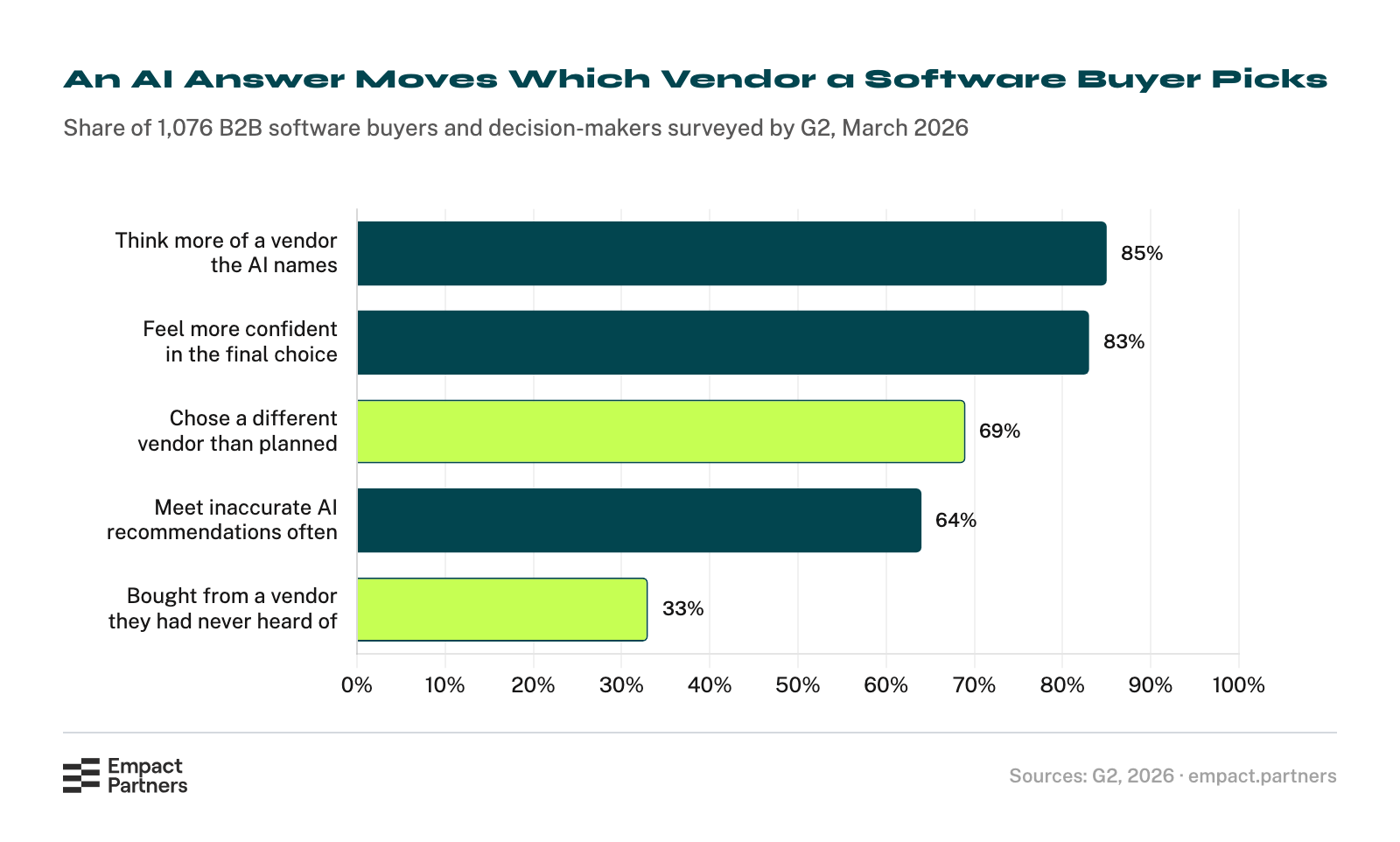
People do not only ask the AI. They act on what it says. In G2’s March 2026 survey, 69% of buyers ended up with a different software vendor from the one they had planned on, because of what an AI chatbot told them, and 33% bought from a vendor they had never heard of.4
Being named does work on the buyer: 85% think more of a vendor when an AI chatbot mentions it, and 83% feel more confident in their final choice.4 The same buyers report the failure rate. 64% meet inaccurate AI recommendations often or very often, and 45% say a citation from a software review site is what makes them believe an answer.4
Of the 63% of buyers in TrustRadius’s January survey who used AI on a recent purchase, 94% fact-checked what it told them.7 And the trust has a ceiling buyers state plainly. In G2’s June survey, 47% would let an AI agent research and recommend while people keep the decision, and 9% would let it make the purchase.5

.png)
Highlights
Read together, they place the decision upstream of the form, inside a buying group the CRM sees one person of, built partly from an AI answer that reads vendors’ own pages. That makes it a measurement problem before a marketing one, and measurement is the plumbing RevOps owns.
The Shortlist Is Ranked Before Anyone Fills In Your Form
6sense asked its buyers when the ranking happens and who wins it. In the 2025 survey:
The 57% is what makes it an argument. If the first meeting did the persuading, the first vendor would win more often when nobody had ranked the list, and it wins less often. The ranking persuades, and it is done before you arrive. The AI inside the product pulled the call forward. It did not pull the decision forward.
.png)
An AI-built shortlist sticks harder than one built by hand. In G2’s June survey, buyers who sourced recommendations from an AI chatbot bought from their initial shortlist in at least three of their last five purchases 80% of the time, against 65% for buyers who did not.5
The AI keeps a favorite too, though a looser one. Each software question asked at least ten times in our Qvery run came up a median of 53 times.
The same brand came first in 48.02% of ChatGPT’s answers and 54.27% of Google AI Mode’s, and for the middle half of questions that share ran from 35.23% to 73.77% on ChatGPT and 38.32% to 75% on Google AI Mode.1
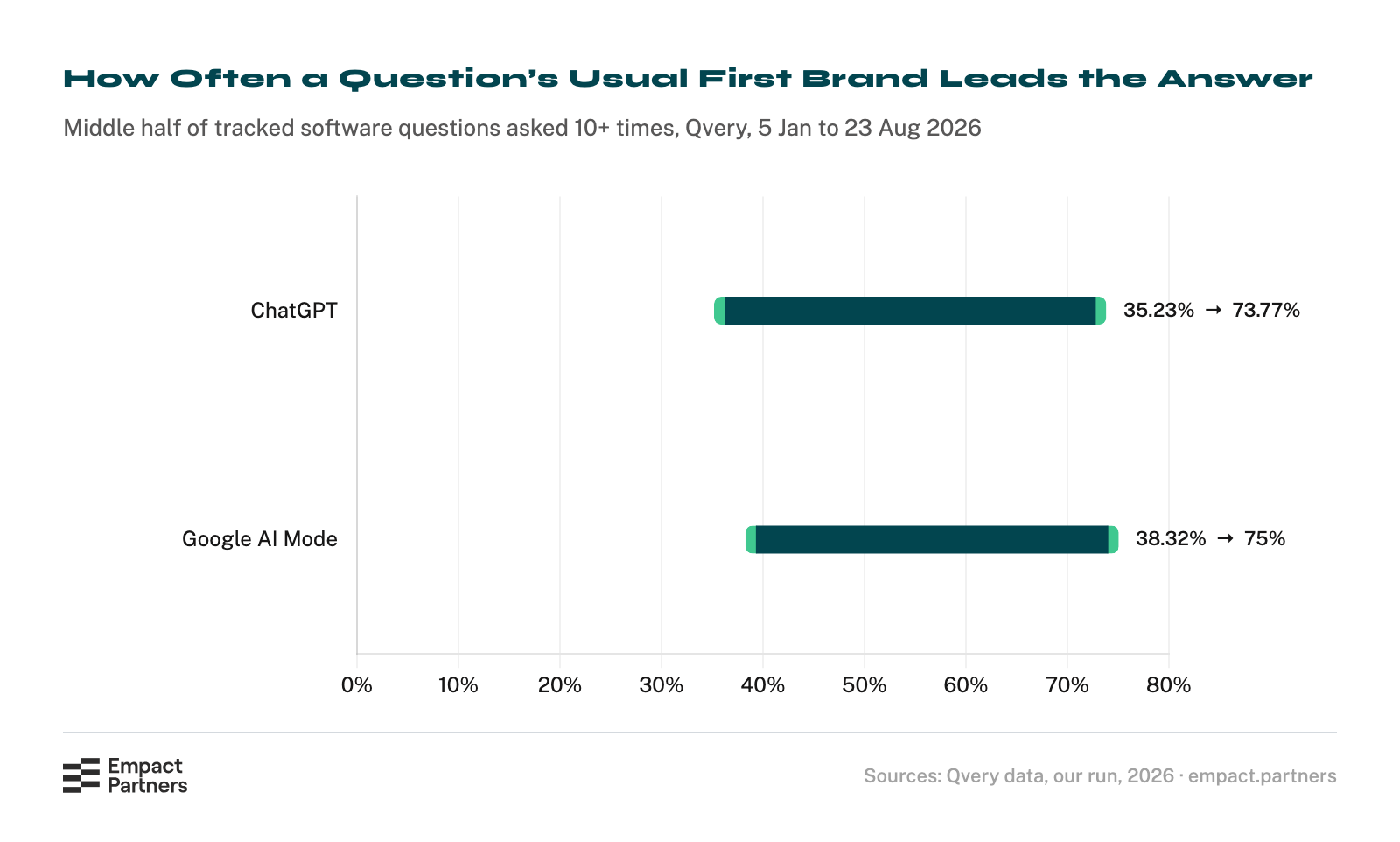
Qvery’s count is a different measurement from 6sense’s, so the two do not subtract. They point the same way: the buyer’s ranking is close to settled by the time anyone calls, and the AI’s list, for many questions, is still open. The place to get onto a shortlist is the answer, before the group sits down to rank.
Empact Partners, the go-to-market consultancy behind this page, runs RevOps from inside B2B software teams as one of its six workstreams: routing, the data on which signups deserve a call, and the path from first touch to closed. When a partner’s sales team says the leads are bad, we look first at what the lead score is scoring.
The Lead in Your CRM Is One of Twenty-Two People
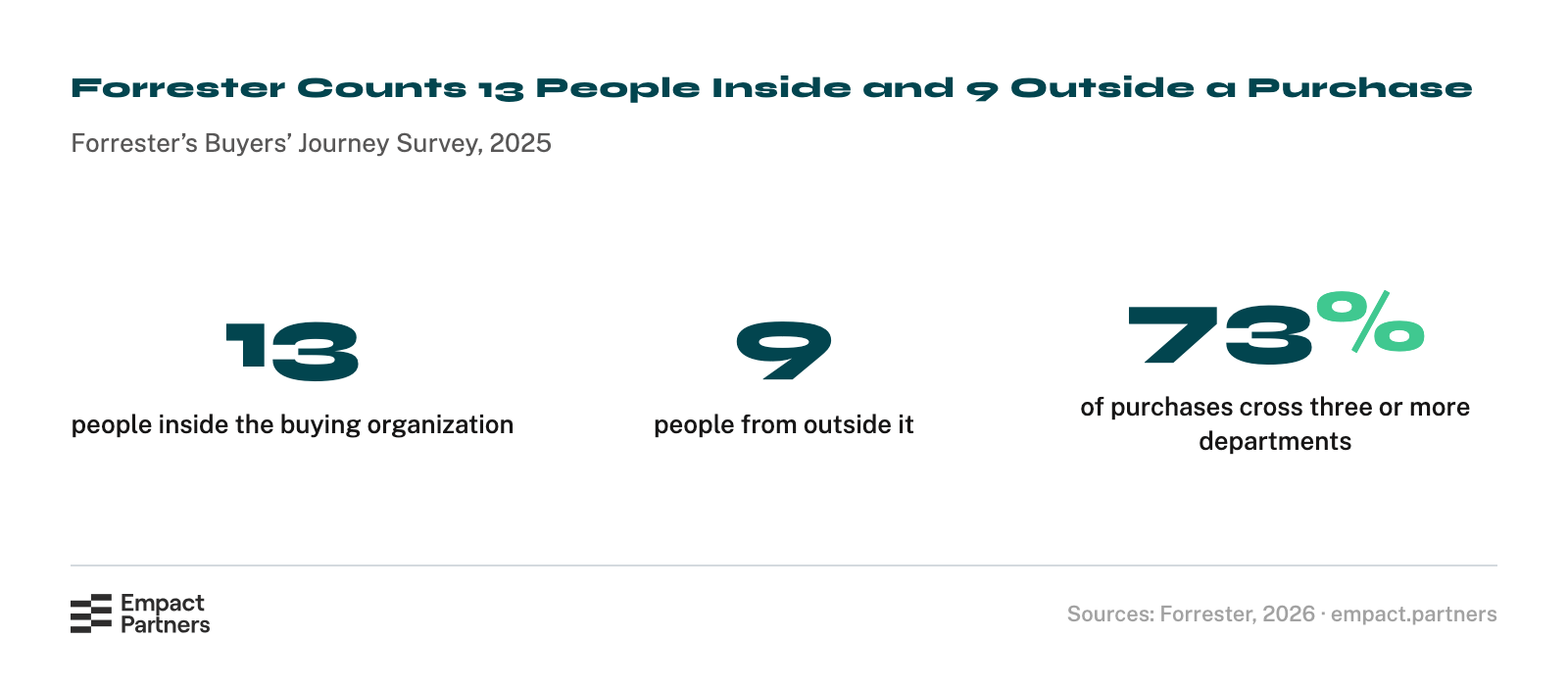
Forrester’s Buyers’ Journey Survey of 2025 counts 13 people inside the buying organization and 9 from outside it in a typical purchase decision, twenty-two in all, and 73% of purchases cross three or more departments.9 Procurement alone sits among the decision-makers in 53% of buying cycles, from the start.12
Now set two counts from different populations side by side, as a direction and never a subtraction. The median ChatGPT answer to a software question names six brands.1 TrustRadius found 83% of buyers shortlisted three or fewer products.7
Between the answer and the shortlist, a group of people you have never emailed cut the list down, and none of that meeting reached your CRM.
A CRM built around one contact per opportunity files a twenty-two-person decision under whoever filled in the form. In a RevOps engagement we enrich and tie every new contact to its account, so the procurement lead who downloads the security page and the engineer who asked ChatGPT last week show up as one buying group instead of two cold leads.
The AI Reads Your Own Pages Before It Names You
If the answer writes the first shortlist, the next question is what the answer reads. Qvery’s August study of paired buying questions in CRM found the leading vendor’s own domain in 35.20% of the category’s answers, and five tracked review directories together in 4.80%.10 The engine treats your pricing and comparison pages as the category’s documentation.
The other sources buyers trust have moved with it:
A settled category is a list you plan against. A loose one is a list you can still join, which makes the category your buyers ask about the first thing worth measuring.
Your own pages doing the buyer’s research is not new to us. For PDF Reader Pro we wrote the product guides prospects read to try the tool before buying, and they came to carry 15–20% of monthly sales, with sales up 85% from June 2023.14
Getting into that answer is the Generative Engine Optimization half of this: GEO puts your brand in the answer an engine gives when a buyer asks about your category, and it is built from what your users say in public and what other sites write about you. RevOps tells you the answer is sending buyers. GEO works on the answer.
What the First Month of RevOps Instrumentation Looks Like
A CRM’s source field records the last thing that happened before the form: a newsletter click, a direct visit, an ad. It cannot record the ChatGPT answer that named you three weeks earlier, because nothing passes from the answer to your site except, sometimes, a referrer. The buyer can record it, if somebody asks.
So the first month of a RevOps engagement with us is mostly about where the buyer came from:
- Audit the source field: where it gets its value, and which routing rule overwrites it.
- Add one question to every form and to the first call’s notes, “Where did you first hear about us?”, in free text, stored in a field routing never touches.
- Split pipeline reporting by that answer, so an AI engine, a community thread or a colleague shows up as a source next to the paid channels.
- Read the engine side: whether the category’s AI answers name you at all, which Qvery measures every day.
- Start GEO beside it, because the answer your buyers quote back is the answer GEO works on.
The cheapest version of this has already worked for one partner. A specialty insurance brokerage came to us with 100,000 Reddit views across five posts and zero leads. After we rebuilt the program around the communities its buyers sit in, it produced nearly 40 qualified leads in one month.11
The attribution needed no tool. Buyers called the CEO and said which Reddit thread had sent them, which is the self-reported field done by phone.
In practice the engagement opens with that audit and a roadmap, a named senior consultant owns it and sits on the calls, and RevOps usually runs beside GEO or content because the three feed each other. The first month gives you a field you can trust. The pipeline it explains takes quarters.
The Number to Watch Next Quarter
For every opportunity opened next quarter, put two columns side by side: what the CRM’s source field says, and what the buyer said when asked. The deals where the buyer named an AI engine, a community or a colleague and the CRM says direct or organic are the size of the journey your funnel cannot see.
Nobody can yet say how much of the AI’s list survives into the buyer’s. The surveys ask buyers and Qvery reads answers, and no study so far follows one buyer from the answer to the signature.
If your sales team says the leads are bad and you suspect the decision is being made somewhere your CRM cannot see, book a call with me, and let’s see whether we could work together.
Sources
- Qvery, our sister company: the 413,276 ChatGPT and Google AI Mode answers collected for the 28 software companies whose buying questions it tracks, 5 January to 23 August 2026, with the distinct brands each answer named and the brand it named first counted for this article, read 9 October 2026.
- 6sense, “2025 B2B Buyer Experience Report: How AI Is (and Isn’t) Disrupting Buying Journeys”, 2025.
- Gartner, “Gartner Sales Survey Finds 67% of B2B Buyers Prefer a Rep-Free Experience”, press release, 2026.
- G2, “New G2 Research: Half of B2B Software Buyers Now Start Their Research With AI Chatbots”, press release for The Answer Economy report, 2026.
- G2, “G2 2026 Buyer Behavior Report: The Evaluation Maze”, 2026.
- Forrester, “B2B Buyers Make Zero-Click Number One”, John Buten, 2026.
- TrustRadius, “TrustRadius 2026 B2B Buying Disconnect Report Reveals AI Has Changed How Buyers Research, But Not What They Trust”, press release, 2026.
- Qvery, “Have AI Engines Already Settled Your SaaS Category’s Top 5? Check Before You Try To Break In”, 2026.
- Forrester, “Three Realities About B2B Buying Networks”, Katie Fabiszak, citing Forrester’s Buyers’ Journey Survey, 2025, published 2026.
- Qvery, “Your SaaS Category’s AI Answers Run on Vendor Sites, Not Review Sites”, 2026.
- Empact Partners, specialty insurance brokerage case study, read 9 October 2026.
- Forrester, “Forrester’s 2026 Buyer Insights: GenAI Is Upending B2B Buying As Leaders Face Mounting Pressure To Justify Every Dollar Spent”, press release for The State Of Business Buying, 2026.
- Qvery, “First AI Recommendations for a Brand-New SaaS: What the Answers Had in Common”, 2026.
- Empact Partners, PDF Reader Pro case study, read 9 October 2026.


