
55 B2B Marketing Attribution Statistics
55 figures on what B2B attribution reports see, what buyers say they missed, and how often AI answers link to the vendors they name.
 Anri-Cornel MareeWith
 Vlad Shvets
On this page
- Highlights
- Fewer Than Four in Ten B2B Marketers Trust Their Measurement
- Click Models Give the Same Conversions Different Sources
- Most of a B2B Purchase Happens Before Anyone Fills a Form
- Buyers Name Sources the Software Never Recorded
- AI Answers Name Vendors Without Linking to Them
- How to Report the Buyer’s Answer Beside the Click Record
- Frequently Asked Questions
Empact Newsletter
One email a month on what is working in AI search and SaaS go-to-market.
More than half of B2B marketers in a March 2026 survey said they track marketing all the way to closed revenue.1 Yet when HockeyStack set 8,500 buyers’ own answers beside its customers’ click data, the tracking filed 83% of conversions under direct, organic or paid search, while only 47% of the buyers named search, content or the website as their source.2
So ask every new lead, in their own words, where they first came across you, and report that answer beside the source your CRM recorded. The two records disagree most on word of mouth, communities and, more and more, AI answers, the channels a budget review argues about.
Empact Partners sets up pipeline and attribution reporting in the CRMs of SaaS companies, and the gap between the recorded source and the buyer’s own answer is where that reporting can mislead a budget.
Highlights
The figures below come from surveys of marketers, from vendors that set the two records side by side, and from our own count of how often AI answers link to the software they name. What they found:
- 39% of senior B2B marketers are confident they can measure marketing’s financial impact, and 12% rate their attribution advanced.3
- 83% of conversions went to direct, organic or paid search under click models, against 47% of the same buyers’ own answers.2
- 28 of 189 leads who said an AI engine sent them were credited to AI by first-touch tracking, the source of their first recorded visit.4
- 0.9% of n8n’s conversions went to AI engines in Google Analytics 4 (GA4), against 9% in its signup survey.5
- 83.4% of brand mentions in Google AI Mode answers came without a link to that brand’s site, against 26.1% on ChatGPT.6
- 35% of B2B buyers used their own contact details on a vendor’s form.7
- 72% of answers to one vendor’s how-did-you-hear field were vague or missing.8
Read together, the figures say a click report shows how a buyer reached your site, and it takes the buyer’s own answer to learn what sent them there. Much of the difference comes from touches that produce no click, such as a colleague’s advice or an AI answer, and buyers also forget some of what they saw.
Fewer Than Four in Ten B2B Marketers Trust Their Measurement
ANA and NewtonX asked 200 senior marketing leaders at US B2B companies of 500 people or more how well they measure marketing’s effect on financial results, in May 2025. What the survey found:3
- 39% are confident they can measure marketing’s impact on financial performance, 7% extremely and 32% very.
- 12% rate their attribution approach advanced, and most rate it basic or worse.
- 47% name improving attribution reliability among their top three measurement fixes.
So most senior B2B marketers rate their own attribution basic or worse and are not sure it shows what marketing earned. Here is how all 200 rated their attribution:
How Senior B2B Marketers Rate Their Attribution
ANA and NewtonX, 200 senior US B2B marketing leaders, May 2025
View the data
| Label | Value |
|---|---|
| Advanced | 12% |
| Intermediate | 32% |
| Basic | 32% |
| Ad hoc or manual | 11% |
| Insufficient | 11% |
| No attribution approach | 3% |
Only 44% rate theirs advanced or intermediate. The rest, more than half of these large companies, set budgets with a model their own marketers call basic or worse. The confident group does better: 61% of them rate their attribution advanced or intermediate, against 32% of the rest.
A separate survey, of a different population, sounds surer. Anteriad and Ascend2 asked 631 marketing decision-makers at B2B and mixed B2B and consumer companies of 250 people or more, in the US, the UK and Asia-Pacific, in March 2026:1
- More than half say they track marketing to closed revenue with a complete attribution model.
- 40% connect some marketing to revenue, with gaps in their attribution.
- 18% say that complete model is also how their company measures marketing today.
- 33% name connecting marketing to closed revenue as a top analytics challenge, and 28% doubt their data’s accuracy.
So most of the companies that claim a complete model still do not use it to measure marketing.
DemandScience asked 750 marketing leaders at companies with $100 million or more in revenue in October 2025, half of them in technology or software, and found confidence and results pulling apart:9
Adding tools is the most common response when pipeline quality dips. A new tool can record more of what happens on your site, but no tool records a recommendation made in a meeting room or an AI chat.
The doubt reaches the people who sign the budget. In Gartner’s 2024 survey of 378 senior marketing leaders, 52% said they could prove marketing’s value and get credit for it, and they named CFOs (40%) and CEOs (39%) as the executives most skeptical of that value.10 Those are the two people an attribution report most needs to convince.
A model can be complete and still file most of last quarter’s pipeline under direct and organic search. Those labels record how buyers arrived. What sent them is a question only the buyers can answer, and it is worth asking before the budget review.
 Anri-Cornel Maree on LinkedInOpens in a new tab
Click Models Give the Same Conversions Different Sources
Part of that doubt is built into the models. HockeyStack, which sells attribution software, read 8,500 demo, pricing and contact requests at 36 B2B SaaS companies from February to December 2023 under two models: first touch, which credits the first recorded visit, and last touch, which credits the visit before the form.2
More than 80% of the conversions landed under direct, organic or paid search whichever model did the counting, so neither model could say much about the other channels those teams pay for. The two still disagree on which of the three gets the credit:
The Same Conversions Under First Touch and Last Touch
HockeyStack, 8,500+ conversions at 36 B2B SaaS companies, Feb to Dec 2023
View the data
| Label | First touch | Last touch |
|---|---|---|
| Direct | 30.44% | 26.56% |
| Organic search | 30.84% | 23.39% |
| Paid search | 22.31% | 32.9% |
Paid search climbs from about a fifth of the conversions at first touch to about a third at last touch. HockeyStack reads the rise as buyers who heard of a vendor elsewhere, searched its name and clicked the brand ad at the top of the results. A last-touch report then credits the brand campaign with buyers who had already decided to look for the vendor.
A first-touch report hands more of the same buyers to direct and organic visits, which hides where they heard of you just as well. Choosing a model decides which channel gets the credit. Neither model can add a touch it never recorded, so switching between them moves credit around without adding what is missing.
Measurement is already where CMOs put their effort. In Gartner’s 2025 CMO Spend Survey, 41% named using data, analytics and measurement among their top five steps to raise marketing’s productivity, more than named any other step.11 So most of that effort goes into reading the recorded touches better.
Most of a B2B Purchase Happens Before Anyone Fills a Form
Analytics may record visits before a form, but the CRM learns who the buyer is at the form, and by then most of the decision is made. 6sense surveyed buyers of B2B software, services and physical goods for its 2026 report, and they first talked to a seller 59% of the way through a buying cycle of 10.3 months.7
By then 91.4% had already ranked their shortlist, which means a CRM meets most buyers after they have chosen. Three of the survey’s findings set the limit on what it can record:
Only about a third of buyers put their own details on a vendor’s form, so the CRM record may belong to a colleague who joined late, and the source attached to it describes that colleague’s path. And because the buyer’s team opens most first conversations with a vendor, the call a rep logs usually comes at the end of the research, with the favorite already chosen.
Dreamdata, which also sells attribution software, measured the size of that stretch in its customers’ data, 66 million sessions and 3.5 million customer journeys, for its March 2026 benchmark:12
- 88 touchpoints across 4 channels and 10 stakeholders in the average journey, up from 76, 3.7 and 6.8 a year earlier.
- 281 days on average from a company’s first LinkedIn ad impression to closed revenue.
- 81% of the journey happens before a deal enters the sales pipeline, up from 70%.
A form that asks one person for one source will miss most of a journey with ten people and 88 touches. And for deals that began with a LinkedIn ad, the first impression came about nine months before the revenue, so a report that looks back one quarter can miss where those deals began.
Buyers Name Sources the Software Never Recorded
Set the buyers’ own answers beside the click data and the gap becomes a number. In HockeyStack’s data, 83% of conversions sat under direct, organic or paid search in the click models, while 47% of the buyers’ answers fell under search, content or the website.2
HockeyStack reads that 36-point gap as conversions the click record files under direct, organic or paid search while the buyer names something else. Those buyers named sources a click cannot carry, such as a colleague, a community, a podcast or an event.
HockeyStack then checked where the click models had filed the buyers who named those sources, and estimated their revenue from its customers’ average win rate and contract size:
Word of mouth, communities and LinkedIn are the channels the report files under other names. Buyers who named search, about half of all answers, brought an estimated 27.5% of revenue, with the rest from the other answers. If those estimates hold for your company, cutting the undercounted channels because the report shows little of them would cut the larger deals.
Omniscient Digital, which sells organic and AI-search growth work, ran the same comparison on its own leads in August 2026, setting HubSpot’s first-touch source beside a free-text question:4
- 189 of 213 answering leads named ChatGPT, Claude, Gemini, Perplexity or “AI”.
- 28 of the 189 were credited to AI referrals by first touch.
- 95 to organic search, 59 to direct and 7 to referral or other, among the 161 first touch missed.
- From 6 to 50: the AI-sourced leads first touch missed each quarter, over two years.
Read only the AI referrals line and the channel brought 28 leads. Read the answers and it brought 189, most of them filed as organic search or direct, so a budget set on that line would value AI search at 28 of 189, about a seventh of what buyers reported.
Two software companies published the same comparison for their own signups in 2026: n8n, the workflow automation platform, with Graphite,5 and OtterlyAI on its own.13 In both, the survey moved credit in two directions:
Where the Buyer’s Answer Moves Credit From Click Tracking
Survey share minus GA4 last-touch share, in points, n8n and OtterlyAI, 2026
View the data
Press Enter or Space to pin the note. Press Escape to release it.| Label | More credit in the buyer’s answer | More credit in click tracking | Note |
|---|---|---|---|
| n8n: AI engines | 8.1 pts | – | |
| n8n: Google Search | 23 pts | – | |
| OtterlyAI: Claude | 10.5 pts | – | |
| OtterlyAI: ChatGPT | 4 pts | – | |
| OtterlyAI: Google Search | – | 19.3 pts |
AI engines gain credit in every case, from 4 points for ChatGPT at OtterlyAI to 10.5 for Claude. Google Search gains 23 points at n8n and loses 19.3 at OtterlyAI, so the buyer’s answer does not simply add to one channel. It moves credit wherever memory and the click record disagree, which is why both belong in one report.
When a colleague or an AI answer sends a buyer, no click records it, and the buyer’s answer may be the only place it shows.
The answer has blind spots of its own. When Dreamdata tested an optional “How did you first hear about Dreamdata?” field in 2022, about 70 of 100 demo requests filled it in, and 49 gave a source it could use.14 That means only half of the requests carried an answer anyone could act on.
Ruler Analytics found 72% of its own demo requests answered vaguely or not at all. In one customer’s data, 47% of the leads who picked a dropdown’s first option had come from somewhere else.8 The field needs the same scrutiny as the report it corrects.
Recall has limits too. More than 90% of the buyers who named a source outside search had seen at least 100 LinkedIn ad impressions in the 30 days before their demo request, though their answers named word of mouth, podcasts or outbound.2 Exposure does not prove the ads did the work, and it is a reminder that the answer records what a buyer remembers.
A free-text answer is a lead to check. A buyer can write ChatGPT while the CRM says organic search, and both can be true, because the search started in the AI answer and ended on Google. Keep both columns in the report and the budget review sees the whole path.
Anri-Cornel Maree on LinkedInOpens in a new tabAI Answers Name Vendors Without Linking to Them
AI answers are the newest touch that leaves no click. Half the marketers HubSpot surveyed in September 2025, 49%, said AI answers had already cut their web traffic from search,15 so the question is where that attention went.
The Empact Panel, which we built, puts our software partners’ buyer questions to ChatGPT, Google AI Mode and Claude weekly, then files each answer beside the pages it linked. From 12 October to 27 November 2026 it collected 232,556 answers from each of ChatGPT and Google AI Mode across the panels of 13 software partners, all to questions that name no brand.6 Counting the pages each answer cites:
An AI answer almost always offers a link, then, and AI Mode offers a quarter as many pages to click through as ChatGPT. It also cut back during the window, from an average of 3.61 cited pages per answer in the week of 12 October to 2.22 by the week of 2 November, while ChatGPT held between 8.27 and 9.31:
Pages Cited per AI Answer, Week by Week
Empact Panel, 13 software panels, median panel’s weekly average, Oct to Nov 2026
View the data
| Label | ChatGPT | Google AI Mode |
|---|---|---|
| 12 Oct | 8.52 | 3.61 |
| 19 Oct | 8.56 | 3.51 |
| 26 Oct | 8.43 | 2.62 |
| 2 Nov | 9.31 | 2.22 |
| 9 Nov | 8.36 | 2.25 |
| 16 Nov | 8.71 | 2.38 |
| 23 Nov | 8.27 | 2.55 |
With fewer cited pages, a buyer has fewer links to click, and fewer visits arrive labelled as coming from AI. A team that saw its AI referrals drop in November should check the engine’s change before it blames its own visibility.
Whose pages get those links matters more for attribution. On Google AI Mode, 83.4% of the times an answer named a software brand the Panel tracks (the partner or a rival), it linked to none of that brand’s pages, against 26.1% on ChatGPT. And 53.6% of AI Mode answers that named tracked vendors linked to none of them, against 6.1% on ChatGPT:
Vendors Named in AI Answers Without a Link to Their Site
Empact Panel, 13 software panels, unbranded questions, 12 Oct to 27 Nov 2026
View the data
| Label | Brand mentions with no link to the brand’s own site | Answers naming vendors that link to none of them |
|---|---|---|
| ChatGPT | 26.1% | 6.1% |
| Google AI Mode | 83.4% | 53.6% |
A buyer who meets your product in one of those answers is likely to reach you by typing your name or searching for it, since the answer’s links point elsewhere. Analytics files that visit as direct or organic search, and the AI answer that started it never appears in the report. One partner’s Panel shows how little of what the engines cite is the vendor’s own site:
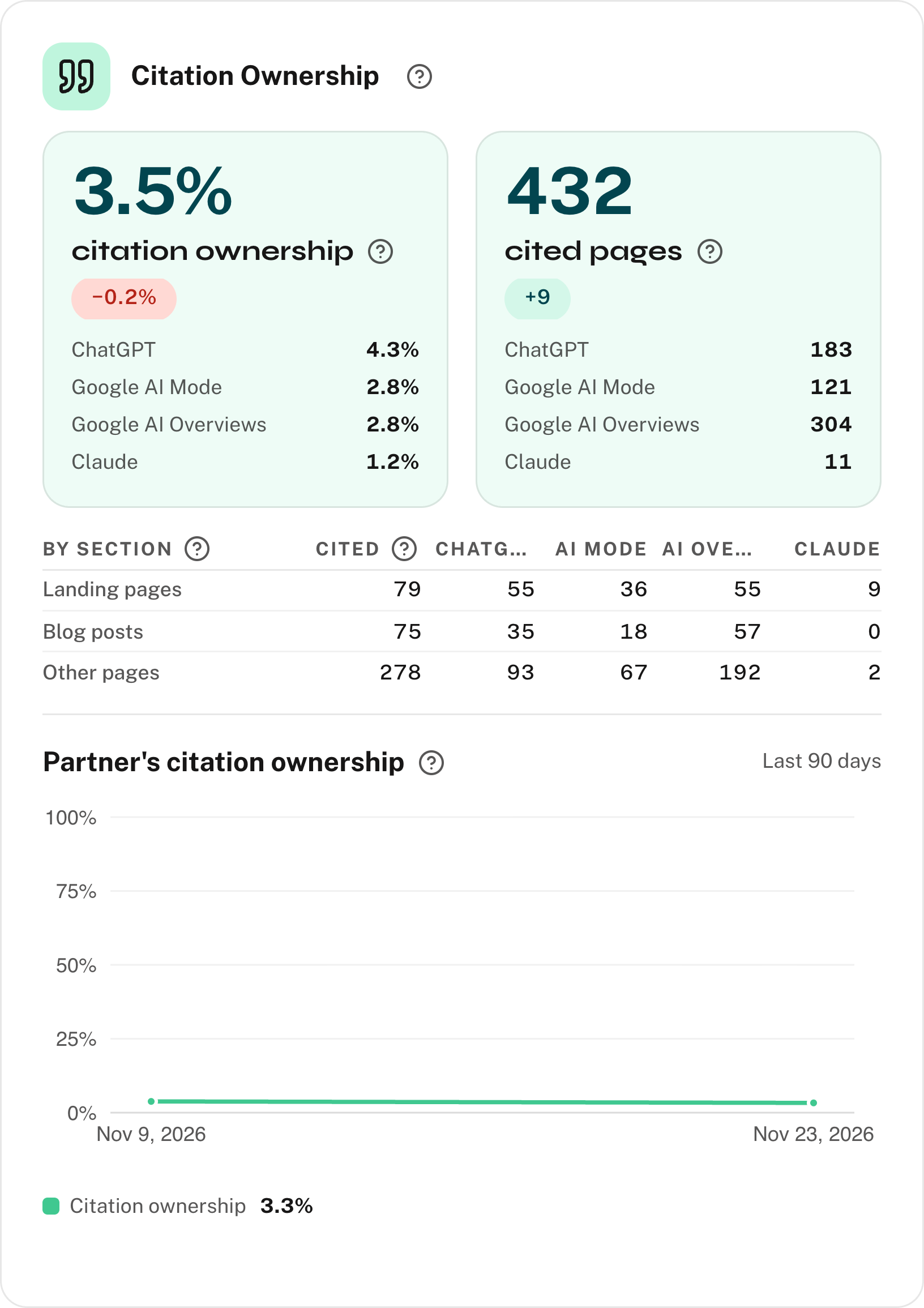
Other measurements agree on the click. In n8n’s data, 90% of the conversions its survey credited to AI engines never clicked a citation link and arrived as direct traffic.5 Omniscient’s most-retrieved page appeared in AI answers 210 times in a month, and the same page drew 10 referral sessions from AI tools that month.4
Pew’s browsing panel found that people who got an AI summary on Google followed one of its links on 1% of those visits, and clicked any result on 8% of them, against 15% when no summary appeared.16
The AI referrals line in analytics counts the rare click. The rest of the influence arrives later, as a typed address or a search for your name, and the report files it under another channel. Here is one buyer’s visit as each record sees it:
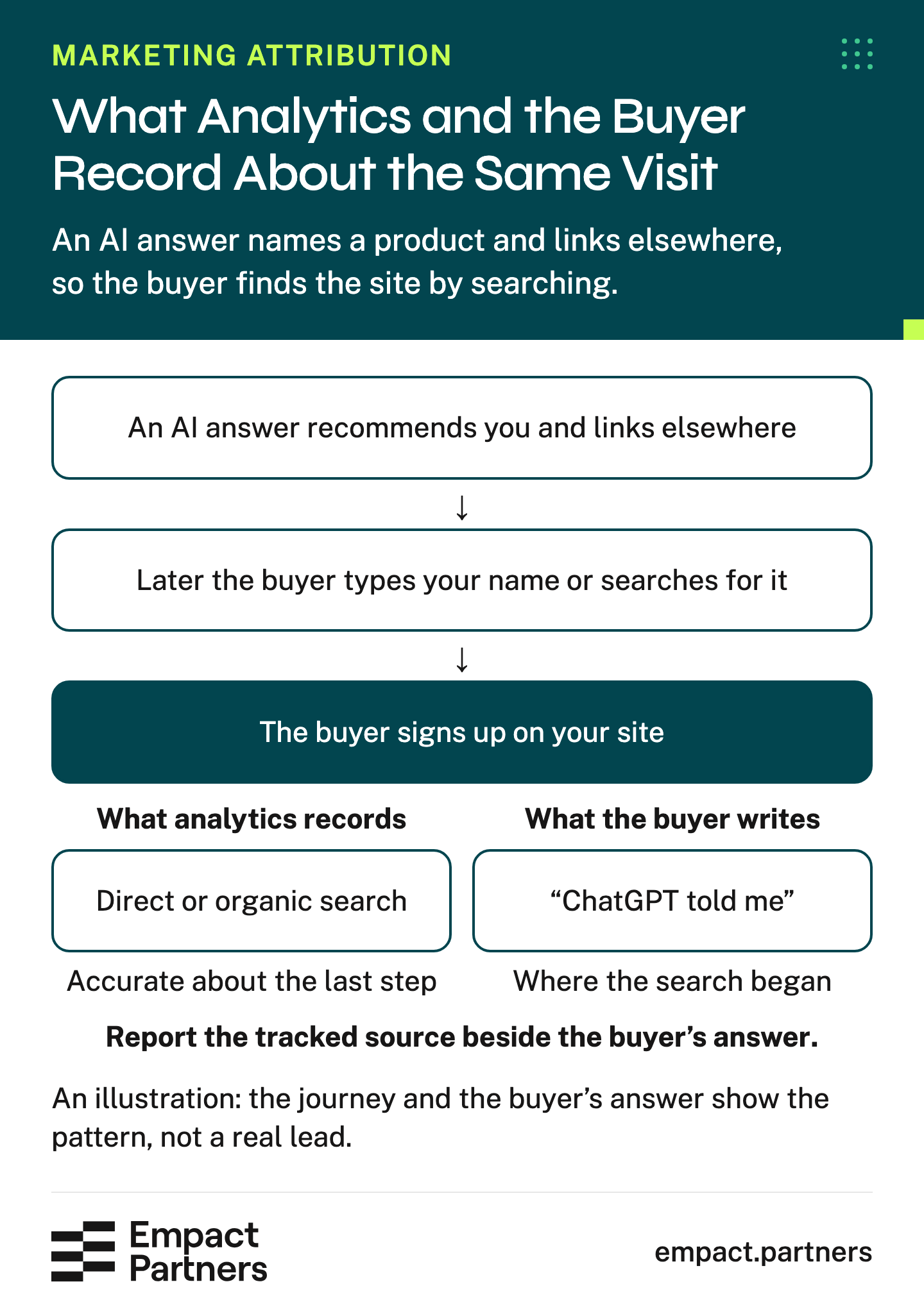
Analytics records the search that brought the buyer to the site. It has no record of the AI answer that gave them your name, and the form’s question is a second record where that answer can show up.
AI answers are still a minority source. In 6sense’s survey, 26% of buyers used large language models (LLMs) such as ChatGPT to find new vendors, and 25.2% said LLMs significantly shaped how they saw vendors they already knew.7 That is a minority of buyers, and in the n8n, OtterlyAI and Omniscient figures above, click tracking undercounted AI engines every time.
An AI answer that names a product without linking it still sends buyers, through the search bar. In analytics that looks like branded searches and direct visits rising while the AI referrals line stays flat, and the free-text answers are what show which engine started it.
Anri-Cornel Maree on LinkedInOpens in a new tabHow to Report the Buyer’s Answer Beside the Click Record
The fix is to keep the click record, add the buyer’s answer beside it and judge both against a written definition of the signup worth counting. Without that definition, both records count every lead alike, and marketers already rank lead quality first.
In HubSpot’s 2026 survey of 1,505 marketers, lead quality and marketing-qualified leads (MQLs) led the KPIs that matter at 39%, ahead of lead-to-customer conversion at 34% and return on marketing investment at 31%.15 And 73% said their budgets face more scrutiny than before, so the number a budget review cares about is the one a source report has to tie to.
A team that has not written down what a qualified signup is can count leads from every source and still not say which source produced the ones sales wanted. The playbook here covers writing it with sales, around the signups a call can help:
In RevOps, the workstream this problem belongs to, our first step is an audit of the stack and how data moves through it. We then add a self-reported source field to your signup and demo forms and set up reporting on pipeline and attribution in the CRM your team runs today, with the buyer’s answer and the tracked source each labelled.
If a community campaign on Reddit or an AI-search campaign is going to be measured by its leads, we agree the method with you before it launches, so the budget review can see which leads the campaign brought.
Before the first campaign is judged, these should be in place:
- The question: an open text box asking where the buyer first heard of you, on every signup and demo form, never a dropdown.
- Fixed categories: the categories the answers are sorted into, written before the first answer arrives, with AI engines and communities as lines of their own.
- A qualified signup, defined: the signups sales wants, written down with sales, so both records count the same thing.
- Both records, side by side: the CRM’s first-touch source and the buyer’s answer, each labelled, in one monthly view.
- Dated views: each view states the months it covers, so no two periods get compared by mistake.
Categories written before the first answer arrives keep each month comparable with the last. Categories made up while reading tend to drift toward whatever turned up that month, and then the trend a budget review needs is hard to read.
Anri-Cornel Maree on LinkedInOpens in a new tabThen watch, month by month, the share of new signups whose answer names a source your CRM filed as direct or organic search. While that share stays high, test the click report’s channel credit before next year’s budget follows it.
Frequently Asked Questions
How many B2B marketers trust their attribution data?
Fewer than half, on the most demanding question. In ANA’s May 2025 survey of 200 senior marketers at large US B2B companies, 39% were extremely or very confident they could measure marketing’s financial impact, and 12% rated their attribution advanced.
Gartner’s 2024 survey found 52% of senior marketing leaders able to prove marketing’s value and get credit for it. Marketers trust their data more readily than what it proves, so when your team says it trusts the numbers, ask whether it means the data or the conclusion drawn from it.
Which attribution model is best for B2B SaaS?
None of the click models can see a touch that produced no click, so the choice among them changes who gets credit more than how accurate the report is. Last touch favors the brand search at the end, and first touch favors direct and organic visits. For long, multi-person B2B cycles, keep a locked first-touch source, the last touch and the buyer’s own answer on every record, and test a budget question by changing spend in one segment and watching pipeline.
Why does most of our pipeline show as direct or organic traffic?
Because that is how a buyer arrives after the real discovery happened somewhere analytics cannot see. Someone hears your name from a colleague, a community thread or an AI answer, then types your address or searches your name days later. In HockeyStack’s data, buyers who named word of mouth were filed under direct, organic or paid search nine times in ten. Ask new leads in a free-text field and compare their answers with the recorded source.
How much do AI answers affect B2B attribution?
More than the AI referrals line suggests, because most of their influence produces no click. At n8n, AI engines held 0.9% of conversions in GA4 and 9% in the signup survey. At Omniscient Digital, first-touch tracking credited 28 of the 189 leads who named an AI engine. 6sense’s 2026 buyers keep it in proportion: 26% use LLMs to find new vendors, so measure the effect rather than assume it.
Do ChatGPT and Google AI Mode link to the vendors they recommend?
Often they do not. Across 232,556 answers from each engine to questions naming no brand in our Empact Panel, Google AI Mode cited no page on a named brand’s own site in 83.4% of brand mentions, and ChatGPT in 26.1%. Over half of AI Mode answers that named tracked vendors linked to none of them. A buyer who wants the product has to search for it, which is why AI influence shows up as branded search and direct visits.
Is self-reported attribution accurate enough for budget decisions?
On its own, no, and neither is click tracking. Buyers skip optional fields, give one-word answers and forget ad impressions they saw. Dreamdata got usable answers from 49 of 100 demo requests, and Ruler found 72% of its answers vague or missing. Read the buyer’s answer beside the tracked source, and use it to question a channel’s credit rather than to set a budget line by itself.
Should “how did you hear about us” be a dropdown or free text?
Free text. Buyers tend to pick whatever sits at the top: in one Ruler customer’s data, 47% of the leads choosing a dropdown’s top option were attributed wrongly. A dropdown also needs an entry for every channel a buyer might name, the AI engines included, and a missing entry hides that channel entirely. Sort the free-text answers into categories fixed in advance, so each month reads against the last.
How long is a B2B buying journey, and how much can attribution see?
About nine months in Dreamdata’s data. Its customers averaged 281 days from a first LinkedIn ad impression to closed revenue, with 88 touchpoints and 10 stakeholders in the average journey. 6sense found buyers contact a seller 59% of the way through a 10.3-month cycle, and only 35% put their own details on a vendor’s form. Attribution records the end of that journey, the form and the visits before it, and misses much of the research that came first.
What should count as a qualified signup?
The signups your sales team would choose to call, written down with sales before any campaign is judged. Write it as fit (company size, role, use case) plus a signal of intent (a demo request, a pricing visit, a product action). Without one, a report can show every channel producing leads and still not show which one produced the deals, which is the question a budget review asks.
Do we need new attribution software to fix this?
Usually not. The tracking you have already records clicks well, and the buyer’s answer is one more field on the forms you already run, read beside it each month. A switch of CRM makes sense only when an audit shows the tool itself is what holds your team back.
Sources (16)
- Anteriad and Ascend2, "The 2026 B2B Marketing Edge" (2026)↩1↩2March 2026; read on 28 November 2026.
- HockeyStack Labs, "The State of First-Touch, Last-Touch, Self-Reported Attribution and Revenue" (2025)↩1↩2↩3↩4↩5↩6↩715 December 2025; read on 28 November 2026.
- ANA and NewtonX, "The Confident B2B Marketer" (2025)↩1↩2↩3October 2025; read on 28 November 2026.
- Omniscient Digital, "First-Touch Attribution Captures 15% of Our AI-Sourced Leads" (2026)↩1↩2↩328 August 2026; read on 28 November 2026.
- Graphite, "Last-Touch Attribution Only Captures 10% of n8n’s AEO Conversions" (2026)↩1↩2↩3↩417 June 2026; read on 28 November 2026.
- Empact Partners, "Empact Panel, 13 software partner panels" (2026)Empact Partners' own data↩1↩2↩3↩4↩5232,556 answers each from ChatGPT and Google AI Mode to 41,936 questions naming no brand, weekly collections from 12 October to 27 November 2026; read on 28 November 2026.
- 6sense, "2026 B2B Buyer Experience Report" (2026)↩1↩2↩3↩4November 2026; read on 28 November 2026.
- Ruler Analytics, "Asking ‘How Did You Hear About Us’ Isn’t Enough" (2022)↩1↩211 July 2022; read on 28 November 2026.
- DemandScience, "The 2026 State of Performance Marketing: Exposing the Marketing Data Mirage" (2025)↩1↩2December 2025; read on 28 November 2026.
- Gartner, "Survey Finds Only 52% of Senior Marketing Leaders Can Prove Marketing’s Value and Receive Credit For Its Contribution to Business Outcomes" (2024)↩118 September 2024; read on 28 November 2026.
- Gartner, "2025 CMO Spend Survey Reveals Marketing Budgets Have Flatlined at 7.7% of Overall Company Revenue" (2025)↩112 May 2025, Figure 2; read on 28 November 2026.
- Dreamdata, "Announcing The LinkedIn Ads 2026 Benchmarks Report" (2026)↩110 March 2026; read on 28 November 2026.
- OtterlyAI, "Claude Drives 10.6% of Our Signups. Google Analytics Says 0.1%" (2026)↩16 July 2026; read on 28 November 2026.
- Dreamdata, "We tested self-reported attribution. Here’s what we learned" (2022)↩114 March 2022; read on 28 November 2026.
- HubSpot, "The 2026 State of Marketing Report" (2025)↩1↩2of September 2025; read on 28 November 2026.
- Pew Research Center, "Google users are less likely to click on links when an AI summary appears in the results" (2025)↩122 July 2025; read on 28 November 2026.
Keep reading
Statistics 46 Unlinked Brand Mention Statistics
46 figures on how often AI answers name a SaaS brand without linking its site, what they cite instead, and why the mention still counts.

Statistics 38 Link Building Statistics
38 figures on what links cost, what Google still counts, and how often AI answers cite sites with few links.

Statistics 39 Vendor Website AI Citation Statistics
39 figures on how often AI answers cite a software vendor’s own site, which of its pages they pick, and where that leaves the budget.