
Attribution Can’t Tell You Which Channel Drives Pipeline
An attribution model splits credit among the touches your systems saw, so it can’t say which channel drove a deal. A holdout test can.
 Leon ClaassenWith
 Vlad Shvets
On this page
Empact Newsletter
One email a month on what is working in AI search and SaaS go-to-market.
Your attribution model can’t tell you which marketing caused a deal, and a better model won’t either. Keep one simple model for bookkeeping, ask each new lead how they first heard of you, and test a channel before you trust its credit. To test one, switch it off for one group of accounts, keep it on for a similar group, and compare the qualified deals each group brings in.
Empact Partners builds the RevOps reports SaaS companies run their pipeline on, each number counted from the actual deals by a rule anyone can read. No rule, ours included, answers the first question a CFO asks, which channel produced the deal.
Even so, none of what follows needs a new tool or outside help, including ours. It holds for B2B SaaS companies that sell through months of sales conversations, and your team can act on it alone.
An Attribution Model Only Divides Credit Among the Touches It Saw
An attribution model is a rule for splitting up the credit for a deal. First touch gives all of it to the first recorded touch and last touch to the last. A multi-touch model spreads it across several by a formula, and a data-driven model learns its split by comparing the runs of touches that ended in a deal with those that didn’t.
All of those rules work from the same input, which is the touches your systems recorded. Most of what a buying group does over those months happens somewhere else, in conversations, community threads, podcasts and AI answers that name you without a link. None of it reaches your CRM, and an example deal shows the shape of it.
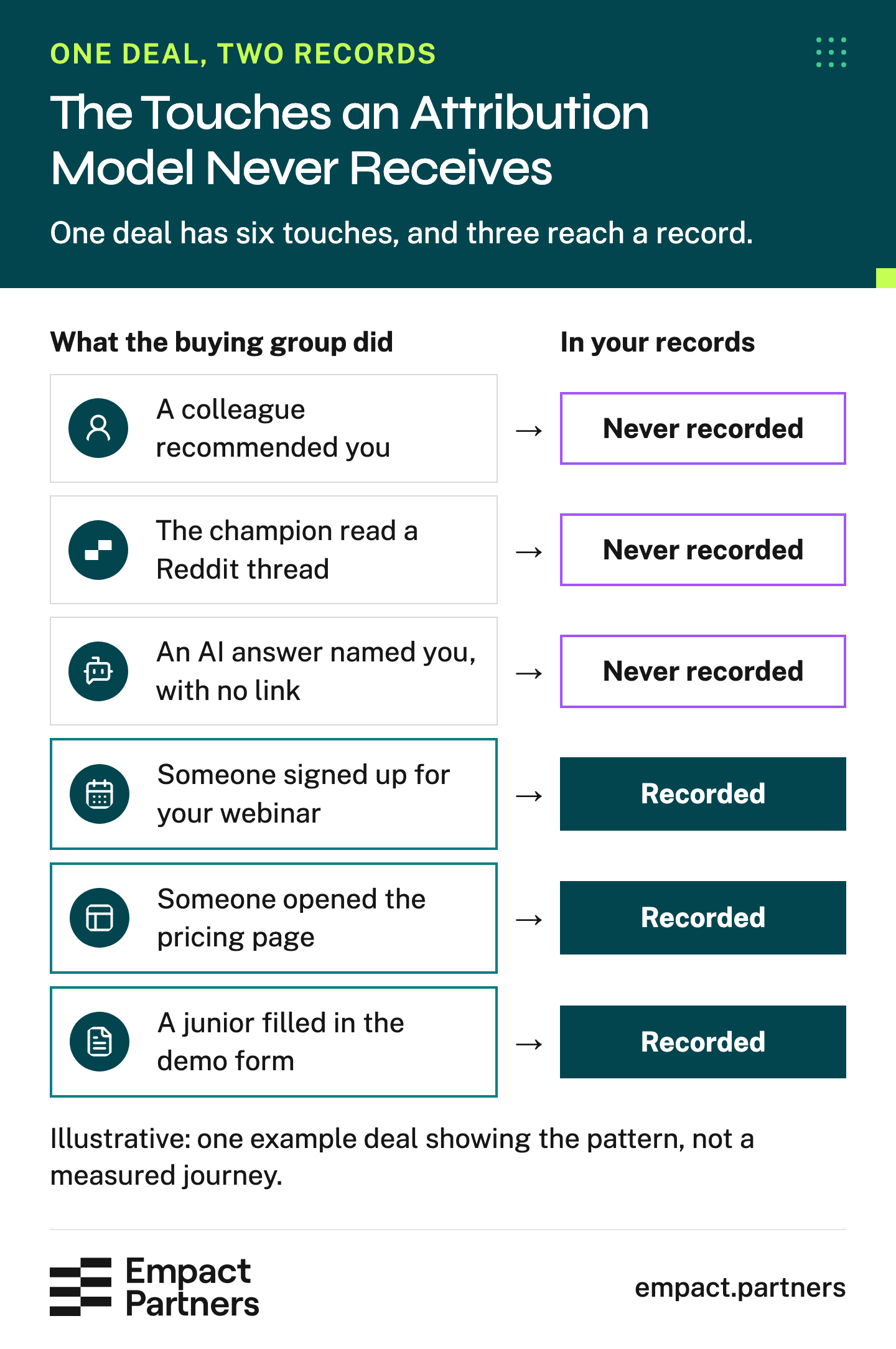
Change the model and you change how the credit moves among the three recorded touches. No model can move the other three into your records.
Most of the deciding also happens before a buyer talks to you. 6sense, which sells account-based marketing software, surveyed B2B buyers for its 2026 report and found the choice largely made before the first contact with any seller.1
So the form your model treats as the start arrives late, and nearly two times in three it doesn’t carry the buyer’s own name and email. When a CFO asks which channel produced last quarter’s pipeline, your report can only show how a rule split the credit among the touches it saw.
It can’t tell you which of those touches the deals needed. To know that, you would have to watch the same quarter run again with one channel switched off.
A better attribution model gives you a finer split of the same incomplete records.
A Better Model Reads the Same Missing Records
Any model is only as good as the records it reads. We found out how thin ours were when we tried to answer the question for our own pipeline.
None of our systems had recorded which partners came from our own outreach. So we rebuilt the record company by company, from the mail, the outreach replies, the CRM and the old board.3 The rebuilt record sorts the 59 partners we had won by October 2026 into five groups, by how each first reached us.
Where Our 59 Partners Came From, Rebuilt From the Conversations
Empact Partners’ won or past partners by source, read from every conversation with each company, data as of 22 Oct 2026
View the data
| Label | Value |
|---|---|
| Referral | 18 |
| Cold outreach | 18 |
| Existing relationship | 11 |
| Not in the record | 7 |
| Inbound | 5 |
These are a consultancy’s deals, so read the split as our record and never as a benchmark for a SaaS signup flow. The gap between what happened and what got recorded applies to any SaaS company. Nearly half of our partners began in a conversation, and even our outreach wins had to be pieced back together by hand.
The credits we did hold were weaker than they looked. When a second AI model checked the rebuilt record and tried to disprove every partner it credited to a campaign, one turned out to have come in as a warm referral. The meeting our records credited to the campaign was booked after a person had already introduced us. Try the same reading on your own won deals.
Before you buy a model, read the conversations behind ten won deals and write down where each one started. If your CRM’s source field disagrees with what you read, a better model will only split the wrong answer more finely.
 Leon Claassen on LinkedInOpens in a new tab
The same gap shows up inside a software company’s own tools. For one of our software partners, GA4 (Google Analytics 4) counted about 240 visits from AI assistants in a quarter this year, and its CRM about 130. The CRM also changed its answer later, though the customers had not changed. It now credits ChatGPT with one paying customer for the quarter before, where our record from that time shows two.
When the report stops making sense, most teams reach for a new tool. DemandScience surveyed 750 senior marketing leaders at large companies, and 55% of them said they add attribution or analytics tools when pipeline comes under pressure, the most common response.2 The new tool reads the same records, gaps included.
A new model also inherits every flaw in those records. The same company sits in the CRM twice, a source field stays blank, an open deal has no owner. The free CRM Health Report finds those gaps in one export and ranks them for cleanup. For our RevOps partners, the full agent behind it checks each new export.
Doesn’t a Board Need One Number for Marketing’s Pipeline?
It does. Without one, budget goes to whoever argues best in the planning meeting, and a model at least applies the same rule every quarter. A multi-touch model is the usual candidate for that number, so judge it both ways before it reaches the board:
Pros
- One written rule ends the argument over which team gets the credit
- It shows which channels turn up in the paths of the deals you won
- With thousands of conversions a month, it can steer bids inside the ad platforms
- Newer tools record far more of the journey on your own site than last touch did
Cons
- It reads only recorded touches, and nearly half of our own partners started somewhere it would never see
- It can’t say what pipeline would have been without a channel
- Switching models resets the history the board compares each quarter against
So keep a model, a simple one, written down and reported the same way every quarter as the shared count. That is bookkeeping, and bookkeeping is worth having. The trouble starts when the team reads that credit as the reason deals happened. When the reason looks wrong, they shop for a model that gives the answer they expected.
The case for a model is strongest where conversions are many and cycles are short, in self-serve products and ecommerce. A SaaS company that closes tens of deals a quarter has too few paths for that. Each path is also missing most of the months of conversation behind it, so no model can learn what a channel was worth.
Split the Board’s Question Into Three You Can Answer
“Which channel produced our pipeline?” hides three smaller questions, and each one can be answered. None of the answers comes from a better model.
Scroll horizontally to see all columns when the table is wider than this page.
| The question underneath | How to answer it | What the answer still can’t tell you |
|---|---|---|
| Where did this buyer first hear of us? | A free-text question on the form or the first call, answered by each new lead | How much that first source mattered next to everything after it |
| What is our pipeline, and where did each deal start? | A count taken from your deals under one written rule, with one simple model kept for bookkeeping | Whether any channel caused the deals it counts |
| Does this channel produce pipeline? | Switch the channel off for one group of accounts, keep it on for a similar group, and compare the qualified deals each brings in | Anything about the channels you left running |
The third question gets skipped most often, though it alone looks at what happens without the channel. It has a name:
If qualified pipeline moves the same way in both groups, you have no evidence the channel was producing it, whatever share of the credit it had. Read the test on qualified pipeline or booked meetings, which arrive within weeks. Closed revenue comes too slowly, and in too few deals, to show a difference.
We test our own outbound this way. Some of our emails go out right after something changes at a company, like a new sales leader, and we want to know whether that trigger earns meetings. So the same number of similar companies get our usual email in the same weeks, with the trigger held back, and we compare the meetings each group books.
We hold ourselves to two more rules. In a test of a new email for a partner whose outbound we run, each company gets one version, never both. And we ignore any group under 200 emails, where chance alone moves the numbers too much to read. One test is still a direction, never the last word, so the channel you pick is the real decision.
Test the channel your next budget meeting will fight over, and only that one. A test on a channel nobody plans to cut won’t change any decision. One on the biggest line in the budget will, whichever way it comes out.
Leon Claassen on LinkedInOpens in a new tabWhat to Do Before You Buy Another Attribution Tool
We would leave the tool question for last. First we review your stack and how lead and deal data move through it, because that is where the gaps start. Then we set up the pipeline and attribution reports in the CRM you already have, each number counted from your deals by a rule written down where sales and finance can both see it.
We suggest a new CRM only when that review shows the CRM itself is the obstacle. Until then, the fix is in the records. Each new lead gets asked where they heard of you, a qualified lead gets a written definition, and each campaign gets a measure agreed before it starts. That work covers five things:
- A read of your stack and how lead and deal data move through it
- Pipeline and attribution reports, automated, in the CRM you already have
- Every figure in them traced to the deals it counts, under a written rule
- A self-reported source field and a written definition of a qualified lead or signup
- How sales and how finance each count a won deal, written down and matched deal by deal
The written counting rule is the part most teams can start on this week. The playbook my colleague Teddy Cipolla wrote builds it into one weekly revenue view, with win rate, how long deals take, stage conversion and the forecast, that sales and finance both trust.
So before a better attribution model goes on next quarter’s budget, put that money into one test instead. Take the channel your board argues about most, switch it off for a group of accounts, and read the result on qualified pipeline. Keep the model you have for the books.
Frequently Asked Questions
Is multi-touch attribution worth paying for in B2B SaaS?
Multi-touch attribution is worth having as bookkeeping, and rarely worth paying more for as an answer to what caused a deal. Your CRM and your analytics tool most likely record first and last touch already.
A paid model earns its price when you have thousands of conversions a month and short cycles, so it has enough paths to learn from. With tens of deals a quarter, spend that money on clean records and one holdout instead.
Which attribution model should we use for reporting?
The simplest one your team will keep using without arguing, written down and applied the same way every quarter. First touch for where pipeline starts is a common choice, reported beside the buyer’s own answer.
What matters more than the model is that every number is counted from the deal records, so a figure can be traced to the deals behind it. If you ever change the model, say so in the report with the date and the reason, or every comparison with an earlier quarter breaks.
How long should a holdout test run?
Long enough for the result you are measuring to appear, including the time between a buyer meeting your marketing and booking a call. In B2B that is weeks, never days. Set the length, the groups and the measure before you start, and don’t end the test early because the first fortnight looks good or bad.
If your buyers take weeks to respond to anything, add those weeks. A test read before the effect could arrive will tell you the channel did nothing.
What if we close too few deals to test anything?
Then test on something more frequent than a closed deal, such as booked meetings, qualified opportunities or demo requests from the accounts you target. Hold the channel back from a region or a segment large enough to produce a few dozen of those in each group.
If even that is out of reach, run the pause anyway and read it as a direction, with the buyer’s own answer beside it. If the test and the buyers’ answers point the same way, that is enough to act on.
Can marketing mix modeling answer the question instead?
Marketing mix modeling estimates each channel’s effect from how spend and results moved together over time. It needs a long history, real variation in spend, and enough volume per period, which most SaaS companies closing tens of deals a quarter don’t have.
Where it fits, it is still an estimate, and it earns trust when a holdout test has checked it. For most B2B SaaS teams the holdout comes first.
How reliable is the “how did you hear about us” answer?
Rough, and still worth having. Buyers misremember, and a dropdown invites them to pick its first option, so ask in an open text field and code the answers each month.
The answer still sees what tracking never does, such as a colleague’s tip, a community thread, a podcast or an AI answer. Our attribution statistics show how far the buyer’s answer and the click record drift apart.
Do AI answers make attribution worse?
Yes, in one specific way. An AI engine can put your name in front of a buyer with no link to your site, so the visit that follows arrives as direct traffic or a branded search. Your model credits whatever it saw last.
Nothing in a model can recover that step. The buyer’s own answer can, and so can counting how often the engines name you over the same months. Give both a full quarter before you call the channel empty.
What should we tell the board while the first test runs?
Tell them what each number is. The shared count is bookkeeping, the buyer’s answers show where pipeline starts, and the test will say whether one named channel produces pipeline, with a date for the answer.
Telling them now what the numbers can’t show is easier than explaining next quarter why the model’s answer changed. Name the budget decision the test will settle, so the wait has a purpose.
Should we switch CRM to fix our attribution?
Rarely. Most attribution trouble lives in the records and the forms that create them, and a new CRM imports the same duplicates, blank source fields and deals with no owner.
Switch only when a read of the stack shows the tool itself blocks the reporting your team needs, and then plan the migration so the history survives. Clean records in the CRM you have come first.
Which channel should we hold back first?
The one with the biggest budget line and the loudest argument about it, often the paid channel the CFO already doubts. A channel that is cheap or uncontested can wait.
Avoid testing two channels at once on overlapping groups, and keep everything else steady while the test runs. A product launch or a price change in the middle of it will swamp the difference you are trying to see.
Sources (3)
- 6sense, "2026 B2B Buyer Experience Report" (2026)↩1↩2
- DemandScience, "The 2026 State of Performance Marketing: Exposing the Marketing Data Mirage" (2025)↩1
- Empact Partners, "our own record of where our partners came from, rebuilt from the conversations with every company in our CRM, data as of 22 October 2026" (2026)Empact Partners' own data↩1↩2
Keep reading
RevOps How to See and Report the Pipeline AI Engines Send You
Buyers who find you in AI answers rarely click. Stamp each buyer’s own answer on the deal, then show the board those deals by both sources.

RevOps How to Calculate CAC by Channel from Closed-Won Deals
Ad platforms count form fills, not customers. Count CAC by channel from closed-won deals, for short self-serve and long sales-led cycles.

RevOps 5 Best CPQ Tools for SaaS Subscription and Usage Pricing
Five CPQ tools for SaaS teams, compared by the CRM each one needs and what happens when a usage deal changes mid-contract.