
How to See Which Signups Came From ChatGPT and Reddit
Signups from ChatGPT and Reddit land in analytics as Direct or Google. Add one form field, code the answers with Claude, report both.
 Anri-Cornel MareeWith
 Vlad Shvets
On this page
Empact Newsletter
One email a month on what is working in AI search and SaaS go-to-market.
Direct traffic and searches for your brand name are climbing, and the AI referrals line in your analytics barely leaves zero. When the budget for your AI-search or Reddit work comes up for review, neither line says what that work brought in.
Most of what the AI line misses is a buyer who read a recommendation in ChatGPT or a Reddit thread, opened a new tab and typed your name. Analytics files that visit as Direct, its label for a visit with no known source, or as a Google search.
Omniscient Digital set the answers to its optional “how did you hear about us” field beside its own tracking 1. Of 213 answers, 189 named ChatGPT, Claude, Gemini, Perplexity or just “AI”, and this is where its first-touch tracking, the first visit it recorded, had filed those leads:
Where Tracking Filed 189 Leads Who Named an AI Tool
Omniscient Digital’s own leads: HubSpot first-touch source for each lead whose answer named an AI tool, published August 2026
View the data
| Label | Value |
|---|---|
| Organic Search | 95 |
| Direct | 59 |
| AI Referrals | 28 |
| Referral or other | 7 |
154 of the 189 sat under Organic Search or Direct, two lines a report reads as healthy. Tracking credited 28 to AI, about one in seven. For the rest, the buyer’s own answer was the only record of where the search began.
Empact Partners sets up the RevOps reporting SaaS companies use to see which channels bring in pipeline. Before an AI-search or Reddit campaign that will be judged on leads, we want this question on the signup form.
By the end, each answer saves to the contact record and your categories are set before the first one arrives. Each month’s coded answers then sit in one report with the source your CRM recorded. You need four things before Step 1, and only the second may need someone else:
This counts where buyers who signed up say they heard of you. It can’t show which AI answer named you, or the buyers who read one and never signed up.
How to Add the Question to Your Signup Form
Step 1: Add the question as an open-text field
Ask in free text, never with a dropdown. A dropdown measures the order of your options: in one company’s data that Ruler Analytics checked, 47% of the leads who picked the first option had come from somewhere else 2. It also asks buyers to think in your channel names, and nobody remembers a ChatGPT answer as Organic Search.
Word it “Where did you first hear about us?” The word “first” pulls the buyer past yesterday’s search for your name, back to where the search began. In HubSpot, the field and the property it saves to are made in one pass:
In HubSpot’s form editor
Open the form.
Go to Marketing, then Forms, hover over your signup or demo form and click Edit.
Add the field.
Click the + add icon at the top left and drag a Multi-line text field onto the form.
Create its property.
In the Edit field panel, click Create new property, label it First heard about us, then click Create property.
Set the label and options.
Type the question as the label, and leave Help text and the grey prompt inside the box empty.
Empty help text matters more than it looks. A hint that names channels, such as a podcast, an AI tool or a friend, hands the buyer the same menu a dropdown would. Turn on Required field on a demo request, where the buyer is already asking for a call. For a self-serve signup, ask on the first screen after the account exists, where the question can’t cost you the signup.
Left optional on Dreamdata’s demo form, the question was answered on about 70 of 100 requests, and 49 of the answers were useful 3. The Required field switch sits at the foot of the panel:
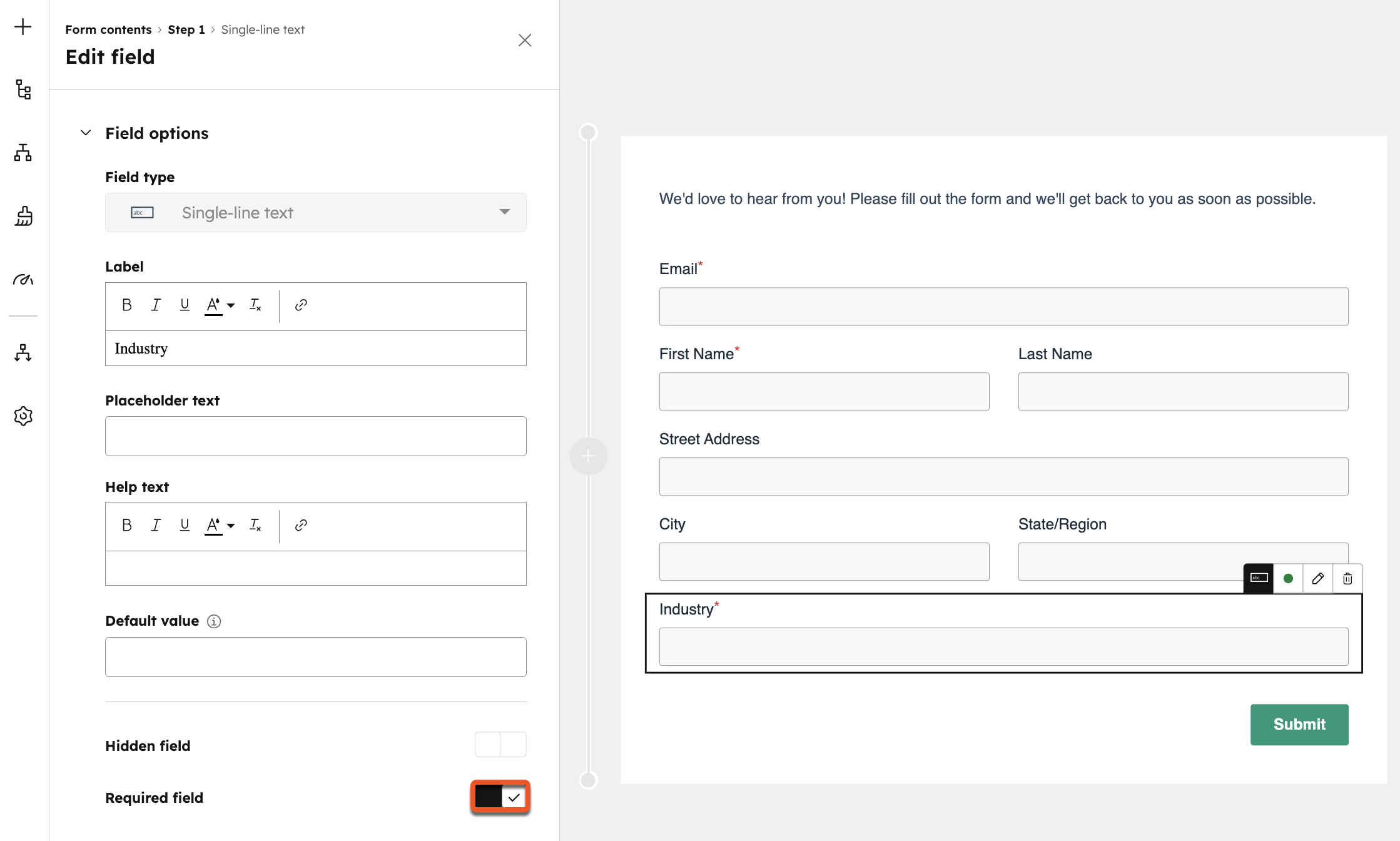
Submit the form once with your own email address, then open your contact record. First heard about us should hold your answer exactly as you typed it. If it’s empty, the field is connected to another property, so reopen Edit field and check which property it names.
Step 2: Map a Typeform or Webflow form to the same property
If the form lives outside HubSpot, send its answer to the property you just created, so every contact carries it however they signed up. Each tool keeps the mapping in a different place:
Scroll horizontally to see all columns when the table is wider than this page.
| Form | Where the mapping lives | What to set |
|---|---|---|
| HubSpot | The field’s Edit field panel | The property is connected when you create it in Step 1 |
| Typeform | The HubSpot integration, then Map to Contacts, then Map questions | Your long-text question mapped to First heard about us |
| Webflow | The HubSpot app’s + Webflow form, with Collect data from website forms switched on in HubSpot | A Text Field whose Name is the property’s internal name, letter for letter |
Webflow is where this step goes wrong. The long-answer box you would reach for, a Text Area, won’t map: Webflow’s own guide to the app says the mapping takes plain text inputs only 4. The property’s internal name is under Settings, then Properties, on the property itself. Check either tool the same way as Step 1, with one test submission and the contact record.
Fix the Categories Before the First Answer Arrives
Step 3: Write your categories into a table
Write the categories before you read a single answer. Categories invented after reading describe whatever turned up that month, and next month’s answers get sorted into a different set, so the trend a budget review needs never forms.
Our test used seven categories. Five cover the channels this report exists to count. Other named source catches a channel outside them, and Unknown is for answers that name no source:
Scroll horizontally to see all columns when the table is wider than this page.
| Category | What goes in it | Detail to record |
|---|---|---|
| AI assistant | ChatGPT, Claude, Gemini, Google AI Mode or AI Overviews, Perplexity, Copilot, or just “AI” | The engine, or unnamed |
| Reddit or community | A Reddit thread or subreddit, a Slack or Discord group, a forum | The community |
| Referral | A person: a colleague, a friend, an investor, a customer, a former employer | Who |
| Search | Google, Bing, “searched”, Google Ads | The engine |
| Event | A conference, a trade show, a webinar, a meetup | The event |
| Other named source | LinkedIn, a podcast, YouTube, a newsletter, a review site, an article | The source |
| Unknown | Blank, “n/a”, “don’t remember”, “online”, “internet”, a joke | Nothing |
Search can’t tell a search for your name from a search for your category, so the table doesn’t try. If you run outbound, add a line for your own outreach now, before a buyer writes that your rep emailed them. That gap showed up in our test, in Step 6.
Step 3 is the hardest to undo, because every later month is coded against these lines. Before the form goes live, read the table once more against every channel you spend on, outbound and events included.
Code Each Month’s Answers With Claude
Step 4: Export the month without names or emails
At the start of each month, open Contacts in HubSpot and filter Create date to last month. Add two columns to the view: First heard about us, and Original source, the channel HubSpot recorded for the contact’s first visit. Export the view as a CSV, the plain spreadsheet file every tool reads, and keep it.
Step 5: Run the coding prompt in Claude
Open Claude, start a new chat and paste the prompt below, replacing its last line with your two columns. Change the category definitions only where your Step 3 table differs from ours:
You are coding answers to the question "How did you hear about us?" from our signup form.

Use only these categories:
- AI assistant: the person names an AI tool (ChatGPT, Claude, Gemini, Google AI Mode or AI Overviews, Perplexity, Copilot) or just says "AI". Put the tool in the detail column, or "unnamed".
- Reddit or community: a Reddit thread or subreddit, a Slack or Discord group, a forum.
- Referral: a person told them (a colleague, a friend, an investor, a customer, a former employer).
- Search: Google, Bing, "searched", Google Ads. Do not guess whether they searched for our name.
- Event: a conference, a trade show, a webinar or a meetup.
- Other named source: any other source they name (LinkedIn, a podcast, YouTube, a newsletter, a review site, an article).
- Unknown: blank, "n/a", "don't remember", "online", "internet", or a joke.

Rules:
1. Code where they first heard of us if the answer says so. Otherwise code the first source they name.
2. If they name a second source, put it in second_source. If an AI tool appears anywhere in the answer, it must appear in category or in second_source.
3. Never force an answer to fit. If two categories fit, pick the closer one, set confidence to low and say why in the note.
4. Keep each answer exactly as written.

Return a CSV with these columns: id, answer, category, detail, second_source, confidence, note
Then a table of counts by category, and a list of the ids you marked low.

The answers:
[paste your CSV export here]
You get back one CSV row per answer and a count by category. We wrote 60 answers to test the prompt, with the typos, blanks, one-word replies, jokes and double sources that real answers carry. No company’s signups are in that test. Claude coded all 60 in 33 seconds and kept every answer exactly as written. These rows show the calls it made:
Scroll horizontally to see all columns when the table is wider than this page.
| Answer | Category | Second source | Confidence | Claude’s note |
|---|---|---|---|---|
| chatpgt | AI assistant | None | medium | Typo read as ChatGPT |
| Read about you in a ChatGPT answer last month and searched for you today | AI assistant | Search | high | First heard via ChatGPT; search came later |
| a friend told me about you, then I asked ChatGPT if you were any good | Referral | AI assistant (ChatGPT) | high | Friend named first |
| SaaStr | Event | None | low | SaaStr could be the conference (Event) or its community/content (Other named source); the answer does not say |
| sales rep emailed me | Other named source | None | low | Our own outreach rather than a person recommending us, so not a true Referral; no category fits cleanly |
| my mom | Referral | None | medium | Could be a joke but read literally as a person who told them |
| was a customer at my last company | Referral | None | low | Not told by a person; they used us at a former employer. Referral is the closest fit but could be read as prior product use |
| been using you for years | Unknown | None | medium | Says they are a long-time user but names no source |
Rule 2 earned its place in the third row. The friend came first, so the row is a Referral, and ChatGPT still shows up in the second column, where a count of AI mentions will find it.
Step 6: Read every row Claude was unsure of
Across the 60, Claude marked 50 rows high, 7 medium and 3 low, and its closing summary named only the 3 lows. The prompt never defined medium. The model added that level on its own, so whoever reads only the summary skips seven judgment calls. Read every row that isn’t marked high.
Three of those rows needed a person. “my mom” came back as a Referral because the model read it literally, and on a B2B form it’s a joke. Our table had no category for people who already use the product, so the two returning users landed in different categories. It had none for our own outreach either, so “sales rep emailed me” had nowhere to go.
Use the first month to find gaps like these. Add a new category when the next month starts, and rerun the earlier months’ answers with it, so every month in the report is coded against the same table. Never change the table halfway through a month. Before the counts go into the report, run four checks:
Before the counts go in
- Every row marked medium or low has been read by a person
- Jokes and blanks are coded Unknown
- Any new category is written down with the month it starts
- The raw answers stay in the export, beside the codes
Anri-Cornel Maree, who wrote this guide for Empact Partners, reads the test this way:
Give the model the sorting, and keep a person on the categories and on every row it doubts. In our test it coded 60 answers in 33 seconds, then filed a joke as a referral and put two returning users in two different places. Those are calls about your business, and they need someone who knows it.
 Anri-Cornel Maree on LinkedInOpens in a new tab
Report the Coded Answers Next to Your Analytics
Step 7: Cross the coded answers with HubSpot’s original source
In Google Sheets, paste your export and Claude’s CSV into two tabs and pull each contact’s category into the export with XLOOKUP, the Sheets formula that finds a row by its ID. Then insert a pivot table with the coded category down the side, Original source across the top and a count of contacts in each cell.
Each cell is a group of signups described by two records at once, and the two records are not competing. Analytics knows the visit that converted. The buyer knows where the search began:
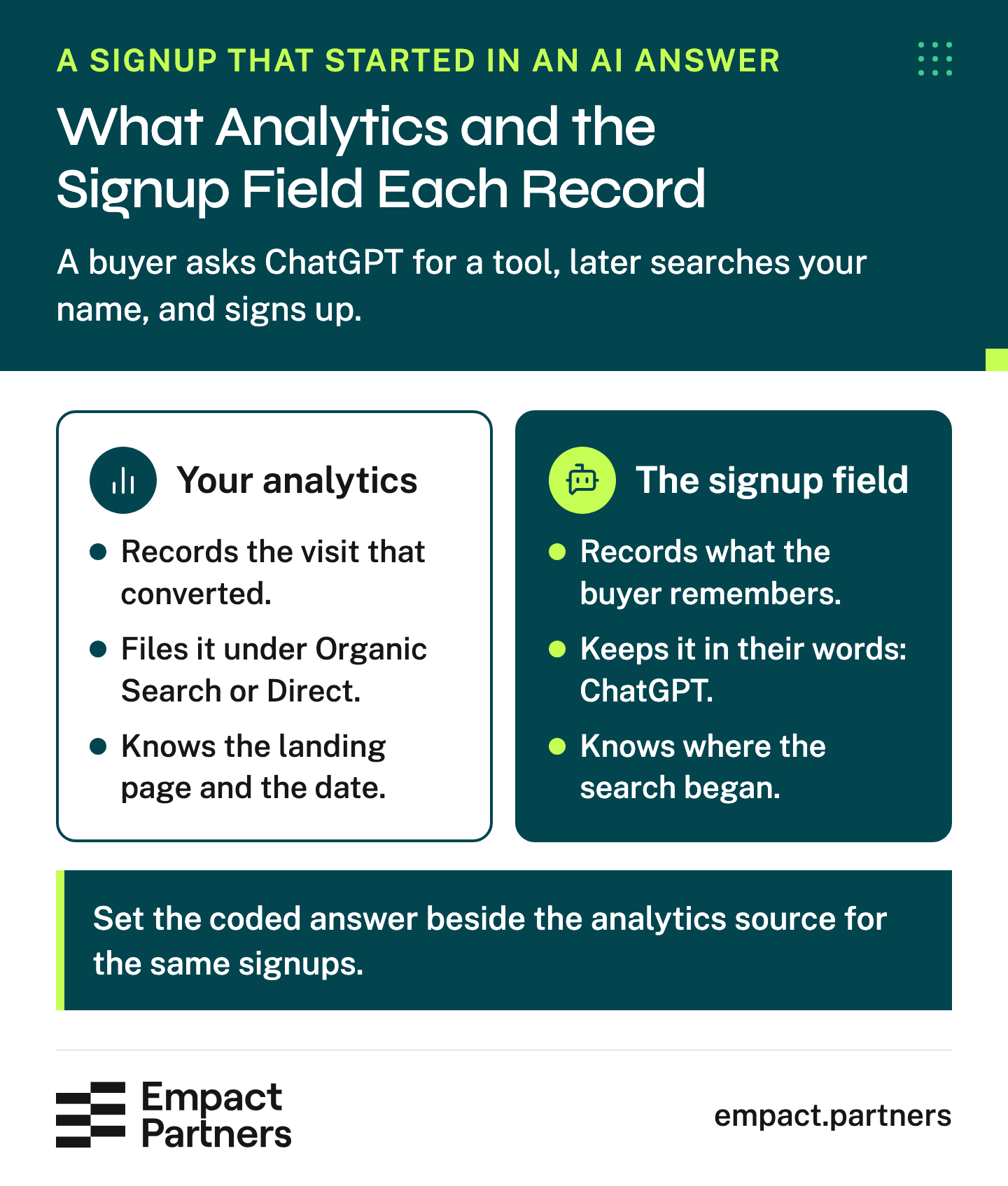
So the report keeps both, for the same signups. Read the AI assistant row first, because it shows where analytics put the people who named an AI tool:
Scroll horizontally to see all columns when the table is wider than this page.
| Coded category | Where HubSpot filed most of them | How to read it |
|---|---|---|
| AI assistant | Direct traffic or Organic search | AI answers sending buyers who never clicked a link |
| AI assistant | AI referrals | Buyers who clicked the link in the answer |
| Reddit or community | Direct traffic, Organic search or Referrals | Threads sending buyers who came back later |
| Search | Organic search or Paid search | The two records agree |
| Unknown | Anywhere | Leave these out of the comparison |
Two companies have published both columns for their own signups. n8n’s analytics credited AI with 0.9% of conversions, while its post-signup question put AI at 9% 5. Otterly published the same comparison channel by channel 6:
Where Otterly’s Signups Came From, by Analytics and by Its Signup Question
Share of signups, GA4 last touch against the post-signup survey, published July 2026
View the data
| Label | Analytics (GA4 last touch) | The signup question |
|---|---|---|
| Google Search | 35% | 15.7% |
| ChatGPT | 7% | 11% |
| Claude | 0.1% | 10.6% |
Otterly reads the drop in Google Search as discovery that starts in an AI answer and finishes on Google. Its founder puts the Claude gap down to links: ChatGPT now links the brands it names while Claude mostly didn’t, so a Claude recommendation could only arrive as a typed address or a search 6.
Step 8: Write the month’s line for the budget review
Report the month in one sentence with both numbers: how many signups analytics credits to AI, how many named an AI tool in their answer, and where analytics filed those buyers. Leave the analytics number as it is, and don’t move Direct into the AI column.
Direct also holds bookmarks, returning users and links pasted from chat apps, and the coded answers come from people who remembered and chose to say. Each number is wrong in its own way, which is why the report carries both.
The AI line in your analytics counts clicks, and an AI answer can send you a buyer without one.
The field also hears only from people who signed up. It can’t show AI answers that named you to buyers who never signed up, or answers that recommended a competitor instead.
You measure those in the engines themselves, by asking them your buyers’ questions every week. The playbook below sets up that weekly reading with 100 buyer questions and one scoring sheet, and shows how to judge whether a change in the answers is real:
When to Put the Question on Your Form
Put it on the form before the campaign it will judge. Answers collected after a budget review starts can’t show what the channel did before it, so the channel goes into its review with only the analytics line.
When we take on a SaaS team’s RevOps, the first job is an audit of its stack and the way data moves through it. The reporting for pipeline and attribution comes next, built in the CRM the team already has.
We do AI-search visibility and Reddit marketing for SaaS companies too, and that work faces the same budget reviews. So for AI-search or Reddit work, we’d start with this question and its monthly report, because the buyer’s answer is the only record of where those searches began. Working with us on it includes:
RevOps reporting with Empact Partners
- An audit of your stack and data flows, to find what is broken
- Automated reporting for pipeline and attribution, in the CRM you already use
- A monthly report on the pipeline numbers, with the coded answers next to your analytics
- Dashboards your marketing, sales and product teams all work from
From the second month on, watch the gap between the share of signups that named an AI tool and the share analytics credits to AI. If the coded share climbs while the analytics line stays flat, buyers are arriving from answers they never clicked, and the next budget review can see it.
Frequently Asked Questions
Should the question be a dropdown or open text?
Open text. A dropdown measures the order of its options as much as the buyer’s memory. Ruler Analytics found that 47% of leads who chose the first option in one company’s dropdown had come from somewhere else. Buyers also don’t think in channel names, so someone who met you in an AI answer may well tick Search.
Free text needs a monthly coding pass. The prompt in Step 5 coded our 60-answer test in 33 seconds.
Should the field be required?
For a demo request, yes, because the buyer is already asking for a call and three more words cost little. For a self-serve signup, ask on the first screen after the account exists, so the question can’t lose you the signup itself. Optional fields go unanswered often: on Dreamdata’s demo form about 30 of 100 requests left it blank, and only 49 of the 100 gave a useful answer.
How many answers do we need before the numbers mean anything?
Enough that one person changing their answer doesn’t move a category by several points. Read the first month for gaps in your categories rather than for shares. Start comparing in the second month, and judge a trend on three months or more. A single launch, event or viral thread can fill one category for a few weeks and empty it again.
Can we use ChatGPT or another model instead of Claude?
Yes. The prompt names its categories and rules in plain text and asks for a CSV, so any capable model can run it. Keeping the prompt and the categories fixed each month matters more than the model. Then a change in the counts comes from your buyers, never from a reworded prompt. Whatever you use, read every row it doesn’t mark as high confidence.
Is it safe to paste signup answers into an AI tool?
Paste only the record ID and the answer. Names, email addresses and company domains stay in your CRM export, and the record ID joins the codes back to it afterwards. Before the first run, check which AI tools your company allows to receive customer data. Keep the raw answers in the CRM, where the contact can ask for them to be deleted with the rest of their record.
Why do AI-sourced visits show up as Direct traffic?
Analytics files a visit as Direct when it arrives with no source attached. Someone who sees your name in an AI answer and types your address, or pastes a link from a chat app, arrives that way. One who searches your name instead shows up as Organic Search. Only a click on a link inside the answer can carry the engine’s name, and n8n found that 90% of its AI-driven conversions never made that click.
Does this replace our attribution software?
No. Tracking is right about the visits it can see: the page, the date, the campaign and the click that converted. The buyer’s answer is right about the first step, which tracking can’t see when no link was clicked. HockeyStack’s study of more than 8,500 answers from 36 B2B SaaS companies found over 80% of conversions under Organic, Direct or paid search in tracked models 7. Keep both, joined on the contact.
What if buyers write Google when an AI answer sent them?
Some will, because the search is the step they remember last, and the coding can only record what was written. Asking where they first heard of you helps, since “first” points them back past yesterday’s search. Read the Search row as search plus whatever sent people to search for you, AI answers included, so it overstates search as a first source.
What does a high coded AI share with almost no AI in analytics mean?
Your buyers are meeting you in AI answers and arriving later by search or by typing your address, which is the pattern n8n and Otterly published. It doesn’t mean your analytics is broken. Keep the analytics number in the report with the coded number next to it. The cross-tab from Step 7 explains the gap, since most of those buyers sit under Direct or Organic Search there.
Will Claude code answers written in other languages?
Yes. Our test included a Spanish answer, “me lo recomendó ChatGPT”, and it came back as AI assistant with high confidence and the answer kept exactly as written. Keep your categories in one language so the counts compare, and let the model read whatever language the buyer wrote in. Read a sample of those rows in the first month, since a slang word or a local brand name is where a translation goes wrong.
Does Reddit get its own category?
Give it one if Reddit is part of your marketing, because a thread can send buyers for months after it was posted and the answers will name the community, sometimes the thread. Otherwise keep it with Slack, Discord and forums. Record the subreddit or thread in the detail column, so you can see which communities send buyers rather than only how many.
Sources (7)
- Omniscient Digital, "First-Touch Attribution Captures 15% of Our AI-Sourced Leads" (2026)↩1↩2
- Ruler Analytics, "Do You Need a ‘How Did You Hear About Us?’ Form Field?" (2022)↩1
- Dreamdata, "We tested self-reported attribution. Here’s what we learned" (2022)↩1
- Webflow, "How to link Webflow forms to HubSpot using the native app" (2026)↩1
- Graphite, "Last-Touch Attribution Only Captures 10% of n8n’s AEO Conversions" (2026)↩1
- Otterly.ai, "Claude Drives 10.6% of Our Signups. Google Analytics Says 0.1%" (2026)↩1↩2↩3
- HockeyStack Labs, "The State of First-Touch, Last-Touch, Self-Reported Attribution and Revenue" (2025)↩1
Keep reading
RevOps How To Audit The HubSpot Workflows You Already Run
Find conflicting HubSpot workflows, assign owners and test what is safe to pause before you delete it or add an AI agent.
RevOps 5 RB2B Alternatives, Matched to Why You’re Switching
Five RB2B alternatives matched to why teams leave it, from visitors outside the US and EU consent rules to alerts nobody acts on.

Statistics 25 AI Engine Citation Overlap Statistics
How few sources ChatGPT, AI Mode, Gemini and Claude share for one question, and which engine and source work to fund first.