
How to Test Cold Email Subject Lines From Published Guides
A subject line that won in another sender’s market is an idea for yours. Test it first where a loss is cheap, and judge it by meetings.
 Gabby SaaymanWith
 Vlad Shvets
On this page
Empact Newsletter
One email a month on what is working in AI search and SaaS go-to-market.
A guide built on millions of cold emails ranks its templates by reply rate, prints the subject lines that won and names the day buyers answer most. When your replies have been thin for a quarter, pasting its lines into the next sequence looks like the cheapest fix you have.
Those lines won with another sender’s buyers and another sender’s offer, and copying the words gives you neither. Treat a published winner as an idea and test it where a loss is cheap. Change one thing at a time, and keep it only if more people reply and more of the calls they book take place. Opens don’t count, and no result means anything until your email reaches the inbox.
I work on outbound at Empact Partners. We get SaaS companies meetings through signal-based outbound, writing to buyers in the week something changes at their company. Every subject line we suggest to a partner has gone through our own campaigns first.
Why a Guide’s Winning Subject Line Proves Little About Yours
One guide behind this year’s advice started as a LinkedIn post by Tomer Levi in October. He wrote that his company sends about 100 million cold emails a day, and pulled the ten that drew the most replies. Each one already ranked in the top fifth by replies among the emails its own sender wrote.6 So the ten did well against their own senders’ other emails, with their own senders’ buyers, and the selection shows nothing beyond that.
None of that tells you what the same line does for a different sender, because a reply answers more than the subject line.
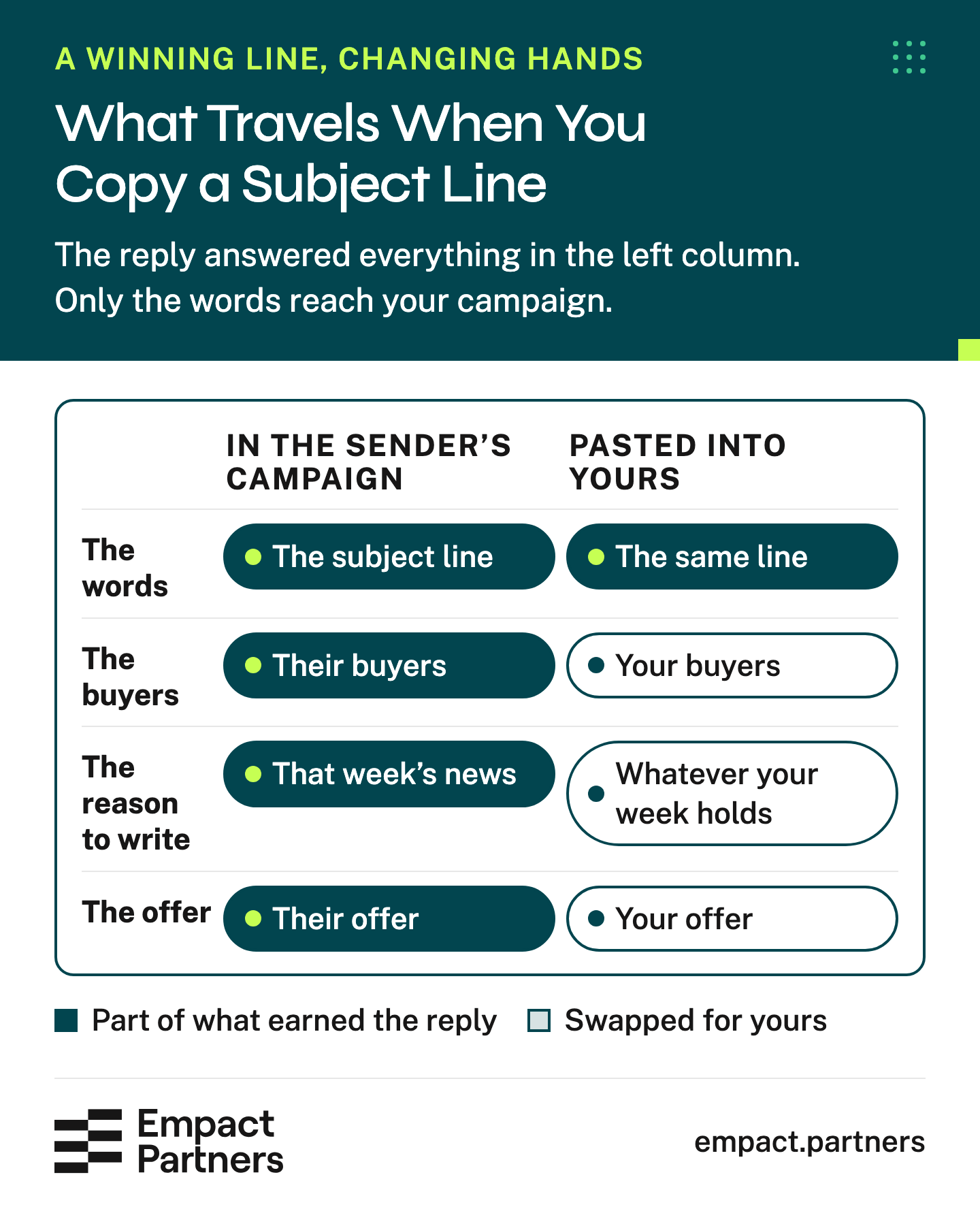
A guide can print the words, and that is all it can give you. Everything that earned the reply stays with the sender who had it.
A line that won for another sender tells you only what to test next.
We learned how much the rest weighs from our own outreach. In September 2024 our founder wrote to the founder of a startup that had just raised a round and was hiring a product marketer. The subject was “GTM @” and the company’s name, and a reply asking about pricing came back in seven minutes.
This November our hiring-signal emails used the same subject shape, with two others, on 601 companies that were hiring for sales or marketing roles. They drew six replies and no meetings.3
The replies suggested why. Three of the six said in their own words that the company had decided to hire in house, and our email had asked them to reverse that decision. The 2024 email reached a founder with new money and no team yet. The subject line was the same, and the moment was different, which is the part no guide can hand you.
When a subject line wins, write down who it went to and what had just changed for them. If you can’t say, you don’t know what won yet, and neither does the guide that printed it.
 Gabby Saayman on LinkedInOpens in a new tab
If a line that won once can draw no meetings when the moment changes, a winning send day deserves the same suspicion.
Our Own Data Showed No Best Day to Send
Timing advice has the same problem, with bigger numbers behind it. Instantly’s 2026 benchmark report, built on billions of cold emails across thousands of workspaces, says Wednesday “consistently delivers the highest engagement.”5 That is the average of every sender on the platform, and the page prints no measure of how large the Wednesday lead is.
Our own record points elsewhere. From late February to June we sent 7,692 emails from one template through seven people’s inboxes, and counted the people who replied, with auto-replies taken out. Wednesday tied for our worst day. Tuesday drew 1.06% against 0.49% on Monday and Wednesday, which is the gap a guide would print as “send on Tuesday”:1
Reply Rate by Weekday in One Wave of Our Own Outreach
Emails that drew a reply from a person, 95% range, 7,692 emails, Feb to Jun 2026
View the data
| Label | Range |
|---|---|
| Monday | 0.25% to 0.97% |
| Tuesday | 0.65% to 1.71% |
| Wednesday | 0.24% to 1.02% |
| Thursday | 0.36% to 1.2% |
| Friday | 0.42% to 1.29% |
So few people reply to cold email that each day’s rate is uncertain. Each bar shows the range that day’s true rate could fall within, and every range overlaps the others. Even if all five days had the same true rate, we’d see gaps this large about one time in three.
The hour of the send told us even less. Our Tuesday isn’t worth scheduling a campaign around, and the benchmark doesn’t print enough to judge its Wednesday.
Our senders looked even further apart. A count in April showed one sender at 41 replies and another at none, and it went into our notes as a finding. That count included out-of-office replies. Counted as people who wrote back, the seven senders drew between one and 12 each, which is the spread chance produces at these volumes.1
Treat a difference you didn’t set out to test as a question. Before you act on one, recount it as people, strip the auto-replies and ask how often chance alone would hand you the same gap.
Gabby Saayman on LinkedInOpens in a new tabWe couldn’t test the subject line at all. Almost every email in those waves used the company’s name followed by “on Reddit.” In our 2025 versions, labeled A, B and C, we changed the subject, the proof, the length and the ask at once, so we couldn’t tell which change helped.2 That is why the next wave we built records which subject version every email carries, so its comparison will be clean.
A stricter test still leaves one question open, which is whose buyers should see the borrowed line first.
Isn’t Our Own Market the Only Test That Counts?
A partner would put it plainly. Your outreach goes to SaaS founders, and ours goes to HR directors who buy payroll software. Whatever won or lost in your campaigns says nothing about our buyers, so testing there first only delays the test that matters.
That’s right, and the 2024 subject line shows it from inside our own outreach. It drew a reply in seven minutes from one funded founder in 2024. In 2026 the same subject shape went to about a third of the 601 hiring companies and drew three replies and no meeting. A win on our campaigns predicts nothing about a partner’s buyers, and we don’t sell it as a prediction.
Our own outreach is where we learn to read a test without a partner paying for our mistakes, such as the count that turned out to be out-of-office replies, or the replies that never became a meeting.
When you have more borrowed ideas than tests, give the next test to one you’ve seen work where you could read the result. A guide’s winner hasn’t cleared that bar yet, however big the sender.
Gabby Saayman on LinkedInOpens in a new tabOur result doesn’t predict a partner’s, but it beats a guide’s as a reason to choose which idea goes first, because we know exactly what we changed and how we counted. A campaign can test one change at a time, so the slot matters. Whether the line works for a partner’s buyers is then settled on their own campaign, against the email they send now.
How to Run a Subject-Line Test You Can Read
A test can’t tell you anything when several things move at once, which is what sank our own 2025 versions. Before you send a borrowed line, hold everything else still:
- One change. The subject line or the send time, never both in the same test.
- Same conditions. The same kind of companies, the same weeks, the same inboxes and senders for both versions.
- Split by company. Each company gets one version, chosen at random, so no buyer sees both.
- Opens off. Turn open tracking off for both versions. The tracking image is unreliable and can hurt where the email lands.
- Count people. Strip the auto-replies, then count the people who wrote back, not the emails in a thread.
- Margin first. Write down before the send how big a difference would change your mind, and what you’ll do with a tie.
Run that way, replies give you the early read and the calls that take place make the decision. Our November signal campaigns show why replies can’t decide alone. The emails about a job posting drew as many replies as the emails about an accelerator place, from the same inboxes in the same weeks. Not one of them became a meeting:3
Scroll horizontally to see all columns when the table is wider than this page.
| Signal, companies emailed | Replied | Calls booked |
|---|---|---|
| Funding round, 420 | 4 | 2 |
| Accelerator place, 300 | 6 | 3 |
| Sales or marketing job, 601 | 6 | 0 |
A booked call may not have happened yet, either. The funding and accelerator emails booked five calls, and by 26 November three had taken place. All three led to a proposal.4 Report booked calls apart from calls that took place, because a line that lifts only bookings hasn’t shown it adds anything.
If you want candidates for your next test, try the free Cold Email Grader. It reads one of your emails, subject line included, and returns a rewrite with three things to test, one at a time:
Test first whichever suggestion changes the reason you’re writing or who you write to. The biggest gaps in our own record lined up with those, such as funding emails booking calls where hiring emails booked none.
Test a Borrowed Line on Outreach You Can Afford to Lose First
So give the next borrowed subject line part of a campaign and never the whole of it. It earns its place only if more of the calls it books take place, and a tie keeps your own email, because at your volume the borrowed line hasn’t shown it does anything for your buyers.
If someone else runs your outbound, ask which ideas they tested on their own sends before sending them to your prospects, and what those tests couldn’t settle. I’d trust an answer that includes some ties more than one that doesn’t.
Our playbook on signal-based outbound puts the subject line after the reason to write and the inbox, and judges every campaign on the replies and meetings it brings:
If our Outbound consultants ran your campaigns, a borrowed line would go through our own outreach before any of your buyers saw it. On your next campaign each company would get your current email or our rewrite, never both, with open tracking off. We’d keep the version that wins on held meetings as well as replies. Buyers who ask for a call would go straight to your sales team.
Frequently Asked Questions
Can we use a subject line from a guide unchanged?
You can send it, but treat that send as a test. The line won among its sender’s buyers, behind its sender’s offer, and the guide can’t pass either of those on to you.
Send the borrowed subject to some companies in your next campaign and your current subject to the rest, with everything else the same. Keep the borrowed one only if it gets more replies and more calls that take place. If you can’t run a split, keep your own subject and work on the reason you’re writing instead.
What is the best day and time to send cold email?
Neither Instantly’s benchmark nor our own data shows a day that wins by enough to plan around. Instantly’s 2026 benchmark puts Wednesday first across every workspace on its platform, without printing how big the lead is. In our own wave Wednesday tied for last and Tuesday came first, a gap no larger than chance produces at our volume.
Send on working days inside your buyers’ working hours. Keep the schedule steady, so it isn’t a second change hiding inside your test. Then test who you write to and why you’re writing, because the biggest gaps in our own record lined up with those.
Why shouldn’t we judge a subject line by its open rate?
An open is counted when a hidden image in the email loads, and many mail apps load those images on their own or block them, whatever the reader does. So the open rate can rise or fall while your subject line stays exactly the same.
The tracking image can also push an email toward spam, so a test with opens switched on can change where your email lands. Turn tracking off on both versions and count the people who reply instead.
How many emails does a subject-line test need?
More than most teams expect, because so few people reply. At a reply rate near one percent, 500 companies a version gives you about five people replying on each side, and five against eight is noise.
In our own analysis a group under 200 emails isn’t read at all, and 200 to 499 counts as an anecdote. Even 7,692 emails couldn’t tell our weekdays apart. If your campaigns are small, test bigger changes, such as the reason you write, where a real difference would be large enough to show.
Should we test the subject line and the send time together?
Not in the same test. If both change and replies rise, you can’t tell which change did it. That is what happened to our 2025 versions, where the subject, the proof, the length and the ask moved at once.
Test one at a time, starting with the one you care about most, and hold the other fixed. Several changes at once can rescue a failing campaign, but they can’t tell you which change to keep.
What counts as a kept meeting?
A call that took place. A calendar booking doesn’t tell you whether anyone attended. In our CRM a deal moves to “met” only when something shows the call happened, such as the meeting notes or the thread afterwards.
Count held calls for each version over the same number of weeks after the send, since late replies and rebooked calls keep arriving after the campaign ends.
What should we test before the subject line?
Whether the email reaches the inbox, then why you’re writing and to whom. In our own outreach this year, reply rates fell in step with inbox placement even as the copy got more personal.
In November our hiring-signal emails reached the inbox and still drew no meeting, because the moment was wrong for the buyer. A subject line can only add to an email that arrives at the right time for the right person.
Does a winning test on your outreach predict ours?
No, and we don’t present it that way. Our own campaigns go to different buyers with a different offer. A test there shows whether we can read the result cleanly and what the line does with our buyers, and nothing about yours.
That cuts both ways. A line that loses with our buyers might still win with yours, and a line that wins with ours might fail with yours.
How long should a subject-line test run?
Long enough for the calls to happen, which takes longer than the replies. In our November campaigns one company replied sixteen days after our email and met us two days later. A test judged after its first week would have missed both.
Our November scoreboard covered three weeks of sends. Of the five calls it counted, two hadn’t happened when we read it, and one of them was booked for the next day. Send both versions in the same weeks, then read them on the same day, well after the last email went out.
What if the test ends in a tie?
Keep the email you already send, and write the tie down with its numbers and its weeks. A tie is a result. It tells you the borrowed idea hasn’t shown an advantage for your buyers at this volume.
Running the same test again until one side wins is how a chance gap becomes a rule. Move on to a change that could make a bigger difference, such as the signal you write about or the offer.
Sources (6)
- Empact Partners, "our own outreach from 27 February to 11 June 2026" (2026)Empact Partners' own data↩1↩2↩37,692 emails from one template and seven senders, analyzed by weekday, hour and sender in October 2026.
- Empact Partners, "our own copy analysis of 75 outreach campaigns sent from May 2025" (2025)Empact Partners' own data↩1to May 2026, as of 18 August 2026.
- Empact Partners, "our own signal campaigns, 2 to 25 November 2026" (2026)Empact Partners' own data↩1↩2with the outcomes recorded in our CRM.
- Empact Partners, "our CRM’s record of the calls those campaigns booked, as of 26 November 2026" (2026)Empact Partners' own data↩1
- Instantly, "Cold Email Benchmark Report 2026" (2026)↩1instantly.ai.
- Tomer Levi, "We send ~100M cold emails a day" (2026)↩1LinkedIn post, 12 October 2026, linkedin.com.
Keep reading
Outbound 5 Best Inbox Placement Testing Tools for Cold Email
Five inbox placement testers for cold email, sorted by how often you test and whose inboxes they use, with live prices per test.

Outbound Why Cold Email Belongs on a Separate Sending Domain
Cold email belongs on its own domains. What they protect, what still ties them to you, and what four of ours that hit spam showed.

Outbound How Long to Give Outbound Before Deciding It Works
When outbound works, kept meetings come within a quarter and revenue a sales cycle later. What to count in month one, at day 90, and after.