
What Your CRM Needs When Your SaaS Moves Upmarket
Bigger deals stall on people your CRM never recorded. Put every buying role on the deal, and flag one-person deals past discovery.
 Sinead HovelmeierWith
 Vlad Shvets
On this page
- Put Every Buying Role on the Deal Record
- Company Hierarchies Don’t Show Who Can Approve the Purchase
- Move Deals Between Stages Only on the Buyer’s Evidence
- Flag Every Deal Past Discovery That Has One Person on It
- Product-Led and Sales-Led Companies Start the Map in Different Places
- Give the Role Map an Owner Before the Next Pipeline Review
- Frequently Asked Questions
Empact Newsletter
One email a month on what is working in AI search and SaaS go-to-market.
Most SaaS companies move upmarket with the CRM they built for small deals. Each deal has one contact, usually the person who signed up or took the first call, and the stages record what the seller did: demo given, proposal sent. When the first mid-market deals reach proposal and stop moving, nothing in the record says why.
Deals that size stall for reasons no CRM can fix, such as price or timing. What a CRM can show early is a person with a say in the purchase who was never in the record. Forrester’s State of Business Buying 2024 report found that 13 people in the buying organization take part in a purchase decision on average. It also found that 89% of purchases cross two or more departments.1
Empact Partners runs RevOps for SaaS sales teams. For a company moving to bigger contracts, that means a CRM that shows who else decides on each deal.
Put Every Buying Role on the Deal Record
A buying role belongs to one person on one purchase. The operations lead who champions your product this quarter may be a bystander on next year’s renewal, and the controller who approves this spend may never see your name again. So the role lives on the link between the deal and the person, never in a field on the contact.
Both large CRMs have a place for that link. Salesforce records the role a contact plays on an opportunity as a standard part of the product. HubSpot does it with association labels, such as a contact labeled Buyer on a deal, on its Professional and Enterprise plans. A small-deal setup rarely uses either, because a deal with one contact never needed them.
What goes on the link is a role map. It carries a row for every role a purchase this size needs, filled or not. The empty rows tell the deal owner what to ask next:
Scroll horizontally to see all columns when the table is wider than this page.
| Role | What they decide on this deal | Person, or unknown | Evidence so far | Next question |
|---|---|---|---|---|
| Champion | Whether the purchase gets argued for when you aren’t in the room | Operations lead at the site that will use it | Ran the demo with their team, joined the scoping call | Who else has to agree before this goes to budget? |
| Budget owner | Whether the money is approved | Unknown | None yet | Who approves spend of this size? |
| Technical evaluator | Whether the product works in their systems | IT manager at the parent company | Joined the technical call | What does the trial have to prove? |
| Security reviewer | Whether you pass their vendor review | Unknown | No questionnaire received | Who sends the security questionnaire, and when? |
| Procurement or legal | The contract terms and the paperwork route | Unknown | None yet | Which steps does a contract take there? |
| Signer | Whose name goes on the order form | Unknown | None yet | Who signs, and up to what amount? |
| The team that will use it | Whether it gets adopted after the sale | Three operations analysts | Two are on the trial | Who would stop using it first, and why? |
Two rules keep the map honest. An unknown role stays on the deal as unknown, because a deleted row stops prompting anyone. And one person can hold several roles, so the map counts people separately from roles. A champion who also owns the budget is two rows and still one person.
None of this demotes the champion. A good one is where most of the map comes from, because they know who has a say and how a purchase gets done there. Sellers who swear by champions make that point themselves, and a buyer-side voice adds whose name goes on the purchase order (PO):
Tips from Reddit
What sellers on Reddit say about who decides
No amount of research and prep beats getting on the phone and developing a champion that can coach you through their org and the decision makers
They’re the ones who can tell you who is gonna kill your chances, how to win them over, and what’s just a distraction.
Ultimately there will be one persons name on the PO, but in order to win the deal you need to win over all the stakeholders.
So the champion’s row records what they told you about the others, and every other row records whether anyone has confirmed it. The map now says who decides. The org chart must not get to answer that question instead.
Company Hierarchies Don’t Show Who Can Approve the Purchase
Larger buyers come as groups: a parent company, its subsidiaries, and the sites or teams that will use the product. The CRM needs that structure for routing, reporting and renewals, and HubSpot ships it as parent and child company labels. What the structure can’t tell you is who decides on this purchase.
Take a deal at one site of a manufacturing group, as an illustration. The site’s operations lead runs the evaluation and is the only person on the record. The reporting line puts them under a regional director, who looks like the obvious approver.
On the role map, the regional director has no role on this deal at all. The parent company’s IT team owns the security review, and its finance controller signs anything above a set amount. The two records describe the same people and answer different questions:
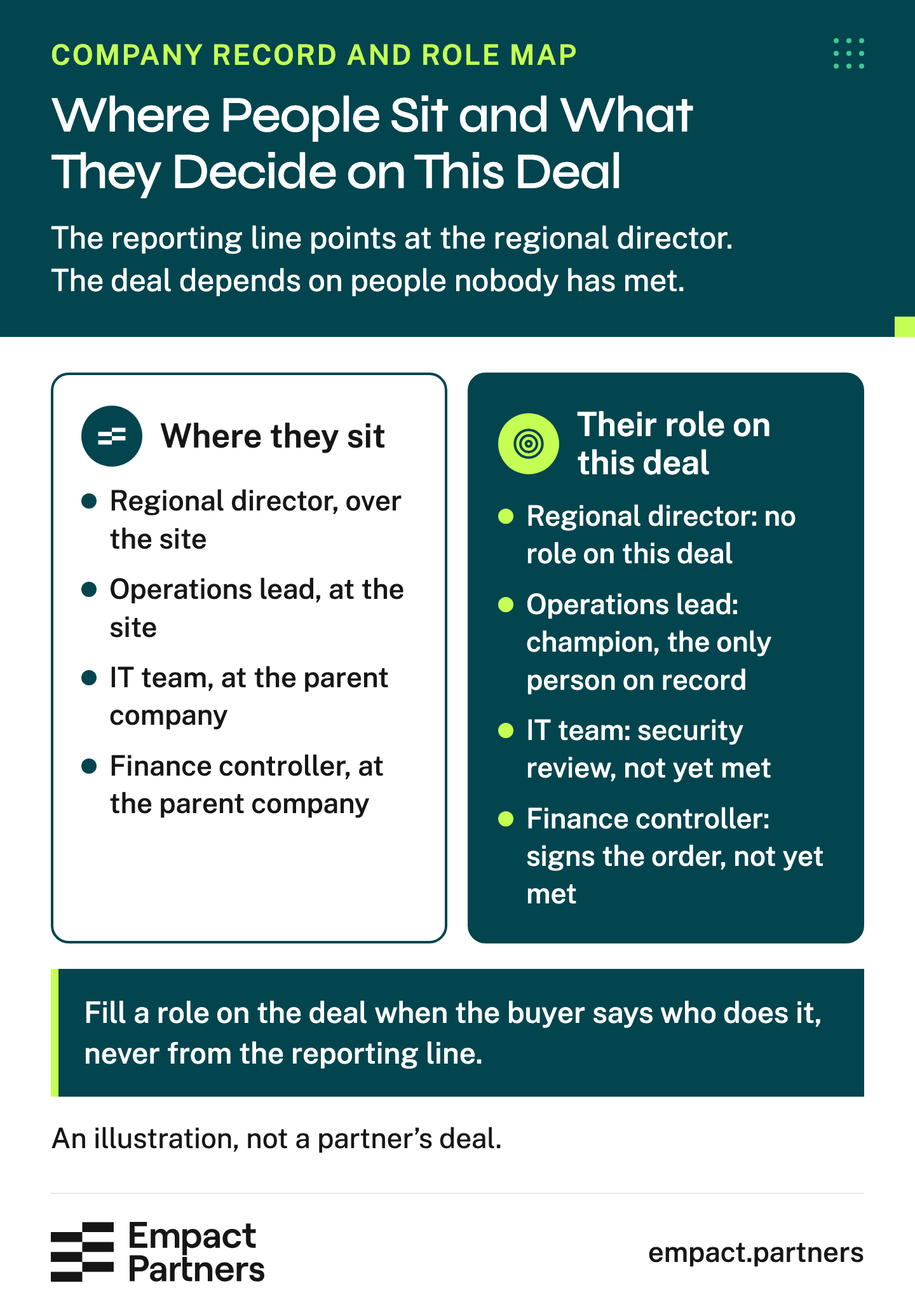
Keep the hierarchy on the company records and never let a reporting line fill a role on the deal. A role gets filled when someone on the buying side says who does it, or when that person turns up in a meeting or a thread.
Knowing who decides still doesn’t tell you how far they have got. That is what the stages are for.
Move Deals Between Stages Only on the Buyer’s Evidence
A small-deal pipeline moves on the seller’s activity: the demo happened, the proposal went out. In a committee purchase, that pipeline measures your team’s effort and says nothing about whether anyone on the other side has moved.
Our own pipeline at Empact Partners moves on what happened with the buyer. A deal moves to met when a call took place, to proposal sent when a priced offer went out, and to ready to sign on the buyer’s go-ahead. Won takes two independent pieces of evidence, such as a signed agreement and a kickoff that was held. The pipelines we build for partners follow the same rule.
For a larger deal, write the buying roles into each exit. Security, legal and finance run alongside the evaluation instead of after it, so no stage belongs to one of them. What changes from stage to stage is which roles must have given you something before the deal can leave:
Scroll horizontally to see all columns when the table is wider than this page.
| Stage | A deal leaves it when | Whose evidence | What may still be unknown |
|---|---|---|---|
| Discovery | The buyer has confirmed the problem and said who else will have a say | Champion | Budget owner, security, procurement, signer |
| Evaluation | The evaluator has seen the product work on their own case, and the security review has started | Technical evaluator, security reviewer | Signer, procurement route |
| Business case | The budget owner has seen the case and confirmed the money exists | Budget owner | Procurement route |
| Proposal | A priced proposal has reached the budget owner, and the signer and their limit are known | Budget owner, signer | Nothing on the role map |
| Contract | Procurement or legal has the paperwork and the signer has a date | Procurement or legal, signer | Nothing on the role map |
The proposal row is the strict one on purpose. A deal can have three engaged people and still nobody who can approve the money. That deal should not leave proposal until the budget owner and the signer are known.
Stage names matter less than the exits. If your team has stages it already trusts, keep them and rewrite only what it takes to leave each one. Pipeline Design drafts that rewrite from a short description of your stages, team and tools. It sends back a definition for each stage, the evidence a deal needs to leave it and the fields that record that evidence, and your CRM stays untouched:
With roles on the deal and buyer evidence on every exit, a one-contact deal stops looking healthy in the pipeline report. That is the moment to flag it.
Flag Every Deal Past Discovery That Has One Person on It
A CRM that carries larger deals should flag an open deal past discovery that has one person on it. Treat that deal as at risk until someone shows the person can sign alone. Past discovery means the first stage after the one where the buyer confirmed the problem, whatever your pipeline calls it. Before that point one contact is normal, because the deal may never become a deal.
A deal past discovery with one person on it rests on a decision nobody on your team has heard.
The CRM can check the rule every time a deal changes stage or its people change. A deal with nobody on it gets its own flag, for missing data. A deal with one person is flagged when all of these are true:
- It is open. The deal hasn’t been won or lost.
- It is past discovery. Its stage comes after the one where the buyer confirmed the problem.
- One person has evidence. Only one person from the buying company has done something on this deal since it entered its stage. A meeting attended, a reply in a thread or a seat on the trial all count.
- No proof of sole authority. The deal carries no written evidence that this person can sign alone.
The flag goes to the deal owner with the next question attached. Ask the champion for an introduction to the budget owner, book a meeting with the evaluator, or get the amount up to which this person can sign.
Two things clear it. A second person who holds a role the deal needs, such as the budget owner, the evaluator or the signer, does something on the deal. Or the deal gets written evidence of sole authority, such as the buyer’s signing limit in an email or a purchasing policy they shared. A name typed in from a profile clears nothing, and neither does giving the same person a second role.
Sellers on r/sales describe both ends of the one-person deal, the one that died with a single engaged contact and the buyer who could have signed alone:
Tips from Reddit
What sellers on Reddit say about one-person deals
My champion who I built the framework of everything around was just making stuff up.
So in twelve months of meetings you never asked him for an org chart or one intro upward?
“Delegated authority” find out how much can your champion sign off on.
I've seen many situations where an individual had budget authority and the governance structure allowed them to make the commitment.
The first two are a year of meetings with one person whose authority nobody tested, on a deal the people with the final say had never heard of. The last two are the buyer who can commit alone. That buyer is real, which is why the flag asks a question instead of predicting a loss.
A process run by procurement with one point of contact answers the flag with a note. When the written process names the evaluators and the signer, that is evidence of those roles before you can meet them.
The rule is the same for every company. Where the missing roles come from depends on how the company sold before.
Product-Led and Sales-Led Companies Start the Map in Different Places
A product-led company adding sales starts with a CRM full of users. It knows who signed up, who invited colleagues and which teams hit their plan’s limits, and the product never needed any of them to approve more than a card payment. A sales-led company moving to bigger contracts starts with relationships: one contact per company who has signed every order so far, under an amount nobody else had to approve.
The two start the role map from opposite ends:
Scroll horizontally to see all columns when the table is wider than this page.
| What to compare | Product-led, adding sales | Sales-led, moving to bigger contracts |
|---|---|---|
| Where the deal starts | A product signal, such as a team hitting its plan’s limit | A contact who has bought from you before |
| What the CRM already has | Users, their activity and the workspace they belong to | One contact per company, past orders and call history |
| What it lacks | Anyone who has approved spend | Everyone above the amount your contact could sign alone |
| The first role to find | The budget owner | The signer, and their limit for this amount |
| The false comfort | A busy admin who looks like a champion and a budget owner at once | A familiar contact whose word was enough at the old price |
Both columns end in the same place. Authority stays unknown on the map until someone on the buying side shows it, and one of the two starting points hides that better than the other:
The product-led start fools a team faster. Usage data reads like a relationship, so a deal opened on a busy workspace feels multi-threaded before anyone with a budget has joined a call. Count the people who have done something on the deal, never the people active in the product, and leave the budget owner’s row marked unknown until a buyer names them.
 Sinead Hovelmeier on LinkedInOpens in a new tab
For a product-led team, the first link worth adding is between the workspace and the deal. The people on the trial then appear on the role map as users and nowhere higher. For a sales-led team, it is the signing limit on the long-standing contact’s row, checked against the size of the new proposal.
None of this survives a quarter unless somebody owns it.
Give the Role Map an Owner Before the Next Pipeline Review
Start with the deals you already have. Put the role map and the flag on every deal open past discovery, and leave the stage definitions alone for now. Before anything changes in the CRM, have each rep place the same 10 to 20 real deals on the map alone, then compare. The roles they disagree on are the ones the map has to define better, which is how we test new pipeline stages too.
You can run the audit this week: one report of open deals past discovery, with the people on each. Keeping the map true takes longer, because the people on a large deal change while it is open, and that work belongs to someone whose job includes it.
The map needs three owners, each for a different part of it:
- The deal owner fills in the roles as they learn them, after each meeting.
- The sales manager reviews the flags in the weekly pipeline review and asks the next question on each one.
- RevOps owns the rule, the fields and the report that counts flagged deals by stage.
For a SaaS company making this move, Empact Partners would start with the stack and the data flows. Then we would read the deals already open past discovery, because they show which roles your record is missing.
We clean and enrich the CRM you already have, put the roles on the deal, and set up the flag and the reports your managers read. We would also build an AI agent that reads your sales call notes and proposes who played which role for the deal owner to confirm. One of your people owns what it writes to the CRM.
The stage half has its own playbook. It defines each stage by something the buyer did, so every rep puts the same deal in the same stage:
No published number says how much more often one-person deals stall, ours included, so settle it on your own pipeline. On the day a quarter opens, save the deals past discovery that have one person on them. When it closes, compare how often those closed with how often the rest did.
If the flagged deals close just as often, your buyers decide alone more often than the rule assumes, and you can relax it. If they don’t, you have your reason to keep every buying role on the deal.
Frequently Asked Questions
What is a single-threaded deal?
A single-threaded deal is one where your team has dealt with one person at the buying company. On a small purchase that person often decides alone, so it is normal.
On a larger one it usually means the budget owner, the evaluator and the signer have never spoken with you. You hear what they think only when your contact reports back. In the CRM it shows up as a deal past the stage where the problem was confirmed, with one person associated.
Which buying roles does a mid-market deal need?
Start with a champion, a budget owner, a technical evaluator, a security reviewer, someone from procurement or legal, and the signer. Add the people who will use the product as users.
Some purchases fill several of those rows with the same person, and some buyers skip security review for a small tool. Keep every row on the deal until the buyer tells you it doesn’t apply, because a row you deleted can’t remind anyone to ask.
Can one person hold several buying roles?
Yes. On mid-market deals the champion sometimes owns the budget too. Record each role they hold, with the evidence for each, and count the person once. That matters for the single-contact flag, which counts people. A champion who is also the budget owner leaves the deal flagged until another role joins or there is written proof they can sign alone.
What counts as past discovery?
The first stage after the one where the buyer confirmed the problem and said who else will have a say. Pipelines call it evaluation, demo, solution or qualified. Use your own stage order and set the flag on that stage, whatever its name. Before it, one contact is expected, because many early conversations never become real purchases.
Does a flagged deal mean it will be lost?
No. A flag means one question about the deal is still open. Flagged deals close, some because the one person could sign alone all along.
What changes is that the deal owner has to show which case it is before the deal moves on, and the forecast treats the deal as uncertain until then. To learn whether flagged deals close less often with your buyers, compare a quarter of them with the rest.
How do we handle a buyer who can sign alone?
Ask for the limit and write it down. Some companies let a manager commit spend up to a set amount, and the champion usually knows theirs.
Record it on the deal with its source, such as an email from the buyer or the purchasing policy they shared, and the flag clears. If the proposal grows past that limit, the flag comes back, because someone else now has to sign.
Should buying roles live on the contact or on the deal?
On the deal. A role describes what someone does in one purchase, and the same person can champion one deal, review the security of another and never touch a third.
A role field on the contact gets overwritten by the next deal, and the record of who did what on the earlier one goes with it. Keep the job title and team on the contact, and the role on the link between the contact and the deal.
Do we need new software for this in HubSpot or Salesforce?
Not for the role map. Salesforce has contact roles for opportunities as a standard object. HubSpot uses association labels on the contacts linked to a deal, on Professional and Enterprise plans, and links parent and child companies with labels of their own.
The flag is a report or a workflow built on those fields. Signal and enrichment tools can add names, but a name a tool added is a lead for the deal owner, never evidence of a role.
How do product users connect to a sales deal?
Through the company or workspace they belong to. When a team’s usage opens a deal, associate the users on the trial with it and give them the user role, nothing higher. Their activity shows that the product is being used. It says nothing about who will approve the spend, so the budget owner’s row stays unknown until someone at the company names them.
Can an AI agent fill in the buying roles?
An AI agent can propose the roles. It can read the notes from each sales call and the email threads on a deal. From those it can suggest who acted as the evaluator, who raised a security question and which new name came up.
The deal owner confirms or rejects each suggestion. A role the agent guessed and nobody confirmed is still a guess, and the flag should treat it as one. Test the agent before it can write to your CRM on its own.
When should a company add this to its CRM?
Before the first deals large enough to need more than one approval, which usually arrive with the first mid-market contracts. The cheapest moment is while the first few big deals are still open, because the reps still remember who they met.
After a quarter of stalls, the same map has to be rebuilt from memory, and the stalled deals are the ones nobody remembers well.
Sources (1)
- Forrester, "The State Of Business Buying" (2024)↩14 December 2024, on Forrester’s The State Of Business Buying, 2024 report. Read 20 November 2026.
Keep reading
RevOps How to See Which Signups Came From ChatGPT and Reddit
Signups from ChatGPT and Reddit land in analytics as Direct or Google. Add one form field, code the answers with Claude, report both.

RevOps 5 RB2B Alternatives, Matched to Why You’re Switching
Five RB2B alternatives matched to why teams leave it, from visitors outside the US and EU consent rules to alerts nobody acts on.

RevOps How To Audit The HubSpot Workflows You Already Run
Find conflicting HubSpot workflows, assign owners and test what is safe to pause before you delete it or add an AI agent.