
5 RB2B Alternatives, Matched to Why You’re Switching
Five RB2B alternatives matched to why teams leave it, from visitors outside the US and EU consent rules to alerts nobody acts on.
 Gabby SaaymanWith
 Vlad Shvets
On this page
Empact Newsletter
One email a month on what is working in AI search and SaaS go-to-market.
RB2B tells you which people from US companies are on your website and posts their LinkedIn profiles to Slack. It’s cheap to start. The free plan names companies, and Starter adds people for $79 a month. It also stops early. Person-level matching works only for US visitors, Starter sends a LinkedIn link and nothing else, and the HubSpot and Salesforce connections start on Pro at $149 a month 1.
There are a handful of good reasons to replace it. Your buyers sit in Europe, where RB2B names the company and never the person. Your legal team asks about consent. The alerts arrive and nobody answers them. Or a website visit says too little on its own. Those reasons split in two, and only one side changes with the vendor:
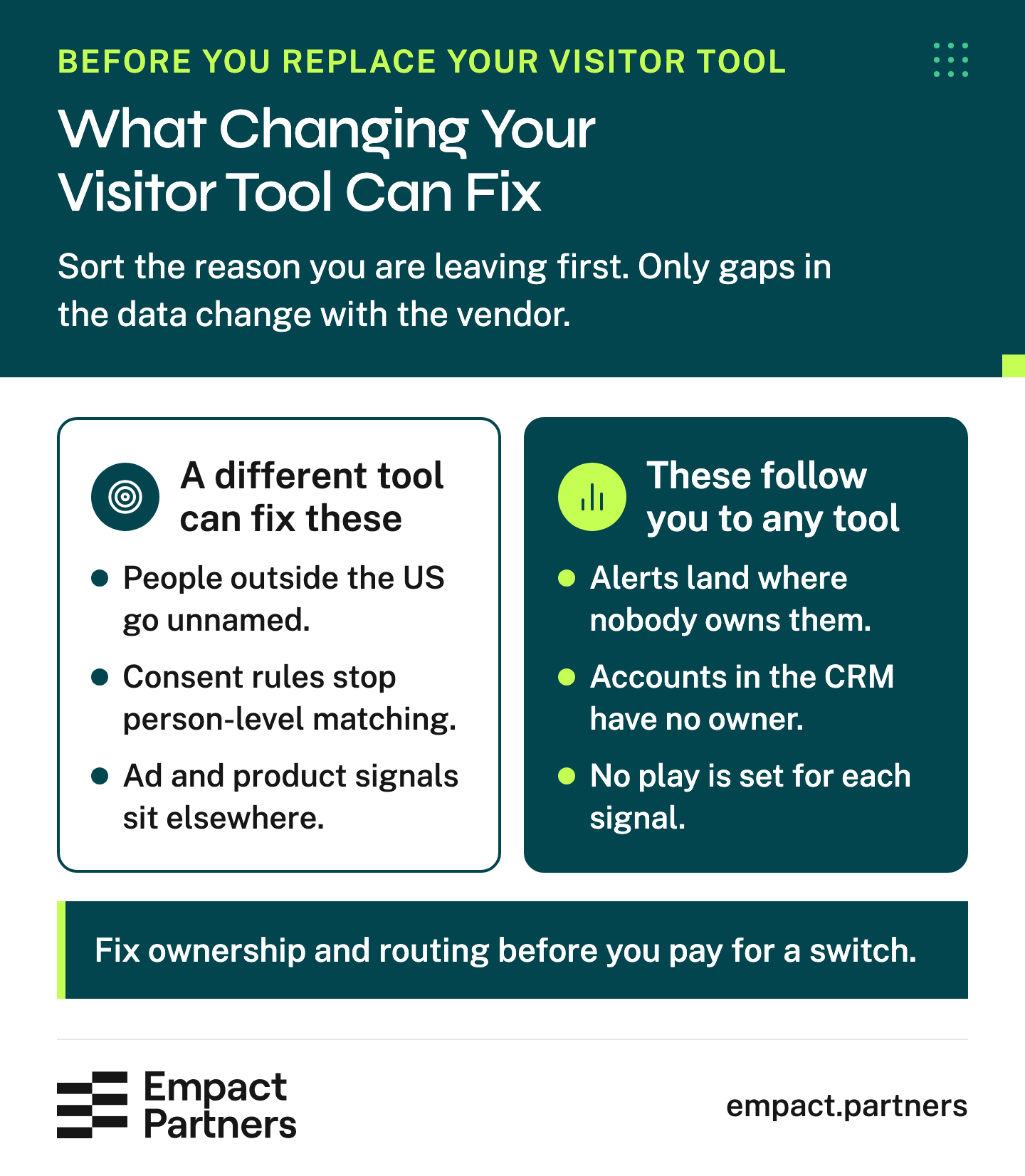
Pick a new tool for a gap in the data. A gap in what happens after the match comes with you to any vendor, and its fix sits in your CRM.
Empact Partners connects the systems behind a SaaS company’s revenue operations and sets up the alerts that say which signals and deals to act on, so identified visits stop dying in a shared channel. We reviewed these five tools for teams leaving RB2B.
Each one fixes a different gap, and the table sets them against what you have now:
Scroll horizontally to see all columns when the table is wider than this page.
| Tool | The gap it fixes | Who it names | Starting price | What you give up |
|---|---|---|---|---|
| RB2B, for comparison | — | People in the US, companies anywhere | Free, then $79 a month | — |
| Leadfeeder | Buyers outside the US | Companies anywhere | $79 a month, billed yearly | The visitor’s name |
| Warmly | Visits nobody answers in time | People and companies | $10,000 a year | The low monthly price |
| Factors.ai | Ad spend you can’t tie to accounts | Companies, people as an add-on | $199 a month | Names by default |
| Common Room | Visits read without other signals | Companies anywhere, people in the US | $2,500 a month, billed yearly | A quick setup |
| Vector | The cold “I saw you visited” email | People in the US | $36,000 a year | Monthly plans and price |
Leadfeeder
Best for: teams whose buyers are mostly outside the US, or whose legal team won’t sign off on naming visitors.
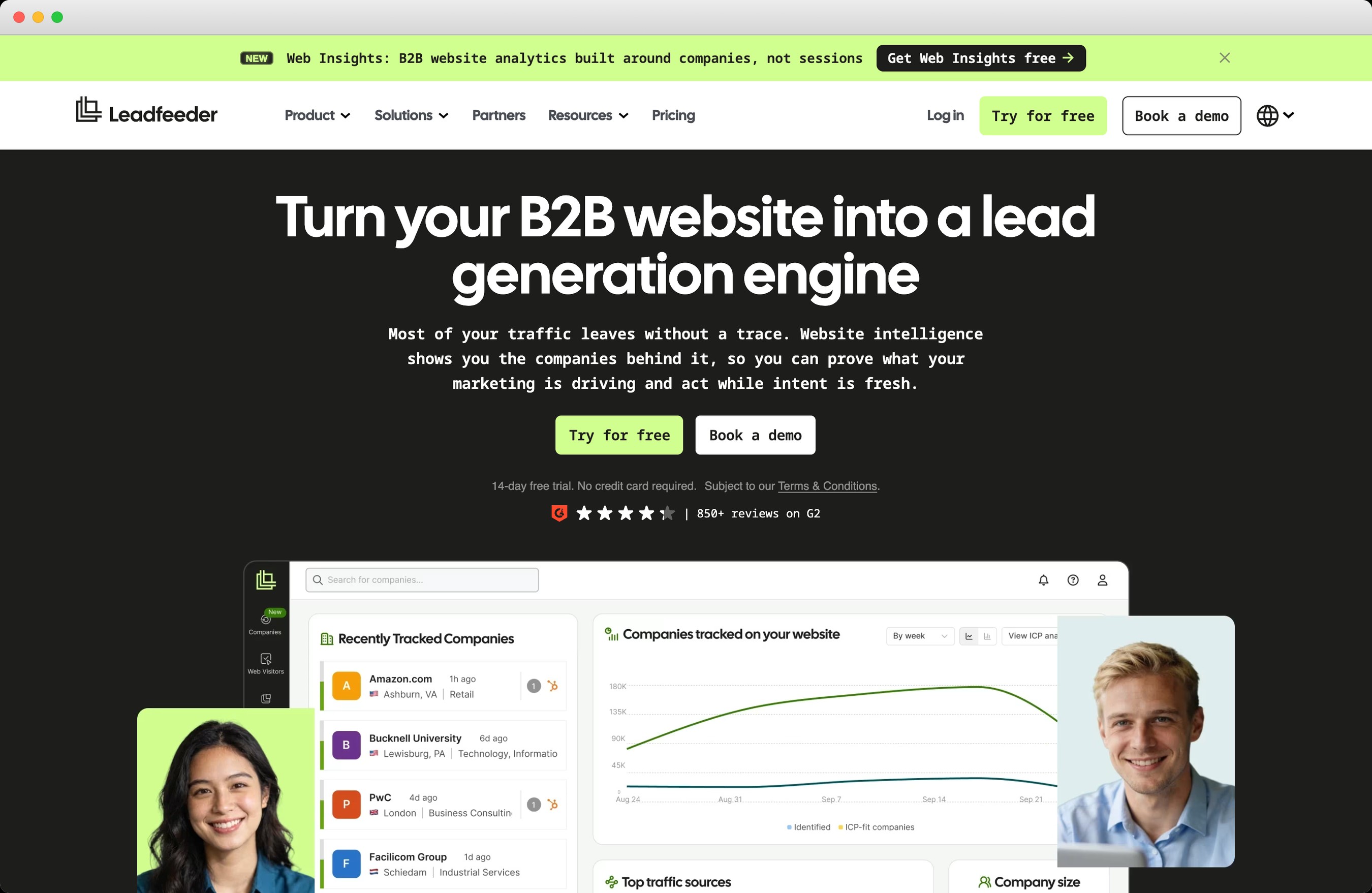
Leadfeeder is company-level visitor identification, sold as Dealfront until it took the Leadfeeder name back on 24 March 2026 2. It matches each visit’s IP address, the network address the visit came from, to a company in any country where companies register their addresses 3.
The reason to switch is what you pay for. RB2B’s paid plans are priced on person-level matching, which stops at the US border 1. Leadfeeder prices by the companies it identifies. Its own guidance says naming a person in the EU needs consent as well as a legal basis, while company-level matching usually rests on legitimate interest 3.
What you give up is the visitor. Leadfeeder gives you contacts at the visiting company from its database, never the person who came, and its Activate plan sells their emails and phone numbers for credits 4. Reviewers say the contact data runs thin, and two describe yearly plans that renewed before they knew about a 30-day cancellation window.
Pricing
- Lite: free, with the last 100 companies a month and 7 days of history.
- Discover: from $79 a month billed yearly, or $113 month to month, for up to 50 companies a month, with real-time alerts and CRM sync.
- Activate: from $369 a month billed yearly, or $527 month to month, for 1,000 companies and 200 credits, adding verified emails and phones, display ads and CRM automations.
- Scale: from $599 a month, billed yearly only, for 2,000 companies and 1,000 credits, with a dedicated success manager.
Pros and cons
Against RB2B, the switch trades the person for the company:
Pros
- Matches companies in any country where they register their IP addresses
- Unlimited users and tracked domains on every plan, the free one included
- Prices by companies identified, not by person-level matches you can’t use in Europe
Cons
- No person-level identification at all
- Contact details cost credits, and reviewers report gaps
- Yearly plans renew unless canceled 30 days ahead, by two reviewers’ accounts
What G2 reviewers and Reddit say about Leadfeeder
Reviewers like the visit data, and their complaints are about the people behind it.
The visit metadata (source, campaign, keyword) is clean and reliable.
Growth lead at a mid-market companyAug 2026 The contacts, there are not always identified contacts for all companies, especially access to emails.
Small-business reviewerOct 2026 r/gtmengineering
View threadonly a minority of visits resolve at all, since remote work, mobile and VPN traffic don’t sit on a company IP, and some of what does resolve is an ISP rather than a company.
Sep 2026
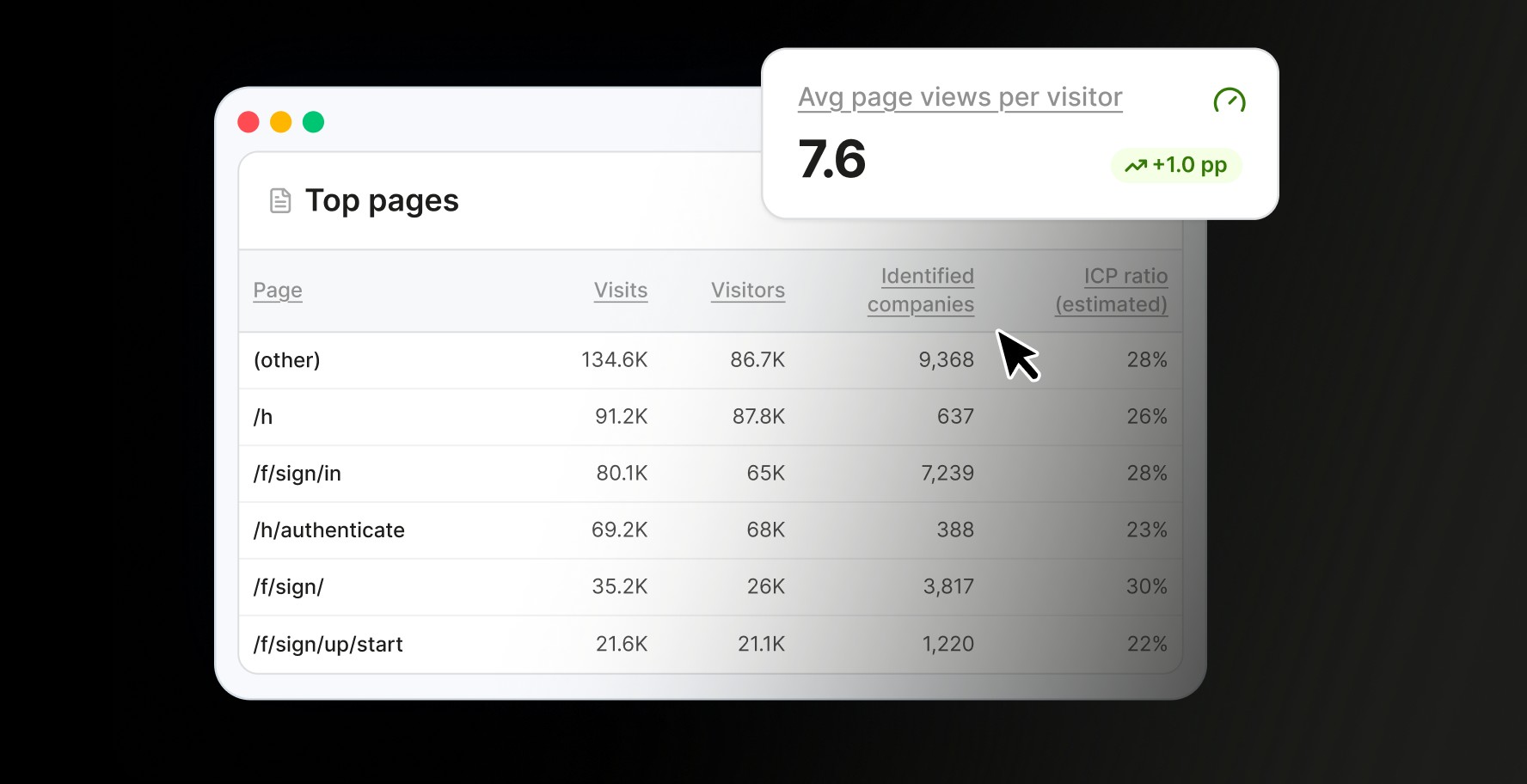
Web Insights shows which pages bring in companies that fit
Web Insights comes with every plan. It reports traffic by company instead of by session. You see which channels, campaigns and pages bring the companies you want, and each row is scored for fit with your ideal customer profile 4. For a team leaving RB2B because its Slack feed went nowhere, this is the screen that tells marketing which campaigns to keep.
Verdict: the switch for a team whose buyers are mostly in Europe or Asia, or whose lawyers have ruled out naming visitors. If your buyers are mostly American and your reps want a person to call, stay on RB2B, because Leadfeeder hands them a company and a database contact instead.
Warmly
Best for: inbound teams that want a visit answered while the person is still on the site, by chat, routing or a booked meeting.
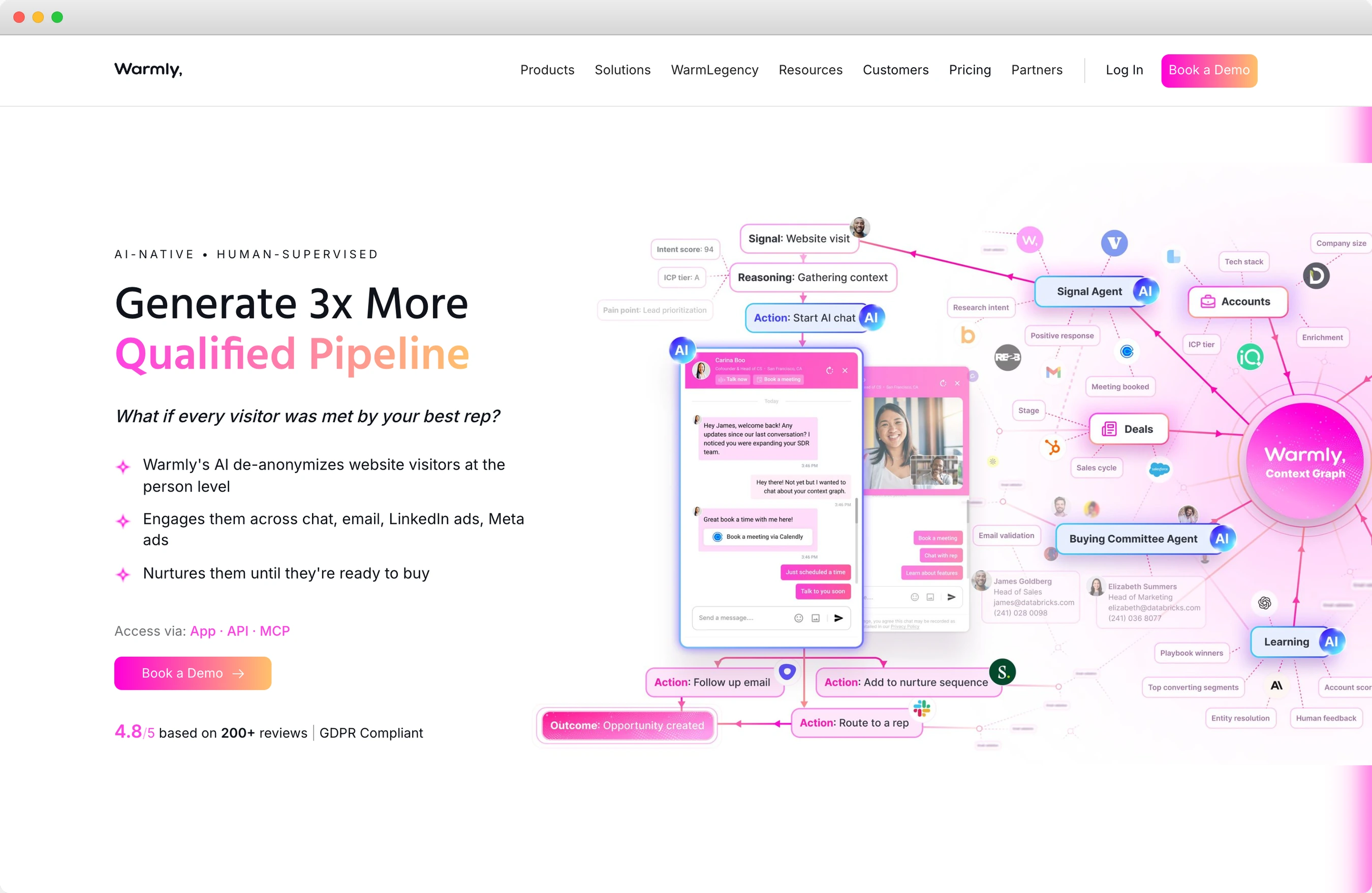
Warmly identifies the people and companies on your site and then acts on the visit. It can open an AI chat, hand the visitor to a live rep, route the account to its owner, book a meeting and follow up by email and ads 5. On 30 June 2026 Warmly announced it had agreed to be acquired by HubSpot, and on 16 November its pages still read “HubSpot is acquiring Warmly” 6.
That’s the part RB2B leaves to you. RB2B posts a name to Slack, and if nobody picks it up, the visit is gone. Warmly’s entry plan already filters visitors by your ideal customer profile (ICP), and includes real-time alerts, lead routing and CRM sync. The chat that talks to the visitor starts one plan up 5.
Price is where it hurts. Warmly starts at $10,000 a year, sold through its sales team. One G2 reviewer counted data on 30 to 40 of every 100 visitors. A Reddit user who had run RB2B for almost two years found RB2B’s match rates slightly better than Warmly’s.
Pricing
- AI Web-Deanonymization: from $10,000 a year, or $4,875 a quarter, with visitor identification, ICP filtering, alerts, lead routing, CRM sync and retargeting.
- Inbound Chat: from $20,000 a year, or $6,500 a quarter, adding the AI chatbot, live chat and email follow-up.
- AI Inbound Autopilot: from $30,000 a year, or $9,750 a quarter, with unlimited AI agents.
- Add-ons: the GTM Signals Package and Warm Experiences, $10,000 a year each.
Pros and cons
Against RB2B, you pay for what happens after the match:
Pros
- Routing, CRM sync and ICP filtering on the entry plan
- A chat that reaches the visitor while they’re still on the page
- Retargeting by email, LinkedIn and ads from the same record
Cons
- From $10,000 a year, with no self-serve monthly plan
- An agreed HubSpot acquisition, still pending on 16 November 2026
- One heavy RB2B user found RB2B’s match rates slightly better
What G2 reviewers say about Warmly
Reviewers book meetings from it, and their complaints are a noisy setup and thin coverage.
Our SDRs book meetings directly from the ICP-visitor and closed-lost Slack channels, and the visitor-level data has become a core input into our broader ABM signal framework.
Mid-market reviewerApr 2026 Initial setup took some tuning. Slack notifications were very noisy at first, and the integrations with both Apollo and Salesforce required more back and forth work than I’d have liked.
G2 reviewerApr 2026 i have also noticed that the data they provide is very limited like if 100 users visited my websites then i will get data of only about 30-40 people so ratio is 30-40%, they can improve this further
Mid-market reviewerApr 2026
Lead routing sends each visitor to the rep who owns the account
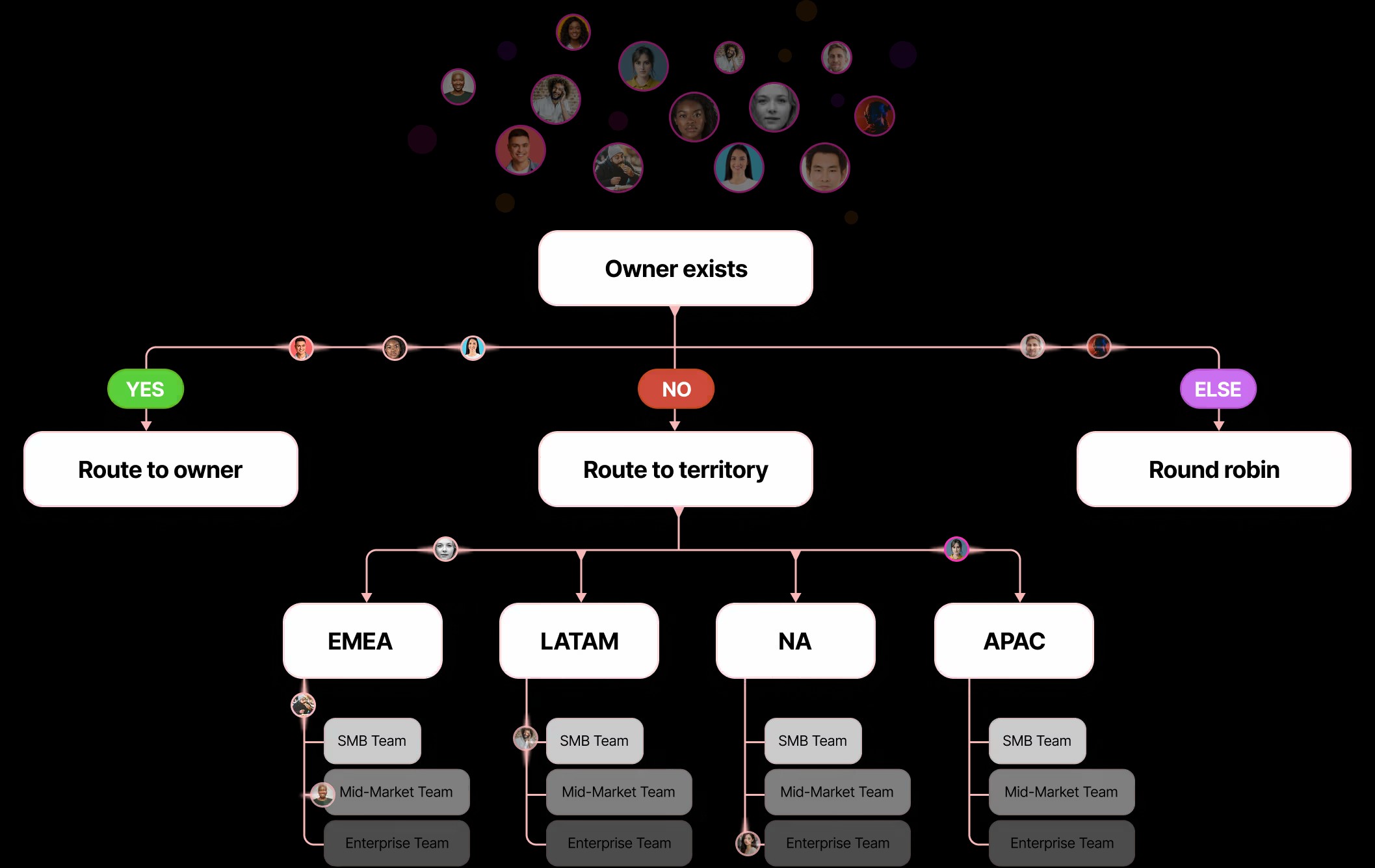
Warmly’s routing checks whether the visiting account already has an owner. If it does, the visit goes to that rep. If it doesn’t, it goes by territory and segment, and anything left over goes round robin, as Warmly draws it below. This is the step RB2B never takes. It’s also only as good as the owner field in your CRM, because a visit from an account with no owner falls through to the fallback rules.
Verdict: the switch for an inbound team with the traffic to justify $10,000 a year and a CRM that knows who owns each account. If your RB2B alerts die because nobody owns them, fix ownership first, because Warmly routes on the same field. On Salesforce, get the roadmap after the HubSpot deal in writing before you sign a year.
Factors.ai
Best for: teams spending on LinkedIn and Google ads that want to see which campaigns bring target accounts back to the site.
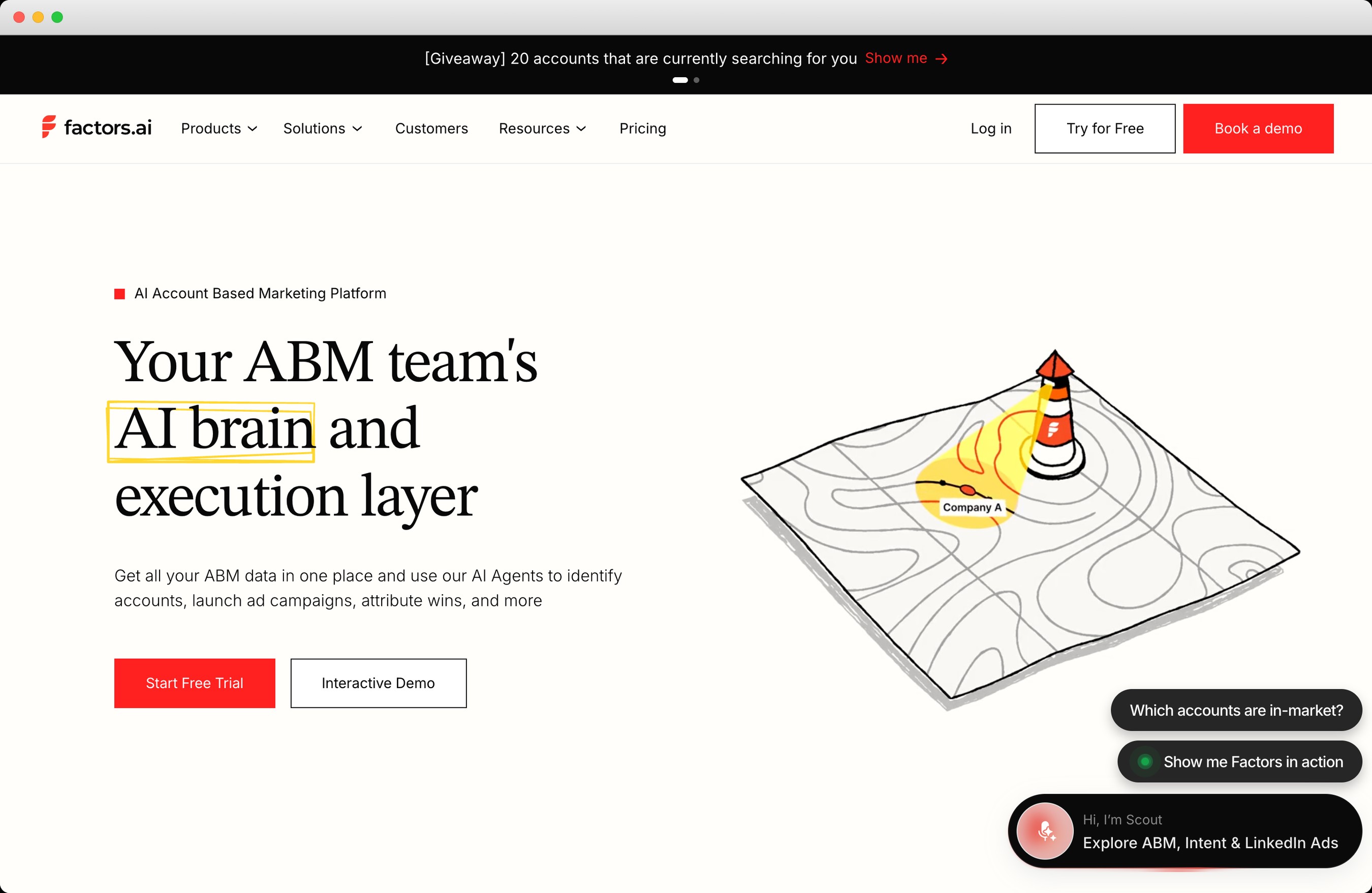
Factors.ai is account identification and analytics for teams running account-based marketing. It names the companies on your site and sets their visits, ad impressions and G2 activity on one timeline per account. Its higher plans also sync audiences to LinkedIn and Google Ads 7.
The reason to switch is a different question from RB2B’s. RB2B tells you who visited. Factors.ai tells you which campaign brought the account and what it did next, including the LinkedIn ads its people saw and never clicked 8. Its own pricing page sells user identification as an add-on labelled RB2B, so a team can keep RB2B’s names and add the account view on top 7.
Names are the catch. By default Factors.ai identifies companies, person-level identification costs extra as the RB2B add-on, and reviewers say smaller companies often go unmatched. Sales and marketing also need to agree which field marks a deal as sourced. Otherwise they credit the same deal to different campaigns, and the timeline becomes a well-drawn picture of the argument.
Pricing
- Lite: $199 a month after the free trial, with company identification, traffic analysis and Slack or Teams alerts.
- Basic: $6,000 a year, adding segments, LinkedIn ads influence, rule-based alerts and CRM sync.
- Growth: $20,000 a year, adding custom account scoring and the full buyer journey.
- Enterprise: from $36,000 a year, adding predictive scoring and audience syncs to Google and LinkedIn Ads.
Pros and cons
Against RB2B, you trade names for the story of each account:
Pros
- Visits, ad impressions and G2 activity on one timeline per account
- Shows which LinkedIn and Google campaigns bring accounts back
- RB2B available as a paid add-on if reps still want names
Cons
- Companies only, unless you pay for the add-on
- Smaller companies often go unmatched, by reviewers’ accounts
- Annual contracts by default, quarterly only on request for early-stage startups
What G2 reviewers say about Factors.ai
Reviewers use it to judge their channels, and their complaints are unmatched small companies and a rising price.
It allows us to determine whether certain media channels are really serving to the right audience and bringing the right accounts back to our site.
Mid-market reviewerOct 2026 I also like the Ad Pilot feature for running Google and LinkedIn ads, which Warmly didn’t have.
Mid-market reviewerOct 2026 Some website visitors don’t get matched to a company, especially smaller companies. Pricing can also go up as usage grows.
Mid-market reviewerSep 2026
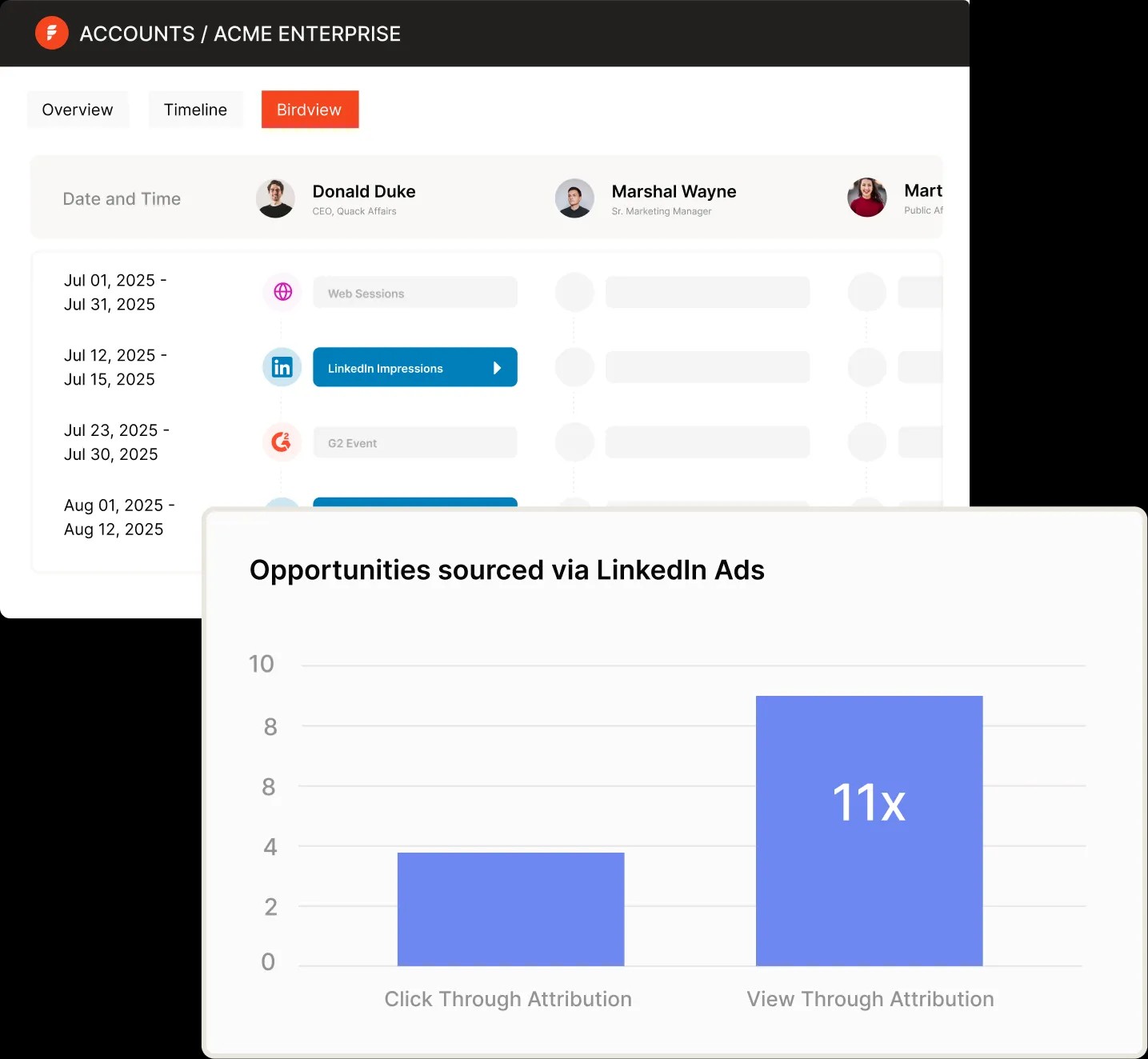
The account timeline shows the ads people saw before they visited
Open an account and its web sessions, LinkedIn impressions and G2 activity sit in date order, person by person. The LinkedIn AdPilot reports then credit campaigns with the visits, demos and deals their audience saw, not only the clicks 8. View-through credit counts an ad someone saw without clicking, and the model is the vendor’s own. Test it on a campaign before you move budget on it.
Verdict: the switch for a team with a real LinkedIn and Google budget that can’t say which campaigns bring target accounts back. If your reps need a person to call, keep RB2B beside it as the add-on rather than replacing it.
Common Room
Best for: companies whose buyers try the product or join its community before they talk to sales.
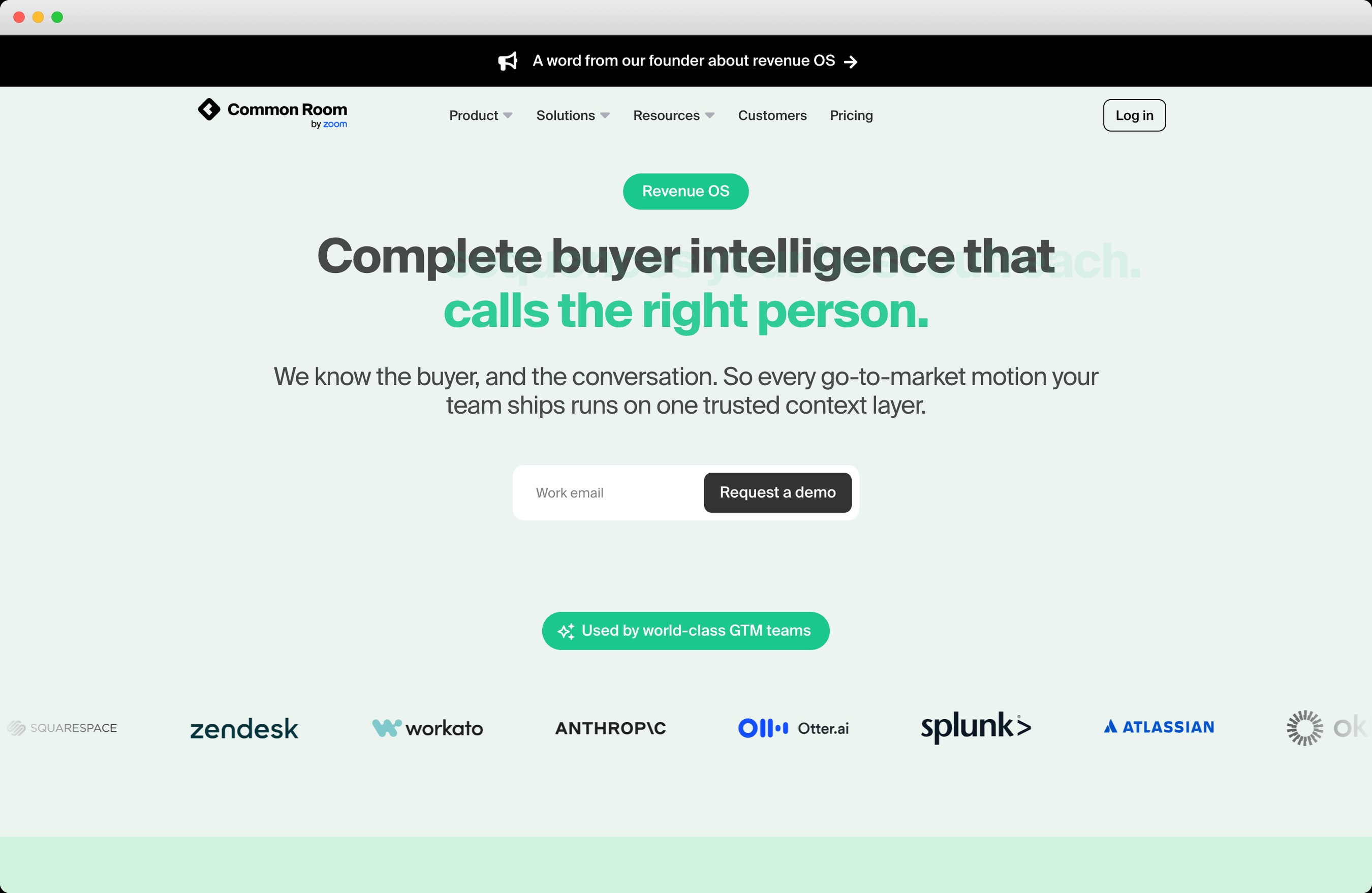
Common Room collects buying signals from your website, CRM, community channels and third-party intent data and joins them on one record per person and account. Zoom bought it, and Zoom says the deal closed in July 2026 9. It still sells its own plans beside a Zoom edition 10.
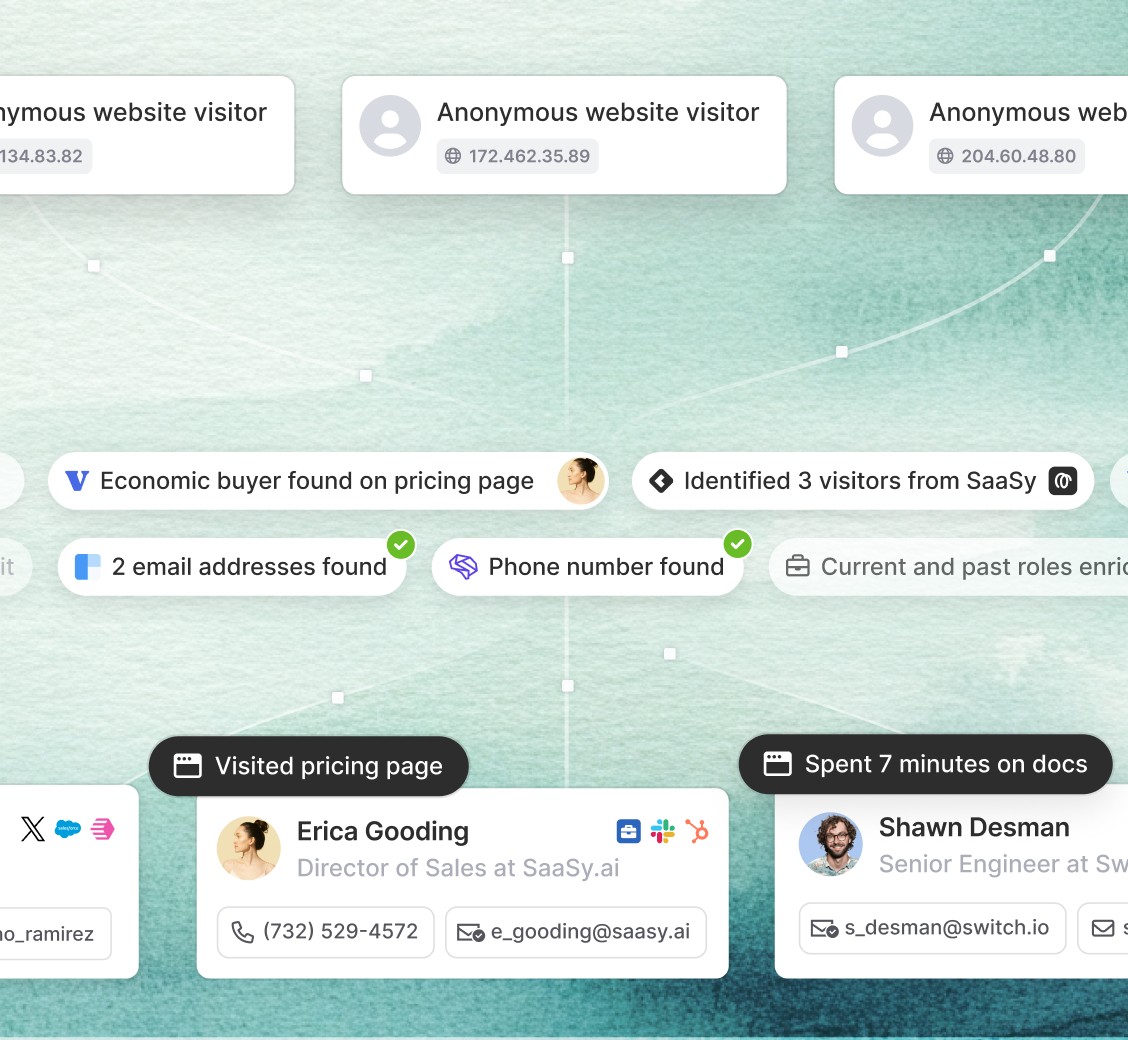
Its website tracking names companies worldwide out of the box. For US visitors it adds person-level identification through Vector, with 1,000 Vector credits a month included 11. So switching keeps your US names. It also adds what a visit alone can’t tell you, such as a visiting developer who is active in your GitHub community, or a former champion who just changed jobs.
Weight and cost are the trade. Essential is $2,500 a month on annual billing, and product usage signals are an add-on below Enterprise 10. Reviewers also describe a learning curve before the workflows fit how the team sells. More signals help only when the team knows what a rep does when each one fires, so write that down before you pay for ten sources.
Pricing
- Essential: $2,500 a month, billed yearly, with 5 seats, up to 100,000 contacts and website deanonymization capped at 1,000 a month.
- Advanced: a custom price, with 15 seats and up to 250,000 contacts.
- Enterprise: a custom price, with 30 seats, up to 750,000 contacts and unlimited website deanonymization.
- US person-level matching: 1,000 Vector credits a month included, more on a paid Vector plan.
Pros and cons
Against RB2B, the visit becomes one signal among many:
Pros
- Web visits joined to community, job-change and intent signals on one record
- US person-level matching included through Vector
- CRM, sales engagement and Slack connections on every plan
Cons
- $2,500 a month to start, on annual billing
- Product usage signals cost extra below Enterprise
- A learning curve before workflows match your sales process
What G2 reviewers and Reddit say about Common Room
Reviewers like the single view, and their doubts are about contact data and what intent means.
I can map engagement across open source repos, community forums, and digital brand channels into one shared dashboard, so marketing, community, and sales can see the same signal data.
Small-business reviewerNov 2026 Wrong email addresses and disconnected phone numbers seem to be a pretty common issue, so relying on Common Room’s built-in enrichment alone can be risky.
Small-business reviewerNov 2026 r/AskGTM
View threadCommon room and tools like it confuse ‘interest’ with ‘intent.’
Jun 2026
Waterfall enrichment adds US names to the companies it already sees
Common Room tracks visits worldwide at company level and, for US traffic, asks Vector for the person. Common Room says this reaches up to 50% contact-level visibility of US traffic 12. The page gives no denominator, so the figure can’t be compared with RB2B’s stated coverage.
Verdict: the switch for a product-led or developer-facing company whose buyers show up in GitHub, Slack communities and the product before the pricing page. If the website is your only signal, it’s a lot of platform to buy for one input, and RB2B or Leadfeeder covers that job for less.
Vector
Best for: teams selling mainly in the US that want named visitors but would rather reach them with ads than with a cold email.
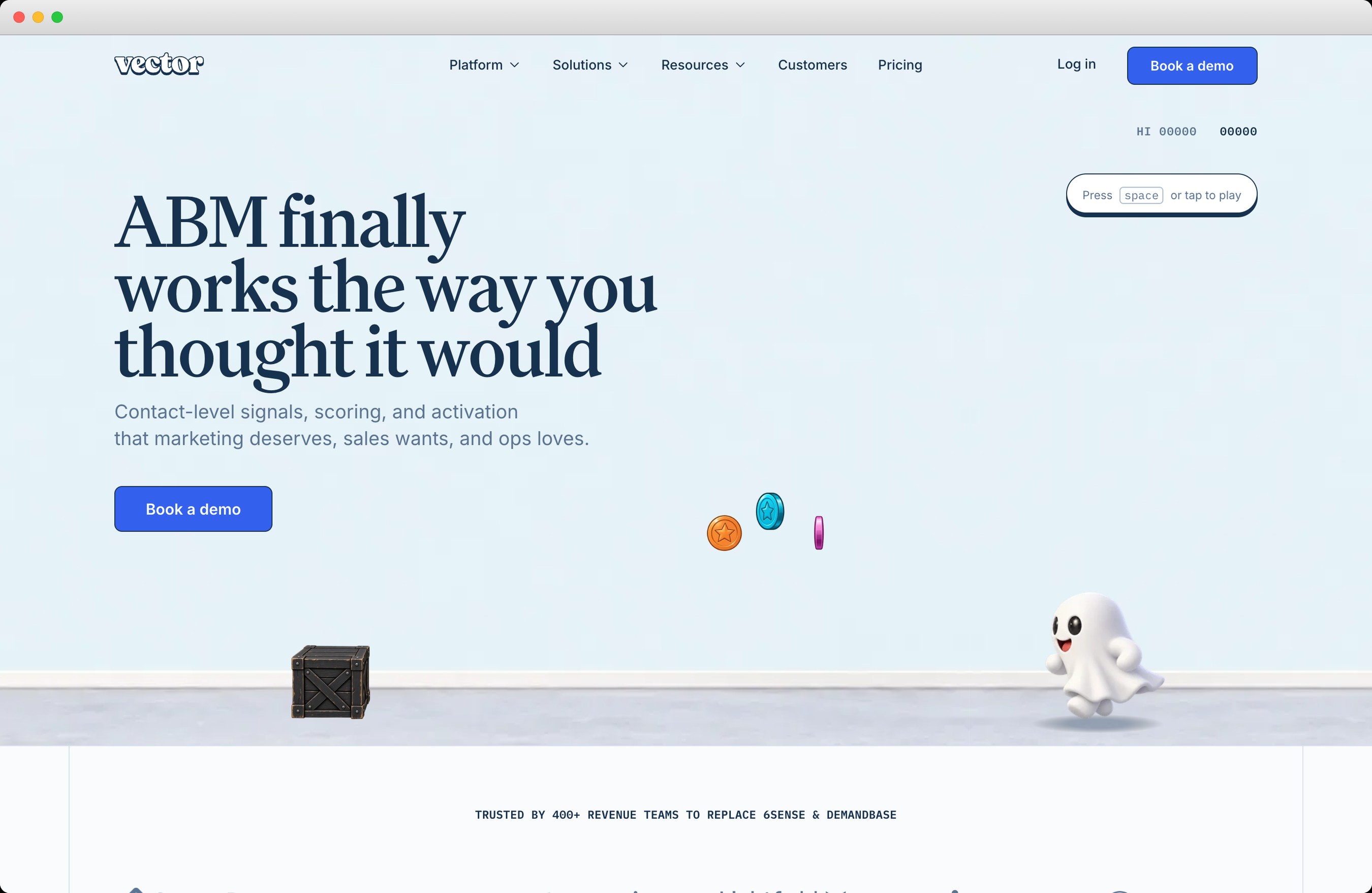
Vector identifies the people behind US website visits and ad engagement and builds contact-level audiences from them for LinkedIn, Google and Meta. Bid agents adjust its LinkedIn bids every 15 minutes 13. It sells the whole platform on one annual contract, priced by your site traffic and ad spend and starting at $36,000 a year 13.
The reason to switch is the follow-up. One long-time RB2B user on Reddit says most people sent an email saying “I saw you were on the website”, which lands as creepy to anyone who isn’t in go-to-market work. Vector keeps the name and moves the follow-up into ads aimed at the buying group, then reports which named contacts engaged.
Price, coverage and speed count against it. Vector calls itself US-focused, because its contact-level matching depends on US identity data 14. And the same two-year RB2B user who compared Warmly found Vector too slow for any near-real-time play.
Pricing
- Growth: up to 25,000 monthly site visitors and $25,000 monthly ad spend, with 1 bid agent. Vector’s site says plans start at $36,000 a year.
- Scale: up to 100,000 visitors and $100,000 ad spend, with 3 bid agents, enterprise single sign-on and a data processing agreement.
- Enterprise: up to 250,000 visitors and $250,000 ad spend, with 5 bid agents.
- Seats: unlimited on every plan, on one annual contract.
Pros and cons
Against RB2B, you keep the name and change what you do with it:
Pros
- Named US visitors turned into LinkedIn, Google and Meta audiences
- Bid agents that adjust LinkedIn bids every 15 minutes
- Reports on which named contacts engaged with the ads
Cons
- From $36,000 a year on an annual contract
- US-focused, with no contact-level matching elsewhere
- Too slow for real-time plays, by one heavy RB2B user’s test
What G2 reviewers and Reddit say about Vector
The praise is for the ad sync, and the sharpest test found a lag.
What I find most helpful about Vector, from a product perspective, is how easily it syncs between our CRM and the various ad platforms, providing insights about users in a practical, real-world way.
Mid-market reviewerAug 2026 r/gtmengineering
View threadVector has better data.
Aug 2026 r/GTMbuilders
View threadAlso tested vector, warmly etc against RB2B recently (had been using RB2B for almost 2 years, millions of visitors per month) - slightly better match rates on RB2B - and vector has massive lag that killed any near-realtime plays.
Apr 2026
Contact-level audiences put ads in front of the people who visited
Vector builds ad audiences from named contacts instead of company names, and keeps them current as the buying group changes 14. The ads go to the people who visited and the rest of their buying group, instead of to everyone at the company who uses LinkedIn.

Verdict: the switch for a US-focused team with a real ad budget that wants RB2B’s names without the cold email. If ads are a small line in your budget, $36,000 a year is hard to justify against RB2B’s monthly plans.
Which Gap Are You Switching For?
Name the gap before you book demos, because each of these tools fixes a different one:
- Non-US buyers: your buyers are outside the US, or your legal team is asking about consent. Leadfeeder, starting on Discover at $79 a month billed yearly.
- Unanswered visits: visitors leave before anyone replies. Warmly, if your CRM already knows who owns each account.
- Untraced ad spend: you can’t tie campaigns to accounts. Factors.ai, with RB2B kept as its add-on if reps still want names.
- Thin signals: a visit says too little alone. Common Room, if your buyers also show up in your community and product.
- Tired cold email: you have names and no good way to use them. Vector, if your buyers are in the US and ads are a real budget line.
- Ownerless alerts: they land in a channel nobody owns. Keep RB2B and fix the routing.
That last gap is the cheapest to fix, and RB2B already sells most of the fix. Its Pro plan tags high-intent pages, filters visitors by your ideal customer profile and sends them to HubSpot or Salesforce 1.
A new vendor won’t fix an alert that lands in a channel nobody owns.
Practitioners on Reddit describe what to change before you change the vendor:
Tips from Reddit
What teams changed before switching
To cut noise, group pages by intent and only alert when an account hits 2 or more bottom‑funnel pages in 7 days and matches ICP, while excluding ISPs and large orgs with weak match quality.
It also helps in ongoing deals as we know what page they are visiting by generating slack alerts.
worth running 2 in parallel for 14 days before committing either way. 5-minute install each, and the data delta plus workflow fit tells you everything
The first two tips change which visits reach a person, and the third is how to test a replacement fairly.
An RB2B feed that sends every visit to one shared Slack channel reads as noise, whatever the match rate. Send pricing-page visits from open deals to the deal owner and the rest to an ad audience, and the same data reaches someone who can use it.
 Gabby Saayman on LinkedInOpens in a new tab
Routing reads your CRM, so its gaps come with you whichever tool you pick. The CRM Health Report reads an export of your CRM and returns the duplicate records, empty fields, deals nobody has touched and accounts with no owner, with what to fix first. This run is a free preview. For our partners, the full version of the agent works on the CRM their routing reads:
What We Would Fix Before You Switch
Our view is that a switch should follow a gap you can point to in your own data. So before you pick a tool, find where identified visits go today, how many reach an owner and how many match an open deal. If most of them die in a channel, the fix is in your CRM.
With Empact Partners, a named senior GTM consultant owns the work, and it starts with an audit of the tools you run and how data moves between them, then a roadmap. Our RevOps work covers:
- Your marketing, sales and product tools connected, so every team reads the same CRM data
- A cleaned and enriched CRM
- Alerts on the signals and deals that need action now
- Automated reporting on pipeline and attribution, in dashboards inside the CRM you already have
If you’d rather start on routing yourself, the playbook shows how to send reps only the signups a call can help. It also shows how to measure in revenue what those calls add:
Before you sign anything, write the gap down in a sentence, with the number that would prove it closed. That might be meetings from inbound visits, the share of European traffic you can name or accounts sourced from LinkedIn. The right tool is the one that moves that number.
Frequently Asked Questions
Does RB2B identify visitors outside the US?
Only at company level. RB2B’s pricing page says company-level identification is global on every plan, the free one included, and person-level identification is US only 1.
For a visitor in Germany or Singapore you get the company and the pages it read, never the person. If most of your traffic is outside the US, much of what the paid plans charge for can’t run on it.
Is it legal to identify individual website visitors in the EU?
Your lawyer should judge your setup, because each vendor’s guidance is its own reading. Leadfeeder’s says naming a person in the EU needs the visitor’s consent under the ePrivacy rules and a legal basis under the General Data Protection Regulation (GDPR) 3. Consent given on another website doesn’t carry over.
Company-level matching usually rests on legitimate interest, backed by a balancing test you write down. Common Room and Factors.ai both say their default tracking collects no personal data 15 7.
Which RB2B plan sends visitors to HubSpot or Salesforce?
Pro, from $149 a month. Starter, at $79, posts LinkedIn profile links to Slack or Teams with no email addresses and no other integrations. Pro adds business emails and the HubSpot, Salesforce, Clay, Zapier and webhook connections.
Pro+, from $199, raises RB2B’s stated coverage from 15-20% to 35-45%. Overage costs 45 cents a resolution on Starter and 25 cents on Pro and Pro+ 1.
Will switching raise our match rate?
Don’t count on it. Each vendor states its rate on its own terms, with no shared test behind the numbers. The most detailed comparison we found is one Reddit user’s.
After almost two years on RB2B at millions of monthly visitors, they tested Vector and Warmly against it, and RB2B’s match rates came out slightly better. A vendor’s rate tells you little until it’s measured on your own traffic. Run a candidate beside RB2B on the same pages for two weeks, then compare the meetings each one produced rather than the match counts.
Why do RB2B alerts stop turning into meetings?
Often because of what happens after the alert. A long-time RB2B user on Reddit says the common play was an email telling the visitor you saw them on your site, and that it stopped working.
Person-level matches also misfire on shared home connections, where the person named is a spouse or relative of the real visitor. Teams that keep RB2B alert only when a fitting account reads a high-intent page, and send that alert to the account’s owner.
Is Leadfeeder the same company as Dealfront?
Yes. Dealfront became Leadfeeder on 24 March 2026 and renamed its visitor product Web Visitors 2. The rebrand changed no prices, and existing contracts stay with the same Dealfront companies in Germany and Finland. If an older comparison you’re reading calls it Dealfront, the product it describes is the one in this roundup.
What does HubSpot’s deal for Warmly mean for current users?
Warmly announced on 30 June 2026 that it had agreed to be acquired by HubSpot, and said that day that contracts, pricing, product and integrations stayed unchanged 6. On 16 November its site still describes the deal as in progress.
Warmly says its longer-term aim is to connect its agents across HubSpot’s platform. If you run Salesforce, get the roadmap from Warmly in writing before an annual renewal.
Is Common Room still sold on its own now that Zoom owns it?
Yes. Zoom announced the deal on 2 July 2026 and says it closed that month 9. Common Room still publishes its own plans, with Essential at $2,500 a month billed yearly, and a Zoom edition beside them 10.
G2 now names Zoom as the seller. A Common Room customer also gets 1,000 Vector credits a month for US person-level matching 11.
Can we run two identification tools at once?
Yes, and some vendors build it in. Common Room passes US visits to Vector for person-level matching 11, and Factors.ai sells RB2B as an add-on for user identification on its paid plans 7.
Two scripts mean two bills and a rule for which match wins when they disagree. Decide that rule before both tools are writing to your CRM.
What should we check in our CRM before switching tools?
Whether each target account has an owner, whether open deals sit on the right accounts, and how many duplicate companies and contacts you carry. A new tool’s alerts and routing read those fields.
If they’re wrong, you get the old problem again with a bigger invoice. Reviewing an export against those three questions shows the size of the job before you sign anything.
Can Empact Partners connect the visitor tool we pick?
Yes. Connecting the tools a team keeps to its CRM, so marketing, sales and product read the same data, is part of our RevOps work, and the choice of visitor tool stays yours.
Sources (15)
- RB2B, "Pricing" (2026)↩1↩2↩3↩4↩5
- Leadfeeder, "FAQ: Dealfront becomes Leadfeeder" (2026)↩1↩2
- Leadfeeder, "Company-level vs person-level website visitor identification" (2026)↩1↩2↩3
- Leadfeeder, "Pricing" (2026)↩1↩2
- Warmly, "Pricing" (2026)↩1↩2
- Warmly, "is joining HubSpot" (2026)↩1↩2
- Factors.ai, "Pricing" (2026)↩1↩2↩3↩4
- Factors.ai, "LinkedIn AdPilot" (2026)↩1↩2
- Zoom, "to acquire Common Room" (2026)↩1↩2
- Common Room, "Pricing" (2026)↩1↩2↩3
- Common Room, "Enhanced US visitor tracking" (2026)↩1↩2↩3
- Common Room, "Web visitor identification" (2026)↩1
- Vector, "Pricing" (2026)↩1↩2
- Vector, "Is account-based marketing dead?" (2026)↩1↩2
- Common Room, "Website tracking FAQs" (2026)↩1
Keep reading
RevOps How to See Which Signups Came From ChatGPT and Reddit
Signups from ChatGPT and Reddit land in analytics as Direct or Google. Add one form field, code the answers with Claude, report both.

RevOps How To Audit The HubSpot Workflows You Already Run
Find conflicting HubSpot workflows, assign owners and test what is safe to pause before you delete it or add an AI agent.
Brand Marketing The 7 Best Digital Asset Management Tools for a SaaS Brand
Compare asset libraries for SaaS teams by update rules, storage, pricing and the copies they cannot fix.