A GEO Audit, Start To Finish
ChatGPT named rivals when you asked your category question. This audit shows which pages put them there, and which of yours it can quote.
 Garith PriorWith
 Vlad Shvets
On this page
Empact Newsletter
One email a month on what is working in AI search and SaaS go-to-market.
If ChatGPT recommended three of your competitors when you typed your category question, start the audit with that question and leave your own site for last. Log which brands each answer names, open every page it cites, and only then check which of your own pages an engine can quote. The answers lean mostly on pages other people publish about you, so that order shows you where the work is.
Buyers now ask ChatGPT, Google AI Mode and Claude which tool to pick, and Empact Partners gets its SaaS partners into those answers through generative engine optimization. Our partnerships start with an audit, and these steps are the part you can run by hand.
We ran them on 28 November 2026 for SOC 2 compliance software, which SaaS companies buy to pass the security audit their enterprise buyers ask for. Openlane, one of the vendors in it and no partner of ours, stands in for your company. It was named in 2 of our 60 answers, while a third-party article sat behind 53 of the 60. You need two engines that answer without an account, a spreadsheet, an afternoon and one answer from your web team:
The sheet ends up in three blocks: the names, the pages behind them and your own pages. It shows where your category’s names come from and which of your pages an engine can quote. Getting onto the pages you’re missing from is outreach, and it starts after the sheet.
Log Which Brands the Engines Name for Each Buyer Question
Step 1: Write ten questions a buyer would type
Draft ten questions your buyers would type when they want names to choose from, with no brand in any of them, yours included. A brand in the question pulls the answer toward that brand. Our first was “What is the best SOC 2 compliance software for a small SaaS startup?” The other nine each added a detail a real buyer adds, such as team size, a deadline or a second standard.
How you word them decides every count after this step, and writing them in a buyer’s own words has a tutorial of its own. Put the ten in column B of the Audit tab, with a short code such as Q01 in column A.
Step 2: Ask each question three times on both engines
Open a private window, go to ChatGPT without signing in, paste the first question and send it. Then search the same question on Google and choose AI Mode from the tabs under the search box. Start a new chat for every run, because a follow-up in the same chat answers in the light of the last one. Ask from the country your buyers are in, since the shortlist can change with where the question comes from. Ours came from the US.
We ran each question three times on each engine, because names move between runs and one answer can’t tell you whether a brand will be there tomorrow. A good answer arrives as names, usually with a reason for each and small source chips under them:
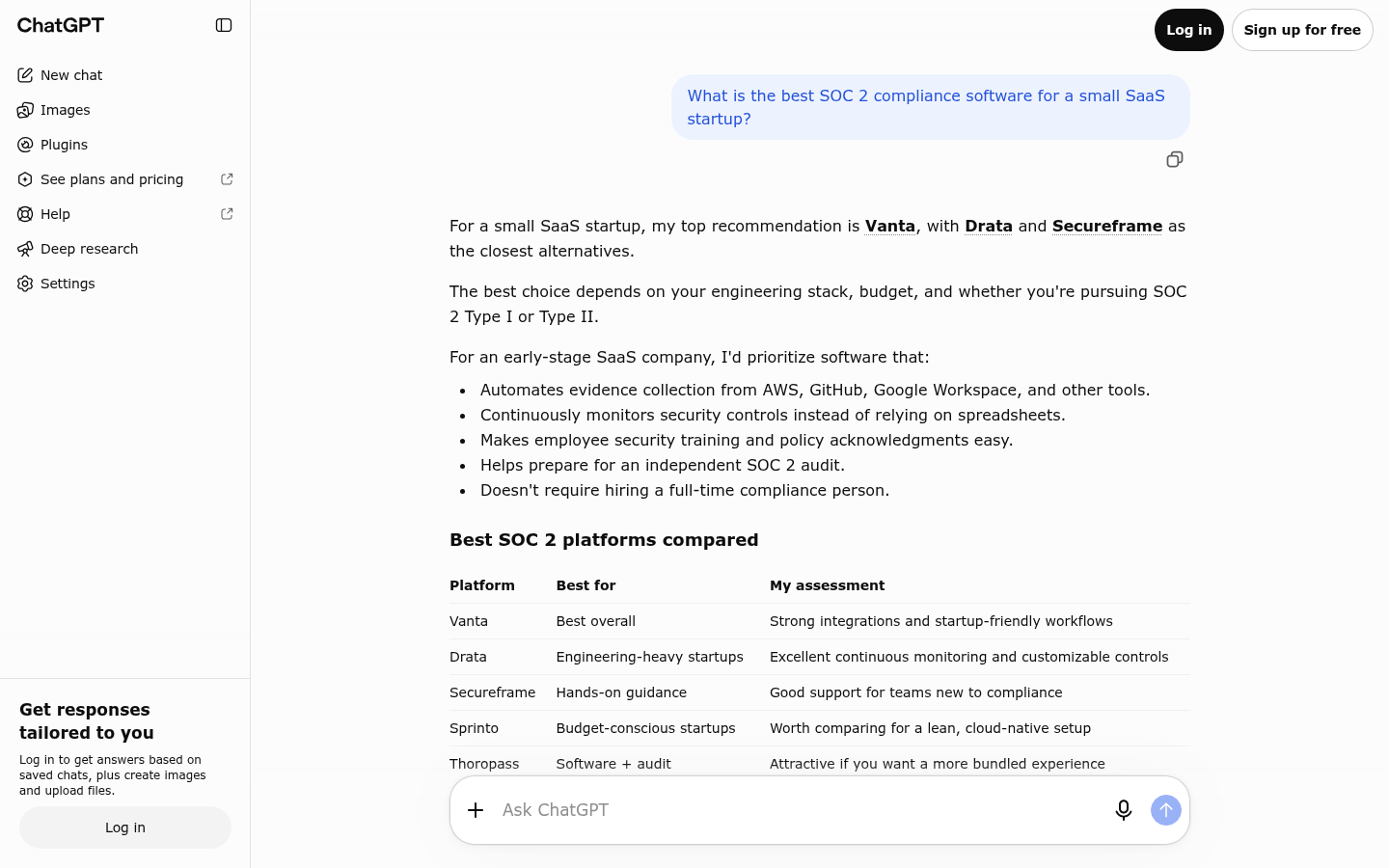
If an answer explains SOC 2 instead of naming products, reword the question so it asks for options. All sixty of ours named at least one brand, with web search on in every answer.
Step 3: Log the names in the order each answer gives them
Each answer becomes one row on the Answers tab. Paste this header into cell A1 of that tab. It’s tab-separated, so each label lands in its own column:
Date Engine Question ID Run Brands named, in order You named? Pages cited NotesWrite the brands exactly as the answer spells them, first to last, and mark yourself yes or no. In our sixty answers 1, five brands owned the shortlist, Vanta, Drata, Secureframe, Sprinto and Thoropass:
When you summarize later, count a brand for a question only when two of the three runs on an engine named it, so a one-off doesn’t make the summary. Three runs show who owns the shortlist, and five make the count steadier, which is how our visibility baseline tutorial runs it.
Sort the Pages Behind the Answers by Who Published Them
The pages cited under each answer are the half of the sheet you can act on, because a page can be approached or changed and an engine can’t.
Step 4: Copy every cited page into the Pages tab
Under each answer, open every source chip. A chip can stand for more than one page:
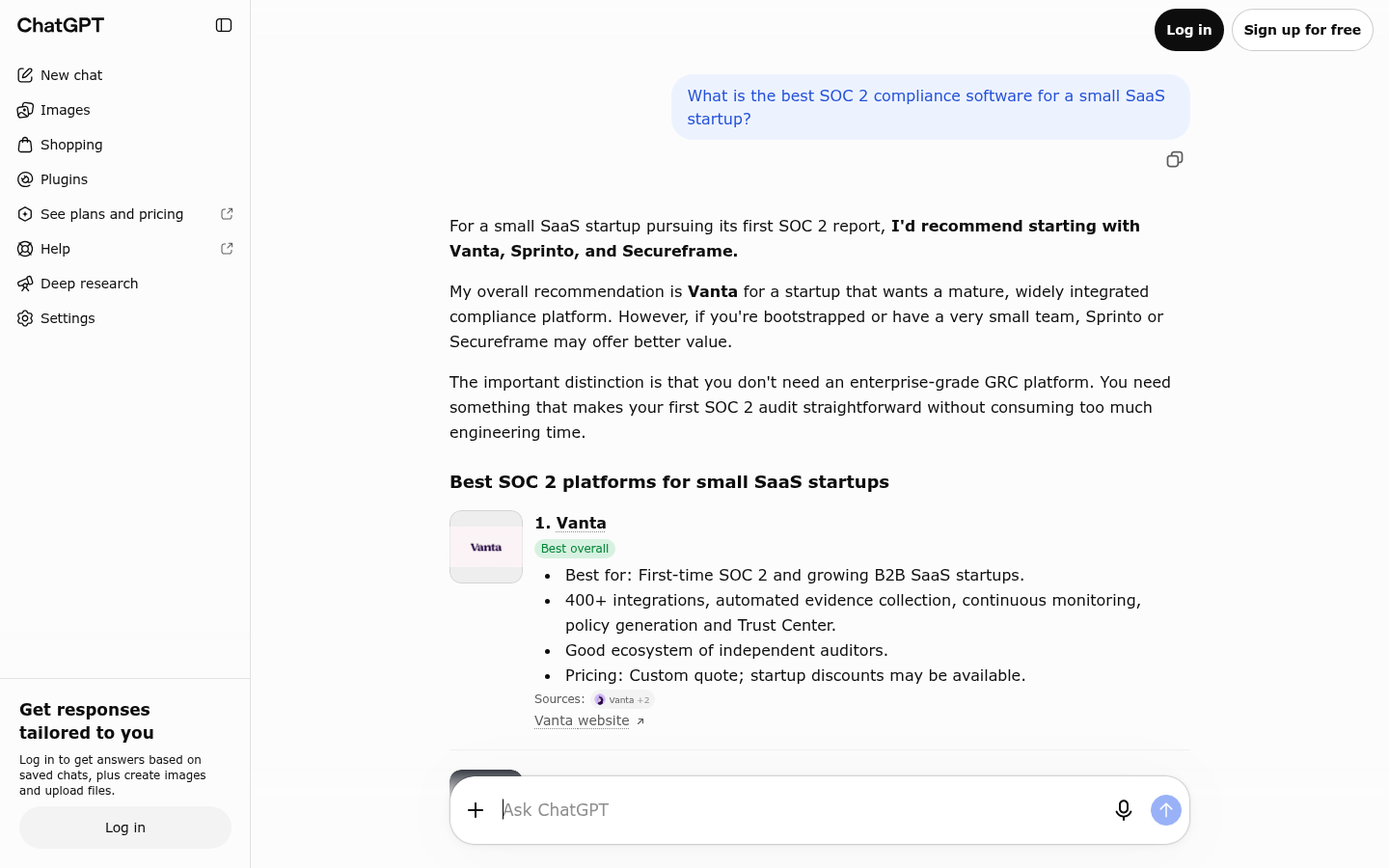
The Pages tab keeps one row per page. Paste this header into its A1, then add each address the first time you meet it and count it every time it comes back, by engine, with the question codes it was cited for:
Page Type Publisher named as an option? ChatGPT answers AI Mode answers QuestionsCut the tracking tag ChatGPT adds to each address, everything from ?utm_source onward, or the same page lands in the sheet twice. Our sixty answers cited pages 417 times, and 189 of those pages were different.
Step 5: Set aside the links that only follow a name
Give every page a type by who published it. Five types cover almost everything: a third-party article, a page on a named vendor’s site, that vendor’s homepage, a Reddit thread and an official document. Count a publisher as a vendor when some answer names it as an option, and as a third party otherwise. A security firm that writes a SOC 2 roundup and is never named in an answer is a third party.
Then sort out the homepages. ChatGPT prints a website link under most products it names, and 114 of its 325 citations in our run were vendor homepages. Almost every vendor citation it made, 181 of 188, went to a brand the same answer had already named. The link is there because the brand was named, so it can’t tell you why. Keep those rows in the sheet and leave them out when you decide what to work on.
With the homepages in their own row, the two engines lean on different kinds of page:
What ChatGPT and Google AI Mode Cited, by Who Published the Page
Share of each engine’s citations, 30 answers each to ten SOC 2 software questions, US, 28 Nov 2026
View the data
| Label | ChatGPT | Google AI Mode |
|---|---|---|
| Third-party articles | 38.8% | 43.5% |
| Named vendors’ pages | 22.8% | 45.7% |
| Vendor homepages | 35.1% | 3.3% |
| Reddit threads | 0% | 6.5% |
| Official documents and video | 3.4% | 1.1% |
AI Mode cited four Reddit threads across six answers, and ChatGPT cited none. So in this category we’d put Reddit after the articles, and we check that split before we suggest Reddit marketing anywhere.
Step 6: Read the pages cited most often
Sort the Pages tab by the two answer columns and open the top rows. For each one, note who wrote it, when, and whether you’re on it. AI Mode leaned on one page most, in 10 of its 30 answers. It was a roundup a security vendor had published ten days before our run, with its own product first:
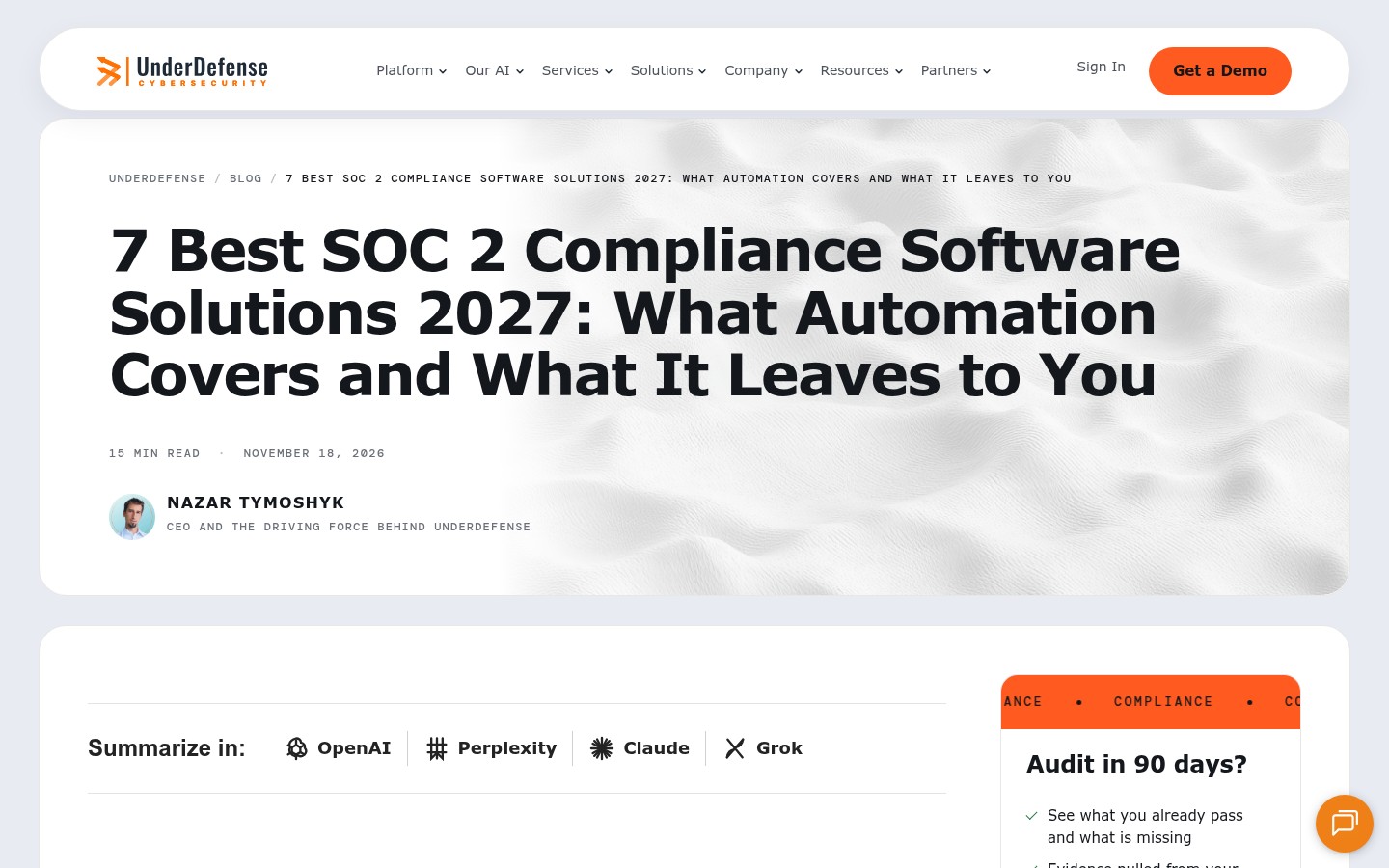
AI Mode named UnderDefense in 3 of the 10 answers that cited the page. ChatGPT’s most cited roundup came from Dupple, a newsletter publisher, and it sat behind 10 answers across five questions. These are the software roundups the engines cite in this category, and their editors are the people a vendor in it writes to.
The AI Citation Gap Report runs this half of the sheet for your own category. It puts 100 buyer questions to ChatGPT and Google AI Mode, reads the cited pages and returns the ones that name your rivals and skip you. It’s a free run of the agent we keep running every week for our partners:
Check Which of Your Own Pages an Engine Can Quote
Your own site comes in only now. Third-party pages sat behind most of the answers in our run, and your own pages decide what an engine can say about you once it reads them.
Step 7: Pick the page you’d want quoted for each question
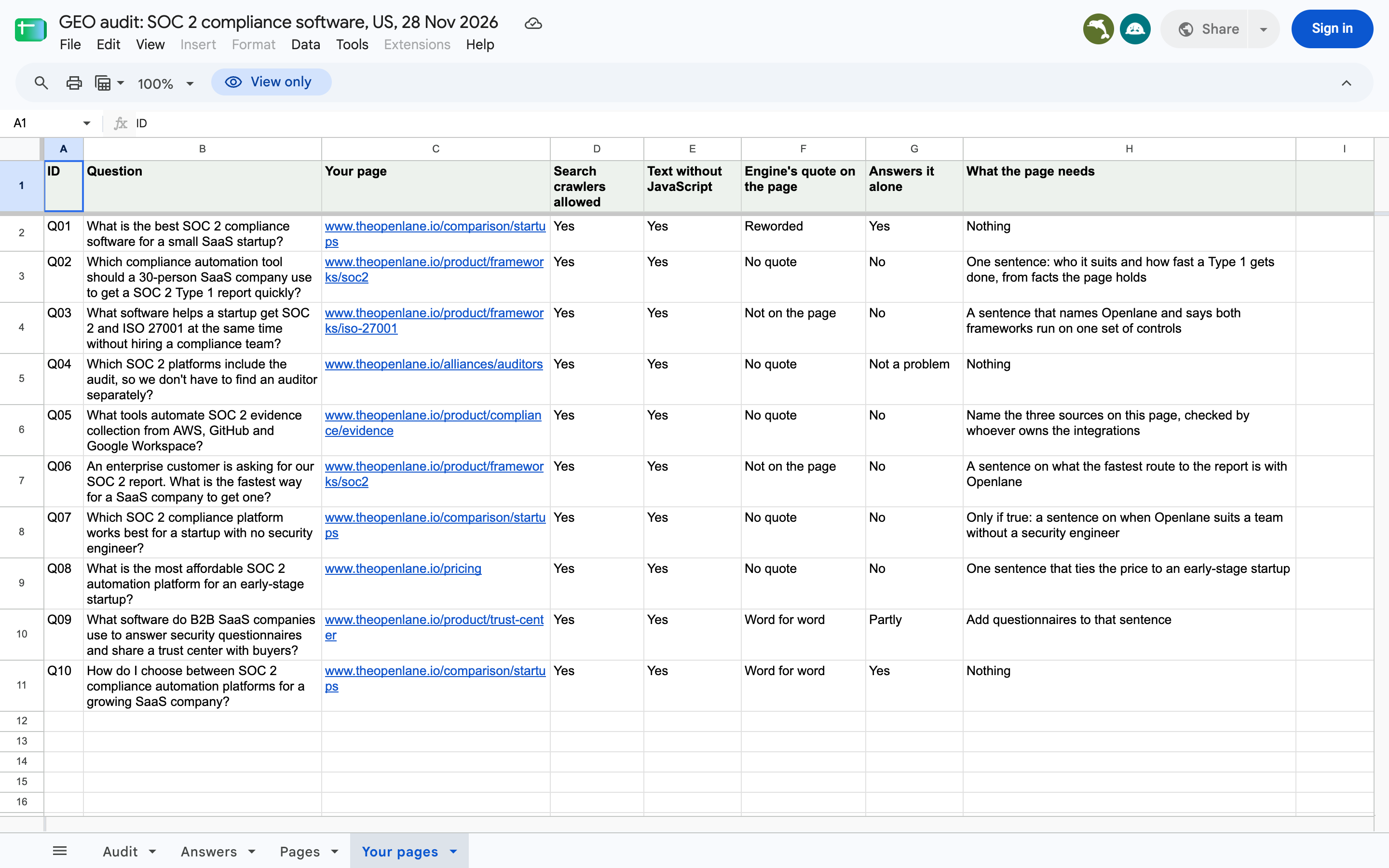
For each question, choose the page on your site you’d want an answer to rest on. That’s the pricing page for a price question and a comparison page for a which-one question. For Openlane that came to seven pages for ten questions. Paste this header into A1 of the Your pages tab and give each question its row:
Question ID Question Your page Search crawlers allowed Text without JavaScript Engine's quote on the page Answers it alone What the page needsStep 8: Read robots.txt for the crawlers that answer buyers
Open yoursite.com/robots.txt in a browser. The crawlers behind the answers are often not the ones the file names, and OpenAI and Google each document which is which 23:
Scroll horizontally to see all columns when the table is wider than this page.
| Crawler | Owner | What it does | What blocking it costs |
|---|---|---|---|
| OAI-SearchBot | OpenAI | Finds pages for ChatGPT’s search answers | Your pages stop appearing in those answers |
| GPTBot | OpenAI | Collects pages that may train OpenAI’s models | Your content is kept out of training |
| Googlebot | Indexes pages for Search, AI Overviews and AI Mode | A page outside the index can’t support an AI Mode answer | |
| Google-Extended | Covers training, and live answers in some of Google’s other AI products | Nothing in AI Mode, which runs on the Search index |
Openlane’s file is the one Cloudflare writes for its customers. It blocks GPTBot, ClaudeBot and Google-Extended and never mentions OAI-SearchBot, ChatGPT-User or Googlebot. A crawler the file doesn’t name falls under its last rule, which allows everything, so those three get in. ChatGPT cited Openlane’s pages in four answers. Mark that row yes, and ask your web team whether a firewall screens those crawlers anyway.
Step 9: Read the page as your server sends it
Some crawlers read a page before any script on it runs. Right-click the page, choose View Page Source, and search for the sentence you’d want quoted. If it isn’t in the source, those crawlers get the page without it, and the fix for JavaScript pages is a developer’s job. All seven Openlane pages served their full text, so that column read yes on every row.
Step 10: Ask the engine to quote the page, then find the quote yourself
Paste the prompt below into ChatGPT, signed out, once for each row. Change the page address on the first line and the question on the third, and keep the four numbered lines as they are. This is the prompt exactly as we sent it for Openlane’s page on ISO 27001, the information security standard:
Open this page and read it: https://www.theopenlane.io/product/frameworks/iso-27001

A buyer asked an AI assistant: "What software helps a startup get SOC 2 and ISO 27001 at the same time without hiring a compliance team?"

1. Could you open the page? Answer yes or no.
2. Copy, word for word, the one sentence on the page that best answers the buyer's question. If no sentence answers it, write NONE.
3. Does that sentence name the product and answer the question on its own, without the sentences around it? Answer yes or no, then give the reason in one line.
4. If you answered NONE or no, write the sentence the page is missing, using only facts that are on the page.
A sentence that names your product and answers the question with nothing around it is a sentence an engine can lift into an answer. Then search the page for the engine’s quote before you write anything in the sheet. On five of Openlane’s ten rows ChatGPT returned a quote, and on the other five it answered NONE. Of the five quotes, two were on the page word for word, one reworded a real sentence, and two were not on the page at all.
Nothing in the reply tells you which quotes are invented. When we sent the ISO 27001 prompt again a few minutes after the counted run, the reply quoted the page correctly:
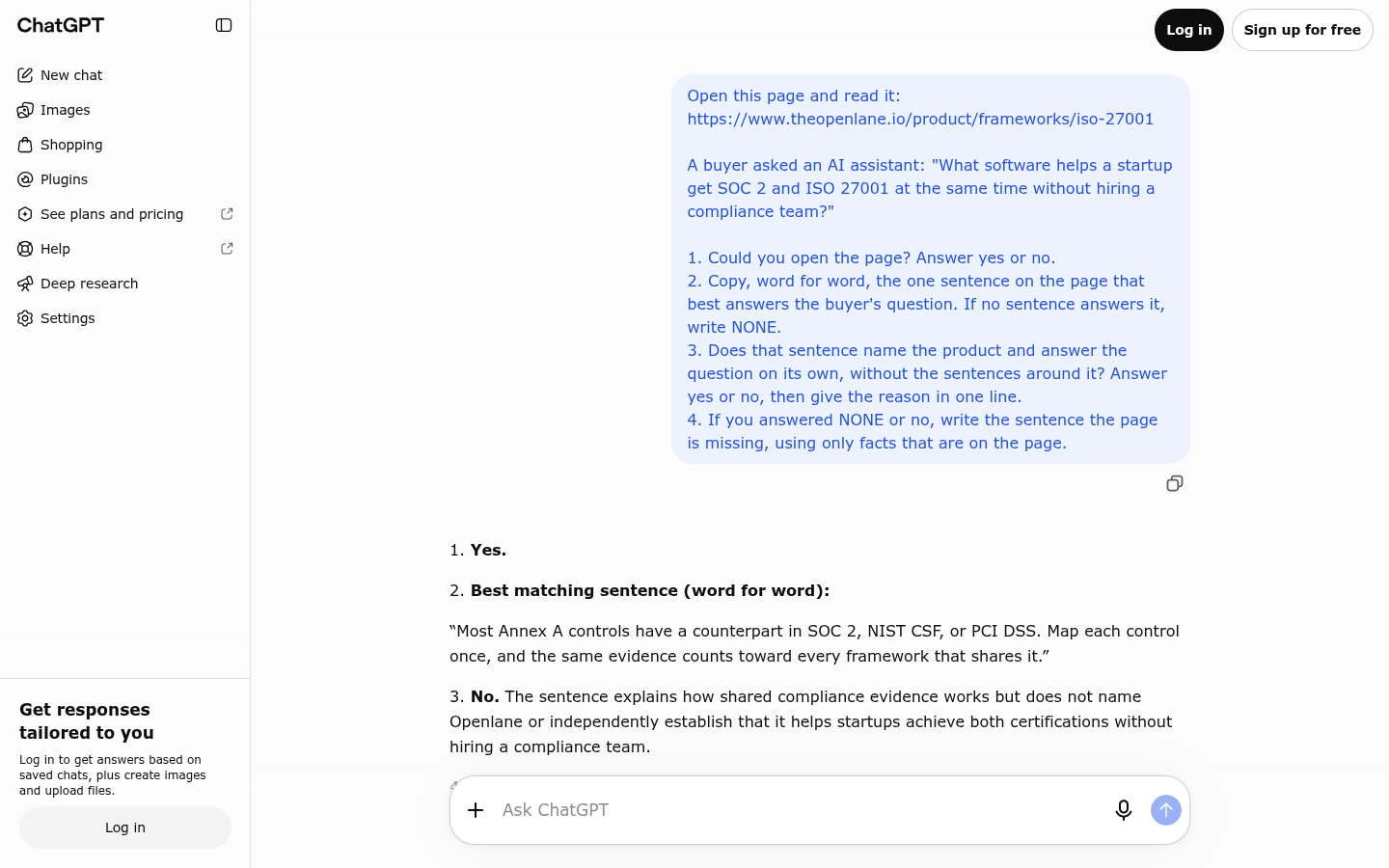
The sentence it suggests on line 4 needs the same search. On one row it wrote in three integrations the page never mentions. Practitioners who run this check on their own sites add what the prompt can’t see, including the content delivery network (CDN) in front of many sites:
Tips from Reddit
What practitioners check on their own pages
worth opening the exact help page it cites and checking whether it ever says in plain words what your product is and who it’s for.
A citation tells you your page contributed information to the answer. It doesn’t tell you that your brand received any recommendation weight.
I’d check the CDN too. A few sites I tested had robots.txt wide open while Cloudflare blocked GPTBot, and the host’s logs never show those requests.
Filled in, the tab says in a line what each page needs:
Read the Sheet Before You Change a Page
The Audit tab brings the three blocks onto one row per question. Paste this header into its A1, then fill each row from the other tabs: the brands each engine named in two runs or more, your count out of six answers, the three third-party sites cited most often for that question, its Reddit threads, and the verdict from Your pages.
ID Buyer question ChatGPT names (2+ of 3 runs) AI Mode names (2+ of 3 runs) You named Third-party pages behind the answers Reddit threads Your page quotableFilled in for our run, it reads like this:
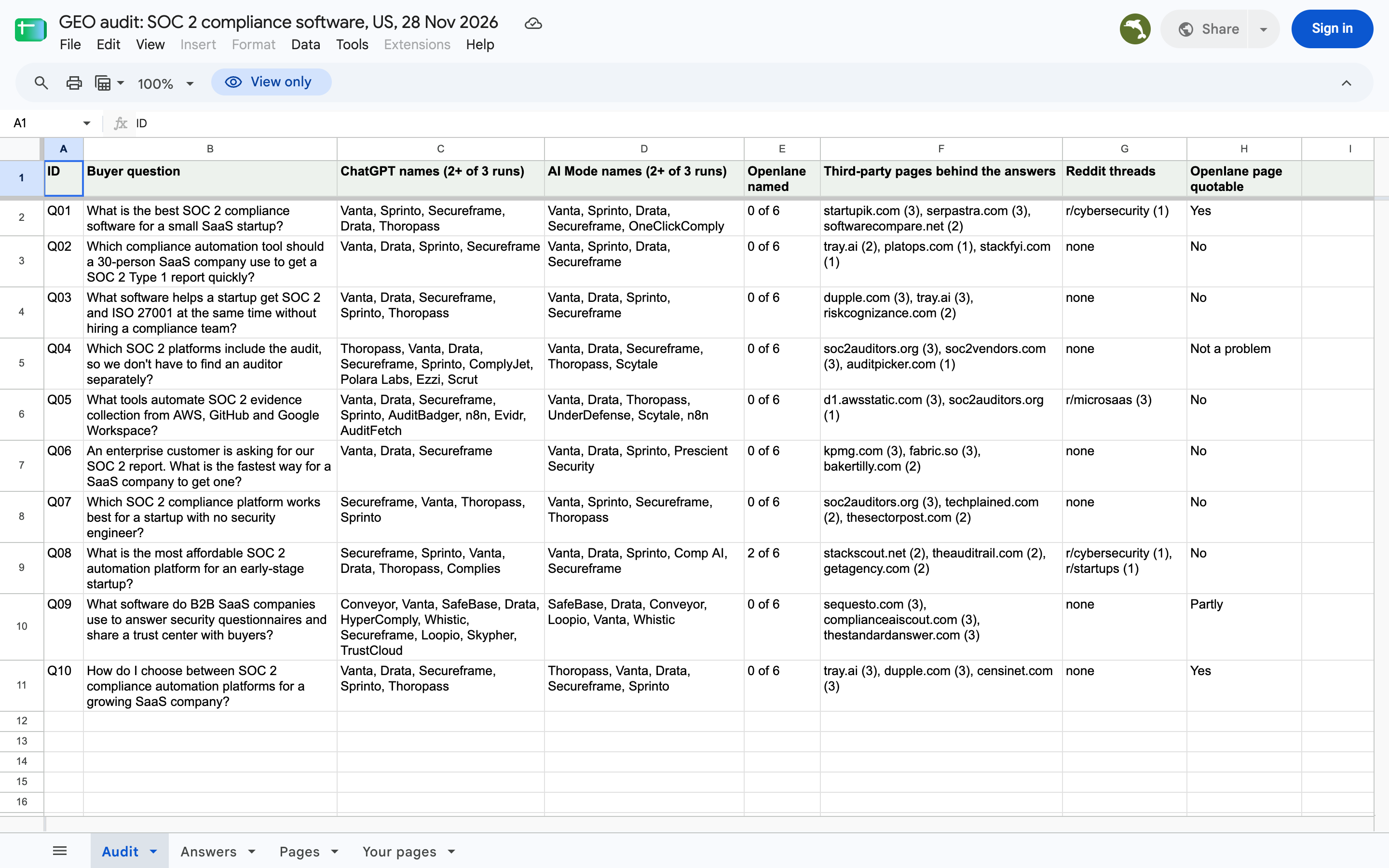
Look at Openlane’s rows. Its comparison page has a sentence that names Openlane and answers two of the questions, and Openlane still went unnamed in all six answers to each of them. ChatGPT cited that same page in all three answers to the ISO 27001 question and named other vendors every time. The one answer that put Openlane first had read its pricing page, which held the fact that question asked for, a price.
So keep two separate columns for every question, the pages the answer cited and the brands it named. The gap between them is where the reading starts:
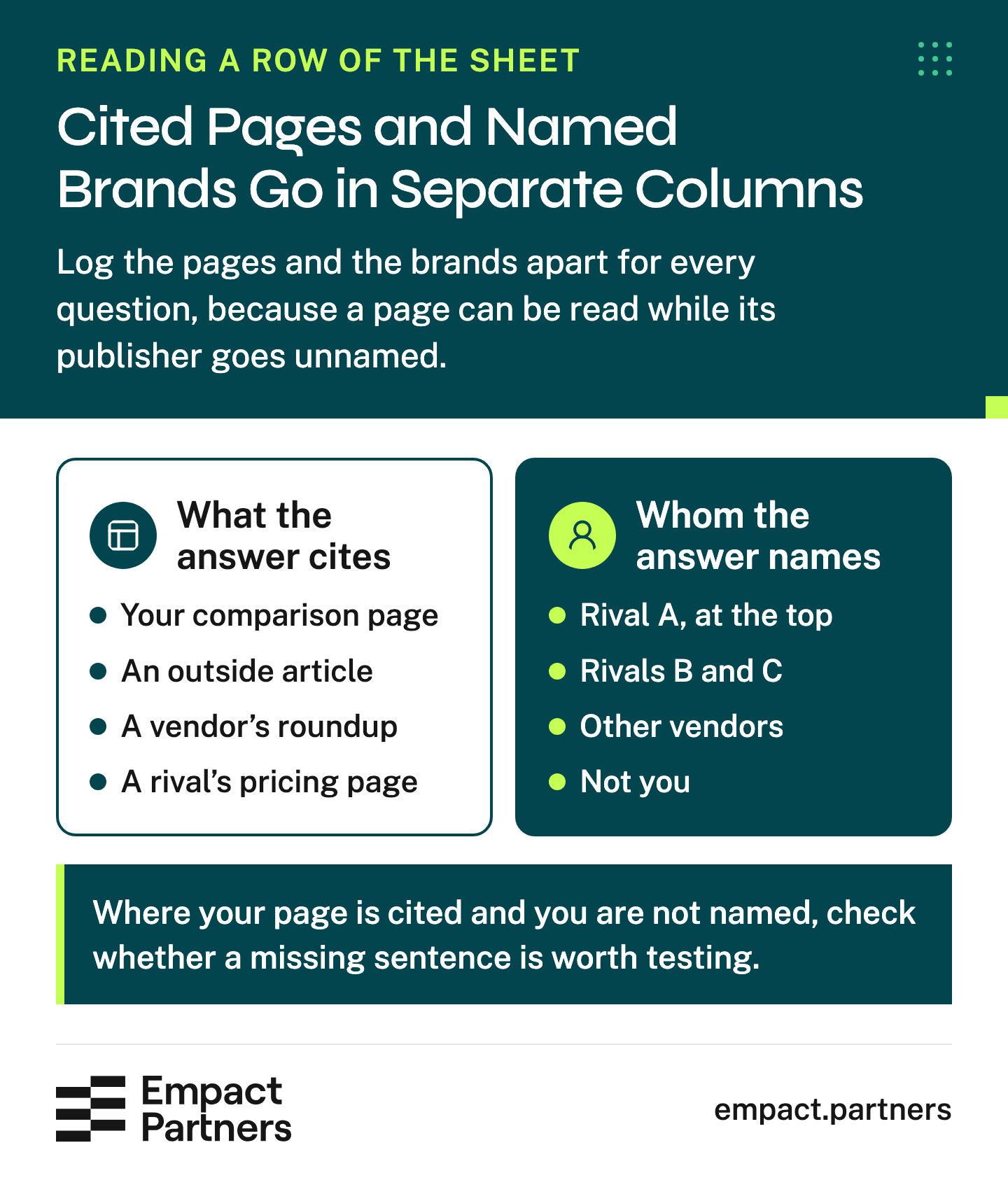
Being cited and being named are separate results, so a row can show one without the other. Of the 417 citations in our answers, 5 pointed at Openlane’s own pages.
Almost everything the engines read was someone else’s page, so the main work in this category is on the third-party articles on the Audit tab and the vendors’ comparison pages beside them. On Openlane’s rows the own-page fixes were single missing sentences, small enough to test while that work runs.
Read where your category’s answers lean before you change a word on your own pages.
Some rows of the sheet need nothing at all:
Leave a row alone when
- Its only citation of a vendor is the website link under a brand the answer already named.
- Your robots.txt blocks training crawlers and leaves OAI-SearchBot and Googlebot open.
- The question asks for something your product doesn’t do. Openlane doesn’t bundle the audit, and its page says its recommended auditors are independent.
- Your own comparison page honestly sends a buyer elsewhere. Openlane’s suggests a guided platform such as Secureframe or Sprinto for a first SOC 2, and that sentence is fair.
On your own pages, start with the smallest safe fix, a sentence on a single page. Openlane’s pricing page holds its prices and a note that startups may qualify for a discount, and no sentence saying who the prices suit. A line that ties them to an early-stage startup, written from those facts and read by whoever owns pricing, is the change to test.
Rerun the quote check on that row, then the question itself, and log both. Prices, plan names and anything said about a rival stay with a person, because a wrong sentence on your own page is the one an engine will quote back.
Among your own pages, I’d start with the rows where the engine cites your page and names a rival. It already reads that page, so one plain sentence about who your product suits is the cheapest test you can run. Where nothing of yours is cited, you have to get onto someone else’s page first, and that takes longer.
 Garith Prior on LinkedInOpens in a new tab
Most of what the sheet sends you to is other people’s pages, and getting onto them is a method of its own:
Run the Same Questions Every Week, in Every Market You Sell In
One run is one market on one afternoon. Names move between runs, cited pages come and go, and a buyer in London can get a different shortlist from a buyer in Chicago. Your sheet answers for the market you asked from, on the day you asked, and says nothing about next month.
The Empact Panel, our own build, keeps the first two blocks of this sheet running. It re-asks a partner’s buyer questions in each of its markets every week and stores each answer with its citations. Here is one partner’s share of voice over 30 days among its US buyers:
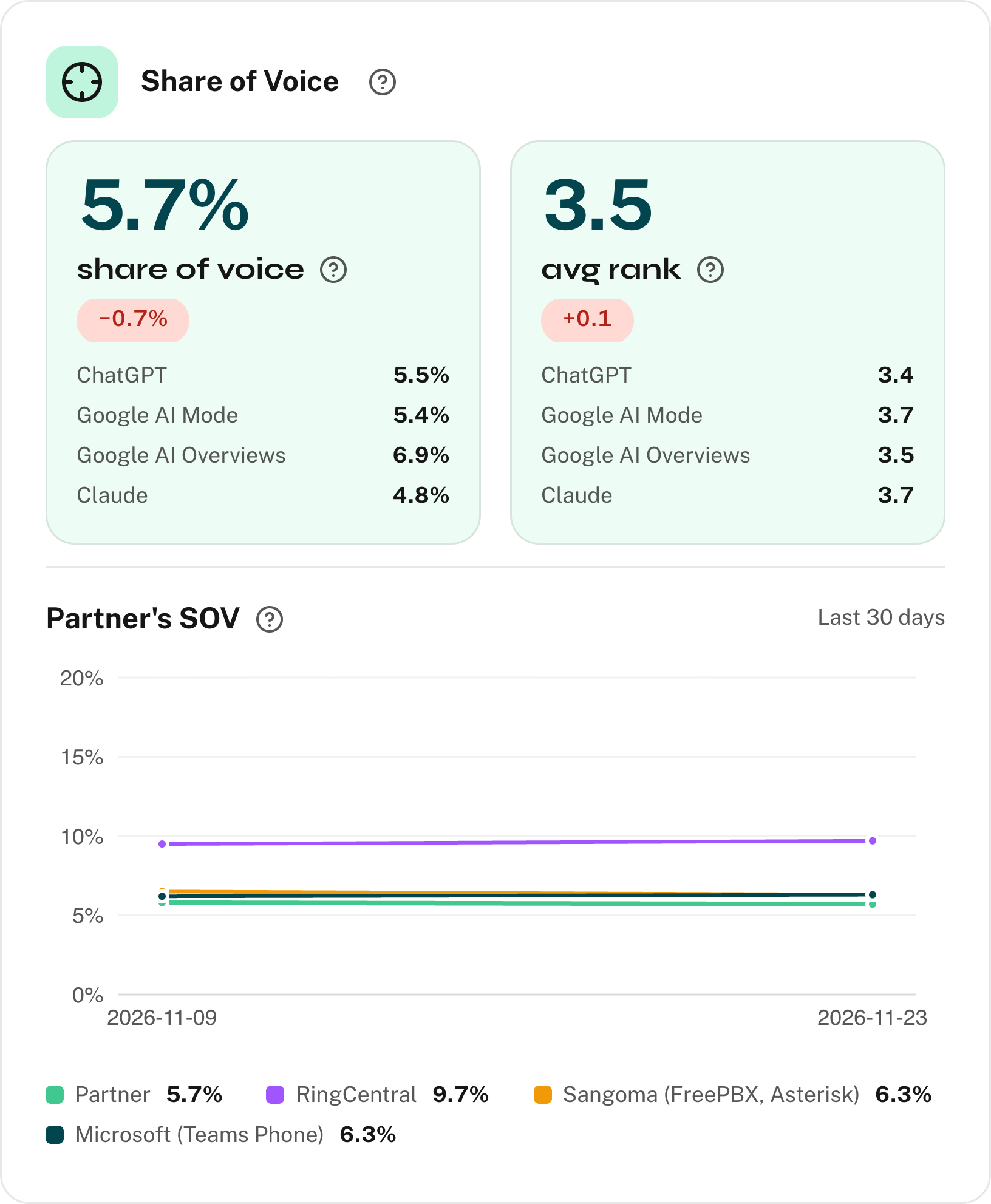
And the same partner over the same 30 days among its UK buyers:
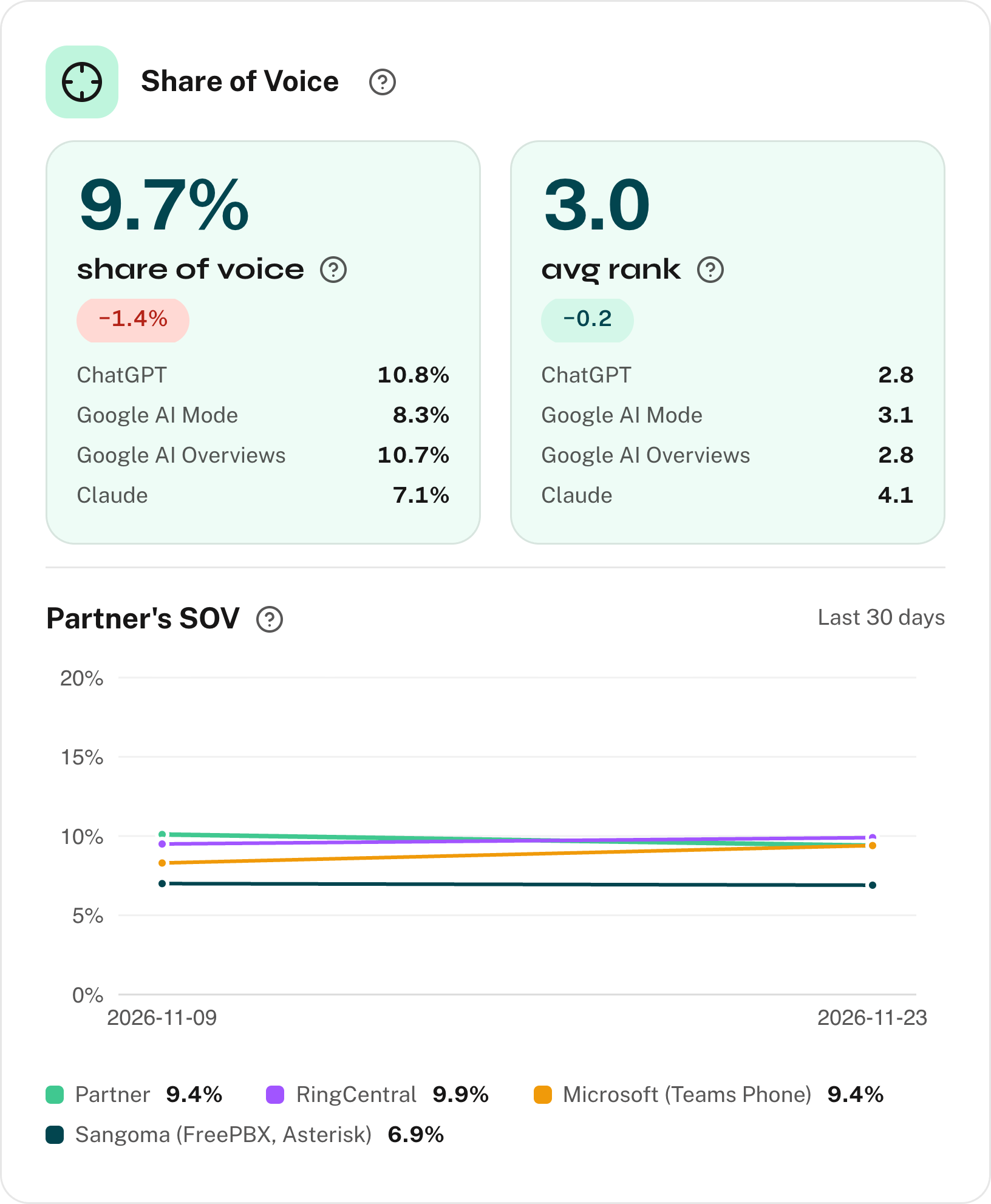
Its UK share is 1.7 times its US share in the same month. The US reading says nothing about the UK, so each market gets its own sheet.
Empact Partners keeps this audit going after the first sheet, and the weekly version covers four things:
What the weekly version covers
- Your buyer questions in the Panel, for each market we agree to track.
- ChatGPT and Google AI Mode scored apart, with the pages behind every answer read.
- Work that starts where your category’s answers lean hardest. In SOC 2 software that means the editors of the roundups and articles the answers cite, and in yours it may be Reddit threads or your own pages.
- A report each time that names what moved and the first thing to do about it.
Before your next run, count the rows where your page is cited and your brand isn’t named. Those are your quickest own-page tests while the work on other people’s pages goes on.
Frequently Asked Questions
What does a GEO audit include?
A GEO audit, short for generative engine optimization, covers four things for each buyer question. The first two are the brands ChatGPT and Google AI Mode name and the third-party pages and Reddit threads cited behind those answers. Then come which of your own pages an engine can quote, and where to work first.
A site checklist of robots rules, schema and page speed is one part of checking your own pages. Run alone, it misses the pages the answers lean on, which in our run were mostly other people’s.
Do I need paid accounts for ChatGPT or Google AI Mode?
No. Both answer signed out, and a signed-out private window is the better test, because a logged-in account carries your history and can tilt the answer toward what you’ve searched before. You need a Google account only to own the sheet. Claude needs an account even for a single question, so a hand-run audit usually covers ChatGPT and AI Mode.
How many questions and runs are enough for a first audit?
Ten questions with three runs on each engine gave us sixty answers. That was enough to see that five brands owned the shortlist and that the cited pages changed from question to question. One run per question misleads, because a name that appears once may be gone on the next try. Add questions once you sell to more than one kind of buyer, since a finance lead and an engineer word the same need differently.
Should we fix robots.txt, schema or llms.txt first?
Check robots.txt first, because a real block on OAI-SearchBot or Googlebot keeps you out entirely, and reading the file takes ten minutes. Many files block only training crawlers such as GPTBot, which leaves search answers alone. Schema and an llms.txt file come after the access checks. Neither is where our run found the gap, since Openlane passed every access check we ran and was still named in two answers out of sixty.
Why does ChatGPT cite our page but recommend a competitor?
In our run it happened when the engine read a vendor’s page for a fact and named the brands from pages that compare vendors. Openlane’s comparison page was cited in every ChatGPT answer to one question, and other vendors were named each time. Check whether your cited page has a sentence that names your product and says who it suits. Then look at the third-party pages cited in the same answer, since they name the brands a buyer sees.
Does Reddit matter for our category?
Reddit matters in some categories and on some engines, and the sheet tells you which. In our SOC 2 run Google AI Mode cited four Reddit threads across six answers and ChatGPT cited none. Count the Reddit rows on your Pages tab before you plan any work there. If they’re rare, the roundups and review pages in the same answers are the better first target.
How long does the audit take, and who should run it?
About three hours for ten questions on both engines with the logging, and another hour for your own pages. A marketer can run all of it without help. Only the bot-protection question goes to whoever manages your website, since a firewall rule doesn’t show up in robots.txt. The reading is the slow part, and it’s the part worth doing yourself the first time.
How often should we rerun it?
Rerun the same questions after any change you make, and on a fixed rhythm for the rows you care about most, because answers shift between runs with nothing changed. Keep the wording identical, or the comparison says more about your edits than about the engines. Run each market you sell in separately: in our Panel, one partner’s UK share of voice was 1.7 times its US share over the same thirty days.
Can a free tool run this audit for us?
A free tool can run one pass of one block. The AI Citation Gap Report above is a single run of the agent behind the second block, for your category, sent to your work email. For our partners the same agent runs every week and picks up each page the engines start citing. A one-off run still leaves the reading and the priorities to you.
What if ChatGPT and AI Mode name different brands for the same question?
Score them apart and keep both rows, because the engines read different pages. In our run they named the same five brands on most questions, while their sources differed and only AI Mode cited Reddit threads. When one engine names a brand and the other skips it, compare the two engines’ cited pages for that question before you decide what to change.
Should the questions name a competitor?
Keep competitor names out of the audit set. Name a rival in the question and the engine starts its answer from that rival, so the count describes the question you wrote. Track “alternatives to” questions in a separate sheet if you need them, and keep them out of the count your team reports upward.
How is a GEO audit different from an SEO audit?
An SEO audit starts from your site and asks whether search engines can crawl, index and rank it. A GEO audit starts from the answers: which brands the engines name for your buyers’ questions and which pages they cite. They overlap on checks such as whether a crawler can read your pages, and in our run that check came third. Openlane passed it and was still named in 2 of 60 answers.
Sources (3)
- Empact Partners, "GEO audit run" (2026)Empact Partners' own data↩1↩2↩3ten buyer questions about SOC 2 compliance software asked on ChatGPT logged out and Google AI Mode signed out, three runs each from a US location, 60 answers and 417 citations, with Openlane’s public pages checked the same day, 28 November 2026.
- OpenAI, "Overview of OpenAI Crawlers" (2026)↩1read 28 November 2026.
- Google Search Central, "AI features and your website" (2026)↩1read 28 November 2026.
Keep reading
GEO Stop Sharing Screenshots Of ChatGPT Recommending You
We asked Google AI Mode one question ten times and got ten different shortlists. Report the share of answers naming you, per market.

GEO How to Get Your SaaS Company Named in AI Search
Find what keeps your SaaS company out of AI answers: blocked pages, missing listings or content that misses the buyer's question.

GEO How to Write a Buyer Question Set for AI Visibility Tracking
Your AI visibility number is only as honest as its questions. Draft them in Claude from your own pages, then cut the ones that flatter you.