Stop Sharing Screenshots Of ChatGPT Recommending You
We asked Google AI Mode one question ten times and got ten different shortlists. Report the share of answers naming you, per market.
 Sharné McDonaldWith
 Vlad Shvets
On this page
Empact Newsletter
One email a month on what is working in AI search and SaaS go-to-market.
A screenshot of ChatGPT recommending your product shows one answer. Ask the same question again and the next answer can name other tools, and a buyer asking from another account, country, or language gets a different shortlist. What to report is the share of answers that name you, counted over several runs, per engine and per market. That share is the number a board should see. Only a product named in almost every answer can trust a screenshot.
My team at Empact Partners helps SaaS companies get onto the shortlists ChatGPT, Google AI Mode, and Claude give buyers who ask what to use. For those partners, we count every week how often they are named, instead of trusting one answer.
This verdict comes from a company that counts answers for a living, so telling you a screenshot is not enough suits us. The count itself costs an afternoon and no software, and every step of it is free to copy.
We Asked One Question Ten Times and Got Ten Different Shortlists
On 20 November we asked ChatGPT and Google AI Mode five buyer questions about social media management software, ten times each.1 We were signed out for every question, and each one went into a fresh session. We picked this category because none of our partners sells in it. One of the five was the question a small team types first: what is the best social media management platform for a team of five?
Google AI Mode gave ten different shortlists in ten answers. The first two answers named eight tools between them and agreed on two. Across all ten, only Sprout Social came back every time:
How Many of Ten Answers Named Each Tool
Google AI Mode, one team-of-five question asked ten times, US, 20 Nov 2026
View the data
| Label | Value |
|---|---|
| Sprout Social | 10 |
| Vista Social | 8 |
| Buffer | 8 |
| Zoho Social | 5 |
| Loomly | 5 |
| Hootsuite | 4 |
| Metricool | 4 |
| Agorapulse | 3 |
| HeyOrca | 2 |
| Planable | 1 |
A screenshot of that first answer would have been genuine. It would also have shown HeyOrca on the shortlist and Loomly off it. Across all ten answers, Loomly turned up in five and HeyOrca in two.
None of the five questions held still on either engine. Each one came back with between five and ten different shortlists over its ten runs on each engine, and Google AI Mode moved the most. SparkToro saw the same instability in January across 2,961 runs by 600 volunteers. Rand Fishkin compared the answers two at a time: fewer than one pair in a hundred from ChatGPT or Google’s AI named exactly the same brands.2
When someone posts a screenshot of ChatGPT naming your product, ask how many of ten answers to that question name it. If nobody knows, the screenshot has shown that the engine can name you, which is worth a smile and nothing in a board deck.
 Sharné McDonald on LinkedInOpens in a new tab
Your Own Five Questions and Your Buyers’ Questions Name Different Tools
Those five questions are also the ones a founder types to check on their own product. Four ask for the best tool for a small business, a team of five, a B2B SaaS team, and a LinkedIn company page. The fifth asks which one is worth paying for.
Buyers ask with their own job attached. So we wrote 35 more the way they do, about Pinterest pins, nonprofits, monthly reports, link-in-bio pages, and posting to Threads and Bluesky, and asked each one twice on each engine.
On ChatGPT, the 50 answers to the five questions named 17 tools. The 80 answers to all forty, two per question, named 69. Some tools that looked strong on the five almost vanished on the forty, and others did the opposite:
Share of ChatGPT Answers Naming Each Tool, 5 Questions or 40
Five high-intent questions, 10 runs, against 40 buyer questions, 2 runs, US, 20 Nov 2026
View the data
| Label | Five questions a founder checks | All 40 buyer questions |
|---|---|---|
| Buffer | 100% | 78.8% |
| Hootsuite | 70% | 67.5% |
| Later | 40% | 42.5% |
| Agorapulse | 56% | 30% |
| Planable | 56% | 18.8% |
| SocialBee | 34% | 13.8% |
| SocialPilot | 28% | 2.5% |
| Publer | 2% | 18.8% |
| Canva | 2% | 16.2% |
SocialPilot was named in 28% of answers to the five questions and in 2.5% of answers across all forty, an elevenfold gap. Publer went the other way, from 2% to 19%. Judged on the five alone, SocialPilot looks like a regular on ChatGPT’s shortlists and Publer like a tool it has barely heard of. Both readings are wrong.
The five were not wrong about every tool. Both sets agreed on the tool called Later: it was named in 40% of answers to the five and in 42.5% across the forty. But the only way to learn that your product is one the five get right is to ask the forty, so you end up counting either way.
We see the same thing in the partner work. The Empact Panel is software we wrote to put a partner’s buyer questions to the engines each week. In one B2B software category we measure with it, we drew random sets from the 1,000 questions a product line carries and checked how often a set’s score landed within five points of the full one:3
So the questions behind a share have to come from buyers, written before anyone looks at an answer.
Who Is Asking, and From Where, Changes the Shortlist Too
Our run had no account and no chat history behind it, and the answers still moved that much. A buyer adds both. Signed in, an assistant can draw on the account’s settings and earlier chats, and the account that has asked about your product most often is yours. In a Reddit thread on exactly this, one practitioner named the account problem and another added time:
Tips from Reddit
What practitioners say about checking from your own account
But the brand’s own laptop is not a ceiling. It’s the one person on earth who has spent months asking ChatGPT about that brand, so it’s the most biased answer you can get, not the best case.
during my 30-day experiment, I ran one prompt daily on a single LLM, and on days 13-14 the results, along with the citations, changed completely.
The second comment is the one to remember before a quarterly review. A screenshot taken during two unusual weeks tells you about those two weeks.
Country and language move the shortlist as well. We asked the same five questions in German from Germany, three times each. In those 15 answers, Google AI Mode named eleven tools that none of its 120 American answers named. ChatGPT named Swat.io in four German answers and in no American one.
Fifteen answers is a small sample, and the test changed the language and the country at once. It still points one way, because an answer read from your own office shows you your own market. Put the account, the place, and the day of asking together, and every buyer sits in a different cell of the same grid:
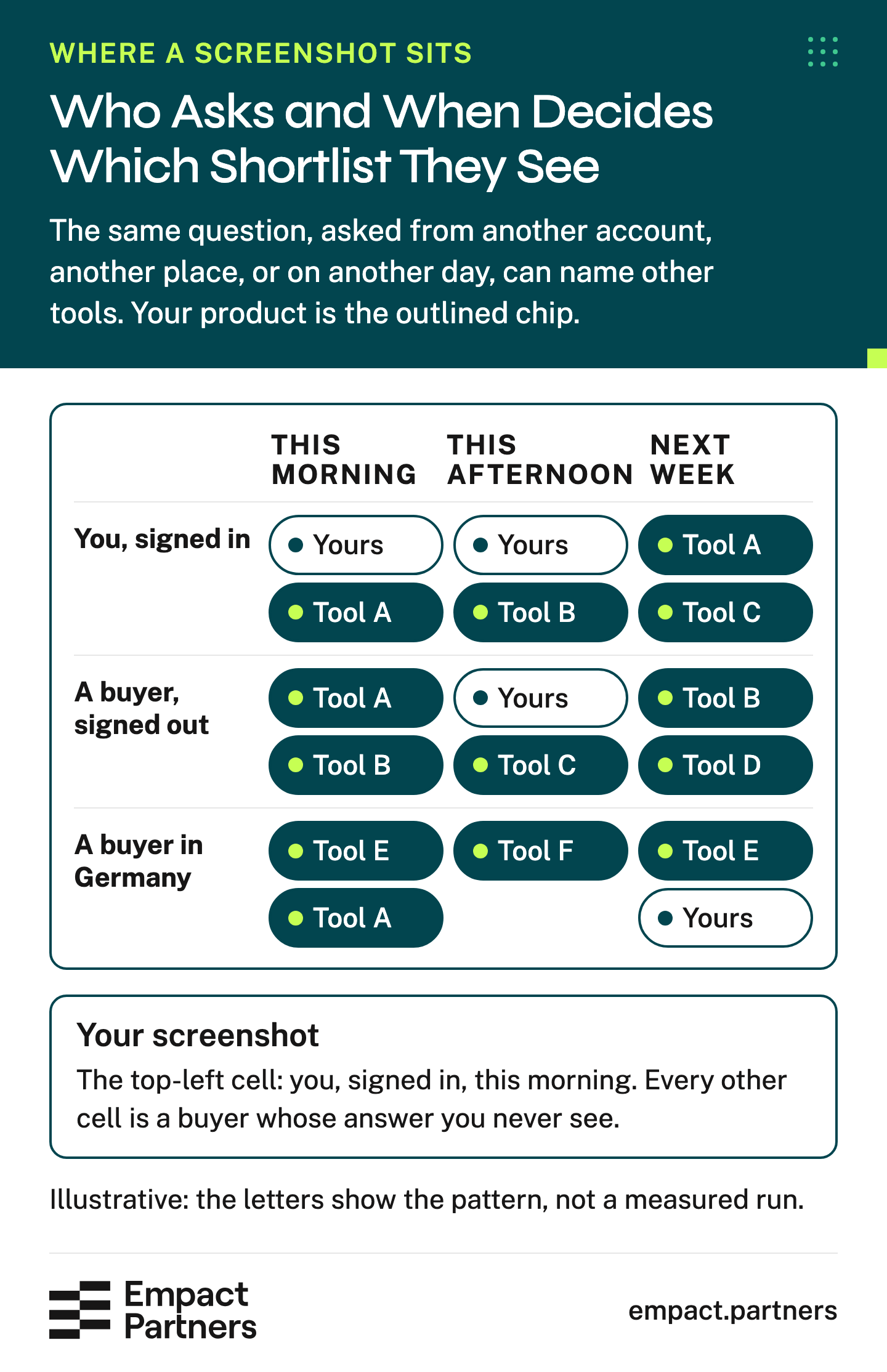
That grid is why a share has to say which market it counts, and why we read AI visibility market by market for any partner selling abroad.
“But the Screenshot Is What My Buyers See”
The objection is fair. The screenshot is a real answer, it costs nothing, and it is what a buyer sees when they ask. A share sounds like software and a budget most teams do not have. So telling a founder to stop celebrating a good screenshot sounds a lot like telling them to buy something.
Weighed honestly, the screenshot has real strengths and real limits:
Pros
- It is a real answer an engine gave
- It costs nothing and takes a minute
- It proves the engine knows your product exists
- It shows how the engine describes you, wording and all
Cons
- The next answer to the same question may differ
- It comes from your account, with your history in it
- It covers your country and your language only
- It cannot tell you how often you are named
Two of the pros are real jobs, and I would keep screenshots for them. One is checking that an engine knows you exist. The other is catching it describing a product you retired or a price you changed. What a screenshot cannot do is stand in for your buyers. Each of them gets an answer of their own, and yours is only one of them.
Each buyer gets one answer, so the share of answers that name you is the best estimate you have of how many buyers see your name.
The share does not need a software budget either. The 300 answers in our run cost us USD 0.36 through a data provider, and a smaller version by hand takes one afternoon.
How to Count Your Share in One Afternoon
Write the questions before you open a single engine, because once you have seen the answers you will be tempted to keep the ones that name you. Writing them is the first step:
Write twenty questions.
The five a buyer asks closest to choosing a tool, then fifteen more in the words buyers use on sales calls, in support tickets, and in the threads they read.
Ask all twenty signed out.
Use ChatGPT, Google AI Mode, and Claude, with a fresh chat for every question.
Ask the five twice more.
Three answers per engine show you which tools hold still and which come and go.
Ask the five once signed in.
The gap between your account and a fresh chat is how far your own history pulls the answer.
Write down every product named.
One row per answer in a spreadsheet, with every product the answer names, whether yours is there or not.
Divide.
For each engine, the answers that name you over all of its answers. That share is your number.
That afternoon is the whole method, and it gives you a baseline worth having before anyone spends money on AI search. What it cannot give you is the same count next month, in every market you sell in, with the answers kept so you can see why a number moved.
Running that count every week, with the answers kept, is the part our consultants at Empact Partners take on. In generative engine optimization (GEO), our first step with a partner is an audit and a roadmap, and after that the count is how we report on the work.
The Panel’s weekly run puts the same buyer questions to ChatGPT, Google AI Mode, and Claude in the markets set for each partner, and files each answer with the pages it cited. An answer names the tools its cited pages name. That makes those pages the place where a share moves, and they usually look like this:
- Pages on the partner’s site that answer what buyers ask, written so an engine can quote them
- A place in the listicles and articles those answers keep citing
- Reddit threads where people who use the product recommend it
For a first count without spending the afternoon, try the free AI Visibility Report. We write 100 buyer questions from your website, put them to ChatGPT and Google AI Mode, and report which answers mention you and which mention your rivals. It is a preview of the measurement we run in full for partners:
A count like that only helps if the board sees it the same way every month.
Put the share in the board deck for each engine and each market, on the same questions every month, and leave the screenshots out. Once a board has watched that number move, a screenshot stops looking like news.
Sharné McDonald on LinkedInOpens in a new tabIn my playbook I set up the baseline from 100 buyer questions and a single scoring sheet, so you can tell whether a move you report is real:
So the next time a screenshot of ChatGPT naming you lands in Slack, ask the same question three more times on each engine. Three answers tell you whether the screenshot was typical. What goes to the board is the share across all your buyer questions, asked the same way every month.
Frequently Asked Questions
Does signing out of ChatGPT give a neutral answer?
Signing out gives a cleaner answer. It removes your account and your earlier chats, but the engine still knows roughly where you are asking from and in what language. Our signed-out run still returned up to ten different shortlists for one question.
Treat a signed-out answer as your baseline, and a signed-in answer as a measure of how far your own account pulls the result toward you.
How many times should we ask the same question?
Three times per engine is enough for a check you run yourself. In our run, every tool that turned up in five or more of the ten answers had already turned up in the first three. Any tool the other seven runs added was named in fewer than half of the answers.
For a number you report every month, spend the extra effort on more questions rather than more repeats. In our run, five questions asked ten times still disagreed with forty questions asked twice by as much as elevenfold on a single tool.
How many questions does an AI visibility number need?
More than the five you would write first. SparkToro’s own conclusion is that a share across dozens to hundreds of prompts, each run several times, is a reasonable measure. We use 100 buyer questions for a first report.
Our sample-size figures show how far a small question set can stray from a large one in a real B2B category. At twenty questions, one answer that names you or leaves you out moves the share by five points.
Which AI engines should we check?
ChatGPT, Google AI Mode, and Claude, the three we track for partners. Score each engine on its own and never average them into one figure, because each draws on different pages and names different tools.
In our run Google AI Mode moved more between runs than ChatGPT on the same questions, and on two of its five questions only one tool appeared in every answer. The engines do not even move at the same rate, so a reading from one says little about the other two.
Why do the tools ChatGPT names change between answers?
Each answer is written fresh, so two answers to one question can take different turns. When the engine searches the web before it answers, as both engines did in our run, each search can bring back different pages. Those pages shape which tools get named.
So the same question can give you a different shortlist an hour later, with nothing about your product or your market having changed.
Is a screenshot ever useful?
Yes, for the two jobs in the pros above, and a third on a live deal. It shows that an engine knows your product exists, which matters for a new brand. It catches an engine describing a feature you retired or a price you changed.
And on a live deal, a screenshot from the prospect’s own account shows what that one buyer was told. Ask them for it. Just never read it as your visibility across the market.
What should a board report show instead?
The share for each engine and each market, on the same questions every month, with the rivals named beside you and their shares. Add the one or two answers that explain a move, so the board can see why the number changed.
Share of voice is a different number, your part of all the brand mentions in those answers. If you report both, say which of the two numbers a given decision rests on, because they can move in opposite directions.
How do we choose questions without rigging the number?
Write them from what buyers say in sales calls, support tickets, and demo request forms, and in the threads they read. Leave out any question that names your brand, since those name you every time.
Then freeze the set before anyone looks at an answer. In our run, widening the five founder-style questions to forty buyer questions moved one tool from 28% to 2.5%, so whoever chooses the questions chooses the number.
Do AI answers really differ by country?
In our run they did. The same questions asked in German from Germany brought up tools that no American answer named on either engine, though a German cell of 15 answers per engine is small.
Ask in each market’s own language, from that market, and keep each market’s share separate. An average across markets hides the one where you are missing, and the country-by-country figures show how wide those gaps run.
How long does it take for GEO work to move the share?
Months. The work on your own site, on the pages AI answers cite, and on Reddit takes a while to reach the answers, and the share follows after that. A page has to be published and crawled, and a mention has to land on a page the engines already cite, before an answer can change.
A swing on a small question set from one month to the next is usually noise. A move that holds across the whole set over a quarter is the one worth reporting, and the one a board should judge the work by.
Sources (3)
- Empact Partners, "run of 20 November 2026" (2026)Empact Partners' own data↩1↩2↩3five buyer questions about social media management software asked ten times each in ChatGPT (web search on) and Google AI Mode in the US, 35 more asked twice each, and the five asked three times each in the UK and in German from Germany. 300 answers, every product named counted on a rubric written before reading.
- Rand Fishkin, SparkToro, "NEW Research: AIs are highly inconsistent when recommending brands or products" (2026)↩128 January 2026, sparktoro.com.
- Empact Partners, "AI Visibility Sample Size Statistics for SaaS" (2026)Empact Partners' own data↩1↩2Empact Panel answers for one partner’s B2B software category, 1,000 buyer questions per product line asked in ChatGPT and Google AI Mode on 23 and 30 September 2026, with random subsets of 10 to 200 questions compared with the full set.
Keep reading
GEO How to Build an AI Visibility Baseline in ChatGPT and AI Mode
One screenshot of an AI answer measures the person who asked. Build a sheet of which companies ChatGPT and AI Mode name for your buyers.

GEO The 5 Best AI Visibility Tracking Tools, Priced and Reviewed
Five AI visibility trackers, each answering a different question, with live prices, G2 ratings and what users say, and how to choose one.
GEO How SaaS Teams Should Compare ChatGPT and Google AI Mode
Compare your SaaS brand across ChatGPT and Google AI Mode, identify visibility gaps, and decide which fixes deserve your team's time.