
How Fast AI Engines Notice New Mentions and Why Some Fixes Lag
ChatGPT can cite a new page within a week and still use a company's old name for months. Here is how to tell which clock an answer runs on.
 Teddy CipollaWith
 Vlad Shvets
On this page
- Live Search and Training Data Run on Different Clocks
- A New Page Can Reach Live Answers Within a Week
- What a Model Learned Can Stay Months Behind
- How to Tell Which Clock an Answer Is On
- Win the Pages Live Answers Already Cite First
- What to Tell a Board That Wants a Monthly Number
- Frequently Asked Questions
Empact Newsletter
One email a month on what is working in AI search and SaaS go-to-market.
When a new listicle mention, review profile or company name does not show up in ChatGPT a few weeks later, most teams read it as a failed tactic. Usually the check ran on the wrong clock. An AI answer comes from live search, which can pick up a page within days, or from what a model learned in training, which stops months back.
Both clocks can be measured. In our own data, ChatGPT cited a partner’s new pages within days, while the same OpenAI model with search off still used renamed companies’ old names months after the change. The gap between those two results tells a team what to fix first, what to wait for, and what to report.
Empact Partners makes SaaS companies visible in AI search, so buyers who ask ChatGPT for a shortlist see their product named. When an answer disappoints, the first thing we look at is which of the two clocks it ran on.
Live Search and Training Data Run on Different Clocks
An AI answer is put together in one of two ways. With live search, ChatGPT or Google searches while writing the answer, reads the pages that come back and cites them. Without search, the model writes from its training, a snapshot of the web that ends at a date called its cutoff. Every answer you check sits on one side:
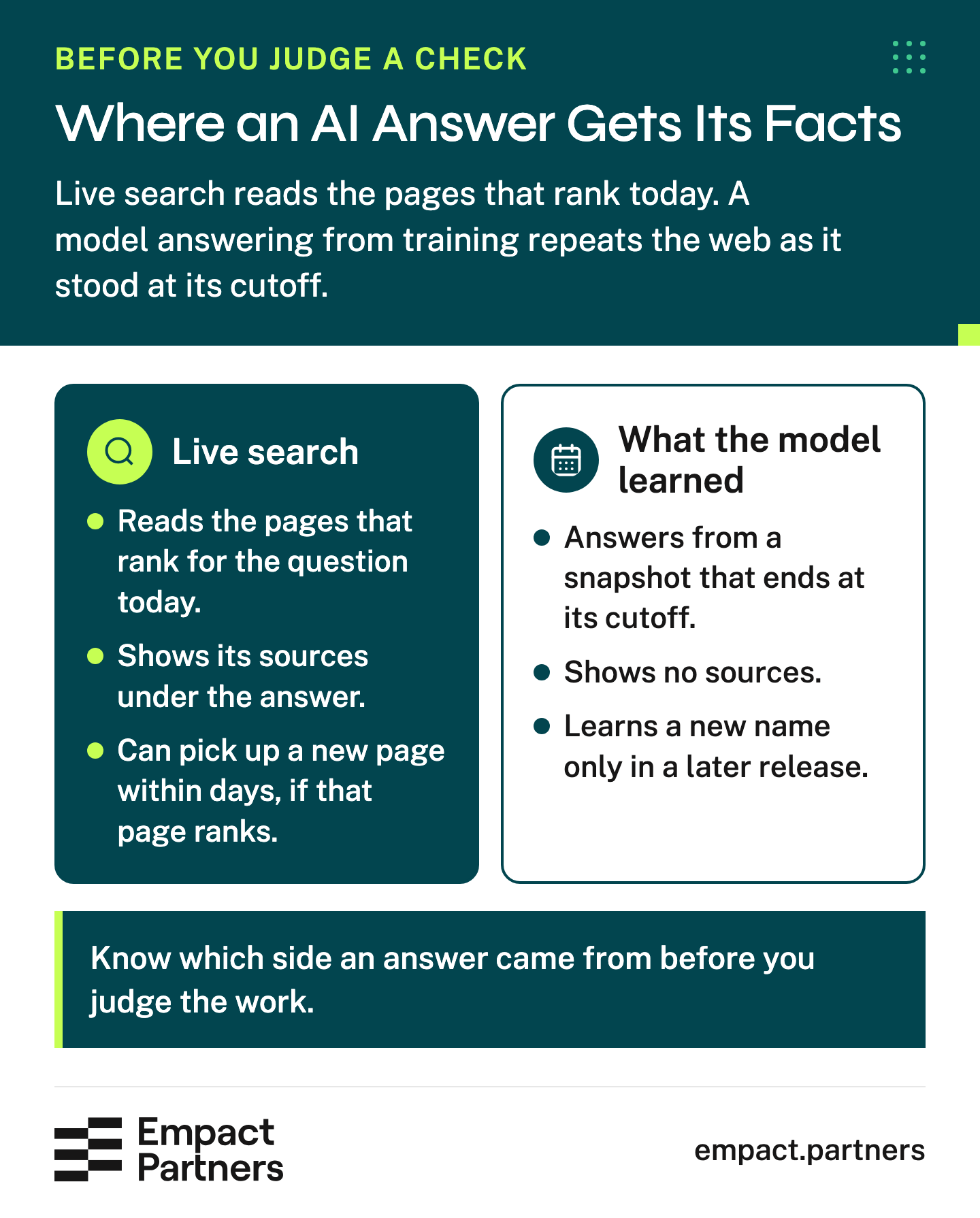
An answer that shows its sources searched the web, and one without them most likely came from the model’s training. The engines say when each happens: OpenAI’s help pages say ChatGPT can choose to search when current information would help, and that answers using search may include citations.4
For Google, a page can support an AI Mode answer once it is indexed and can show in Search with a snippet.6 Claude searches when a question needs current information and cites what it read.13
OpenAI runs a separate crawler for each clock. OAI-SearchBot collects pages for ChatGPT’s search answers, and GPTBot collects pages that may be used to train future models.5 The model we tested, gpt-6.1-sol, documents a training cutoff of 30 April 2026.3 Whatever the web said after that date is not in what it learned.
A New Page Can Reach Live Answers Within a Week
The Empact Panel is the tracker we built to watch these answers. Each week, a partner’s real buyer questions go to ChatGPT, Google AI Mode and Claude, and the Panel saves every answer with each page it leaned on. For one software partner, we timed its 54 blog posts from 12 to 29 October 2026 against those collections through 12 November.2
ChatGPT cited 10 of those posts, every one of them within 8 days of going live, and three within a day. Google AI Mode cited 14, nine within 8 days and five in the two weeks after. The Panel collects once a week, so a citation in the first week is the earliest it can record. The rest of the chart matters more than its fast end:
When One Partner's New Posts Were First Cited
54 new blog posts from one software partner, October 2026, by days after going live
days after05
12 November4440
View the data
| Label | ChatGPT | Google AI Mode |
|---|---|---|
| Cited within 8 days | 10 | 9 |
| Cited 13 to 22 days after | 0 | 5 |
| Not cited by 12 November | 44 | 40 |
By 12 November, 39 of the 54 posts had been cited by no engine at all. The fast clock is fast only for the pages it picks up, and in this partner’s month it mostly picked up one kind. Of the 16 comparison pages, the “best X” and “alternatives to X” posts buyers search for, 9 were cited. Of the other 38 posts, 6 were.
One partner and one month cannot settle why, and this partner’s site is an established one, which a new domain is not. Our read is that an answer cites the pages its searches return, so a page that does not rank for the buyer’s question never gets considered. That is how the engines describe their own search, and it fits what we saw.
A new page can be in the answers within a week. A new name is slower, and that is where the second clock shows.
What a Model Learned Can Stay Months Behind
To time the slow clock, we picked six public companies that renamed themselves, each dated at its own announcement. Bard became Gemini in February 2024.7 Pure Storage became Everpure on 23 February 2026, two months before the model’s cutoff.8 Office Timeline, Kongsberg Digital, BizWatt and Hierographx renamed between May and July 2026, after it.9101112
On 18 November 2026 we asked what each old name is.1 The same OpenAI model answered three times per company with search off, and chatgpt.com answered four times per company, searching the web every time. With search off, 3 of 18 answers gave the current name, and all three were about Bard. With search, 20 of 24 did:
Which Answers Used a Renamed Company's New Name
Answers to “What is [old name]?” on 18 November 2026, model cutoff 30 April 2026
renamed Feb 2024100%100%
renamed Feb 20260%100%
renamed May 20260%75%
renamed Jun 20260%100%
renamed Jun 20260%100%
renamed Jul 20260%25%
View the data
| Label | Search off | ChatGPT with search |
|---|---|---|
| Bard renamed Feb 2024 | 100% | 100% |
| Pure Storage renamed Feb 2026 | 0% | 100% |
| Office Timeline renamed May 2026 | 0% | 75% |
| Kongsberg Digital renamed Jun 2026 | 0% | 100% |
| BizWatt renamed Jun 2026 | 0% | 100% |
| Hierographx renamed Jul 2026 | 0% | 25% |
Pure Storage is the case to remember. The model knew the new name when asked about Everpure directly, and said “formerly known as Pure Storage” every time. Asked about Pure Storage, it described Pure Storage and never mentioned Everpure. Two months of news taught it that Everpure exists, without making Everpure the answer to the old name.
The renames after the cutoff fared worse. The model described the old companies confidently, with no sign its facts were out of date, and could not place the new names. It read Lucen Software as a misspelling of Apache Lucene.
Three answers per company is a small sample, and I would not quote a rate from it. It does show direction. A model trained before your change keeps telling buyers the old version, with full confidence and no sources, until a later release learns the new one. Nothing you publish this month changes that answer. What it changes is the pages live search reads tomorrow.
 Teddy Cipolla on LinkedInOpens in a new tab
Search put the new name in most answers. Hierographx, a small Michigan software company, was the exception: ChatGPT searched and still answered under the old name three times in four. The pages it cited were mostly older ones, a LinkedIn company page, a chamber of commerce article and award write-ups.
Live search repeats what the pages it finds say, and after a rename the old pages outnumber the new ones for a while. Finding those pages is the first job of a rename check.
So the first job on any answer that disappoints is knowing which clock produced it.
How to Tell Which Clock an Answer Is On
Most answers give away their clock, and these are the signs we read first:
Scroll horizontally to see all columns when the table is wider than this page.
| What you see | Which clock | What it tells you |
|---|---|---|
| Sources or citations under the answer | Live search | The answer read today’s pages, so check whether those pages name you |
| A confident description with no sources | Most likely training | It is the model’s memory, possibly months old |
| A question about something recent or specific | Usually live search | ChatGPT tends to search when current information helps |
| An assistant built on a model with search switched off | Training | Nothing after the cutoff can appear |
In our run, ChatGPT searched on its own every time it was asked what a company is, so most checks a team runs in the app land on live search. That makes a disappointing live answer more useful than it feels, because its sources show where to work. The first check takes an afternoon and needs nothing you do not already have:
The first check on your own brand
Ask the identity question.
In a logged-out ChatGPT window, ask what your company is, and note the name, the description and the sources under the answer.
Ask a buyer’s question.
Ask the question a buyer types when building a shortlist in your category, and note who is named and which pages are cited.
Ask again without search.
Put the same questions to Claude with web search switched off, where your plan shows the toggle. That answer comes from the model’s training.13
Compare the two.
If the live answer misses you, the pages it cites are the work. If only the answer without search is out of date, the fix is time and more pages saying the current facts.
Once you know which clock is lagging, the order of the work follows from it.
Win the Pages Live Answers Already Cite First
Start with the fast clock. It pays in weeks, and only through the pages live answers already read, the listicles, reviews, directories and threads that come back when a buyer’s question is searched. A mention added to one of those pages is read the next time that search runs. A mention on a page no search returns can sit there a year and change nothing.
The trained layer catches up underneath, release by release. Every page that names you and states the current facts is one more place a later model can learn them from. That is our read of why the model had settled Bard’s 2024 rename and not Pure Storage’s recent one. You cannot schedule that clock, only make sure the pages it will read say the right thing.
When live answers still skip you a month after a placement, look at the pages they cite before you decide to wait.
People who do this work describe the same order in their own words:
Tips from Reddit
What practitioners say about the two clocks
with search off it’s a different game. the model only “knows” you after a training update, so that’s months and nobody controls it.
the page needs to rank for those keywords or it is invisible to AI.
the directories and roundups that showed up already rank for those queries, so getting listed there is probably the most realistic first step for a new site, alongside the classic SEO work.
Finding the pages that already decide your answers is slow by hand, because each buyer question returns its own set. The free preview of our citation gap agent needs nothing but your website, and shows which cited pages mention your competitors without you:
That order of work also changes what a monthly report can honestly show.
What to Tell a Board That Wants a Monthly Number
A board that asks whether AI search work is working usually wants one number, and one number blends the two clocks. The fast clock can be moving while a blended share sits still. Here is the same partner’s Citation Ownership card for its last 30 days:
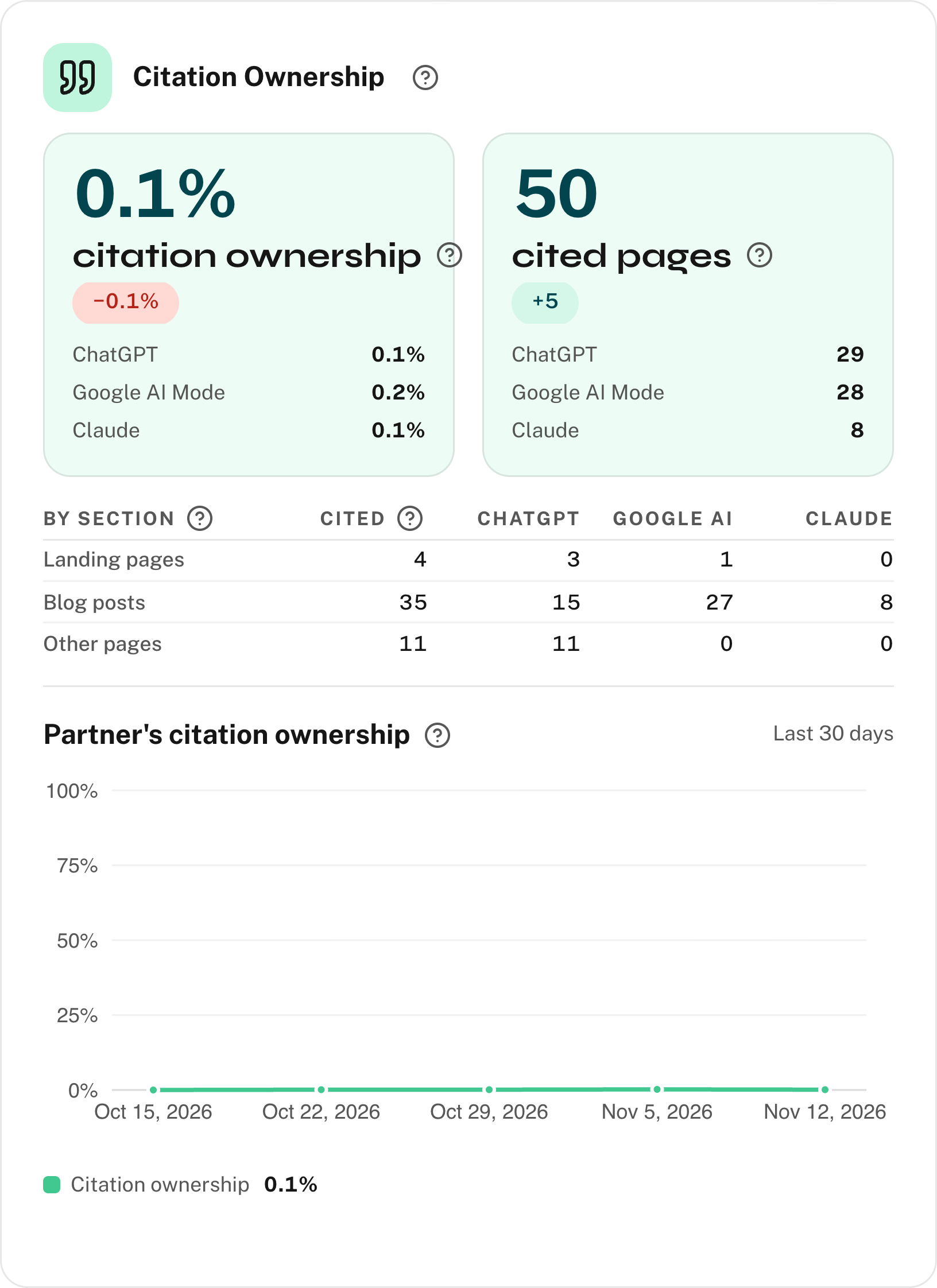
Fifty pages cited in a month is the fast clock working. The flat share line beside them is what a board sees if it gets only one number, and it reads as nothing happening.
So report two lines instead of one, each on its own schedule:
Scroll horizontally to see all columns when the table is wider than this page.
| Line | How often | What it shows |
|---|---|---|
| The live line | Monthly | On a fixed set of buyer questions, which pages the answers cite, which of those name you, and which are new |
| The trained line | Quarterly | The same questions asked with search off, and whether the model’s description of you has caught up |
The trained line moves slowly by design, so it never decides whether the first quarter worked. Our take is that a first quarter of AI search work should be judged on the live line alone, and the trained line read as a lagging check.
Empact Partners would start where the fast clock pays, on the listicles and reviews your buyers’ answers already cite. We put your buyers’ questions into the Panel every week and write to the editors of the cited pages with a case for adding your product. We compare every placement with the answers, and we say up front that the horizon is quarters.
What our AI search work covers
- Your own site, written and built so AI engines can quote it.
- Cited pages, the listicles and reviews answers lean on, with a case put to each editor.
- Reddit threads, where real users recommend the product.
- Standing reports of your visibility and citations, and the first step for every recommendation.
To set up the monthly line on your own, start from our playbook on measuring AI visibility with a fixed set of buyer questions.
Watch one thing in the first month, whether the pages your live answers cite start naming you. When they do, the answers can follow within weeks, and the model’s memory follows releases later.
Frequently Asked Questions
How long until a new mention shows up in ChatGPT?
There is no fixed delay, and the page the mention sits on decides most of it. If that page already comes back when ChatGPT searches your buyers’ questions, a change on it can be read the next time someone asks.
In our Panel data, a partner’s new posts that ChatGPT cited at all were cited within 8 days of going live. Most were never cited, because its searches did not return them. A mention that has to wait for training waits months, until a later model is released with a newer cutoff.
Why does ChatGPT still describe us under our old name?
Either the answer came from training, or the pages live search found still use the old name. With no sources under the answer, assume training. A model knows only what the web said before its cutoff.
In our run, even a rename two months before the cutoff had not reached the model’s answer about the old name. With sources, open them. Those are the pages to update yourself or to ask their editors to update.
How often do AI models learn new information?
Only when a new model is trained and released, and no vendor publishes a timetable for that. Each release has its own cutoff. On 18 November 2026, the OpenAI model we tested still stopped at 30 April 2026, more than six months back. A fact that changed in May was not in what it learned. Live search covers that gap whenever ChatGPT decides a question needs it.
Can we get our brand into a model’s training data faster?
Not on any schedule you control. You can shape what the next training run finds. Keep your own site stating the current facts plainly, allow GPTBot if you want your own pages used, and get other sites to name you the same way.
Being in the data is not the same as being the answer, either. The model we tested knew Everpure existed and still answered questions about Pure Storage without mentioning it.
Does blocking GPTBot keep us out of ChatGPT answers?
Not out of its search answers. OpenAI runs OAI-SearchBot for the pages ChatGPT’s search shows and GPTBot for content that may be used in training, and says the two settings are independent.
Blocking GPTBot keeps your own pages out of future training, so the slow clock can learn about you only from other sites. Blocking OAI-SearchBot is the setting that keeps you out of ChatGPT’s search answers.
Does Google AI Mode pick up new pages faster than ChatGPT?
Not faster in our data, but more widely. Of one partner’s 54 new posts, Google AI Mode cited 14 and ChatGPT 10. ChatGPT cited all of its 10 within 8 days, while five of Google’s first citations came 13 to 22 days after the post went live. Google says a page can support an AI Mode answer once it is indexed and can show with a snippet, so how quickly Google indexes a page sets that clock.
Does Claude search the web before it answers?
When a question benefits from current information, it does, and it cites the pages it read. On plans that show the web search toggle, a person can switch it off for a chat, and the answer then comes from the model’s training alone. That makes Claude a convenient place to see what a model remembers about your company, as long as you write down which mode each answer came from.
How should we split effort between the fast and slow clocks?
There is no separate budget for the slow clock. The listicles, reviews and threads that put you in live answers this month are also pages a later model may learn from.
So the effort goes to winning the pages answers already cite, and to keeping your own facts consistent everywhere they appear. The trained layer follows on its own timetable. A quarter is the honest horizon for the first clock, and model releases set the second.
Why didn’t the answer change after a listicle added us?
Usually one of a few things happened. The answer did not search, so it never read the listicle. It searched, but that listicle was not among the pages returned for that question.
Or it read the listicle and named the brands ranked above you. Open the sources under the answer first. If the listicle is not there, each question returns its own set of pages, and a different page may matter more for that one.
Can our team run these checks without help?
The first check, yes, in an afternoon with a logged-out ChatGPT window and Claude. Running it once is easy. Running it the same way every week, on the same questions and on every engine, is where most teams stop, because answers vary from run to run and only a fixed routine separates a real change from noise. Give that routine an owner before the first report goes out.
Sources (13)
- Empact Partners, "Run A" (2026)Empact Partners' own data↩1↩2six public company renames asked of ChatGPT with search off and with search, 18 November 2026. Read 18 November 2026.
- Empact Partners, "the Empact Panel" (2026)Empact Partners' own data↩1↩2one software partner’s 54 new blog posts timed against weekly collections from 15 October to 12 November 2026. Read 18 November 2026.
- OpenAI, "GPT-6.1 Sol" (2026)↩1model page. Knowledge cutoff of 30 April 2026. Read 18 November 2026.
- OpenAI Help Center, "Searching the web with ChatGPT" (2026)↩1When ChatGPT searches on its own, and citations in answers that use search. Read 18 November 2026.
- OpenAI, "Overview of OpenAI Crawlers" (2026)↩1OAI-SearchBot for search answers, GPTBot for training, set independently. Read 18 November 2026.
- Google Search Central, "AI features and your website" (2026)↩1What a page needs to support an AI Overviews or AI Mode answer. Read 18 November 2026.
- Google, "Bard becomes Gemini" (2024)↩18 February 2024. Read 18 November 2026.
- Everpure, "Pure Storage becomes Everpure" (2026)↩123 February 2026. Read 18 November 2026.
- Lucen Software, "Office Timeline is now Lucen Software" (2026)↩1Renamed 12 May 2026. Read 18 November 2026.
- Kongsberg, "Digital rebrands as Falkor" (2026)↩11 June 2026. Read 18 November 2026.
- Qfactor, "BizWatt officially rebrands as Qfactor" (2026)↩119 June 2026. Read 18 November 2026.
- Hiero, "graphx rebrands as Hiero" (2026)↩121 July 2026. Read 18 November 2026.
- Claude Help Center, "Enable and use web search" (2026)↩1When Claude searches, its citations, and switching web search off. Read 18 November 2026.
Keep reading
GEO How to Tell if AI Is Recommending Your Brand or Just Naming It
Separate AI mentions from recommendations, spot buyer objections, and decide who fixes the proof or positioning behind them.
GEO How to Build an AI Visibility Baseline in ChatGPT and AI Mode
One screenshot of an AI answer measures the person who asked. Build a sheet of which companies ChatGPT and AI Mode name for your buyers.

GEO How To Check Which AI Bots Really Read Your Site
Pull a week of Cloudflare or host logs, check each AI crawler name against its operator’s addresses, and hand engineering a fix list.