
How Many Articles to Publish When AI Writes the Drafts
AI made drafts cheap. The articles worth publishing still carry what your experts know, so budget their hours first and the count follows.
 Samantha SpiroWith
 Vlad Shvets
On this page
Empact Newsletter
One email a month on what is working in AI search and SaaS go-to-market.
Set next year’s content budget from the hours your experts can give, and let the number of articles follow. AI made a first draft nearly free. It did nothing for the part a buyer reads an article for. That part is what your founder, your product lead or your keenest user knows and the ranking pages don’t say.
Getting that knowledge out of them still takes hours from somebody’s calendar. For articles that sell a B2B product to people who know their job, those hours decide how many are worth publishing and what each one costs. Tutorials, help pages and templates lean on them less, because a writer can build those from the product itself.
Empact Partners writes the articles in SaaS companies’ content marketing from interviews with their own experts, so each one tells buyers something the ranking pages don’t. We would plan your year of them from the hours those experts can give.
What an Article Costs When AI Writes the Draft
The savings are real, and a budget that ignores them is wrong. First Page Sage, an SEO firm, surveyed 1,080 marketing and communications teams this year.1 It put the fully loaded cost of a 1,000-word article 70 to 74% lower than in 2022, depending on company size.
The saving was smaller at larger companies, the report found, because compliance review, brand governance and subject-matter validation “do not compress the way drafting does.” On our own publications we saw what happens when that work gets cut. When we let AI write most of each piece, the hours fell sharply and so did the quality.
The time that used to go into drafting went into checking facts, fixing product details and rewriting whatever sounded generic. Put an article’s hours on a line, before and after AI drafts it, and only one stretch gets shorter:
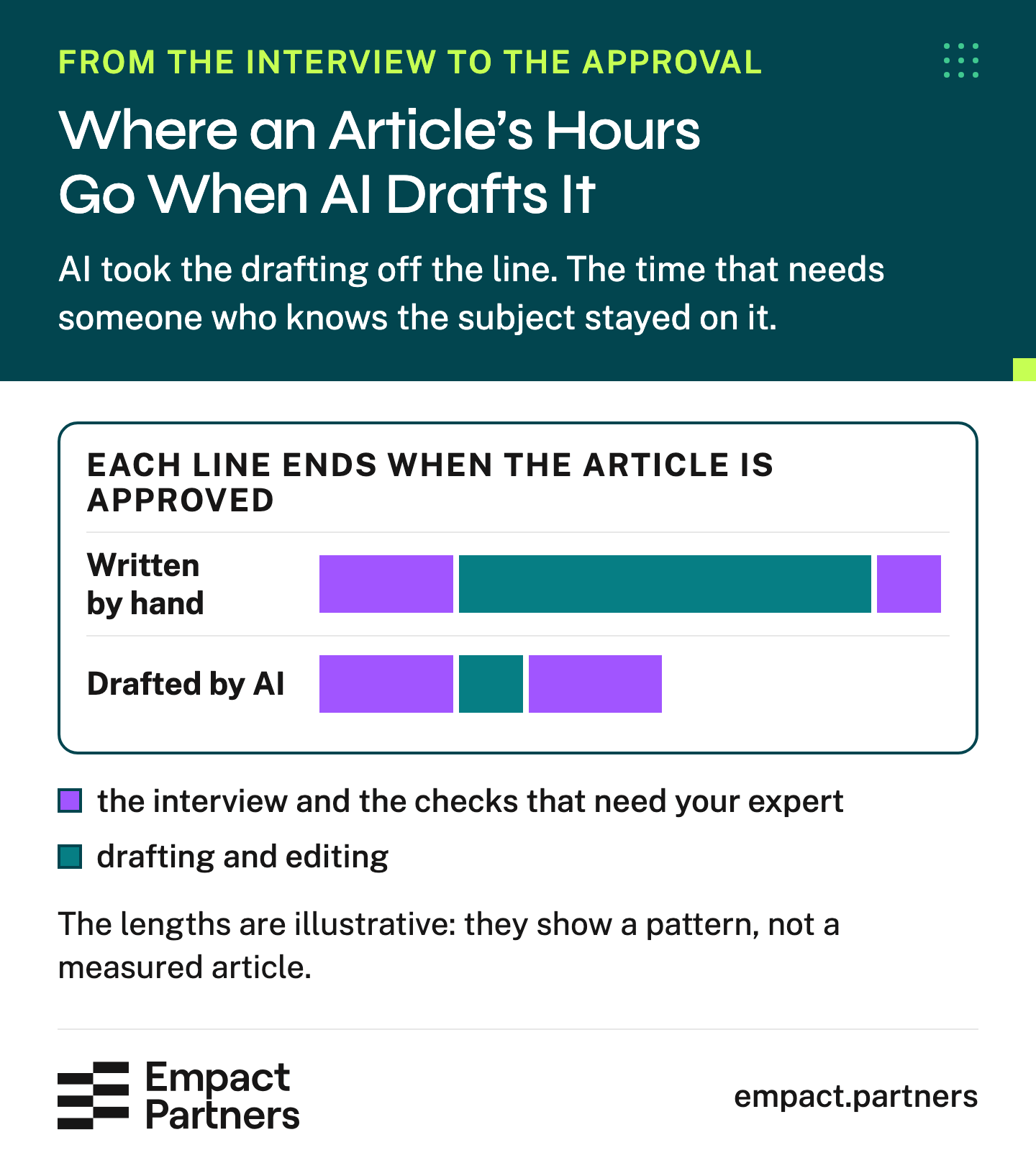
What is left on the line is mostly the time of people who know the subject. They give the article its substance in the interview, and they check that it is still true of the product. That work did not get cheaper because the typing did.
Add up the hours behind your best article from last year, and the writing is rarely most of them. The time went on someone explaining a product decision, and on checking that the piece got the product right. AI shrinks the writing. It leaves the interview and the check, and those hours belong in the budget under the names of the people who give them.
 Samantha Spiro on LinkedInOpens in a new tab
To see your own split, open the Content Cost calculator’s AI Assisted tab. In Human Time With AI, enter every hour your team spends briefing, interviewing, editing and checking:
Once the drafting cost is small, that one field carries most of the total. It also decides how many articles your team can stand behind.
Why Your Experts’ Time Caps How Many Articles Are Worth Publishing
An article earns its reader with something the other pages on the topic don’t have. It might be the reason behind a product decision, the way one user set the product up, or a number from your own data. Each of those comes from a person.
When those people have nothing new to tell you, a drafting agent will still produce the articles, and readers will find nothing in them. NP Digital, the marketing firm Neil Patel co-founded, asked 100 companies where their new content came from and where their organic traffic went.2
Content written entirely by AI was about half of their new output, and it accounted for a twentieth of their organic traffic. The survey sets new output against all traffic, so older pages people wrote may carry part of the human share, and the firm, which sells content work, calls the findings directional:
Scroll horizontally to see all columns when the table is wider than this page.
| Kind of content | Share of new content | Share of organic traffic |
|---|---|---|
| Written entirely by AI | 52.1% | 4.9% |
| AI draft edited by a person | 27.4% | 8.1% |
| Written by a person | 14.5% | 87% |
AI drafts that a person edited were more than a quarter of the output and drew 8.1% of the traffic, far closer to raw AI than to the pages people wrote. My reading is that the human pages carried what their writers knew before the first line, which an edit adds only when the editor brings new material. The survey can’t prove that, and it doesn’t claim to.
One practitioner posted the same shape from a small SaaS blog on r/GrowthHacking in August.5 Over four months, 28 of their 30 generated articles drew almost nothing, and six of the 10 written by hand brought in almost all the organic signups. The batches covered different topics, so it is one person’s experience, and it points where the survey does:
An article is worth publishing when it carries something your experts know that the ranking pages don’t say.
Our own cases show articles coming out of conversations. Vestlane makes compliance and investor onboarding software for private market funds, read by fund managers, their investors and the lawyers who advise them. We wrote 16 specialized pieces from more than nine hours of interviews with its founders and outside experts.3
SystemOne is a booking platform for artist bookers. We interviewed booking firms that use it, one at a time, and each interview became a case study of how that kind of firm works. In both partnerships the pieces came from what people told us.
The obvious reply is that most of what your experts know has been said already, somewhere, and can be used again.
Can’t We Reuse What Our Experts Already Said?
The case for publishing more without asking for more time is a strong one. Your team has already said a great deal of what it knows in recorded sales calls, support tickets, the docs and last year’s webinars. An agent can draw on all of it, and one good interview can feed several articles.
Where the knowledge sits in the product, volume works too. Two of our writers produced more than 500 how-to tutorials for PDF Reader Pro, each on a task people do with PDFs. Its organic traffic doubled in a year, and the product guides were credited with 15 to 20% of monthly sales.4
Tutorials like those teach tasks inside the product, so most of what they need can be learned from the product itself. Reusing your team’s recordings saves fresh interviews in a similar way for a while, and your budget should still see its limits:
Pros
- An hour of a founder’s time can carry more than one article
- The material is already in your team’s own words
- It needs no new interview
Cons
- Every recording describes the product as it was that day
- The decisions, cases and judgments in it run out
- Someone who knows still has to confirm each claim before it goes out
So reuse stretches your experts’ hours without removing them. A transcript from last spring describes last spring’s product. On r/content_marketing, people answering a team that publishes eight posts a month put the planning rule plainly:
Tips from Reddit
Advice to a team publishing eight posts a month
I would make the bottleneck evidence, not drafting.
Eight original posts probably need eight genuine observations, opinions, experiments, or customer insights.
If you don’t know those things - then you’re just churning out thin, useless content even if you’re just putting out one thing per month.
The last two reach the same place from opposite ends. Eight a month needs eight things worth saying, and dropping to one a month does nothing for a team with nothing to say. Either way, the plan starts from what your people know, so build it from their hours.
How to Set Next Year’s Article Count From Your Experts’ Calendars
Start next year’s plan from the people, and leave the count for last. Before anyone agrees to a monthly number, run these checks with whoever owns the content budget:
- Write down who knows what your buyers ask about: the founder, a product lead, the support lead, a seller, and a user or two who would talk to you.
- Ask each of them how many hours they can give this quarter, and plan on the number they give.
- For each person, write the questions only they can answer, and the articles each answer could carry.
- Go through the recordings and tickets you already hold, and mark what is still true of today’s product.
- Put a name beside every article on the plan, for the interview and for the final check.
- Set the monthly count from that sheet, and cut any article with no name beside it.
Those names and hours are a cost, and the budget should show it:
Price your experts’ hours into the content budget at what those hours cost the company. Once a founder’s afternoon has a number beside it, nobody signs off a bigger monthly count without asking whose afternoons will pay for it.
Samantha Spiro on LinkedInOpens in a new tabWhen we write a partner’s articles, the consultant who owns that topic area runs those interviews. Each one is about an hour with a founder or product lead, recorded before any agent drafts. The product facts and the style the agents read are set once for each topic area, and every article still gets its own interview.
One agent writes from the transcript and the partner’s approved facts, and a second checks every claim. Any question either of them raises goes back to the expert, never into the text, and the consultant approves the piece. More articles was our own first answer, and partners turned it down: they asked for fewer, deeper pieces.
I set that method out step by step in our playbook, from the first interview to the approved article:
To find the questions for your next expert interview, start with an article you have already published. The Information Gain Check compares it with up to eight pages that rank for the same search, then emails you five suggested additions or checks, including answers your article is missing.
Take the first two additions to the person who knows the subject best, and you have the start of that interview. The check is a free preview of an agent that reads each article we publish for content partners:
For the articles that sell your product, whatever count your experts’ hours support is next year’s number. Past it, the extra pages have nothing of yours to say.
Frequently Asked Questions
How many articles a month should a B2B SaaS company publish?
Work the number out from your experts’ hours instead of picking a cadence. Name the people who know what your buyers ask, and ask each one how many hours they can give this quarter. Then plan an article for each distinct thing they can tell you that the ranking pages don’t.
If that comes to fewer articles than the calendar you inherited, publish the smaller number. Tutorials and templates built from the product are the exception, since a writer who uses the product can produce many of them.
How much expert time does one article need?
Budget a recorded conversation with the person who knows the subject, plus their time to answer follow-up questions and check the finished piece. The check is the part teams forget to count, and it comes out of the same calendar.
A conversation that covers related questions can feed more than one article, so plan conversations and topics together. For Vestlane, more than nine hours of interviews stood behind 16 pieces.
Who counts as an expert for a SaaS article?
Anyone who knows something your buyers ask about that the ranking pages don’t say. That is usually the founder and a product lead. Your support and sales staff hear buyers’ questions every day, and a user who set the product up can explain what it changed for them.
For SystemOne we interviewed booking firms that use the product, one at a time. Choose by what the article needs: a product decision needs the person who made it, and a setup story needs the person who did the setup.
What does an article cost once AI writes the draft?
Less than it did, though not by as much as the drafting cost alone suggests. First Page Sage’s survey put the fully loaded cost of an article 70 to 74% below its 2022 level. It also found that subject-matter validation did not shrink the way drafting did.
Price your own in the Content Cost calculator. Its AI Assisted tab takes your AI spend and every human hour at your loaded hourly cost. Once drafting is cheap, those human hours are the bulk of the bill.
Can AI write the whole article if we give it our documentation?
AI can write a correct article from your documentation, and for help pages and tutorials that is often enough. What it can’t supply is what the documentation never recorded: why a feature works the way it does, which setup a real user chose, what you would tell a buyer comparing you with a rival.
In NP Digital’s survey, AI drafts edited by a person still drew a small share of traffic for their share of output. Our reading, which the survey can’t prove, is that the gap was what the writer knew, and that knowledge sits with people.
Should we refresh old posts instead of publishing new ones?
Often, yes. Refreshing a post that still ranks needs less of your experts’ time than a new article: a conversation about what has changed, then the check. For Vestlane we refreshed 13 existing articles alongside the 16 new pieces.
Start with posts on topics your buyers still ask about. Give each refresh the same final check a new article gets, because an old claim about your product is the one most likely to be wrong today.
What if our founders and product people have no time?
Then your honest monthly number is small, and that is worth knowing before you set the budget. Ask for a recorded hour you can keep every month or every quarter, and send the questions in advance so the hour goes on what only they know.
Fill the gaps from what your team already says: recorded sales calls, support tickets, the answers your sellers write to buyers. Check anything taken from a recording against today’s product before it goes into an article.
Does publishing more often help SEO or AI search visibility?
Only when each new page adds something readers and engines can’t already get. Google and the AI engines already hold the general answer to most questions, so one more page repeating it gives them little reason to rank or quote yours.
A posting count used to stand in for effort, because each post took a writer days. With drafts nearly free, it only tells you how many pages went out. What earns the ranking or the citation is what the page says that the others don’t.
How do we find enough original topics for the year?
Start from the conversations rather than the keyword tool. A good interview turns up decisions, cases and numbers. Keep the ones the ranking pages don’t have, since those are topics only your company can write. Keep the questions buyers ask on calls and in tickets beside them, and match each question to the person who can answer it.
A topic nobody on your team can answer from experience is better cut than padded out, however much search volume it shows.
How do we know whether the articles were worth the hours?
Track each article on its own line instead of the blog’s total. Watch the visits it draws from buyers, the sign-ups or demo requests it leads to, and whether your sellers send it to prospects. Give it a few months, since search engines and AI answers take time to pick a page up.
Then compare what each expert’s hours produced. If one person’s interviews keep becoming the pieces that convert, give their calendar priority in the next plan.
Sources (5)
- First Page Sage, "AI Content Creation Statistics: 2026 Report" (2026)↩128 October 2026, firstpagesage.com. Survey of 1,080 marketing and communications teams, January to October 2026.
- NP Digital, "How Well Does AI-Generated Content Rank on Google?" (2026)↩1August 2026, neilpatel.com. Survey of 100 companies, numbers rounded, findings described by the publisher as directional.
- Empact Partners, "Vestlane case study" (2026)Empact Partners' own data↩1Read on 26 November 2026.
- Empact Partners, "PDF Reader Pro case study" (2026)Empact Partners' own data↩1Read on 26 November 2026.
- u/Short_Map4588, "I published 40 articles from an ai content generator and tracked them for 4 months" (2026)↩1r/GrowthHacking, August 2026, reddit.com.
Keep reading
Content Marketing The Content a Sales-Led SaaS Needs That Self-Serve Doesn’t
A sales-led deal closes on what a rep can send a buyer. Here is that content set, how to brief it from your calls, and what to build first.

Content Marketing What To Give A Content Agent Before It Drafts Anything
Give your content agent approved proof, buyer language and a clear owner so your team spends less time fixing generic drafts.
Content Marketing How to Build Technical Content Developers Trust
Turn engineers' answers into technical content buyers can check, with clear ownership of interviews, drafts and reviews.