The Content a Sales-Led SaaS Needs That Self-Serve Doesn’t
A sales-led deal closes on what a rep can send a buyer. Here is that content set, how to brief it from your calls, and what to build first.
 Anri-Cornel MareeWith
 Vlad Shvets
On this page
- Why a Blog Calendar Leaves Reps With Nothing to Send
- The Pieces a Sales-Led Deal Uses
- Brief Each Piece From the Objections Buyers Raise
- Write Every Piece So the Buyer Can Forward It
- Where the Content Work Hands Off to RevOps
- Check What You Have, Then Build Three Pieces First
- How We Build Sales Content for Sales-Led SaaS Teams
- Frequently Asked Questions
Empact Newsletter
One email a month on what is working in AI search and SaaS go-to-market.
A SaaS company that sells through a sales team can publish a blog post every week for a year and still leave its reps with nothing to send a buyer. The posts answer what strangers type into Google. The questions that decide a deal come up on sales calls, and nobody turns them into anything a rep can forward.
A self-serve product can win a buyer who arrives alone, reads a page and signs up. A sales-led deal goes through a rep, and the conversion that counts is a booked meeting, then a signed contract. The content that helps at that point is whatever the rep can put in front of the buyer.
Empact Partners writes the customer stories and sales pages that SaaS sales teams send buyers, the part of content marketing that works inside a deal. The best brief for each piece is already in your sales calls.
Why a Blog Calendar Leaves Reps With Nothing to Send
A content calendar is usually briefed from keyword research: what people search for, how often, and how hard each term is to rank for. That brings in readers who have not spoken to your company yet, which is worth having. It rarely reaches the buyer already on a call with your rep.
That buyer’s questions are narrower. Will this work for a company our size? What does it cost against what we pay now? Why you and not the vendor we already use? Most have almost no search volume, so a calendar built from search data never schedules them. The answers stay in the heads of the reps who hear them.
Sellers notice the gap first. UserEvidence surveyed 619 B2B software buyers, sellers and marketers, and 85% of sellers wished their marketing team gave them better and more varied customer evidence.1 UserEvidence sells software for collecting that evidence, so it has a stake in the answer. Reps who go without make their own one-pagers the night before a call.
The Pieces a Sales-Led Deal Uses
We hold that the content mix has to follow how a company sells. Once a sales team closes the deals, the pieces that matter most are the ones a rep can send, and each answers one question at one point in a deal:
Scroll horizontally to see all columns when the table is wider than this page.
| Piece | The question it answers | Brief it from | Who sends it |
|---|---|---|---|
| Customer story for one kind of buyer | Has a company like ours made this work? | Won deals with buyers of that kind, and an interview with the customer | The rep, then the champion, to colleagues |
| Sales page for one objection | The objection reps hear most often | Call notes and the reasons deals stalled or were lost | The rep, in the follow-up email |
| One-pager or business case | What does it cost, and what do we get for it? | Price and timing objections, and the questions the champion’s boss asks | The champion, to whoever signs |
| Comparison sheet | Why you, and not the vendor we use or a tool we build ourselves? | Deals where a rival or an in-house plan came up | The rep, when the buyer names the alternative |
| Webinar | What should we know before we are ready to buy? | Questions buyers ask well before a deal | Marketing invites, and a rep follows up with those who came |
| Directory and review profiles | What do other customers say about it? | Customers willing to write a review | Buyers find them on their own, and reps link them |
A customer story works when the buyer on the call can see their own company in it. The customers of SystemOne, whose software runs tour bookings, range from a single person booking techno acts in Germany to big jazz booking houses in the US. One story could not speak to both, so each customer we interviewed became a case study for that kind of booking business.
The comparison sheet has a public cousin, the comparison page a buyer finds in search before calling anyone. Both answer the same objection, one in a rep’s email and one on your site.
The last two rows bring buyers in, where the first four help close the deals already moving. Webinars and directory listings make little sense for a self-serve product, and they pay off once a sales team exists to take the leads they bring. So they come after the pieces that close.
Brief Each Piece From the Objections Buyers Raise
Keyword research misses most of the questions in that table, because buyers ask them on calls and in email threads far more than in a search box. Your call notes and email threads hold them. So the brief for a sales piece starts from what buyers said, in their own words, and from what happened to the deal afterwards.
The questions that decide a sales-led deal are asked on calls, so that is where its briefs come from.
We ran that count on our own sales. We read the whole conversation with every company in our CRM, from the mail to the call notes. Each objection went into a log with the deal’s outcome: 281 objections from 141 companies.2 They fell into a few kinds. We sell consulting work, not a SaaS product, so read the shape rather than the exact mix:
Objections From Buyers Who Signed and From Lost Deals
281 objections from 141 companies in our own CRM, open deals not shown
59 in all354
50 in all251
44 in all223
44 in all292
35 in all192
28 in all143
11 in all20
10 in all32
View the data
| Label | Raised by companies that signed | Raised in deals that ended lost |
|---|---|---|
| Price 59 in all | 35 | 4 |
| Not now 50 in all | 25 | 1 |
| Will it work for us 44 in all | 22 | 3 |
| Other kinds 44 in all | 29 | 2 |
| Proof and risk 35 in all | 19 | 2 |
| Not a priority 28 in all | 14 | 3 |
| Doing it in-house 11 in all | 2 | 0 |
| Another vendor 10 in all | 3 | 2 |
149 of the 281 were raised by companies that later signed, and 17 came from deals that ended lost. A brief built only from lost-deal notes would have worked from 17 objections. It would have missed the 149 raised by buyers who signed, and what the rep said to each of them.
The won deals hold the better brief. There the objection was raised and the deal still closed. What the rep said is the first thing to read, and to check with the rep before it becomes copy. Building the log for your own deals runs in this order:
Build the objection log
Pull the deals.
Take every deal that reached a first meeting in the last two quarters, won, lost and still open, with its call notes and email threads.
Write each objection down.
One row per objection, in the buyer’s words, with the deal’s outcome beside it.
Sort the rows.
Use a short, fixed set of kinds, such as price, timing, fit, proof, another vendor and doing it in-house.
Find the answer that worked.
For each kind, read what the rep said in the deals that signed.
Check what you already have.
Mark which kinds a rep can answer today with something to send.
Brief the gaps.
Write a brief for each uncovered kind in the buyer’s words, with the winning answer at its center.
The step teams skip is the fourth. A rep who handles the price question well has already written the business case out loud, and nobody kept it. For Anri-Cornel Maree, a Reddit marketer at Empact Partners, that answer is the brief:
A keyword tool shows what strangers search for. It cannot show the few questions your buyers ask on almost every call, or the answer that closed the deals where those questions came up. Count the questions from your own deals and write the winning answer down in the buyer’s words. Then every rep can send it instead of improvising it.
 Anri-Cornel Maree on LinkedInOpens in a new tab
Write Every Piece So the Buyer Can Forward It
The buyer on the call is rarely the only person deciding. In the same UserEvidence survey, 54% of buyers said more than five people inside their company get a say in a software purchase.1 Most of them never hear your rep. They meet your company through whatever the buyer forwards, so every piece has to make sense to someone who missed the call.
That changes the writing. A forwarded piece names the kind of company it is for in its first lines, states the problem the way buyers put it, and ends on one next step. Those words come from the same calls, and from the forums and review sites where buyers describe the problem to each other.
A feature tour written in your product’s own vocabulary does the opposite. It gives a finance lead nothing to repeat to the people they report to. The sales page a rep links carries a second job on top of all that:
The one-pager a champion forwards to whoever signs is the plainest case. It answers the price and timing objections in that person’s terms: what the purchase replaces, what it costs against that, and when the team will see the change.
All of these pieces draw on the same words, so it pays to write them down once, in one place that writers and reps both start from:
Once writers and reps start from the same page, a story a rep forwards says what the sales call said. Whether anyone can tell which piece helped close a deal is a separate question, and the content team cannot answer it alone.
Where the Content Work Hands Off to RevOps
A sales piece passes through two handoffs, and either one can break the loop. The first runs from the call to the brief, where an objection a rep heard has to reach the person writing. The second runs from the rep’s email to the deal record. There the piece is logged against the deal it went to, so the next review can see which pieces were in deals that closed.
The first handoff belongs to the content work. The second belongs to RevOps, the work of connecting the CRM, the forms and the reports so marketing and sales read the same data:
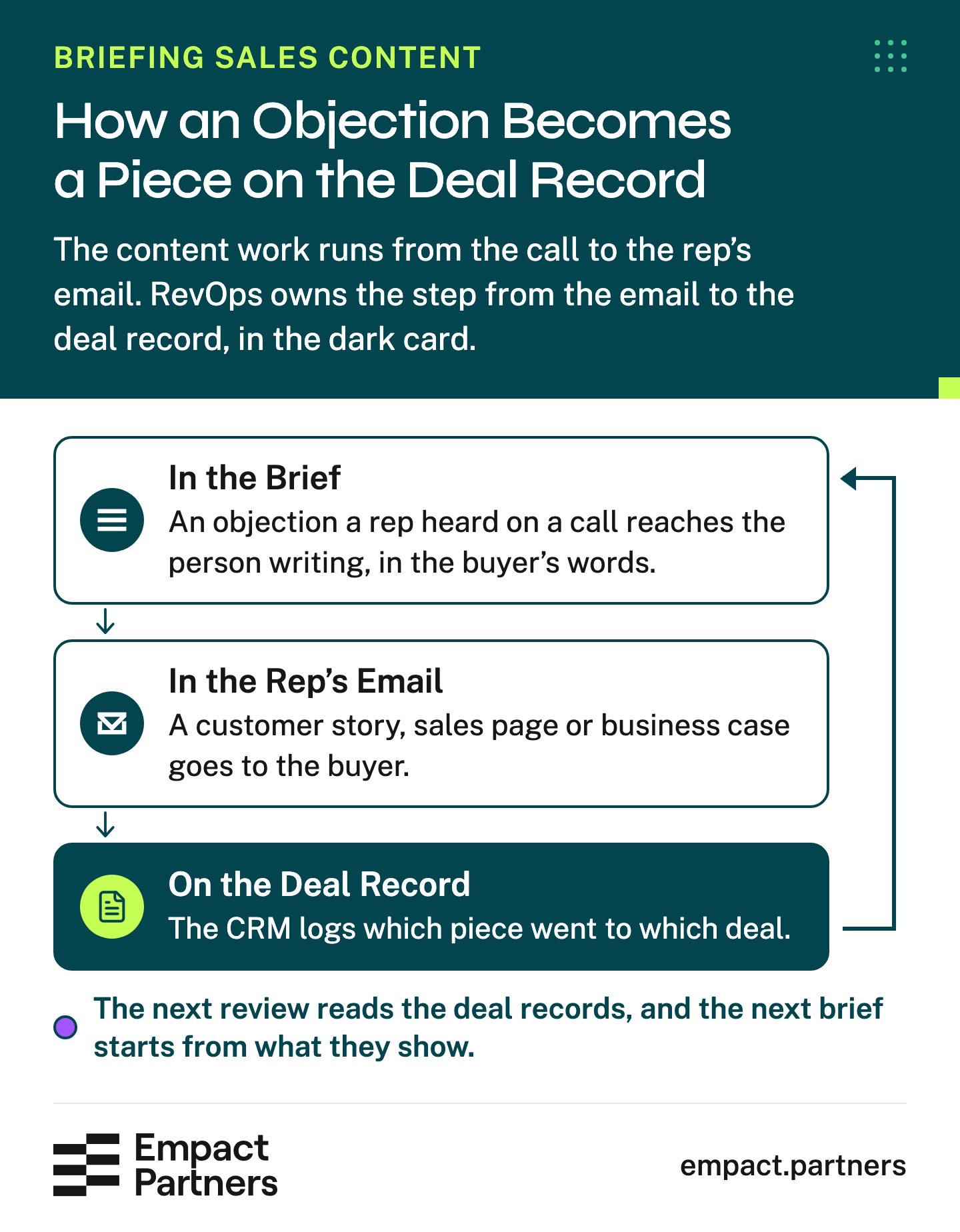
Without the second handoff, the CEO’s question about whether content shows up in deals has no answer, because no record holds it. Webinar sign-ups and directory leads need the same route, into the CRM and on to a rep, with their source kept. Neither handoff needs new software. Each needs an owner, and the second needs a field or an activity type on the deal.
Check What You Have, Then Build Three Pieces First
Most sales-led teams already hold part of the set without knowing it: a case study written for the website, a slide a rep made, an old webinar recording. Run each one through the same checks before you count it:
Before a piece counts as sales content
- A rep can find it without asking anyone
- It names the kind of company it is for
- It uses the words buyers use on calls
- It still makes sense when forwarded to someone who missed the call
- It carries a date and the name of whoever keeps it current
- The CRM records when a rep sends it on a deal
Whatever fails the checks goes back into the brief pile, beside the gaps from your objection log. Then build in this order, before another blog post:
Build these three first
The customer story for the kind of buyer you sell to most.
It answers fit and proof. Together they came up 79 times in our own count, more often than price.
The one-pager a champion forwards to whoever signs.
It carries the price case and the timing case into the room your rep never enters.
The page for the objection your reps hear most.
Your own log names it, and the rep links it in the follow-up while the buyer still has the question.
Webinars and directory profiles come after these three. They bring new buyers into conversations, and those conversations need the first three pieces to finish. The log and the first piece need one person with access to the CRM and the call notes. Keeping the whole set current, with each new objection briefed as it appears, needs a standing owner and takes quarters.
How We Build Sales Content for Sales-Led SaaS Teams
Our take is that a sales-led company should judge its content by what its reps send, and plan it that way from the first roadmap. For a company that sells through reps, the first record Empact Partners would read is its sales calls, before anyone schedules another blog post.
For SystemOne, the work began with the copy for a new website during its rebrand and grew from there. We interviewed its customers for the case studies and grouped its features into a dozen product pages by the jobs buyers come to do. Alongside the launch we planned a review campaign on platforms such as Gartner and Capterra.
Its pipeline ran on account-based outreach, so the stories and pages needed new accounts to reach, and we built a prospecting agent that finds them. We did all of it with the founders, as part of their team, across their whole go-to-market at once. For a sales-led company the roadmap can pair the content work with RevOps for the same reason, since the pieces and the deal records feed each other. Sales content work with us covers:
What sales content work with us covers
- An audit and a roadmap before any calendar
- Interviews with your customers, written up as case studies for the kinds of buyer you sell to
- Sales enablement material written in your buyers’ own words
- A named consultant who chooses each angle and signs off every piece
- RevOps work where the audit finds your deal data split across tools
Judge the first quarter by whether reps send the new pieces at all. A piece nobody sends answers a question nobody on the calls is asking, however well it is written.
Frequently Asked Questions
What is sales enablement content?
Sales enablement content is anything a rep uses to move a deal forward, both what they send buyers and what they read to prepare. The pieces a buyer sees include customer stories, sales pages, one-pagers, comparison sheets and review profiles.
The internal kind, call scripts and battlecards, usually belongs to the sales team or a sales enablement lead. It draws on the same objection log.
Does a sales-led SaaS company still need a blog?
Yes, for the buyers who are not talking to you yet. A blog brings in readers before they reach a rep, and it builds the visibility in search and AI answers that puts your name in front of them. The mistake is paying for the blog while reps have nothing to send.
Feed the problems your sales team hears into the blog’s keyword research too. Those questions can bring in buyers even when a keyword tool shows almost no search volume.
How many customer stories does a sales team need?
One for each kind of buyer your reps meet often. A kind is whatever changes the buyer’s question, such as company size, industry, the team that uses the product or the system it replaces.
Start with the kind you sell to most and add the next one when reps keep asking for it. A rep can use three stories that match the buyers on their calls. Ten stories written for anyone leave the rep to find the match on the spot.
Who should own sales content, marketing or sales?
Marketing writes it, and sales decides whether it works. A content lead owns the objection log and the briefs, reps add objections as they hear them, and a sales manager reads each piece before reps start sending it.
Without one named owner, pieces go out of date, and reps go back to writing their own.
How do we get reps to report the objections they hear?
Make it cheap. A field in the CRM for the main objection on each deal, filled in when the deal changes stage, gets more answers than a monthly survey. Call notes, recordings and the email threads of closed deals fill the gaps where nobody took notes.
Show reps the piece their objection turned into. A rep who sees that happen is more likely to report the next one.
Should a brief come from lost deals or won deals?
Both, for different reasons. Lost deals show where deals die, often late, in procurement or with a person the rep never met. Won deals show the answer that worked, which is the part a writer cannot invent. A win-loss interview with a buyer who chose someone else adds what the rep never heard.
In our own sales conversations, more than half the objections came from companies that later signed, and few from lost deals. A brief built only from lost deals sees a small part of what buyers ask.
How is a sales page different from a blog post?
A blog post answers a question for anyone who searches for it. A sales page answers one objection for a buyer already in a deal, and asks for one next step.
A sales page can rank in search too, but its first reader is the buyer a rep sent it to. So it is written for that person: their kind of company, the words they used on the call and the proof that fits them.
What should a comparison sheet say about the other vendor?
Name the alternative the buyer raised, say plainly where it is the better choice and for which companies, then say where you are. Buyers already know the other vendor has strengths.
A sheet that claims you win on every row reads as marketing, and the colleague it gets forwarded to discounts the rest of it. Keep it to the points buyers raised on calls and date it, because a rival’s product and prices change.
Should sales content be gated?
Not anything a rep sends. A buyer asked to fill in a form to read a case study the rep just emailed may not bother. The colleague they forward it to is even less likely to.
A form can make sense for a long report or a webinar. There the sign-up hands a rep a new lead, and the buyer gets something worth the form.
Can AI write sales content?
AI can draft it. The parts that make a piece work in a deal come from your own record. They are the objection buyers raise, the answer that won the deal and the customer’s own account of the result.
Have the model draft from those parts, and have someone who knows the deals choose the angle and sign off each piece.
How do we know whether a piece of sales content works?
Watch two numbers in the CRM. How often reps send it tells you whether it answers a question they meet. How the deals that received it move, against similar deals that did not, hints at whether it helps. Reps choose which deals get a piece, so check any gap with them before you credit the piece.
Neither number exists until the send is logged on the deal, so set up that field before you judge any piece.
When does a webinar make sense for a sales-led company?
Once the pieces that close deals exist and the CRM routes new leads to a rep. A webinar on a question buyers ask early brings in people who are months from buying, and a rep can follow up with the ones who attended.
Run one before that, and the sign-ups can end up in a spreadsheet with no rep assigned to call them.
Sources (2)
- UserEvidence, "The Evidence Gap: Original Research From UserEvidence" (2024)↩1↩2
- Empact Partners, "Objections in Our Own Sales Conversations, Read From Every Company in Our CRM" (2026)Empact Partners' own data↩1↩2
Keep reading
Content Marketing Is Your SaaS a Fit for Content-Led Growth? The Four Checks
Content-led growth fits SaaS companies whose buyers find vendors on their own. Four checks tell you if yours do, and what to fund if not.

Content Marketing Hire a Content Writer or a Consultancy? Decide Who Owns the Work
Choose a writer, a senior content lead or a consultancy by the work your SaaS team needs owned, reviewed and measured.
Content Marketing Start With Expert Interviews Before You Launch a SaaS Podcast
Decide whether a podcast fits your SaaS team, who owns the work, and how expert interviews become useful buyer content.