


You type the question your best customer asked on their first sales call, in their words: the most affordable tool in your category with SSO, for a team of twenty. Four names come back before you finish reading, each with a reason. One rival is there because its pricing page puts SSO on the cheapest plan.
Your product is fourth, under a line telling the buyer to verify SSO before shortlisting it. It has had SSO on that plan since spring, and every sales call says so. No page the engine can read says it in a sentence, so the engine did the honest thing with what it found and put a warning label on you.
That gap, between what a product does and what its public pages prove, now decides shortlists. Closing it is Content Marketing work, and Empact Partners, a consultancy that sits inside SaaS marketing teams to run their go-to-market, has done it since 2020. Below is how the engines match, and the method we use to act on it.
Buyers Get A Shortlist From One Question, With A Reason Next To Every Name
Buyers have typed questions into search boxes for twenty-five years. The shape of the answer is what changed: three to five names, a reason beside each, and a table if the question asked for one, assembled from the live web while the buyer waits.
Across 408 runs in August, ChatGPT returned an answer with sources 95.59% of the time, in a study by Qvery. Qvery is our sister company, so weigh its numbers knowing that, and check each study’s method on the page we link. What your pages say this week is what the engine reads this week.
To watch what the engine does with a constraint, we asked ChatGPT sixteen questions about newsletter platforms on October 9, a category none of our partners sells in. Four were generic. Twelve carried one constraint each, such as the cheapest tool that takes no cut of paid subscriptions, EU hosting, or SSO for a team of twenty.
Ranked by how many new names each constraint brought in, the twelve questions split in two.
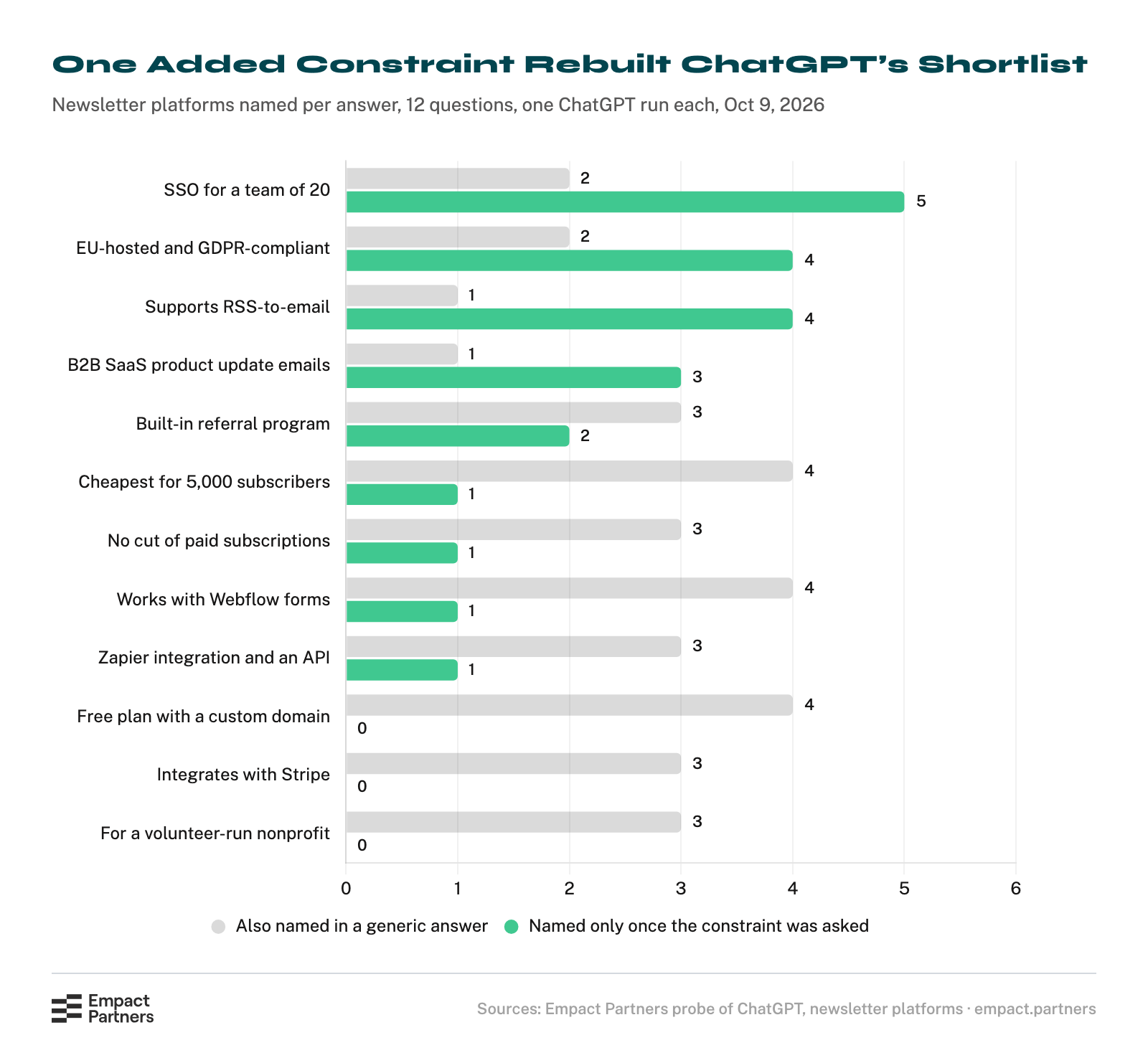
The questions about Stripe, a free custom domain, and a volunteer-run nonprofit stayed with the familiar names. A B2B use case, EU hosting, SSO, and RSS brought in shortlists the generic answers never hinted at. One category, one engine, one run per question: a picture of the mechanism, not a census of the market.
The Engine Grades On Evidence, Which Is Why A Less-Known Product Can Win
Read the reasons beside the names and they split two ways.
We did not check whether either hedged product has the feature. The engine could not find it either, and a warning on the one attribute the buyer asked about is a hard thing to sell past.
A published sentence beating a famous name is the democratizing part, and it is real. A constrained question sends the engine looking for whoever can be shown to meet the constraint, and a small company with a clear page can be that whoever. What the meritocracy grades is evidence somebody published.
Qvery’s study of young SaaS categories draws the boundary of that claim, and part of it argues back. Companies founded in 2023 or later were named often when buyers asked broad questions and about half as often when they asked narrow, qualifier-rich ones, the opposite of what Qvery predicted before collecting.
| The question | What the engines did | What a challenger does about it |
|---|---|---|
| A broad question in a young category | Named a company founded in 2023 or later in 75.84% of answers (Qvery) | Get legible: say what the product is in the buyer’s words |
| A broad question in a mature category | Repeated the same names on every run: four project-management brands, two CRM brands (Qvery) | Stop scoring yourself on it until your own category’s repeat test says otherwise |
| A narrow question, in any category | Named Qvery’s newcomers half as often (38.89%), and in our probe named less-known products whose pages stated the fit | Write the sentence that proves the fit |
Qvery reads the reversal as narrow answers being shorter, built around whichever established name best matches the qualifier.
My reading goes one step further, and it is a reading too. A narrow question asks the engine to verify fit, and an established product has years of documentation, integration guides, and help-center answers stating what it does. A two-year-old product usually has a homepage, a features grid, and a founder who can answer anything on a call.

.png)
The Constraint Decides Which Page Answers
If the engine grades on evidence, the next question is where it looks, and the constraint decides that too. In a Qvery study of constrained SaaS buying questions from August, a roundup or comparison page appeared in 33.6% of price answers and 9.17% of integration answers. The vendor’s own site appeared in 44.8% and 57.5%.
Price questions, in Qvery’s words, go to whoever built the comparison table, and integration questions to whoever maintains the integration. The table half is the job of Generative Engine Optimization, our GEO workstream, which gets a brand into the roundups and threads the engines read.
The half you maintain yourself is Content Marketing’s. Inside the answers that cited a vendor’s own site, Qvery counted which of its pages were read. That says where the engine looked, not why it chose, and it is still the list of pages a content team can change.
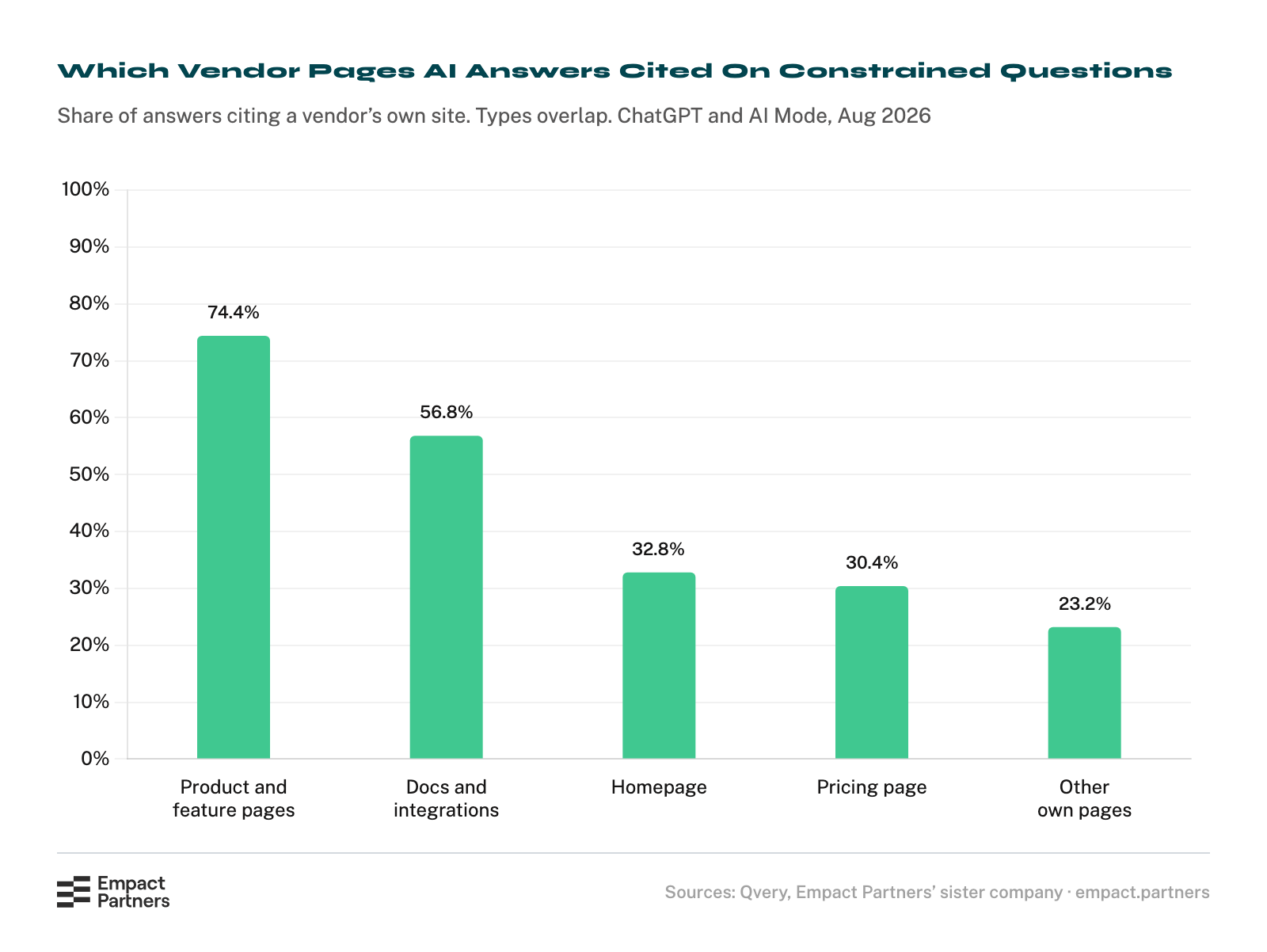
Product and feature pages came first and docs second, both well ahead of the homepage and the pricing page. Whatever the blog contributed sits inside the 23.2% labeled other. A constrained question gets won by the page that describes a feature to someone who needs it.
.png)
Map Every Buyer Question To The Feature That Answers It
A shortlist built on published fit turns AI visibility from a volume problem into a matching problem, and matching has a method. I call it the question-to-feature map, and the name is not clever (it is a spreadsheet). It decides two lists: the pages your content team writes next, and the gaps your product team hears about.
-
Collect the questions as buyers ask them. Keep the constraint: the price ceiling, the stack, the team size, the region, the job. Sales calls, support tickets, and lost-deal notes already hold them, and so do the threads where your buyers ask each other.
-
Rank them before you ask a single engine. Sort by how often buyers ask and what a win is worth. Twenty questions that matter beat two hundred that do not.
-
Ask two engines, several times each. One answer is a sample, and two runs can disagree. Sort nothing until the runs agree.
-
Record who is named and the reason given. The reason is the attribute the engine matched, and it usually quotes a page. Keep the page if the answer cites it.
-
Check the reason against your product and your public pages. Do you have the attribute, and does a page an engine can read without logging in state it in the buyer’s words?
Here is step four on five of our probe questions.
| The buyer’s question | First pick | The reason the answer gave |
|---|---|---|
| Cheapest newsletter tool that takes no cut of paid subscriptions | Buttondown | A $9 monthly add-on and 0% of subscription revenue, from its pricing page |
| GDPR-compliant newsletter platform hosted in the EU | CleverReach | It “states that its servers are located exclusively in Germany and the EU” |
| Newsletter platform with SSO for a marketing team of 20 | Brevo | SSO as a documented Professional-plan add-on, with its price |
| Best newsletter platform for a B2B SaaS company sending product update emails | Loops | Segments by contact properties, user groups, and product activity |
| Newsletter tool with a Zapier integration and an API for a SaaS company | Letterhead | A REST API, webhooks, and Zapier support |
Every reason in that last column is a fact somebody published, which makes it the column your sheet needs most: it tells you what the engine was looking for when it skipped you. Then each question lands in one of three places.
Check The Page Before You Ask Product To Build
The order between the last two matters more than the buckets. Most teams jump from a lost answer to a feature request, because a missing feature is somebody else’s job. Check the page first: the content team controls that fix this quarter, and nobody in product will spot the gap, because to them the feature shipped.
The page that wins a constrained question says the constraint in a sentence: the price in text, the integration named in prose, the plan SSO sits on, the country the data lives in, the team size the product suits. Docs stay public and readable without a login, and each constraint buyers ask about gets its own page.
Engines quote what is written, old or new. An ecommerce operator on Reddit found ChatGPT still quoting a discontinued $149 offer, and another commenter’s fix came down to a sentence on a page:
“Check whether that URL still returns a page. If it does, kill it or redirect it and put the new price in actual text on the replacement. It’ll keep saying $149 for a while regardless. They’re slow to forget and there’s not much you can do about that part.” – u/Zestyclose-Ad-9003, r/ecommerce, Sep 2026
Empact Partners writes those pages under a less fashionable name: product guides. PDF Reader Pro, an Adobe Acrobat alternative, came to us in 2023 with a solid site but no detailed product guides. We wrote how-to guides for the jobs its buyers searched for, each one a preview of the tool doing that job.
By the case study’s count, sales grew 85% against June 2023, when the partnership began, and 15–20% of monthly sales were attributed to those guides. That was search before AI answers, and the mechanism is the same: a buyer looking for a product that does one job, and a page proving this one does.
Content Marketing at Empact Partners is that work at publication scale: product guides and feature pages in the buyer’s words, each owned by a named consultant. For KDAN, the company behind PDF Reader Pro, it ran to more than 500 product tutorials across several products.
The Questions You Still Lose Belong On The Product Roadmap
Some questions stay lost after the page exists, and those are worth more than anything in a feature-request form. A buyer typed the requirement, the engine named the rivals that meet it, and it gave the reason: a lost deal with the winner’s name on it, before your sales team heard of the buyer.
The trap is treating one lost answer as a roadmap item. Product managers already have a rule for that, and one put it plainly on Reddit:
“if 3+ different customers mention the same problem in different words thats a signal. one loud customer is not a roadmap item” – u/Ecaglar, r/ProductManagement, Feb 2026
Apply it to the map. A gap goes to product when several ranked questions lose on the same attribute, and it arrives with what product teams rarely get: the buyer’s words, how often it is asked, which rival wins, the reason given, and who was asking. Another product manager in that thread described where the signal goes today:
“Support conversations die in Zendesk, sales call insights get reduced to a CRM bullet point, CS feedback lives in someone’s head.” – u/frustrated_pm26, r/ProductManagement, Feb 2026
The other honest answer to a gap is a public no. If the product will never serve the buyer who needs EU hosting, the stronger page names who the product is not for and who should pick someone else. An engine quoting your reason for being the wrong fit beats an engine guessing.
When product does ship, the page that proves the feature goes out in the same release, written for the question that produced the request. Teddy Cipolla, one of the consultants on our Content Marketing workstream, has a line for it on our workstream page:

What You Can Run This Week, And What Takes Quarters
Everything in the first column below you can start this afternoon. Twenty ranked questions on two engines, three runs each, is 120 answers to read: a day or two of one person’s time.
| This week, by hand | This quarter and after, as a program |
|---|---|
| Twenty ranked questions with their constraints | The full question set, by buyer role and by every country you sell in |
| Two engines, three runs each, read by a person | The same questions every day, so a change shows up as a trend rather than an anecdote |
| A Write list from the reason column | The pages written, published, and kept current as plans and prices change |
| A short gap list for product | Gaps carried into the roadmap cycle, and re-checked when the feature ships |
| A note of which price questions go to roundups | The third-party half: the roundups and threads behind the price questions |
The second column is where most teams stop, because re-asking hundreds of questions every week is nobody’s job. That half is why I co-founded Qvery, our sister company, so discount the recommendation: it runs a brand’s questions daily on ChatGPT and Google AI Mode, and its free trial shows the data before you take our word.
When a partner brings this to Empact Partners, the work starts with an audit and a roadmap, not a content calendar. A named consultant works in the partner’s own channels, and two or three workstreams run at once, here Content Marketing and GEO, because the page and the roundup answer different halves of the same question.
Measurement ships on a standing schedule, and the horizon is quarters, because the second and third years return more than the first. The map above is the first thing I want on the table.
Watch The Share Of Questions You Win For The Right Reason
The number to watch is the share of your ranked questions where an engine names you for the reason your best customers bought for. It moves when a page gets written and when a feature ships, which makes it the closest thing to a scoreboard this channel has.
If buyers are asking engines questions your product answers and your pages do not, book a call with me and we’ll work out whether we’re the right people to fix it.


