
Why Product-Led Growth Needs One Owner from Signup to Paid
Accounts get lost where marketing, product and RevOps hand them to each other. One person should answer for every stage, whatever the title.
 Gabby SaaymanWith
 Vlad Shvets
On this page
Empact Newsletter
One email a month on what is working in AI search and SaaS go-to-market.
If your product-led growth (PLG) runs through marketing, product and RevOps, one person should own the number from signup to paid: the share of new signups that become paying accounts. That person also needs a say in how each team passes accounts to the next. Write that name down before you change another screen or campaign.
What you give that person matters more than their title, and the need starts the day a second team takes over a stage. In a founder-run startup, the founder already does this job. Once someone does it, deciding what to hand to an outside partner gets much easier.
Empact Partners turns free signups into paying accounts for SaaS companies through product-led growth. We judge every change by whether new accounts go on to pay.
Product-Led Growth Leaks Where Work Passes Between Teams
A product-led path from signup to paid has three stages. Marketing brings the right people to the signup. Product gets them to a first useful result. Then someone decides who buys on their own, who gets a call and what the plan costs. In most companies that last stage sits with sales and RevOps, the team that runs your CRM and decides which rep gets each account.
Each team reports its own stage, and each report can look healthy while paid conversions stall. Signups are up, so marketing had a good month. The onboarding gets finished, so product did too. Sales looked at the new trial accounts, judged them weak and didn’t call. The accounts the company lost aren’t in any of those reports, because they went missing at the handoffs between teams:
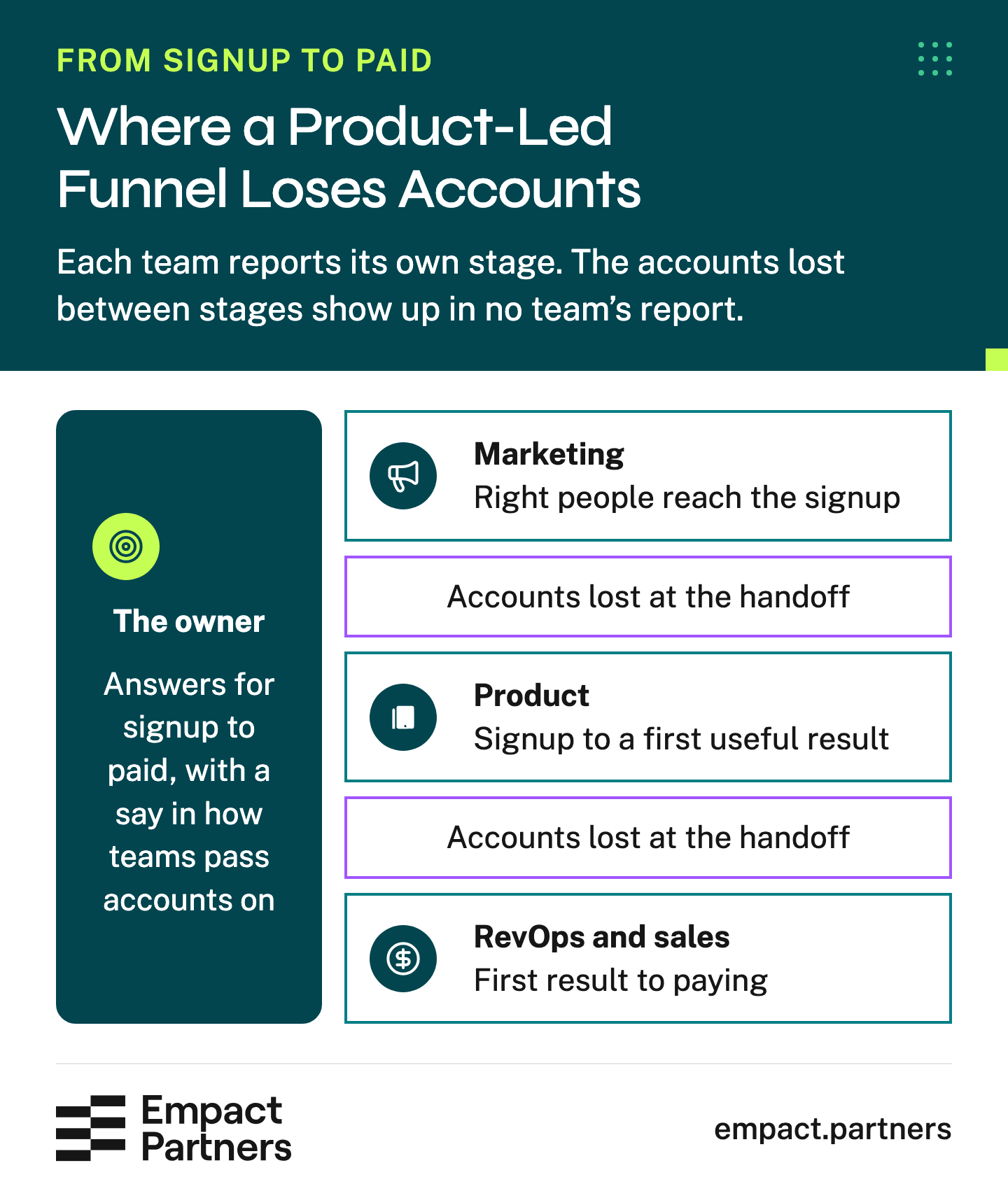
Each of those reports can be accurate. Each team counts its own stage its own way, so an account can be a win in one report and lost in the next, and nobody sees both.
We had a smaller version of this leak in our own pipeline, at a handoff RevOps covers. Before our CRM, someone copied replies to our outreach onto a board by hand. By August 2026, of the 98 companies where a person had written back, 49 had no record.4
The CRM now builds each record from the email itself, and its own check for the week to 26 November found no reply missing.4 That was a sales handoff, and software took it over rather than a person. Still, it shows how much a handoff left to habit can drop, in our case half the companies that wrote back, and a product-led funnel can lose signups the same way.
Nobody’s report shows the accounts lost between two teams, so nobody goes looking for them.
Finding them is half the job. Someone also has to decide which team fixes the stage that loses them.
Someone Has to Decide Which Team Fixes a Stalled Number
A flat paid number has at least three explanations, and each points at a different team. The wrong people are signing up, which is marketing’s to fix. The right people sign up and never reach a result, which is product’s. Or accounts reach a result and nobody routes or prices them well, which belongs to sales and RevOps. On a dashboard all three look the same, signups without payments.
The founders and marketers answering these questions on Reddit split the number before they say whose problem it is:
Tips from Reddit
Before you decide whose problem a stalled signup is
If the free-tool people also aren't touching the prompt, it's a product or onboarding problem. If it's mainly the ad traffic that bounces, you're not failing at activation, you're just paying for the wrong visitors.
A lot of this may just be people who would never have spent a dime. Are you getting users from the right geography/job title/etc.?
Only someone who sees all three stages can tell which explanation is the real one, and that person needs to be able to act on it. They also need a measure for each stage. Ours is a framework we call One Funnel, Three Numbers. The first number is how many of the right people sign up. The second, activation, is how many new accounts get a first useful result. The third is how many of those pay within a set number of days.
One survey of product people suggests how seldom they are held to activation. Product Focus asked 677 product people in 2026, most of them in Europe, which primary metric they answer for. A third had no clear primary metric at all, and another third were held to revenue, which product can’t move alone:1
The Primary Metric Product People Are Held Accountable For
Share of 677 product professionals, mostly in Europe, by the one metric they answer for, Product Focus survey, 2026
View the data
| Label | Value |
|---|---|
| Revenue or P&L | 35% |
| No clear primary metric | 34% |
| Feature adoption | 9% |
| User engagement | 6% |
| Net promoter score | 5% |
| Retention or churn | 4% |
| Shipping velocity | 4% |
| Other | 3% |
Activation isn’t a category of its own in that survey. The closest, feature adoption, was the primary metric for 9% of them, and adoption, engagement and retention together for 19%. So few of the product people surveyed named anything close to activation as their primary metric, which leaves the question of who should answer for it.
ChartMogul’s January 2026 survey of 200 B2B software products shows the same split from the other side. The product team owned activation in 49% of them, while free-to-paid conversion usually fell to sales (28%) or growth (26%).6 In those companies, one team gets new users to a first result and another answers for whether they pay.
Activation is the first sign of whether your signups were worth having, and payment confirms it, so activation should sit with whoever answers for that payment. Product on its own tends to count finished onboarding, and marketing tends to count signups, because those are the parts each team can move.
 Gabby Saayman on LinkedInOpens in a new tab
Once activation is judged on payment, the screens where new users stall become the owner’s business as much as product’s. We wrote down how we raise activation, and how we judge each change by who pays, in this playbook:
An owner with those three numbers can say which stage loses the largest share of the accounts that reach it. The fair objection is that a good weekly meeting could do that job.
Can’t a Weekly Growth Meeting Do the Same Job?
Part of that objection is right. A number handed to someone who can’t move it makes that person the scapegoat for everyone else’s quarter. The better practice, the argument goes, is to align marketing, product and sales on a few shared numbers and review them together every week.
The shared numbers are necessary, and the weekly review is where all three teams see one funnel. The trouble starts when two fixes compete. Say one needs a product sprint and the other needs part of the marketing budget in the same quarter. If nobody in the room has the final say, the three team leads agree both matter and go back to their own plans (which is how a growth review turns into a status update).
If one person in that meeting has the final say, you already have an owner, and that’s all I’m arguing for. Product Focus found the same pull toward clarity. People with clearly defined responsibilities said they hit their deadlines 78% of the time, against 48% where roles were unclear.1 That’s an association rather than a test, and it backs clear roles more than this exact setup. The meeting still has a job once someone owns the number.
Use the weekly growth review to hear the owner’s decision: which stage lost the largest share of its accounts since last week, and what each team changes before the next review.
Gabby Saayman on LinkedInOpens in a new tabThere’s one thing an owner can’t fix, and that’s demand. If people don’t need the product, or need it for one project and leave, no amount of ownership makes them pay every month. An owner reading all three stages is more likely to see that early than three teams each defending their own report.
The Owner Needs Three Rights, Whatever the Title
Whatever the title, the owner needs the right to make three decisions:
- Who counts. Saying which signups are the right people, so marketing is judged on those and not on volume.
- First-session priority. The final say on when work that gets new users to a first result goes ahead of other roadmap items.
- The routing rule. Writing, with sales, the rule for when an account gets a call and when it stays self-serve.
GC AI, a legal AI company for in-house counsel, advertised for its first Head of Self-Serve & Product-Led Growth after a $60 million Series B. The posting gave the role the self-serve P&L across sign-ups, activation, paid conversion and expansion, reporting to the chief revenue officer.2
It made the role responsible for defining the ideal customer, partnering daily with product to influence the roadmap, and agreeing with sales when to route an account to a rep. That covers the three rights, except that the roadmap came as influence rather than the final say. The posting set the role up as a peer of product, marketing and sales.
Miro had the same seat years earlier. Its Head of Self Serve Business and Growth was responsible for the self-service business and led a cross-functional growth team that worked closely with marketing, product and sales.3 Both are role definitions, and neither shows whether the role worked. Before a company gets that far, the number sits with someone else, or with nobody:
Scroll horizontally to see all columns when the table is wider than this page.
| Stage | Who holds signup-to-paid | What the owner needs |
|---|---|---|
| Founder-led, one team | The founder, without having to decide it | Nothing yet, as long as the founder reads every stage |
| First separate teams | Often nobody, or each team its own stage | One named person with the three rights in writing |
| A self-serve business | A head of self-serve | The P&L and the three rights |
The row for first separate teams is the risky one. It’s the first time the path crosses teams, and the first time nobody holds all of it by default. With the number owned, a practical question gets easier to answer: which parts of the work to hand to an outside partner.
Outside Help Works Best Once the Number Has an Owner
A partner should do the work your owner decides on, and leave the number with them. Empact Partners would start from the same three numbers your owner uses and judge every change by whether new accounts pay.
When the leak is at the top, with too few of the right people signing up, the work happens before anyone signs up. There we get the product named in the AI answers, forums and review sites buyers check before they try anything. Across all three stages, the work includes:
- An audit of your path from signup to paid, and a roadmap from it
- A first useful result chosen from the job your users signed up to do, and checked in your analytics
- Changes to the first session judged on whether new accounts pay
- Product, marketing and sales data connected in the CRM you already use
- Your product named where buyers look before they sign up
- A named senior GTM consultant on the calls
What stays with your owner is the number and the decision about which team’s plan gives way when two fixes compete for the same sprint or budget. We’d advise against handing that to any partner, us included. A partner usually can’t move your roadmap or your reps’ calendars, so it would hold the number without the rights. What we can do is lay out the numbers behind each of those decisions.
For a first outside read, the free PLG Readiness Score checks ten public signs on your website that show how self-serve your product looks before anyone signs up. It sends five next steps for the gaps. We run the full version of this agent for our partners:
This week, write one name next to the signup-to-paid number and the three rights beside it. Every change after that has someone to answer for it.
Frequently Asked Questions
Does the owner need a growth title?
No. A founder, a product leader, a marketing leader or a head of growth can all hold it. What makes the job real is the number and the three rights: saying which signups count, getting first-session work onto the roadmap, and writing the routing rule with sales.
A title without those rights is the version product people complain about, accountable for revenue they can’t move. Start with whoever already reads all three stages, and give them the rights in writing.
Where should the signup-to-paid owner report?
Close to whoever answers for revenue, so the trade-offs between teams land with someone who can settle them. GC AI put its first self-serve owner under the chief revenue officer, as a peer of product, marketing and sales.
In a founder-run company the founder keeps it until a second team takes a stage. Once that happens, the reporting line matters less than whether the rights are written down.
Does the owner have to manage all three teams?
No. The owner decides how accounts pass between the teams, and each team keeps its own leader. Marketing keeps its channels, product keeps its roadmap and sales keeps its pipeline.
What changes is that one person can say which signups count and decide when first-session work goes ahead of other roadmap items. The same person agrees with sales when an account should get a call. Disagreements go to that person instead of to three separate quarterly plans.
What should the owner look at every week?
The three numbers for each week’s signups: how many of the right people signed up, how many of those reached a first useful result, and how many of those paid within the days you set. Then look at the stage that loses the largest share of the accounts reaching it, and at the one change you’re testing there.
Activation is an early read. Whether a change worked is decided on who paid.
What free-to-paid conversion rate should we expect?
ChartMogul’s January 2026 survey of 200 B2B software products put the median at 8% of signups paying within six months. Trials that ask for a card upfront converted at 30%.5 Those rates mix freemium, trials and price points, so they tell you little about your own funnel.
Compare this quarter’s signups with last quarter’s on the same three numbers. Your own trend tells you more than a median drawn from other people’s pricing.
How long before we know a change worked?
Set the number of days each new account gets to pay before you launch the change. Activation moves first, and it can mislead. Wait until every account in the test has had its full days before calling the result.
If your signups are too few for payment to move in a quarter, say so and keep testing. Nobody should call that a win yet.
Who decides which signups a sales rep should call?
The owner, together with sales. Write down the product action that shows an account needs something only a rep can give, such as pricing a larger plan, and send only those accounts to sales.
Give each routed account one named person and a deadline to reply. Without a written rule, the choice gets made rep by rep, and an account that was ready to buy can sit unanswered.
When does the founder stop being the owner?
Ownership has to be made explicit when a second team takes over a stage, such as the first marketer who owns signups or the first rep who calls trials. From then on, each team reports its own stage, and nobody watches the handoffs unless you name someone.
The founder can be that someone. Hand it over once the founder no longer reads every stage each week.
Should the owner also answer for expansion and churn?
Later, if at all. Signup to paid is the stretch that crosses teams first, so it needs an owner first. GC AI’s self-serve owner carried expansion revenue too, which fits a company where self-serve is a revenue line with its own P&L.
Earlier on, adding retention to the same person’s number makes it harder to see which stage is losing accounts. Give churn its own owner until the path from signup to paid is steady.
What if paid conversions stay flat after we name an owner?
Go back to the three numbers. If plenty of the right people sign up and reach a first result, and few of them pay, look at demand and packaging. If paying accounts use the product hard for one project and then leave, a subscription may be the wrong way to charge for it.
An owner won’t create demand, but they’ll be the one reading all three numbers when the problem turns out to be the product.
Can an outside partner hold the number for us?
We wouldn’t recommend it. A partner rarely has the power to reorder your product roadmap or decide which accounts your reps call, so a partner holding the number has the same problem as an owner without rights.
Use a partner for the evidence and the work on the stage your owner picks, and keep the decisions between your teams in-house.
Sources (6)
- Product Focus, "2026 Survey of the Product Management Profession" (2026)↩1↩2↩3
- GC AI, "Head of Self-Serve & Product-Led Growth" (2026)↩1job posting on Built In, 2026.
- Product School, "Yuliya Malysh, Head of Growth, Miro" (2020)↩1speaker profile, 2020.
- Empact Partners, "our own outreach replies (data as of 18 August 2026)" (2026)Empact Partners' own data↩1↩2and CRM health check (the seven days to 26 November 2026), 2026.
- ChartMogul, Kyle Poyar and ProductLed, "The SaaS Conversion Report: A new look at free-to-paid conversion" (2026)↩1
- ChartMogul and Kyle Poyar, "The SaaS Conversion Report: What’s working to improve free-to-paid conversion" (2026)↩1
Keep reading
Product-Led Growth Which Signup Form Fields to Keep, and How to Test a Cut
Asked to cut signup fields? Judge each by who reads its answer, move what can wait, and test every cut on paying accounts per visitor.

Product-Led Growth What Content Your SaaS Go-To-Market Motion Needs
Self-serve, sales-led and hybrid companies each need different pages. Name how you sell, then find the pieces your marketing is missing.

Product-Led Growth How to Raise Trial-to-Paid Conversion Without More Traffic
Trial-to-paid stuck at 5 or 6%? Split last month’s trials by source and by first actions, then fix the lever that loses most payers.