What Content Your SaaS Go-To-Market Motion Needs
Self-serve, sales-led and hybrid companies each need different pages. Name how you sell, then find the pieces your marketing is missing.
 Sharné McDonaldWith
 Vlad Shvets
On this page
- Three Facts Tell You Which Go-To-Market Motion You Run
- Every Motion Needs a Working Website First
- A Sales-Led SaaS Needs Content Its Reps Can Send
- A Product-Led SaaS Needs Help Pages and Product Guides
- A Hybrid SaaS Needs Both Sets of Content at Once
- Find the Missing Set Before You Commission More
- How We Plan Content Around the Way You Sell
- Frequently Asked Questions
Empact Newsletter
One email a month on what is working in AI search and SaaS go-to-market.
Which content a SaaS company needs depends on how it sells (its go-to-market motion). Name that motion before you fund another piece. Then check what you publish against what it needs, and fill the gaps before you commission more of what you already have.
Content comes in two sets: pages that answer buyers with nobody around, and pieces a rep can send. A self-serve product needs the first, a sales-led company the second, and a company that sells both ways needs both. Fund the wrong set and a year of posts can ship on time and bring in no deal anyone can point at. The writing usually gets the blame.
Empact Partners plans and writes the help pages, guides and customer stories SaaS companies sell with, and runs product-led growth for those whose buyers start alone. Before we plan any of it, we work out how the company sells.
Three Facts Tell You Which Go-To-Market Motion You Run
A go-to-market motion is the route a buyer takes from finding you to paying you. You can name yours from three facts you already hold. Can anyone sign up on your website? Who closes the deal? What does a customer pay, and how?
Scroll horizontally to see all columns when the table is wider than this page.
| Fact | Product-led | Sales-led | Hybrid |
|---|---|---|---|
| Public signup | Yes, and most buyers start there | No, the website books a meeting | Yes, beside a route to sales |
| Who closes the deal | The buyer, inside the product | A salesperson | The buyer on small plans, a salesperson on large ones |
| How a customer pays | Usually by card, on a plan | Usually under a signed contract | Card on small plans, contract on large ones |
| Where a buyer meets your content | Before and after signup, with nobody to ask | Inside the deal, sent by a rep | In both places |
The third fact matters more than it looks, because price moves with how long a sale takes. ChartMogul’s 2025 report draws on 2,500 SaaS companies. The report sorted the companies with more than $300K in yearly recurring revenue by what a new customer pays a month, and by how long it took to win that customer:1
Sales Cycle Length by Monthly Price, SaaS Companies
Monthly sale price bands in US dollars. ChartMogul, SaaS companies above $300K ARR
View the data
| Label | 7-day sales cycle | Over 60 days |
|---|---|---|
| Under 25 | 41% | 2% |
| 25–100 | 28% | 4% |
| 100–250 | 21% | 5% |
| 250–500 | 21% | 7% |
| 500+ | 12% | 18% |
Under $25 a month, 41% of companies close a typical sale in about a week. Above $500, more companies take over two months to win a customer than close one in a week. ChartMogul puts that down to more stakeholders and more due diligence at higher prices.1 Every extra stakeholder is another reader for what a rep sends.
Companies start adding sales well below that price. From a $100 average sale price, most B2B product-led companies add a sales team alongside self-serve, ChartMogul finds.1 So once your average new customer pays more than about $100 a month, expect to need both kinds of content, whatever the team calls its motion.
Every Motion Needs a Working Website First
Before either kind of content, the site it lives on has to work. A broken website or unfixed technical SEO costs every motion the same way. A self-serve buyer signs up on it, a sales-led buyer’s colleagues check it after the first call, and search engines and AI answers read it for both.
Working means plain things here. Pages load and get indexed, and each important page says what the product does and for whom. The routes you sell by, a signup, a demo request or both, sit where a buyer expects them. That work is the technical side of SEO for Google and the AI engines.
Fixing the site can pay before anyone writes a new article. One company in ChartMogul’s 2026 survey made its product and use-case pages easier for Google and AI engines to read. It reported more qualified organic traffic and more demo requests without publishing more.2
A Sales-Led SaaS Needs Content Its Reps Can Send
Once the site works, content splits into two sets, the pages that answer users on their own and the pieces a rep sends. A sales-led buyer meets the second set through a person. A rep sends a customer case study after the first call, a sales page that answers the buyer’s objection, and a short business case for the colleague who signs.
SystemOne sells its booking platform through a sales pipeline, and its biggest channel was account-based marketing, selling to target accounts it had chosen. We wrote its new website, turned its features into a dozen product and solutions pages, and wrote case studies for each kind of booking business. We also planned a review campaign on Gartner and Capterra.
A calendar of blog posts produces none of those pieces. So my advice to sales-led founders is that a plan of blog posts and nothing else will fail them, however good the posts are. The posts can bring readers, and nothing in such a plan turns a reader into a meeting. Check the contract or brief behind your content:
A self-serve buyer has no rep to send them anything, which changes what the content has to do.
A Product-Led SaaS Needs Help Pages and Product Guides
In product-led growth (PLG), a buyer searches for the task they want done and signs up. Stuck on a step, they find the answer on your site or leave. So the content that counts is the help center, guides to doing a job in the product, and use-case pages for each kind of user. They do a rep’s job for a buyer who will never talk to one.
PDF Reader Pro, a self-serve PDF editor that grew up in the consumer market, is the clearest case in our record. Over the partnership we wrote more than 500 how-to guides on the PDF and document tasks people search for. Its case page attributes 15 to 20% of monthly sales to those guides.
Guides and help pages are also what search engines and AI answers quote when someone asks how to do a task. So your documentation is acquisition content as much as support. We judge them by whether users reach the result they signed up for. A tour finished or a checklist ticked does not count until they do.
A content program is easy to judge by the wrong number. Traffic says little about the pieces a rep sends, and booked meetings say little about the help page a new user reads at midnight. Give each set its own measure before you decide any of it failed. A help page that saves a stuck trial is doing its job even if nobody shares it.
 Sharné McDonald on LinkedInOpens in a new tab
Whether a buyer could start alone, and find those answers, often shows on the website before anyone signs up. Our PLG Readiness Score reads ten public signs of it across up to fifteen of your pages, and sends five next steps for the gaps to your work email. We build and run the full agent behind it for our product-led growth partners, and this preview costs nothing:
A Hybrid SaaS Needs Both Sets of Content at Once
Past a certain price, most product-led companies stop being only product-led. In ChartMogul’s 2026 survey of 200 products, 80% of free-trial products and 69% of freemium ones put a person in touch when an enterprise user starts on a self-serve plan.2
Our own read of 59 public cloud companies’ homepages found 18 offering a self-serve button and a sales button side by side in the first screen.3 A company that shows both buttons gets both kinds of buyer.
A hybrid company needs help pages for buyers who start alone and customer stories for the deals its sales team is working, on one website.
The one who clicks the signup needs the help pages and the guides, and the one who asks for a demo needs the pieces a rep sends. That is why we see a hybrid motion as the hardest to build content for.
On one site, the self-serve pages are judged by signups and first results, and the sales pieces by meetings and deals that move. The three motions share a base, the website, and differ in what sits on top of it:
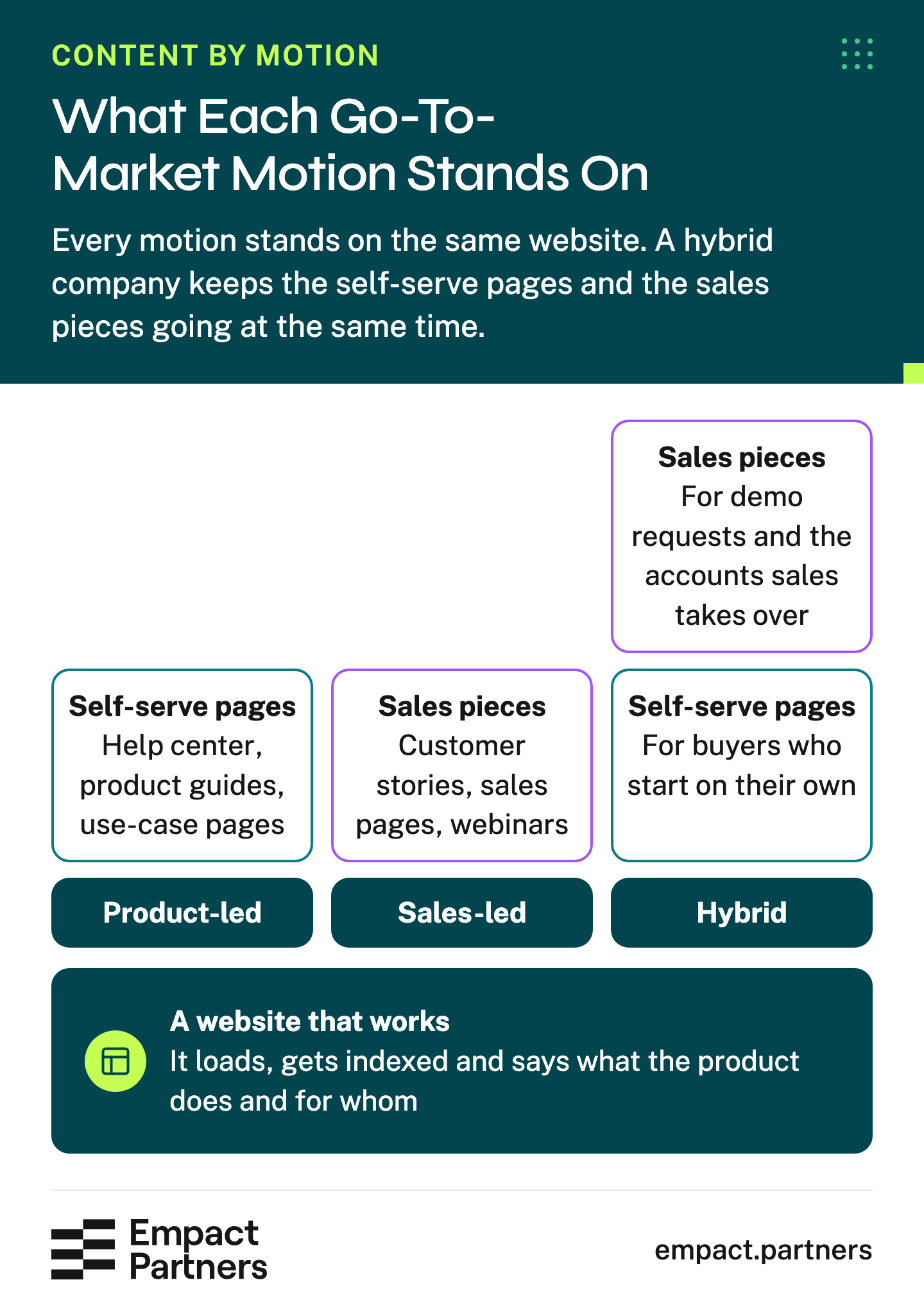
Adding sales does not retire the self-serve pages. The sales pieces go on top of them, and the two meet at one tricky moment, when a self-serve account should move to sales.
When a self-serve account starts to behave like a large buyer, a salesperson should step in while the interest is fresh. The signs are usually more of its colleagues signing up, or heavy use of a free plan. The rep then needs the sales pieces ready to send.
Deciding which signups deserve a call is revenue operations (RevOps) work more than content work. Our playbook on routing signups to sales shows how to pick the accounts a call would help, and how to count what those calls add in revenue:
Whatever your motion, the next step is to check what you already publish against the set it needs.
Find the Missing Set Before You Commission More
The check runs on what you already publish, before anyone commissions another piece:
Name your motion.
Answer the three questions about a public signup, who closes the deal and what a customer pays.
Put every piece in one sheet.
Include blog posts, guides, help pages, customer stories, sales pages, webinars and directory profiles.
Mark the set each piece serves.
It either answers users who start alone, helps a rep inside a deal, or does neither, like a post written only for traffic.
Find the missing set.
Look for the set your motion needs that holds little or nothing.
Check the website under it.
Confirm the pages load, get indexed and offer the routes you sell by.
Inside the missing set, start with the pieces closest to the money. For a sales-led company that usually means one customer story about the buyers you win most often. Next comes a sales page for the objection your reps hear on every call. For a product-led one it is the guides for the jobs users sign up to do, starting where new accounts stall.
A hybrid company needs one of each before it needs another blog post.
How We Plan Content Around the Way You Sell
We name how a company sells before we plan a single piece of its content. The motion decides which set you need, and an audit shows which one you lack. For your company the first look goes to the website, because both sets live on it, and the next to the set your site lacks. Working with us on it includes:
- Your motion named before any content is planned, then an audit and a roadmap instead of a content calendar
- A senior GTM consultant, named at the start, who leads that roadmap and joins your calls
- Product-led growth for the self-serve pages, and RevOps for the handoff that follows them
- Content marketing written with your own experts for whichever set your motion is missing
- Standing reports on how the content performs, and the first move named in every recommendation
A hybrid company needs both sets and the handoff between them, so those workstreams run at the same time.
Frequently Asked Questions
Is a blog still worth funding for a sales-led company?
Yes, once the pieces a rep sends exist. A blog brings in readers your sales team has not met yet, and some of them become meetings.
A blog cannot do the work inside a deal, so fund the customer stories and sales pages first. Then judge the blog by the meetings its readers book. A sales-led company with a strong blog and no customer stories tends to collect readers who never reach a rep.
Do help pages and documentation count as marketing content?
For a self-serve product they are some of the most important marketing pages you have. A buyer searching for how to do a task often finds them before your homepage, and AI answers quote them when someone asks how a product works.
Write them for a person deciding whether to sign up as well as for a user who is stuck. Give every page a clear route to try the product.
At what point does a product-led company need salespeople?
When enough accounts need help a rep can give, such as a larger team buying at once, a security review or a contract to negotiate. ChartMogul’s data puts the usual point at an average sale price of about $100 a month.
Treat price as a guide and watch which signups ask for a call. Write the first customer stories before the first rep starts, so they have something to send from their first week.
How should a hybrid company split content work between the two sets?
By where its revenue comes from and where its buyers stall. If most revenue arrives through self-serve, the self-serve pages come first. The sales set then starts with a customer story for each kind of large buyer.
If a few large deals carry the revenue, reverse the order. In both cases keep one website, one message and one owner for the handoff, so the two sets describe the same product.
Are webinars and review sites worth it for a self-serve product?
Review sites usually are, because self-serve buyers compare products there and AI answers draw on them. Webinars rarely pay early on. They gather people who want to learn before they buy, and without a sales team to follow up, those leads go cold.
Once a sales team exists, both become useful. The companies that attend a webinar become accounts a rep can call that week.
How do we measure content in each motion?
Measure each set by what it is for. For the self-serve pages, count the signups that came through a guide or a help page, and how many of those users reach a first result. For the sales pieces, track how often reps send each one, the meetings booked and whether the deals that got it move faster.
Ask new customers how they first heard of you as well, because buyers who found you through an AI answer or a forum thread rarely show up in analytics.
How long before the missing pieces show results?
Plan in quarters. A customer story can help a deal the week it ships, because a rep can send it straight away. So the sales set tends to show its effect first, in deals that move.
Guides and help pages need time to be found in search and quoted in AI answers, which takes months before momentum shows. Judge each set over quarters, by the result it was built for, before you decide it is not working.
Who should own content in a company that sells both ways?
One person should own the whole of it, with an owner for each set beside them. Product or growth usually owns the self-serve pages, and product marketing or sales enablement owns the pieces reps send.
The overall owner keeps the two telling the same story about the product. They also make sure the handoff from a self-serve account to a rep has the right pieces waiting.
Should we rewrite our existing posts or build the missing pieces first?
Build the missing pieces first. Rewriting improves a set you already have, while the empty set is where buyers are being lost.
Keep the posts that bring the right readers, and refresh the ones that rank and convert. Leave a wider rewrite until the missing set exists. Your posts also become more useful once their readers have somewhere to go next, a guide to try the product or a customer story to forward.
Can a small team keep both sets of content going?
A small team can, if it keeps each set small and current. A few guides for the jobs most users sign up to do cover more ground than a calendar of posts. So does one customer story for each kind of buyer your sales team works.
A small team usually has to choose between keeping both sets fresh and publishing every week. When something has to give, drop the weekly post before either set.
Does any of this change for a company that sells only to large enterprises?
The map holds, and the sales pieces do most of the work. An enterprise deal has more people in it, so the pieces a rep sends multiply. Expect a customer story for each kind of buyer, answers for the security and procurement review, and a business case the champion can forward.
Help pages still matter after the sale, when the customer’s team starts using the product. The self-serve set comes back as onboarding content.
Sources (3)
- ChartMogul, "The SaaS Go-To-Market Report" (2025)↩1↩2↩3↩4Sofia Faustino, 11 June 2025: anonymized billing data of 2,500 SaaS companies, benchmarks from Q1 2024 to Q1 2025, price bands by average monthly sale price excluding companies under $300K in ARR; ChartMogul sells subscription analytics. Read 28 November 2026.
- ChartMogul, "The Conversion Report" (2026)↩1↩2part 2, Kyle Poyar, 18 March 2026: a January 2026 survey of 200 software products, run with ProductLed. Read 28 November 2026.
- Empact Partners, "57 SaaS Website Conversion Statistics" (2026)Empact Partners' own data↩1our census of the homepages of the 63 companies in the BVP Nasdaq Emerging Cloud Index (59 rendered), read 27 and 28 November 2026 at desktop size before any scroll or click. Re-checked 28 November 2026.
Keep reading
Product-Led Growth Why Product-Led Growth Needs One Owner from Signup to Paid
Accounts get lost where marketing, product and RevOps hand them to each other. One person should answer for every stage, whatever the title.

Product-Led Growth How to Find Where New Users Stall in Your SaaS Onboarding
Many onboarding stalls show on the screen itself. Read your first-run flow screen by screen, then test the likely stalls with real users.
Product-Led Growth How a SaaS User’s First Session Decides Retention
Split recent signups by when each first got a result, and you’ll see whether your first session is where your retention is decided.