
How to See and Report the Pipeline AI Engines Send You
Buyers who find you in AI answers rarely click. Stamp each buyer’s own answer on the deal, then show the board those deals by both sources.
 Anri-Cornel MareeWith
 Vlad Shvets
On this page
Empact Newsletter
One email a month on what is working in AI search and SaaS go-to-market.
A board’s pipeline slide is usually built from the source the CRM recorded for each deal, and the AI engines barely show on it. Many buyers who find you in a ChatGPT answer never click its links. They type your name or search for it, so the deal lands under Direct or organic search, and the AI-search work behind it gets no credit.
The companies that first saw AI answers in their numbers saw them by asking. Ahrefs asks new users how they heard about it, and in 2026 Claude and ChatGPT together came to 21.7% of the answers, second only to Google.1 Its referral traffic alone, it says, would have badly undersold that. A signup question collects the same evidence for any SaaS team.
Empact Partners builds the CRM fields and reports that show a SaaS board where deals come from, the work called revenue operations, or RevOps. The buyer’s own answer rarely reaches that slide, because nobody has decided which record should carry it.
A Signup Count Doesn’t Tell a Board What a Channel Is Worth
Once the answers come in, the quick slide counts the signups that named an AI tool and sets that count beside paid and organic. A board reads it as what the channel is worth. It is not, because sources that bring in similar numbers of buyers can bring in very different revenue.
HockeyStack Labs measured how far apart the two can sit, across more than 8,500 self-reported answers from 36 B2B SaaS companies between February and December 2023. For each source it set the share of hand-raisers (demo, pricing and contact requests) beside the share of revenue those buyers brought in.2
The study’s revenue split has no line for AI answers, so it shows the gap between the two shares rather than an AI number:
A Source’s Share of Hand-Raisers Against Its Share of Revenue
36 B2B SaaS companies’ self-reported answers, Feb to Dec 2023 (HockeyStack Labs)
View the data
| Label | Share of hand-raisers | Share of revenue |
|---|---|---|
| Search | 45% | 27.5% |
| Word of mouth | 18.1% | 23.77% |
| Previous customers | 1.5% | 7.06% |
| 1.16% | 2.24% |
Previous customers went from 1.5% of the hand-raisers to 7.06% of the revenue, nearly five times their share, while Search fell from 45% to 27.5%. Nobody can say yet where AI-led buyers fall on that spread, and a signup count cannot tell you. Only the deals those buyers opened can. So the board’s line should count deals and their value, and for that the buyer’s answer has to reach the deal.
Put the Buyer’s Answer on the Deal When the Deal Is Created
The answer arrives on a contact, the person who filled in the form. Pipeline lives on the deal, which Salesforce calls an opportunity. Check whether anything in your CRM copies the answer across. If nothing does, the deal never sees it, and its source becomes whatever a rep types in later.
A signup answer counts toward pipeline only after the deal carries it.
To report answers by channel, someone sorts the free-text answers into a short, fixed set of categories. Once a month suits most teams, because it matches the reporting cycle. So the deal takes the buyer’s words at once, and the category when that month is sorted.
A deal can also carry several people from one company, and each may have answered differently. A few rules, written down before the first deal under the new method, keep every deal stamped the same way:
Rules to write down before the first deal
- Copy the buyer’s answer onto the deal when the deal is created, into a field nothing else writes to, and add its category when that month is sorted
- Give the deal the answer of the contact whose form, signup or booked call created it
- Keep the other contacts’ answers on their own records, and count a deal that is not AI-sourced as AI-influenced when any of them named an AI tool
- Keep outbound deals on the outbound line even when the buyer names ChatGPT later, and count that mention as AI influence
- Put deals where nobody gave an answer, expansion deals among them, on the slide’s no-answer line instead of Unknown
- Keep the buyer’s own words beside the category, so anyone can check it later
The second rule does the most work on deals with a buying committee, where the people who joined at different points remember different first steps:
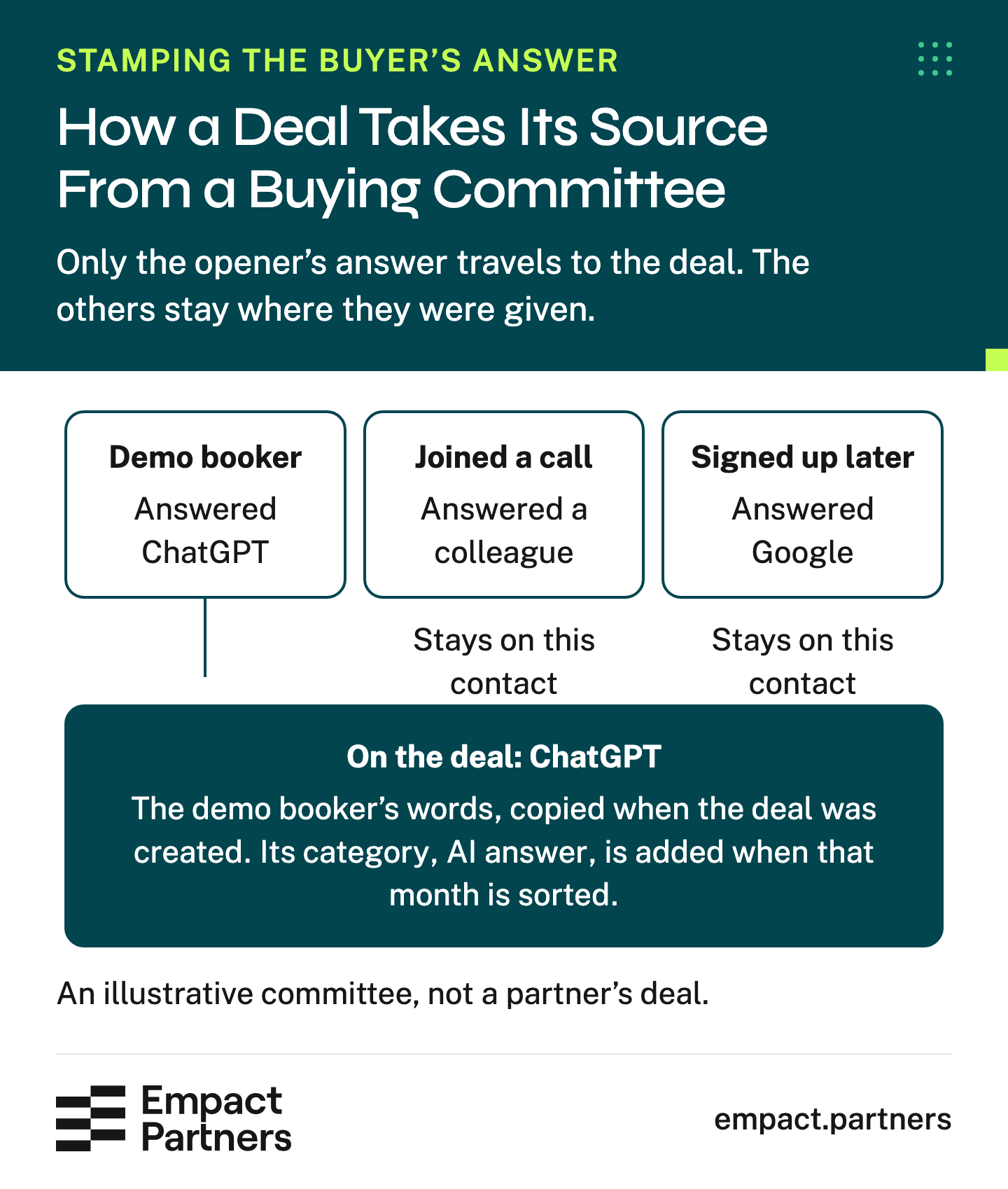
The deal is AI-sourced, from the answer recorded when it began, and the colleague and the Google search stay on their own contacts, where a report can still find them. For Anri-Cornel Maree at Empact Partners, the timing of the stamp is the whole method:
A board funds pipeline, so the buyer’s answer has to sit on the deal before anyone counts it. Stamp it when the deal is created, from the contact whose form opened it, and leave it alone after that. A source a rep fills in three months later records what the rep remembers about the deal, and the board deserves what the buyer said.
 Anri-Cornel Maree on LinkedInOpens in a new tab
What the Pipeline Slide Shows
With the answer stamped on every new deal, the slide can show both records for the same pipeline. The categories from the monthly sorting roll up into the lines a board already reads. Each line shows pipeline created by the CRM’s tracked source beside pipeline created by the buyer’s answer:
Scroll horizontally to see all columns when the table is wider than this page.
| Line on the slide | Pipeline by the CRM’s tracked source | Pipeline by the buyer’s answer |
|---|---|---|
| AI answers | Deals whose first tracked visit was a click from an AI answer | Deals whose opening contact named an AI tool |
| Organic search | Deals filed under organic search, AI-led buyers who searched your name included | Deals whose opening contact named Google or a search |
| Paid | Deals filed under paid search or paid social | Deals whose opening contact named an ad |
| Referral and community | Deals filed under referring sites and partners | Deals whose opening contact named a colleague, a Reddit thread or a Slack group |
| Outbound | Deals your own sequences opened | Outbound deals, whatever the buyer says later |
| Other named sources | Deals filed under email or any other tracked channel | Deals whose opening contact named an event, a podcast, an email or a past job |
| Direct or no answer | Deals filed under Direct or with no tracked source | Deals where nobody gave an answer, expansion deals included |
Each deal has one tracked source and one stamped answer, so each column covers every deal once and both add up to the same total. A row’s two numbers are never added together. Adding them counts the same deals twice, and an AI line inflated that way is the first number a finance lead takes apart.
The two columns will disagree, and the disagreement is the finding, so every number has to show where it came from:
Leave website traffic off the slide, because it counts visits and this slide counts deals. In Databox’s 2025 survey of more than 300 go-to-market leaders, low-growth companies were more than twice as likely as high-growth ones to put traffic on their leadership dashboards.3 One in four of the leaders said at least a quarter of last quarter’s pipeline had been misattributed for lack of reliable click data.
The two columns belong in the weekly pipeline view the team already opens, where AI is judged on the same win rate and cycle length as every other line. If the team has no weekly pipeline view yet, the agent below builds a first one from a single deals export:
What a First Budget Review Can Claim
The first review often comes before the AI line has much in it. AI-search work takes months before momentum shows, and a deal opened in the campaign’s second month may still be open when the review arrives.
HockeyStack Labs saw the same lag in tracked AI traffic. Across 118 accounts, the median share of visits from AI engines that became hand-raisers was 5.24%, and the median share of qualified pipeline from those visits that closed was zero.4
The report does not read that as no deals closing. One reason it gives is observation windows of 30 to 60 days, too short for deals still in progress. Another is sales teams that did not know a lead came from an AI answer, which is the gap the deal stamp closes. So the first review claims what has happened, and nothing that has not:
Before the first review
- Opportunities created and their value, by the buyer’s answer and by the tracked source
- Start and end dates, and the record behind every number
- No revenue counted that has not closed
- The tracked column left as the CRM recorded it, with nothing moved from Direct into its AI line
Beside the pipeline line goes the leading indicator, how often the engines name you for your buyers’ questions, labelled as visibility and never turned into dollars. Where we run a partner’s AI-search work, it comes from the Empact Panel. We built the Panel to collect the answers ChatGPT, Claude and Google AI Mode give those questions every week. If you have no reading of your own yet, the playbook below sets one up:
The deal field, the rules and the two-column slide can be in place before the next review. Filling the AI line is the slow part. Every month has to be sorted into the same categories, and the AI line needs enough deals before a share means more than a handful of stories.
Give the monthly sorting an owner before the first review, or new answers pile up unsorted and the AI line stalls between reviews.
How We Set Up AI Pipeline Reporting for SaaS Teams
Our take is that the method for counting AI-sourced pipeline gets written down before an AI-search campaign starts, even when the method is a single question on a form. Answers collected once a review is under way cannot show the months before it, so the team reporting on the campaign has nothing to show for them.
Empact Partners would begin by auditing the path from your forms into the CRM and on to the reports, because that path is where a buyer’s answer goes missing before it reaches the deal. Where AI-search work is part of the plan, the attribution we would set up first is the deal stamp and the two-column slide above. A setup with us covers:
Setting up AI pipeline reporting with us
- An audit of how your forms, CRM and reports pass data to each other
- Reporting on pipeline and attribution, automated in the CRM you already run
- Every reporting slide dated, with its sources named, as on every slide we send partners
At first the AI line may hold a handful of deals or none, and the two columns will disagree. Because the line is counted the same way from the first deal, next year’s slide can sit beside this one and mean the same thing.
Frequently Asked Questions
Should AI-sourced pipeline count as sourced or influenced?
Both, on separate lines. A deal is AI-sourced when the contact whose form or call opened it named an AI tool, unless your own outbound opened it. It is AI-influenced when it is not AI-sourced but an AI tool still appears on it, named by another contact or by an outbound buyer later.
Report the sourced line as the claim and the influenced line as context, kept apart so nobody reads influenced pipeline as sourced. Write both definitions on the slide itself.
What if the people on one deal give different answers?
Keep every answer and let the rule decide which one is the deal’s source. The contact who opened the deal sets it. The rest stay on their own records, and they count as AI influence only when they named an AI tool.
Disagreement is normal on a committee deal, since the person who booked the demo and the one who joined later met you at different points. What matters is that the rule existed before the deal did, so nobody picks the answer that suits the review.
How long before AI-sourced pipeline shows up as closed revenue?
As long as your sales cycle, plus the months AI-search work takes before buyers start arriving. A short self-serve sales cycle closes deals far sooner than an enterprise one, so read your own cycle length before you promise the board a date.
Report closed revenue by source as it closes. Compare channels on closed revenue only once a full sales cycle has passed since the field went live, because until then the slower deals have not had their chance.
Does this work in Salesforce as well as HubSpot?
Yes, as long as your setup has what the method needs. That means a custom field on the deal or opportunity, a way to copy a contact’s value into it when the deal is created, and a report grouped by that field. Check that your setup can copy the field automatically, and if it cannot, make the copy part of creating a deal.
If deals are created by hand after a meeting, add the answer to the rep’s checklist for creating a deal, taken from the contact record rather than from memory. That keeps hand-made deals on the same rule as the ones a form creates.
How many deals does the AI line need before the board should trust it?
Enough that one AI-sourced deal more or less would not change what you tell the board. Until then, report the count and the value of those deals rather than a percentage, and say plainly that it is early.
A share of pipeline means little while the AI line holds a handful of deals, however small the share looks. A trend needs several periods side by side.
Who should sort the answers each month?
Whoever owns the pipeline report, usually someone in RevOps or marketing operations, with sales leadership reviewing any answer that is unclear. An AI model can do the first pass of the sorting, but a person who knows the business reads every row it marks unsure.
Keep the categories fixed. When one has to change, change it at the start of a month and re-sort the earlier months, so the trend compares like with like.
What date range should the slide use?
The quarter the board reviews, with the same months shown for the year before once you have them. Count pipeline by the date each deal was created, not the date it closed, so a quarter’s AI line reflects the buyers who arrived in it.
State the range on the slide in full, with start and end dates, rather than a label such as last quarter that means different months to different readers.
What do we tell the board if the AI line falls?
The truth, with both columns beside it. A fall in the buyer’s-answer column with steady tracked pipeline can mean fewer buyers met you in AI answers. It can also mean fewer answers were collected or sorted, so check the answer rate first.
The visibility reading is a separate check on the first explanation. A fall in both columns can mean fewer AI-led buyers too, or a wider drop in demand, and the visibility reading and the other lines help tell the two apart.
Either way, dated and sourced numbers keep the conversation on what changed and off whether the numbers can be trusted.
Do we need multi-touch attribution software for this?
Not to start. Multi-touch tools are good at the visits they can see, the clicks, pages and campaigns along a journey. They cannot recover a first step that left no click, which is how AI-led buyers tend to arrive.
The buyer’s answer, stamped on the deal, covers that step for the cost of a deal field and a monthly sorting pass. If you already pay for a multi-touch tool, keep it as the tracked column and add the answer beside it.
Can we put a dollar value on AI answers that never produced a deal?
No, and the slide should not try. Visibility in AI answers is a leading indicator, reported as how often the engines name you for your buyers’ questions. Turning it into dollars means inventing a conversion rate the data does not hold, and the board will rightly discount the rest of the slide.
Show visibility and pipeline side by side over the same months, and let the board see whether one moves before the other.
Sources (4)
- Ahrefs, "How to Measure AI Search Visibility When Attribution Falls Short" (2026)↩1
- HockeyStack Labs, "The State of First-Touch, Last-Touch, Self-Reported Attribution and Revenue" (2025)↩1↩2
- Databox, "Beyond Attribution: The Disappearing Buyer Trail" (2025)↩1
- HockeyStack Labs, "LLM Traffic in 2025: Early Performance, Real Intent, Uneven Results" (2026)↩1
Keep reading
RevOps How to See Which Signups Came From ChatGPT and Reddit
Signups from ChatGPT and Reddit land in analytics as Direct or Google. Add one form field, code the answers with Claude, report both.
RevOps How to Keep Badge Scans and Bought Contacts Out of Your Funnel
Badge scans and bought contacts sink every funnel rate. Hold them in HubSpot until the company engages, and report them on their own line.

RevOps HubSpot vs Salesforce: Pick the CRM Your Team Can Keep Clean
Choose by who will run the CRM each week and what your deals need, then count what AI agent calls will cost on each.