
How to Turn Your Own Data Into a Story a Journalist Will Run
Journalists run findings about their readers’ world. Re-cut your data until it speaks to the market, and build the page they will cite.
 Garith PriorWith
 Vlad Shvets
On this page
- Why Numbers About Your Product Rarely Make the News
- How to Find the Angle in Data You Already Have
- When the Product Data Is Thin, Ask One Question in a Small Survey
- What the Research Page Has to Carry Before You Pitch It
- Pitch One New Finding to the Reporters Who Cover It
- Why the Research Page Keeps Earning Links After the Pitch
- How We Would Turn Your Data Into a Story
- Frequently Asked Questions
Empact Newsletter
One email a month on what is working in AI search and SaaS go-to-market.
Journalists cover findings about the world their readers live in, and a number about your product is rarely one of them. So before you fund a data study, re-cut the data you hold, which means analyzing it again for what it says about your buyers, their market or their work. Put that one finding on a page that shows how it was counted, then pitch it to the reporters who cover the subject.
Skip the re-cut and you can spend a quarter on a report that no reporter covers and no site links to. When your product data is too thin to re-cut, a small survey that answers one question does the same job. Either way, you need a quick test of whether the data holds a story, and the outline of the page that carries it.
Empact Partners gets SaaS companies covered through digital public relations (PR). One of the campaigns we run pitches editors a finding from the company’s own numbers, and the coverage names it on sites buyers read and AI answers quote.
Why Numbers About Your Product Rarely Make the News
A dataset is no longer rare in a reporter’s inbox. In BuzzStream’s 2026 survey of more than 150 digital PR practitioners, 95.9% pitch data-led content, the most common tactic among them.3 BuzzStream sells PR software and surveyed its own users, so read it as the habit of the people it asked. Even so, a dataset no longer stands out just by being one.
Journalists pick a pitch by its subject. A data story is one finding about your buyers, their market or the work they do. It comes from data your company holds, and a reporter can check it. Muck Rack, which sells media databases to PR teams, asked 897 journalists early in 2026 what makes a pitch worth their time:1
What Journalists Say Makes a Pitch Worth Their Time
Share of 897 journalists naming each element, early 2026. Several answers allowed
View the data
| Label | Value |
|---|---|
| Clear relevance to my beat | 70% |
| Interview access to sources | 58% |
| Original data or research | 40% |
| High-resolution images | 37% |
| Exclusive or embargoed content | 33% |
| Pre-written quotes | 14% |
| Social media copy | 3% |
70% named relevance to their beat, the subject they cover. Original data or research came third, at 40%. Cision’s 2026 survey of more than 1,800 journalists points the same way. There, 86% said they reject a pitch that is not relevant to their audience or beat.2
So spend the effort on the subject. Find the part of your data that sits on the reporter’s beat, and the reason their readers would care this month.
How to Find the Angle in Data You Already Have
Product data records what people did inside your product, such as logins, features used and plans upgraded, so its first reading is always about the product. A reporter covering your buyers’ industry has no use for that. Read the same records as evidence about the people using them, their market or the job they do, and some of it becomes news.
Gong is the public example. Its software records sales calls. Gong Labs publishes what those recordings show about how sales teams win, such as a study of more than 120 million calls on what happens when buyers go quiet.5 Each finding is about selling, and the product is simply where the data came from. You can test whether your own finding has made the same move at your desk:
Write the finding as the first line of a news story about your buyers. If that line needs your product’s name to make sense, you have a product update, and reporters already get plenty of those. The data is ready when the line still works with your name taken out.
 Garith Prior on LinkedInOpens in a new tab
Our rule is that a good angle joins what your company knows best to something in the news, or to something people already search for. The product itself can look unrelated. Say you sell scheduling software to clinics. “Our users booked more appointments online this year” is about you.
A finding on how fast clinics refill canceled slots once patients can book online is about clinics, and a health reporter could use it if your data shows it. Run each candidate finding through five checks before anyone builds a page:
- It says something about buyers, a market or a job, and stating it does not need your product’s name
- A reporter who covers that subject would learn something new from it
- It ties to something happening now, or to a question people already search for
- It comes from what your company knows best, so you are a credible source for it
- You can say in one sentence who it covers, how many and when
A finding that fails the checks is not lost. Re-cut it once more, or ask the missing question in a survey. You can also wait until the data covers enough people to say something. Publishing it anyway, as a report, is how a quarter goes on something nobody covers.
Once a finding passes, aggregate it before it leaves the building. The published finding reports medians, shares or counts across many customers, never one customer or a group small enough to recognize. Check your terms of service, your privacy policy and any customer contract before anything is published.
When the Product Data Is Thin, Ask One Question in a Small Survey
A young company, or one with a narrow user base, often cannot say anything about a market from its own records. Run a small survey of the people you want to write about instead, in the communities where they already talk, with a modest incentive for finishing it. Size it to answer one question well, and make no attempt to map an industry.
Write that one question down first. From it you decide who to ask, what to ask and how many answers you need before you can report a result. Have these in place before the survey opens:
One slip catches more company surveys than any other, and it is easy to avoid once you see it:
The same care applies when you split the results. A breakdown by country or job title can turn one survey into several stories. Each group needs enough answers to stand on its own, and the page says how many.
What the Research Page Has to Carry Before You Pitch It
Whether the finding comes from product data or a survey, it needs a home before anyone pitches it. A reporter who likes the finding checks it before using it, and the research page is where they check. A striking number gets attention, and the method behind it is what makes a reporter believe it. So the page carries everything a reporter needs to trust it in a minute:
Scroll horizontally to see all columns when the table is wider than this page.
| Part of the page | What goes in it | What the reporter uses it for |
|---|---|---|
| The finding | One sentence with the number, near the top | The line they quote |
| The method | One sentence on how the data was collected or counted | Deciding whether to trust it |
| The population | Who the data covers, and how many | Knowing what the number describes |
| The date | When the data was collected | Knowing whether it is still news |
| The questions | The exact wording, for a survey | Checking that nothing led the answer |
| One chart | The finding’s shape, labeled | Seeing it at a glance, or asking to use it |
| The limits | What the data cannot say | Writing the caveat themselves |
Keep the page open to read, with no form in front of the method. It is also the page other writers will cite for years, so give it an address you can keep and update next year rather than one tied to a launch.
Pitch One New Finding to the Reporters Who Cover It
With the page up, the finding is ready to pitch. Pitch it as news, with one result, what is new about it, and why it matters to the reporter’s readers now. A survey that repeats what other people already published is a roundup with a logo on it, and the reporter can find those numbers elsewhere.
Send it to the people who cover the subject, one story at a time. Whether to link is the reporter’s call, and some outlets never do. PR people who launch surveys and reports describe the same terrain:
Tips from Reddit
What PR people say about pitching survey data
Hard to say without the subject, but reporters are inundated with surveys and survey pitches. Hard sell on an “exclusive,” especially if you’re immediately pitching follow ups to everyone and their mom.
Surveys often don’t have a huge impact on launch day anymore unfortunately. Unless the data is game changing or touches on a unique and timely trend, I’d advise your client that results will come over time. You should be able to get a few hits on the day of, but then continue to use the data when relevant as part of future pitches or in bylines. I’ve also had luck newsjacking with data - if and when the right story breaks a strong stat can help elevate coverage. This can be est effective if you run the same report regularly so reporters know they can go to you for a specific type of stat.
So good ideas already shared. My experience is that business journalists are much more interested in data than other journalists, so if you can find the business angle to how your data could be used, you might be able to open a door. Check out the American City Business Journals or some other business publication in your area. The other idea would be to find digital journalists - many TV stations have these now, and they love data sets they can use to drive stories - especially if the data sets are interactive b/c it drives time on their site and engagement numbers that they get measured on.
The same pitch works on the editors of the pages AI answers cite, where a data point is something useful to offer in return for a look. Our playbook for moving a link budget into mentions on those pages sets out that pitch step by step:
Why the Research Page Keeps Earning Links After the Pitch
A data story pays back on the research page. A reporter cites the source of a number. When the source is a research page, the link lands there, and writers who repeat the number later cite the same page. We think those links last because the number stays useful, so writers keep citing the page that holds it.
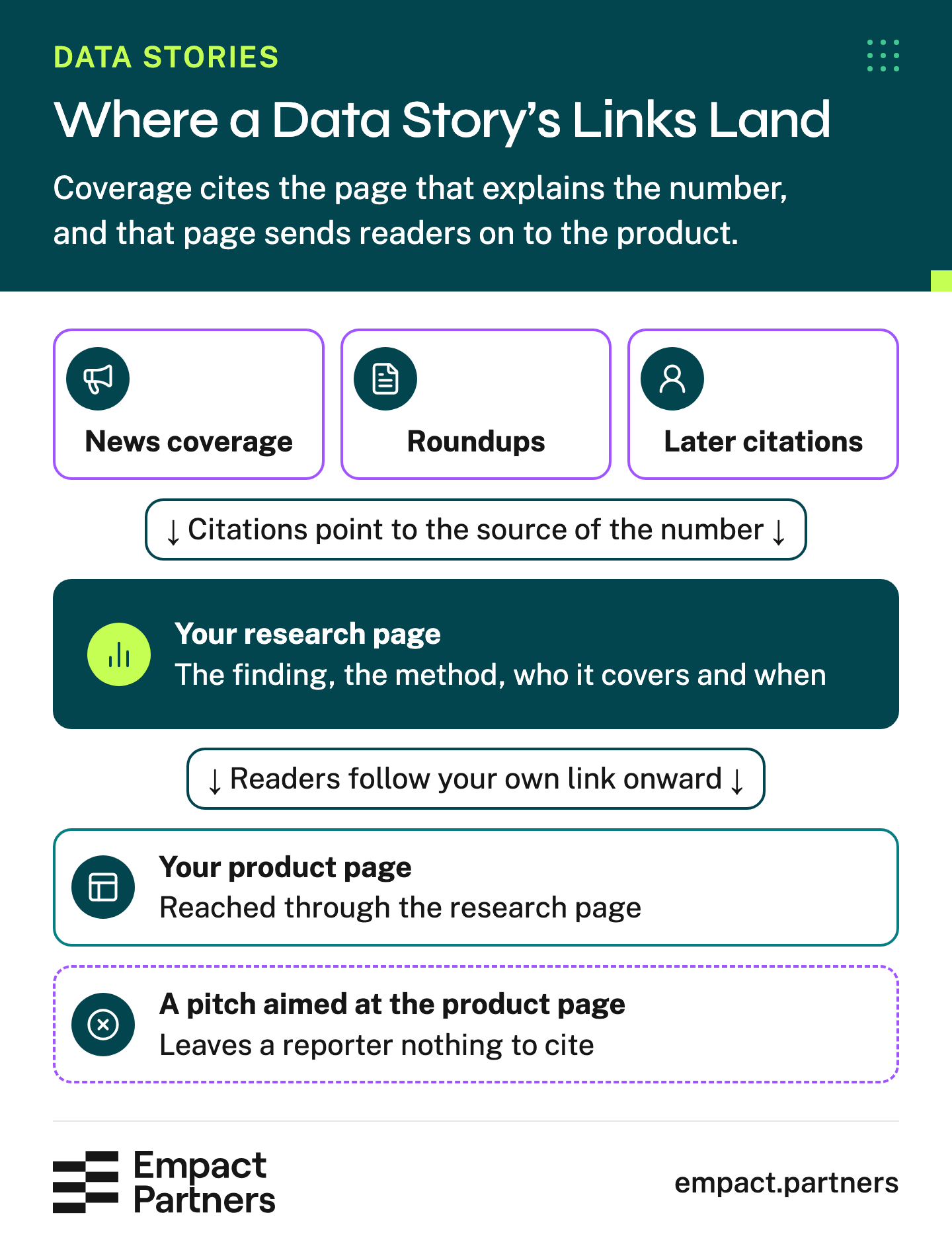
So link the research page to the product page that fits the finding, and pitch the research page. A pitch that sends reporters straight to the product gives them nothing to cite.
Compiled statistics pages are the nearest case we can measure. Most gather other people’s numbers rather than a finding of their own, and they exist to be cited. We counted the sites linking to each page on six SaaS company blogs that each publish at least fifteen of them: HubSpot, Sprout Social, Hootsuite, Semrush, UserGuiding and Tidio.4
Statistics Pages Draw More Linking Sites on Six SaaS Blogs
Median sites linking to each page, DataForSEO backlinks index, read 28 Nov 2026
View the data
| Label | Statistics pages | Other posts |
|---|---|---|
| Semrush | 197.5 | 21 |
| Sprout Social | 180 | 19 |
| Hootsuite | 166.5 | 24.5 |
| HubSpot | 164.5 | 19.5 |
| Tidio | 118.5 | 4 |
| UserGuiding | 23 | 1 |
Across all six, the median statistics page had 143 linking sites, against 11 for the same blogs’ other posts. A blog may promote these pages harder, so treat the gap as a measure of where links collect on pages built to be cited, rather than of what a pitch earns. Writers often cite one tidy page rather than chase every original source, which is why statistics pages work as link magnets.
UserGuiding, where both sampled medians were the lowest in the set, shows the size lesson. Seventeen of the 40 UserGuiding posts we sampled had no linking site at all, while its median statistics page had 23. A smaller company does not need a large study to collect links like that.
Fund a research program only after a small study on one page has started earning links.
The angle test, a small survey and the page are a short project. The pitching is the long part and needs someone whose job it is, because each reporter is pitched by hand, followed up and answered. Then the page is refreshed when the next year’s data comes in.
Some of the coverage will name you without linking at all. Those are the easiest links to ask for, since the writer has already decided you belong on the page. Our Unlinked Mentions Finder looks for articles that mention you and leave out the link, and emails them to you with a draft request for each:
How We Would Turn Your Data Into a Story
We would start from the data you already hold and size the study to what your team can follow up. The first thing we would run is the angle test from this article on your own numbers, because a re-cut that passes saves you the survey. Our mention building consultants then take the pitching and what follows it:
- Every pitch written by a consultant, with a case for the editor and something useful to offer, such as a data point
- One named senior GTM consultant who owns the work and is on your calls
- Each placement logged, and checked weekly against what your buyers see in AI answers
- Mentions without a link found every week and followed up, news stories first
- SEO on your own site, so the research page and the product pages it links to are found
The angle test is the part worth doing together, because it decides whether anything else is worth funding.
Frequently Asked Questions
How many survey responses does a data story need?
No single number works for every story. A reporter reads who answered and how many before anything else, so the count matters less than stating it plainly and claiming nothing beyond it.
Decide before the survey opens which groups you want to report on, because each one needs enough answers to stand on its own. A result about everyone who answered can rest on far fewer responses than one split by country or job title. When a group is too small, report the total and leave the split out.
Can we publish product data without exposing the people who use our product?
Usually, as long as you publish aggregates and check them first. Report medians, shares and counts across many accounts, never a single account and never a group so small that a reader could work out who it is.
Check your terms of service, your privacy policy and any contract that limits how usage data may be used, and ask your own counsel when in doubt. Say on the page how many accounts the figure covers, which also answers the reporter’s first question.
Should we pay a survey panel or run the survey ourselves?
Start with whichever route reaches the people the finding is about. A paid panel reaches people who have never heard of you and lets you set quotas by role or country.
Your own communities reach the exact people you sell to, but they lean toward those who already know you, so the page has to say where the answers came from. Either way, name the source, the dates and the number of answers.
Do journalists trust data that comes from a vendor?
Some are wary, and they judge it by what they can check. A reporter who can see the method, the population, the date, the exact questions and who ran the study can weigh it in a minute.
In Cision’s 2026 survey, 47% of journalists said their ideal pitch includes compelling data.2 Data from a company still has to show its method before a reporter can use it. Without the method, the company’s interest in the result is the only thing they can see.
Should we offer one outlet an exclusive?
Rarely, for a survey. Reporters receive survey pitches all the time, and an exclusive only works when the finding is strong enough that one outlet wants it before anyone else.
A steadier pattern is an embargo for a few reporters who cover the subject, then a wider pitch on launch day. Send each angle to the reporters whose beat it fits. If the data splits by industry or country, those splits are separate pitches to separate reporters.
What should we do when coverage names us without a link?
Ask, briefly and once. Thank the writer and give the exact page to link, usually the research page their readers need to check the number. Say in a sentence why it helps them, and start with news stories, because they go stale fast.
Mentions without links still count for a lot, since AI engines read a brand name in an article with or without a link attached. The link is for the reader, so judge it by the visits it sends.
How long does a data story keep earning links?
Longer than the launch, if the page stays put. Some links may arrive on launch day, and some coverage will name you without one. After that, writers who need the number keep finding and citing the page, and you can reuse the data in later pitches when related news breaks.
Refresh the page each year at the same address, so new citations go to the current edition and old ones still land somewhere useful. A page that moves or disappears loses what it collected.
What is the difference between a statistics roundup and a data story?
A roundup compiles other people’s numbers on one page and earns links slowly, as writers cite it instead of hunting for each original source. Cite every source on it.
A data story is a new finding of your own, pitched to reporters as news. The two work together. Your finding can sit at the top of a roundup on the same subject, and the roundup keeps sending writers to it long after the pitch.
Does a data story help with AI search visibility?
A data story can help, through the pages that cover it. AI answers lean on what other sites publish about a company, so coverage that names you is a mention on the kind of page they read.
The mentions that matter most sit on pages the answers already cite for your buyers’ questions, so check which outlets those are before you pitch. A linked mention and an unlinked one both put your name where an engine can read it.
How do we know the data story worked?
Decide before the first pitch, and set a review date. The first test is whether a reporter who covers the subject ran the finding. The second is whether writers you never pitched cite the research page in the months after.
Then look at what that coverage did for you. Count the visits from those pages to your product pages, and check whether the outlets appear among the pages AI answers cite for your category. A link count on its own says the least about whether it worked.
Sources (5)
- Muck Rack, "The State of Journalism" (2026)↩1↩2897 journalists, surveyed 30 January to 2 March 2026.
- Cision, "5 PR Lessons to Shape Your Media Relations Strategy" (2026)↩1↩2State of the Media Report), 2026. More than 1,800 journalists.
- BuzzStream, "State of Digital PR Report" (2026)↩1More than 150 digital PR practitioners.
- Empact Partners, "our own count of sites linking to statistics pages and other posts on six SaaS company blogs, from DataForSEO’s backlinks index, 28 November 2026" (2026)Empact Partners' own data↩1↩2
- Gong, "Labs" (2026)↩1read 28 November 2026.
Keep reading
Mention Building When Cited Listicles Deserve Your Link Budget
Which listicles AI engines cite for software buyers, what our Panel data shows about listicles and links, and which ones to pitch.

Mention Building Which Unlinked Brand Mentions to Turn Into Links First
Pages name your product without a link. Pick which editors to ask first by what AI answers cite and where the link would send a reader.

Mention Building How to Rank Mention Targets by How Often AI Cites Them
Count how often ChatGPT and AI Mode cite each page for your buyer questions, re-sort your mention targets and give each one an owner.