The ten most-cited domains took 15.63% of every citation ChatGPT and Google AI Mode handed out in March 2026.9 The other 84% went to tens of thousands of other sites. If you have been told a handful of publishers own AI answers, that is the number to hold up against it.
That figure comes from Qvery, our sister company, which has captured roughly 749,000 AI answers and about 9.7 million answer-to-citation links since late 2025, so read its figures knowing who runs it and check the published method behind each one. The rest of the page sets its measurements beside the independent studies we could trace to their origin.
Highlights
Read together, they describe a head that is small, sharp in a few classes, getting tighter on ChatGPT and changing every few months, sitting on top of a tail most brands never measure.
Count Every Citation and the Head Is Smaller Than the Headlines
Washington University researchers captured 7,583 Google AI Overviews between March and April 2026 and counted every one of their 61,212 citations. What the count shows:
AI Overviews spread their citations wider than Google’s own first page does, at every cut of the curve. A brand that cannot reach page one can still be quoted, which is the opposite of what most teams assume when they hear the word concentration.
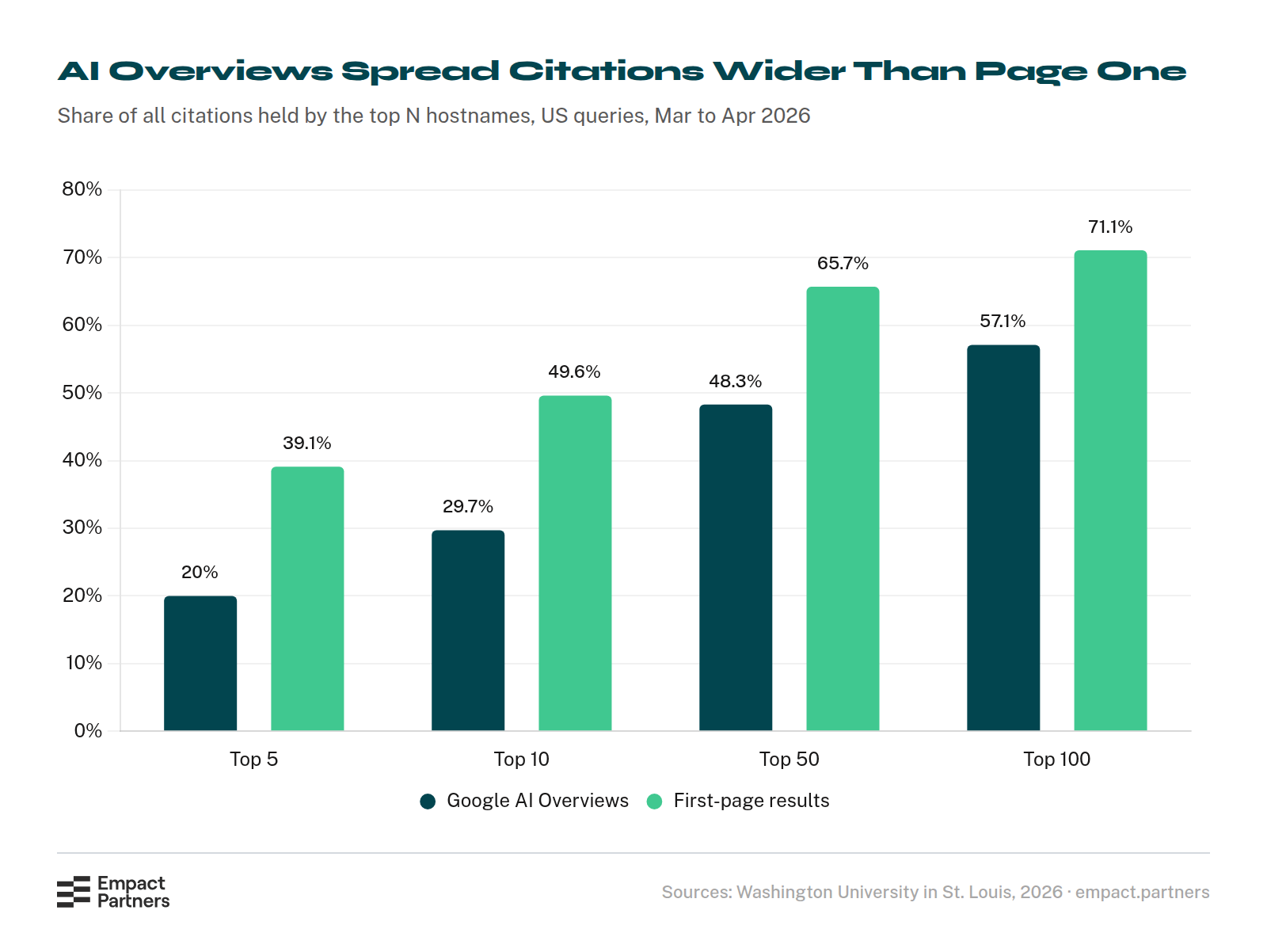
Qvery’s count across ChatGPT and Google AI Mode lands in the same place. In March 2026 the top 10 domains held 15.63% of all citations and the top 100 held 37.52%, which leaves 62% of every citation to domains outside the hundred biggest.9

.png)
Citation Share Is Measured Three Ways, and the Famous Numbers Mix Them
Before any of these numbers goes on a slide, check which of three rulers it uses. The viral figures swap between them without saying so, and the same site can look like a giant or a rounding error depending on the ruler.
| Ruler | What it divides by | Example | Figure |
|---|---|---|---|
| Share of answers | Answers that cite the site, out of all answers | Reddit in ChatGPT responses, early August 2025 | close to 60%3 |
| Share of all citations | Citations to the site, out of every citation | Wikipedia in ChatGPT | 7.8%2 |
| Share of all citations | Citations to the site, out of every citation | Reddit across ChatGPT and AI Mode | 1.13%14 |
| Share of a top ten | Citations to the site, out of citations to the ten biggest sources | Wikipedia in ChatGPT | 47.9%2 |
A site cited somewhere in most answers can still hold a small slice of all citations, because each answer cites many sources. And a share of a top ten says how the giants split their part of the pie, never how big the pie is.
Where Authority Is Narrow, the Head Is Short
The tail is wide on average. In some classes of source it is not, and those classes are where a buying question tends to land. A Northeastern University study of AI search answers from March to May 2025 measured how news citations spread:
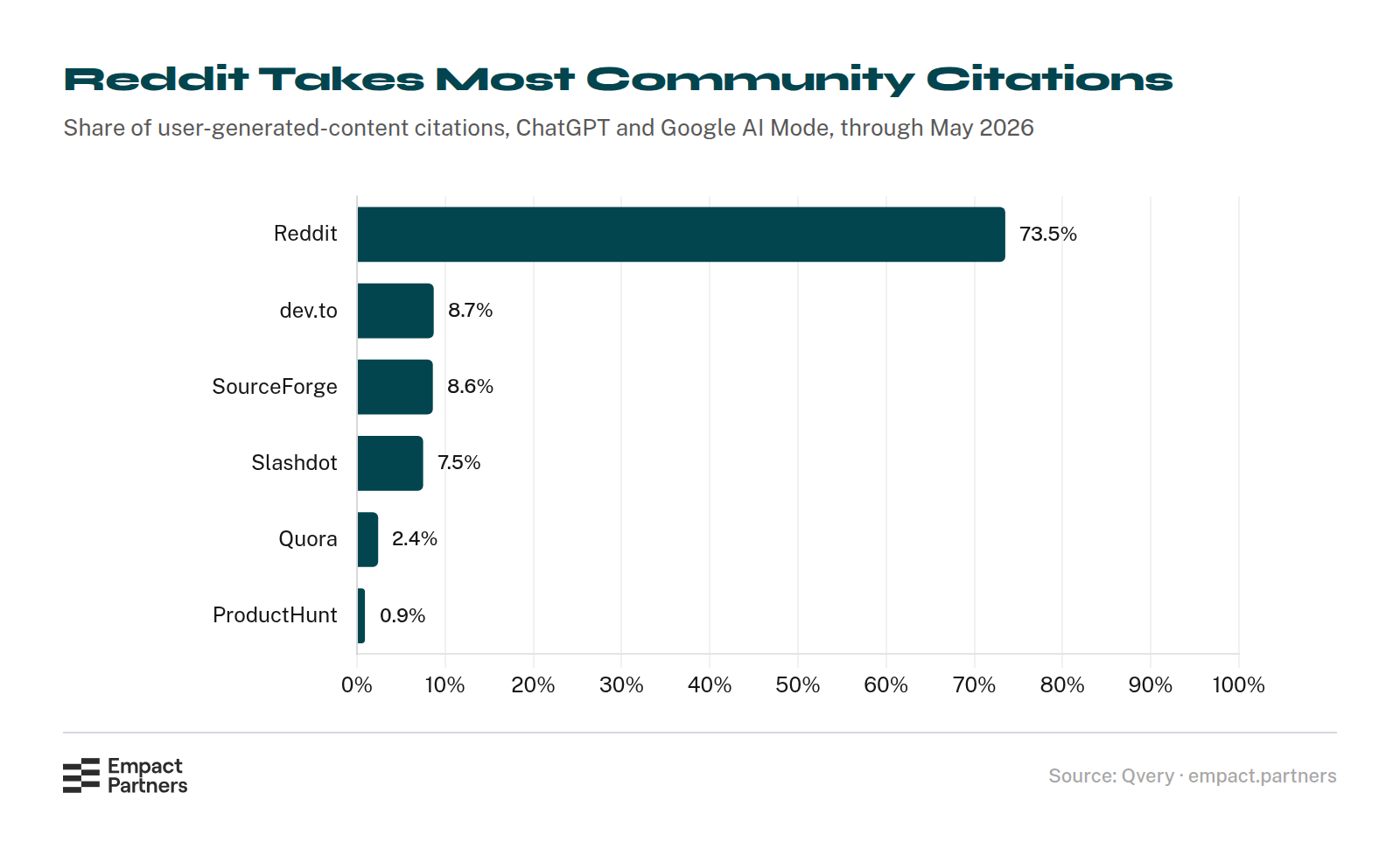
When an engine trusts a narrow set of authorities, it leans on them hard, and the OpenAI models leaned hardest. Community content works the same way. Qvery counted user-generated content at 2.17% of all citations, and inside that class Reddit took 73.5%.11
The pages that carry software recommendations concentrate too. Listicles made up 45.8% of classifiable citations in Qvery’s data.13 And when University of Toronto researchers asked GPT to rank well-known brands, 93.5% of the links it returned were earned coverage on other people’s sites, against 6.5% from the brands’ own.6
Getting onto those pages is the half of generative engine optimization (GEO) we call mention building at Empact Partners: getting a partner named on the short list of pages an engine already quotes, the roundups and threads where the head is short. It is the same reasoning behind mentions versus backlinks, where the citation follows the name rather than the link.
ChatGPT’s Answers Are Narrowing Month by Month
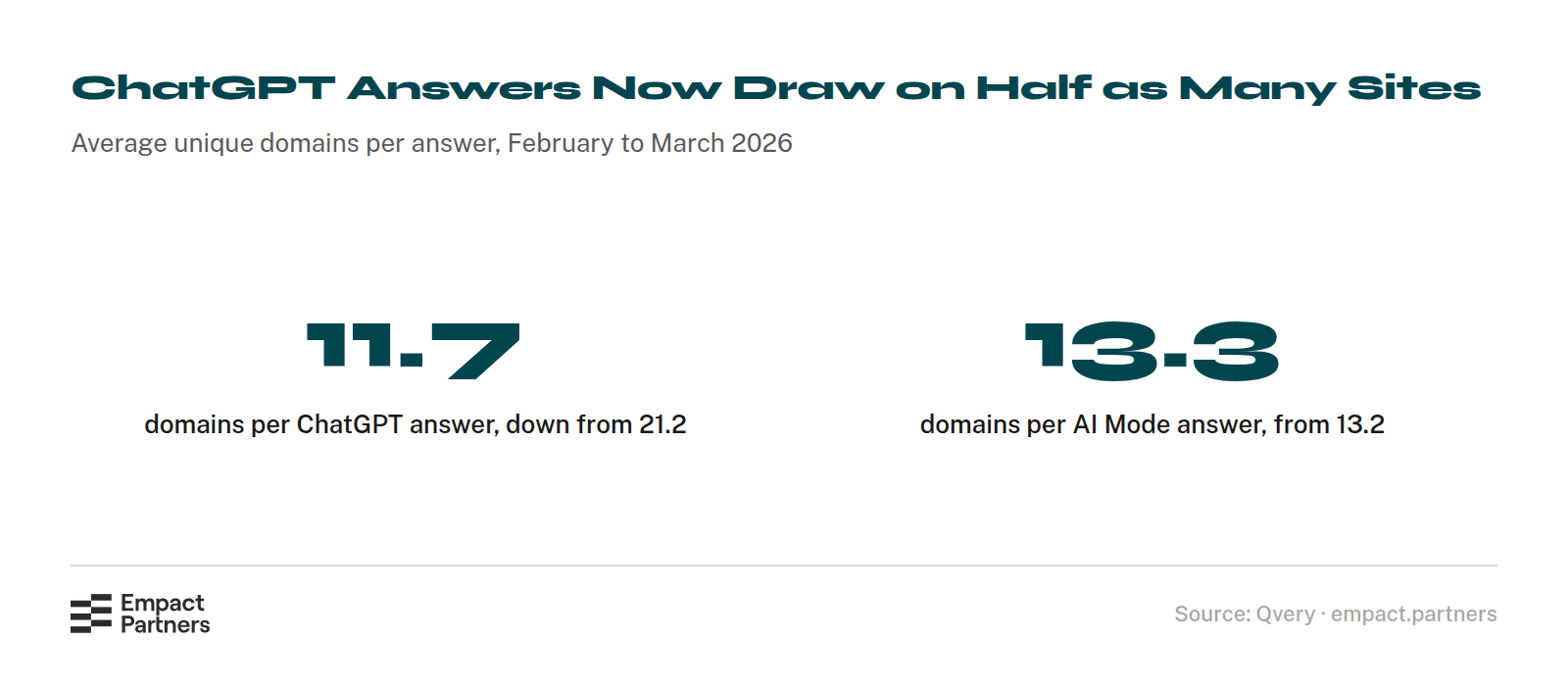
The head is also getting tighter, and fastest on ChatGPT. Between February and March 2026, Qvery measured:
Fewer domains per answer and fewer domains overall is what a narrowing head looks like. Each ChatGPT answer now has room for about half as many sources, and the sources that keep their place take a bigger share of the total.
The Favorites Change Faster Than a Content Calendar
The domains at the top of the head do not stay there. Semrush tracked 230,000 prompts weekly from July to October 2025:
Goodie found 13 of the top 20 most-cited domains had changed between its February 2025 and October 2025 studies.4 In Qvery’s data on software directories, G2’s share of all AI citations fell 78% between January and March 2026.12 A category leader on one surface can lose most of its citations inside a quarter.
The swings run in both directions at once, and differently on each engine. Between February and March, Reddit gained on both engines while YouTube more than doubled on Google AI Mode and fell on ChatGPT.
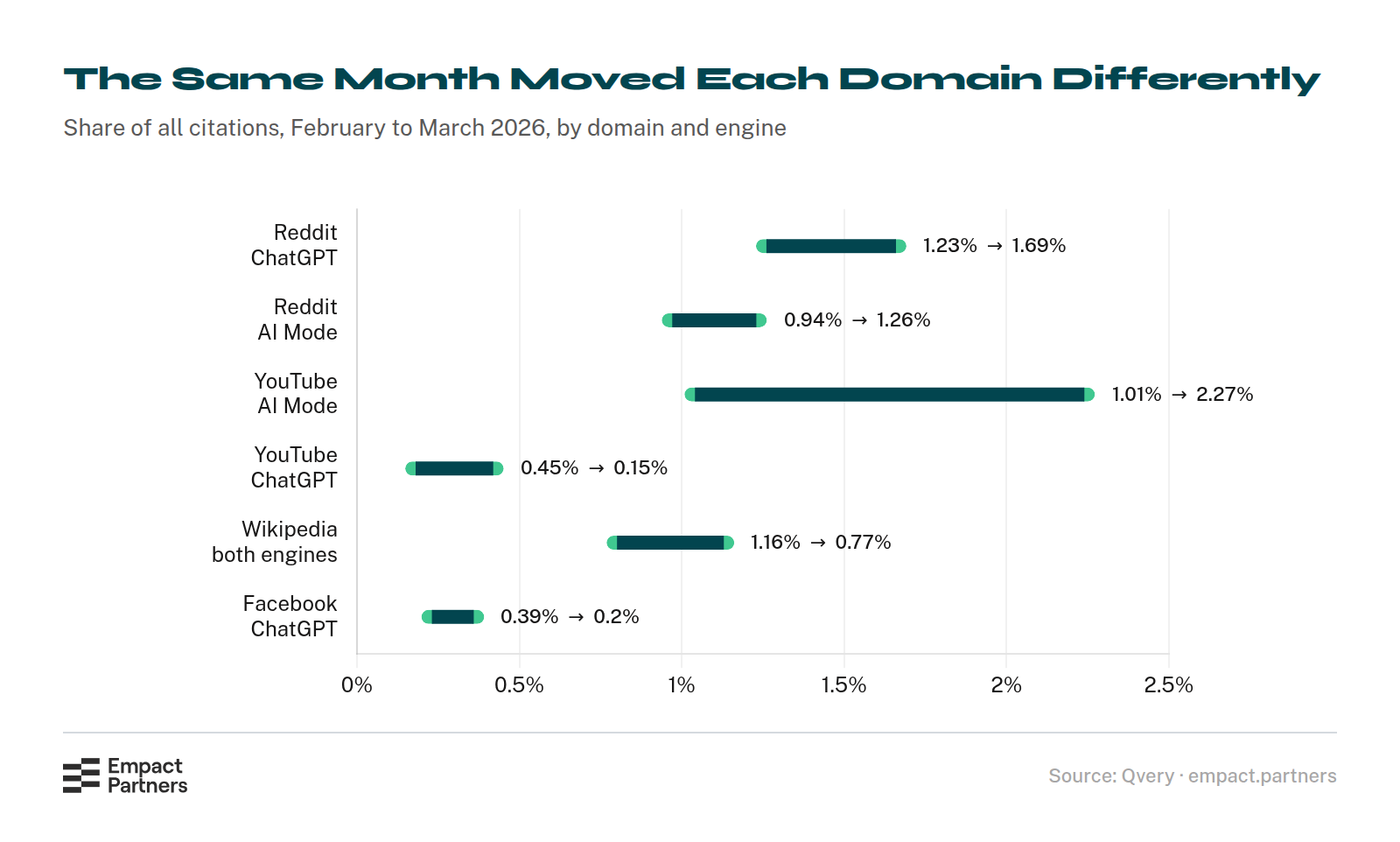
Those swings are why we read a partner’s citation sources every month in Qvery rather than once at the start of a program.
Each Engine Draws From Its Own Pool
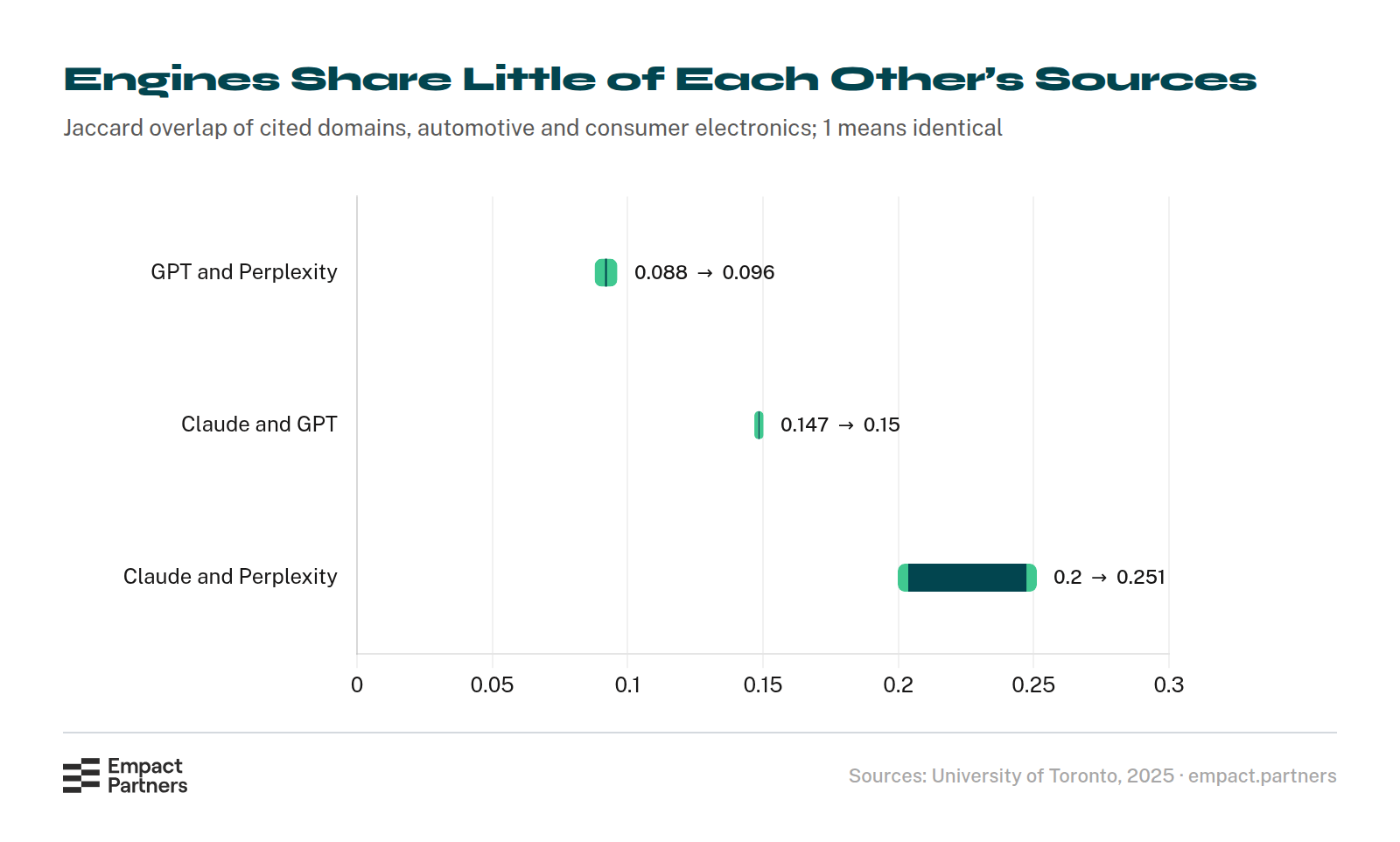
The engines do not agree on whom to trust. University of Toronto researchers measured how many sources each pair of engines shared, using a score where 1 means identical source lists:
The pair to notice is GPT and Perplexity, which share under a tenth of their sources in either vertical.
Google’s own rankings are a narrower door in than they were, too. Qvery found 13.9% of the domains ChatGPT and Google AI Mode cite also rank in Google’s organic top 10 for the same query.10 Ahrefs counted 12% for ChatGPT, Gemini and Copilot.8
For Google’s AI Overviews, Ahrefs put the share of cited pages ranking in the top 10 at 76% in July 2025 and 38% in March 2026, though the second study counted every citation where the first counted the top three, so part of that drop is the ruler changing.7 Either way, a top-ten ranking now explains a minority of what gets cited.
What Our Own Programs Show About Working the Head
Our own record on the most concentrated class, Reddit, says that being on the dominant domain and being chosen there are two different results. For KKday a three-month Reddit program earned 60+ explicit mentions across posts that drew 3,208,973 views.15
For a specialty insurance brokerage, about 100,000 Reddit views on informational posts in big subreddits had produced zero conversions. Switching the posts to recommendation requests turned the same quarter into nearly 40 qualified leads.16 Presence in the head is the entry ticket, and the post still has to be the one a buyer, or an engine, picks.
What 2027 and 2028 Look Like Once the Head Is Full
Everything above is measured. This part is our read of where it goes, and nothing in it is a statistic. Put the trends together and the next two years look like this to us.
.png)
The head keeps narrowing per answer while more brands chase the same pages.
Every SaaS team has now read that listicles and Reddit threads carry recommendations, so by 2027 the roundup that names eight tools will be pitched by most of the category, and the threads engines quote will fill with brand accounts the communities learn to ignore. The pages stay in the head. The brands inside them turn over faster.
Saturated head pages get pruned, rewritten or dropped by the engines that read them, which is the churn already visible in the Reddit, Wikipedia and G2 swings. We expect a program built on a single domain or a single roundup to swing with every engine update through 2028.
The tail is the part that stays open. More than half the hostnames AI Overviews cite appear once, and most of Qvery’s citations go to sites outside the top hundred. Breadth across the niche sites, reviewers and communities each engine reads differently is slower to build and much harder to lose.
What our evidence cannot settle is how fast ChatGPT keeps narrowing, or whether Google AI Mode follows. One month of data shows a turn, and calling it a trend needs the next twelve.
How We Read a Category Before Choosing What to Fund
Empact Partners has run go-to-market work from inside software companies’ own marketing teams since 2020, and reading citation data is now where our GEO work starts. Before we propose which pillar of a GEO program to fund first, we read the partner’s category in Qvery: how short its head is per engine, which head pages persist from month to month, and how wide the tail runs.
What the reading decides:
Most categories need both, in a different order, and the reading decides the order.
Sources
- Xu, Iqbal and Montgomery, Washington University in St. Louis, “Measuring Google AI Overviews: Activation, Source Quality, Claim Fidelity, and Publisher Impact”, arXiv, 2026. 7,583 AI Overviews and 61,212 citations, US queries, 13 March to 21 April 2026. Read 2 October 2026.
- Profound, “AI Platform Citation Patterns: How ChatGPT, Google AI Overviews, and Perplexity Source Information”, 2025. 680 million citations, August 2024 to June 2025. Read 2 October 2026.
- Semrush, “The Most-Cited Domains in AI: A 3-Month Study”, 2025. 230,000 prompts, weekly, 14 July to 12 October 2025. Read 2 October 2026.
- Goodie, “The Most Cited Domains in AI Search: Full Breakdown [58M Citations Analyzed]”, 2026. Compared with its February to June 2025 study of 5.7 million citations. Read 2 October 2026.
- Kai-Cheng Yang, Northeastern University, “News Source Citing Patterns in AI Search Systems”, arXiv, 2025. AI Search Arena data, March to May 2025. Read 2 October 2026.
- Chen, Wang, Chen and Koudas, University of Toronto, “Generative Engine Optimization: How to Dominate AI Search”, arXiv, 2025. Read 2 October 2026.
- Ahrefs, “Update: 38% of AI Overview Citations Pull From The Top 10”, 2026, read with its July 2025 predecessor. 863,000 keywords and 4 million AI Overview URLs. Read 2 October 2026.
- Ahrefs, “Only 12% of AI Cited URLs Rank in Google’s Top 10 for the Original Prompt”, 2025. 15,000 prompts, July 2025. Read 2 October 2026.
- Qvery, “AI Search Citation Trends: March 2026”, 2026. ChatGPT and Google AI Mode, February and March 2026. Read 2 October 2026.
- Qvery, “AI Engine Citations vs Google Organic SERPs: Only 13.9% Overlap”, 2026. 922 queries. Read 2 October 2026.
- Qvery, “98% of UGC Citations in AI Search Come From Just Four Platforms”, 2026. Through May 2026. Read 2 October 2026.
- Qvery, “Software Directories Still Feed AI Citations, Even as G2 Slides”, 2026. January to March 2026. Read 2 October 2026.
- Qvery, “Listicles Are the Most Cited Content Type in AI Search”, 2026. Read 2 October 2026.
- Qvery, “Reddit Is the Most Important Website for AI Search Visibility”, 2026. Read 2 October 2026.
- Empact Partners, KKday case study: Reddit program, three months, views, upvotes, comments and explicit mentions as published on the case study page. Read 20 September 2026.
- Empact Partners, specialty insurance brokerage case study: Reddit program, one quarter, qualified leads as published on the case study page. Read 20 September 2026.