Ask an AI engine a category question in Spanish, from Spain, and 26.4% of the pages behind its answer are Spanish-language. Ask the identical question in English, from the same country, and that share falls to 1.7%.2 The pages on the web did not change between those runs. The question did.
Most localization budgets assume the opposite, that a strong English site competes everywhere and translation is a concession to the markets that complain loudest. The year of measurement that now exists says the English estate is mostly not in those answers at all.
Highlights
Read together they describe a system nobody is selling you. The engines do read the buyer’s language, most of them heavily. But they disagree about how much, they reach that language by opposite routes, and in B2B software the pages they land on are mostly ones you already own. The decision in front of you is not whether to translate. It is which pages, in which markets, for which engine.
Asking In Another Language Returns Another Web
The cleanest evidence here comes from the dullest experiment. Ask the same question twice, change only the language, and hold the market constant.
Weglot ran 400 questions across five topic categories and three lengths, each written in English and in the local language, through four systems in five countries, for more than 16,000 answers.
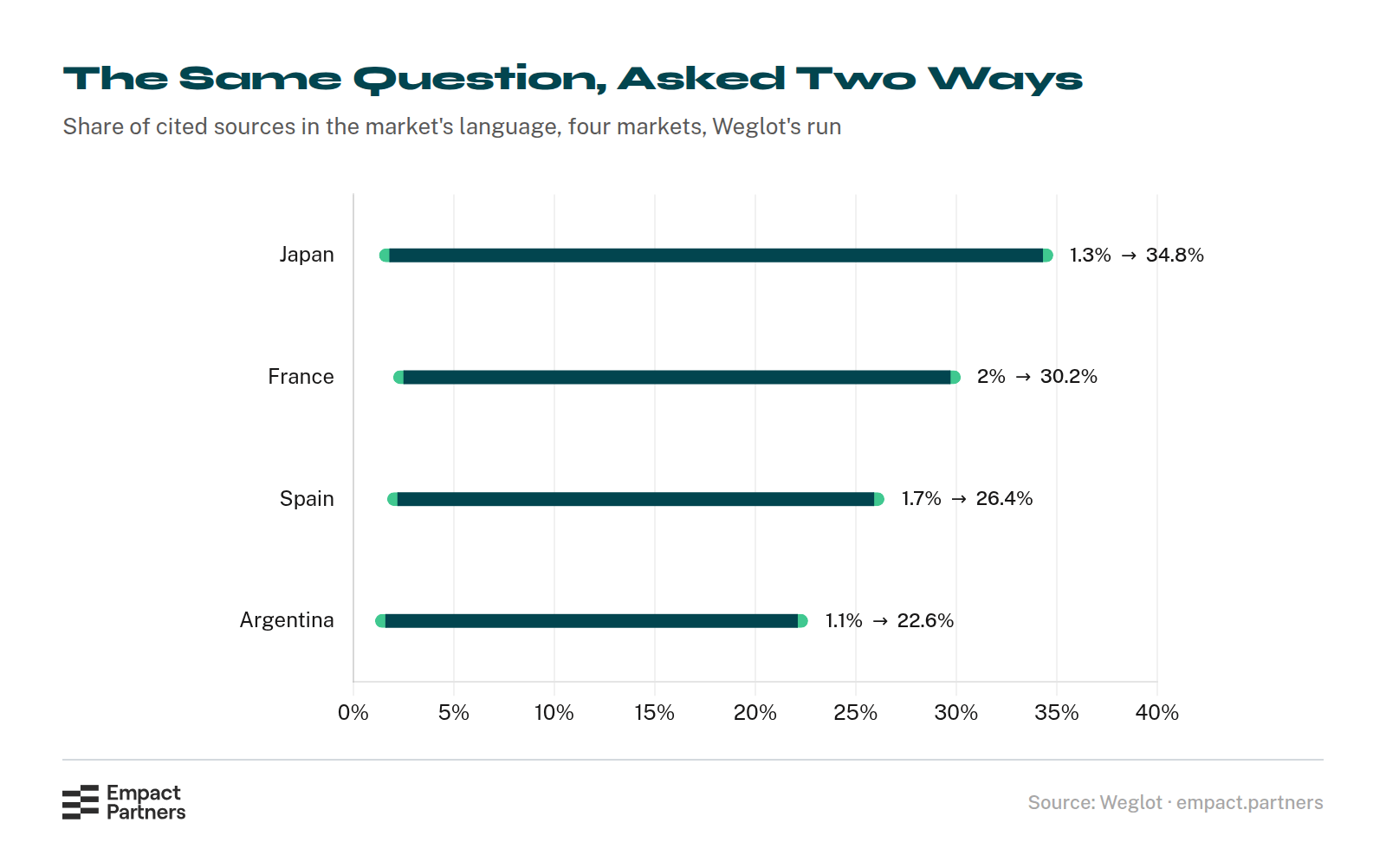
Four markets, four languages, one direction, and the smallest of those multiples is roughly eleven-fold. Senuto’s analysis of 17.8 million Polish keywords puts the ceiling higher, with 96.03% of citations in Polish AI Overviews coming from local Polish sources, though it never says how it decided a source was foreign.12
The English pages in those runs were not ranking badly. They were close to absent, which is a different problem with a different fix, and it is why this decision cannot be made from traffic data.
What changes with the language is not only which pages get cited but which products get named. A preprint published in August 2026 ran the same accounting-software question from the same connections in two languages, six identical runs per cell.
The study is small and its author says so. It also carries the limit that matters most: in its control category, project management software, no domestic vendor appeared in any cell in any language.13
So the effect needs a category where credible local vendors already exist. In a category owned by global products, asking in the buyer’s language will not conjure a local shortlist out of nothing.
Which Engine Answers Decides How Much Of Your Language It Reads
There is no single behavior here to plan against. Temso matched every cited URL to its detected page language across more than four million source-to-prompt language pairs on non-English prompts, in six languages.
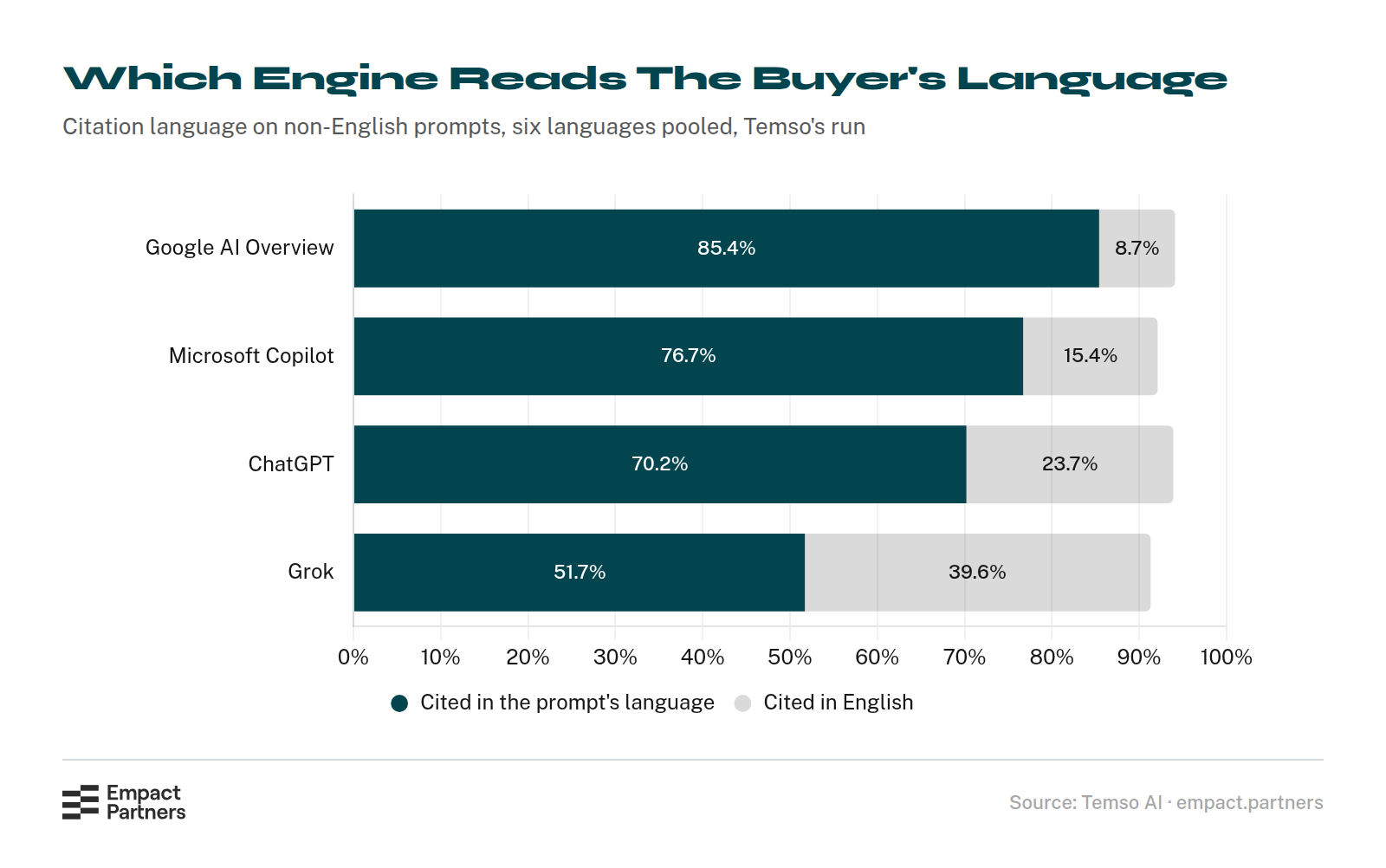
Temso does not name the tool it used to detect a page’s language, which is the one step all of it rests on, so read that as an ordering rather than four precise rates. The ordering holds in two other studies that measured different things.
That second one is a University of Toronto preprint, and it prints no percentage for any engine, so it is a direction and not a number. It was collected in August 2025 on model versions since replaced.
Claude is still the one to flag to anyone whose buyers use it, because it is the only engine measured where translating a page may not change what gets cited at all.
The engines also differ in how much room they have. ChatGPT cites a median of 3 to 4 domains per answer against Google AI Mode’s 14 to 16, and for the same prompt the two Google surfaces share only 17% of cited domains.5

.png)
Measuring per engine rather than once per brand is the first thing we do in Generative Engine Optimization, the work of becoming the brand an engine names when a buyer asks their category question, because a baseline averaged across engines hides the one market where a partner is absent.
ChatGPT Re-Asks Your Question In English
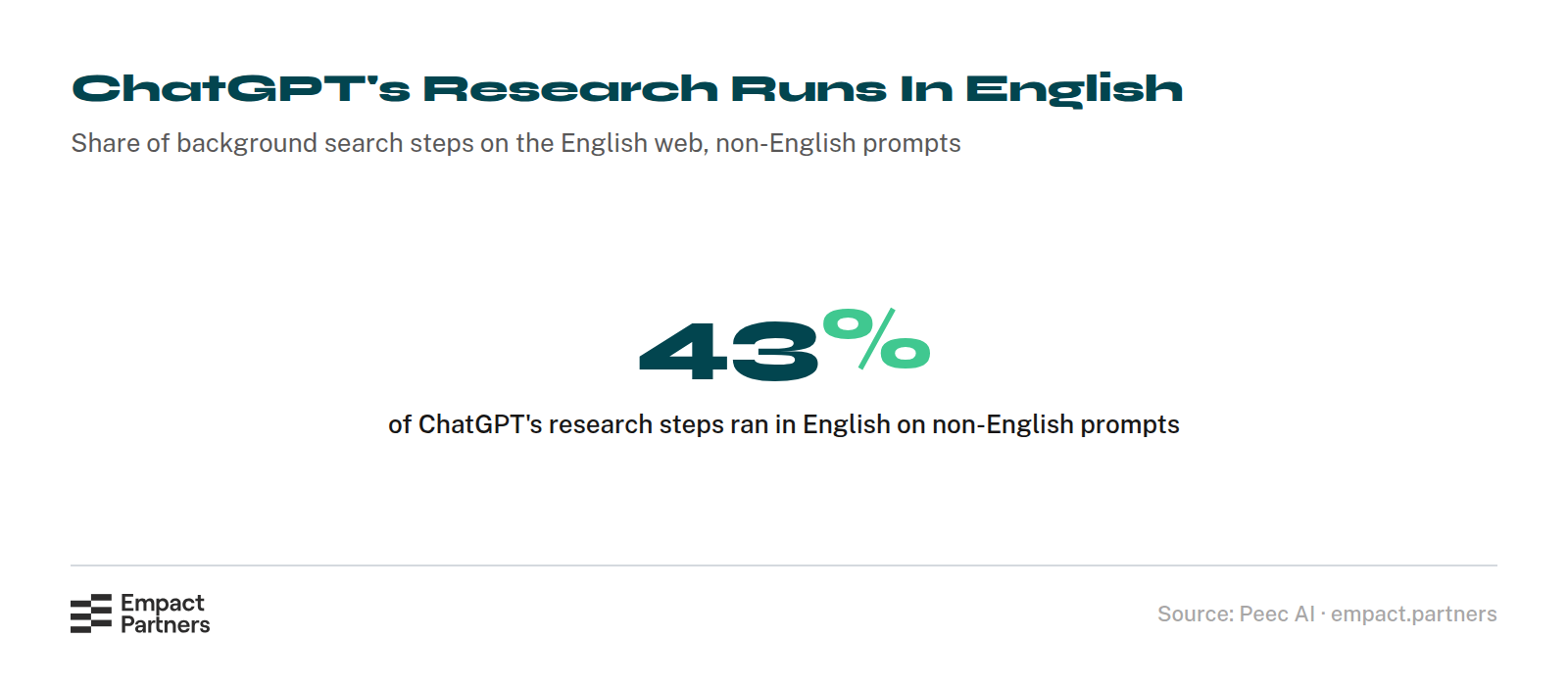
The spread has a mechanism, and it is observable rather than inferred. Peec AI analyzed over 10 million prompts and 20 million query fan-outs and found that ChatGPT does not simply read pages in the language it was asked in.
The pattern Peec describes is a first fan-out in the user’s language and later ones in English. An English page can therefore enter a German answer without anything being translated, and without the engine ever leaving German on the surface.
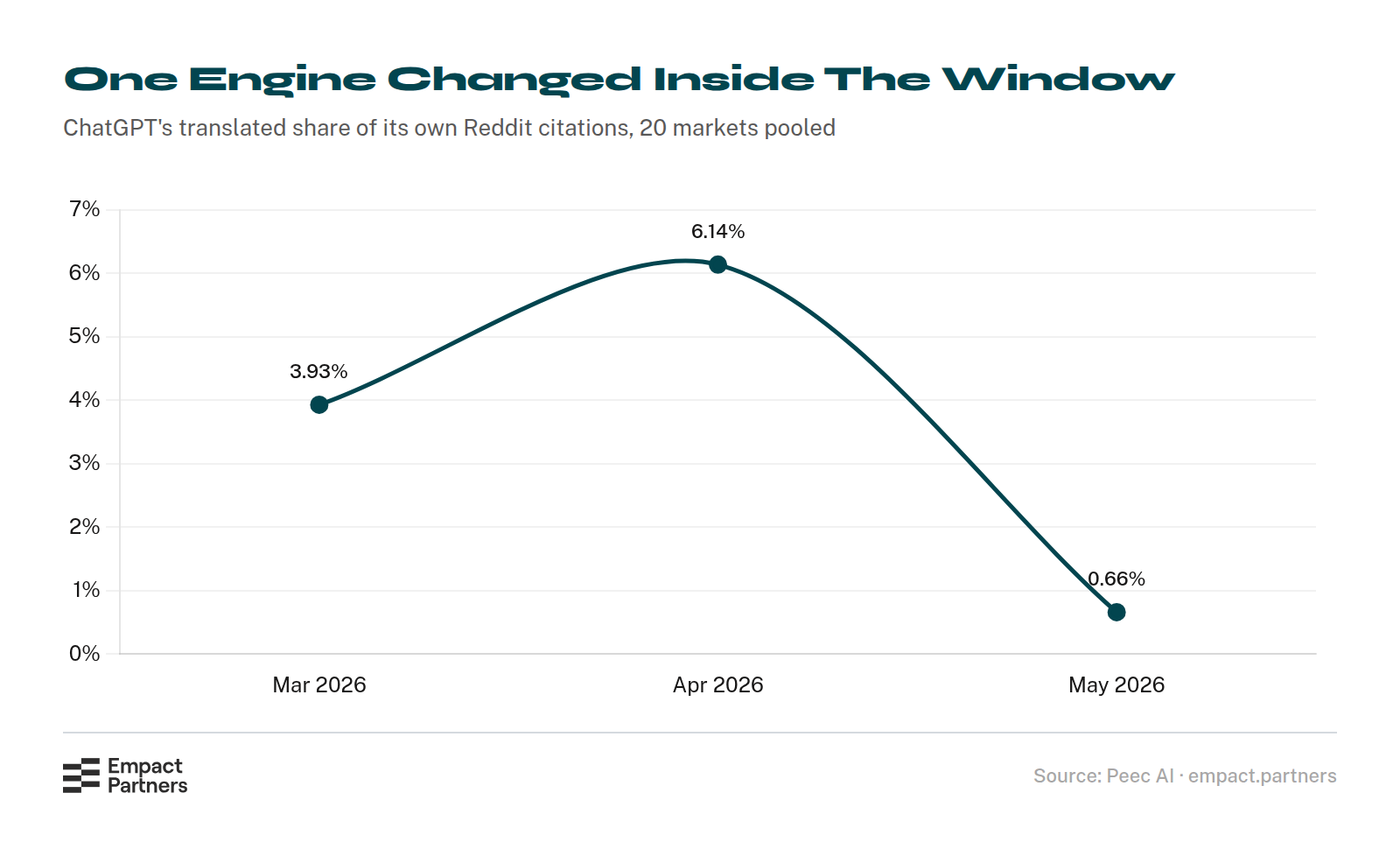
Google reaches the same local-language surface by the opposite route. Reddit machine-translates its own threads and publishes them at distinct URLs, and Peec found those translations cited heavily outside English-speaking markets.
One engine manufactures a local-language source out of an English thread. The other reads English directly and answers in German anyway. Only the first can be influenced by publishing in that language, and neither is what a translation vendor means by local-language visibility.
None of it is stable enough to treat as settled. ChatGPT’s translated-Reddit share fell from 6.14% to 0.66% between April and May 2026, and Peec says plainly it cannot tell whether that sits in the model, the grounding layer or the index.7
The consequence shows up when somebody translates a site. Weglot compared Spanish and Mexican sites with and without a second language version, across 1.3 million citations.
Weglot sells translation and is measuring translation, so hold the magnitude loosely. The shape is what matters: the same spend buys a great deal on one surface and close to nothing on another.
The Local Share Is A Variable, Not A Number
Every figure above is an average of markets and categories you may not sell in. The only study to run identical commercial B2B software prompts across many markets found the local share moving across almost the whole available range.
MaxAEO ran 200 commercial-intent B2B software prompts per market in each market’s own language, across seven engines and twelve markets, logging 1.06 million citation links.
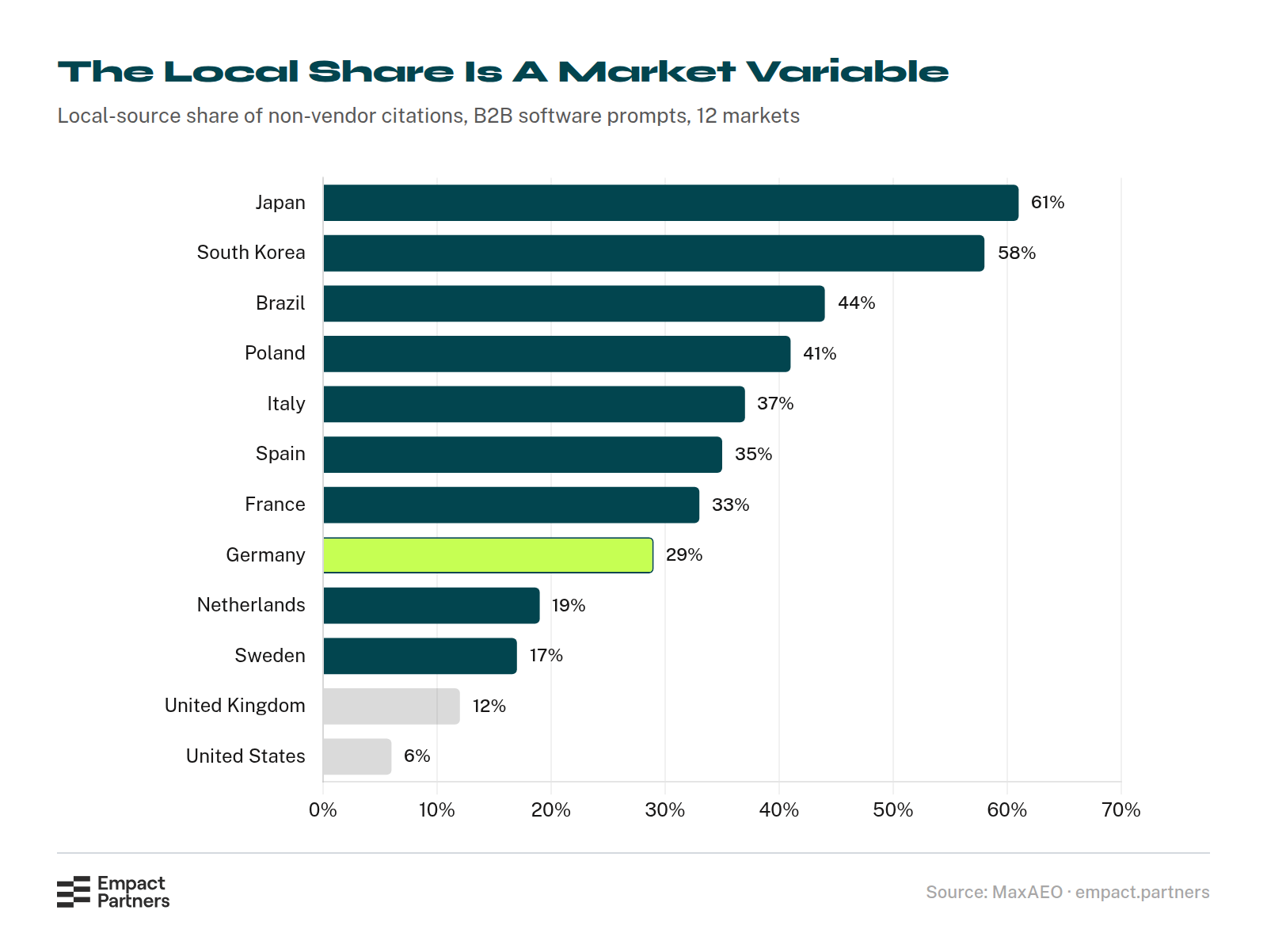
Those twelve figures are shares of non-vendor citations, which excludes the vendor pages that dominate B2B answers, so each one is narrower than it first reads.
Category moves it at least as much as market does. SE Ranking’s 100,000-keyword run in France found 89.34% of sources in French overall, but 57.38% for business queries against roughly 97% in regulated verticals.10 Across Temso’s 47 categories the gap between highest and lowest is 41.4 percentage points, wider than the gap between its most and least local-language engine.1
The one category in that data a software buyer can read directly is the uncomfortable one. In data analytics software, engines cited English pages 48.8% against 47.3% in the prompt’s own language.1
In B2B Software The Answer Runs On Pages You Own
Here the advice inverts. The assumption behind most local-language programs is that the lever is third-party coverage in the market, because that is the lever in English-language software categories. In the two tests that exist in non-English languages, it is not.
Evocia asked 200 B2B software purchase questions in French, four times each with no history, logging 2,259 citations across 288 domains.
Radyant and OMR Reviews ran 96 German-language commercial-intent software prompts across five engines over 20,160 chats and found vendor and manufacturer sites taking 63% of citations.9 Two languages, two prompt sets, two vendors, the same answer.
SISTRIX is the only source anywhere that crosses page type with language, and it does so without a single percentage: product and shop pages dominate the core Google AI Mode keeps, while documentation and institutional sources form ChatGPT’s, with editorial guides rotating through the periphery of both.5
The page-type half we can measure ourselves. Qvery is our sister company, and it has tracked millions of ChatGPT and Google AI Mode citations since January 2026, so discount what follows accordingly and check each figure at its source below. Its content-type classifier, which names roughly an eighth of citations, puts listicles at 5.33% and news at 0.11%.26
.png)
Where the third-party layer does matter, it is a different set of sites per market rather than less of the same ones. SE Ranking ran one method in Germany and the United States on the same day and found review platforms in 31.9% of German AI Overviews against 34.5% of American ones, while G2’s share of those citations fell from 23.1% to 9.3% and German platforms took the places the American ones held.11
Getting named on the right third-party pages in a market is the mentions half of what we run as Generative Engine Optimization, the formula being what real users say about you in public plus where independent sources name you.
In a thin non-English market the honest sequence is your own estate first and the local third-party layer second, which is the reverse of the order that works in English.
The Engine Is Reaching For Density
All of this has one explanation, and it is not that engines prefer English or prefer the local language. They reach for whichever body of pages covers the question best, and language is how the field gets narrowed first.
The supply side sets the ceiling. On W3Techs’ sample, 93.6% of .de websites are German-language and 5.9% are English, while 67.1% of .com websites are English.18 A company whose whole estate sits on a .com is not in the local-language pool its buyers’ questions are answered from, whatever its domain authority says.
Thin supply has been measured for years, in cleaner settings than commercial search.
Neither language alone is enough, which is the finding that most resembles an instruction. Asking in your own language also buys fewer chances at the same time as it narrows the field, which is the squeeze a thin local estate sits inside.
Only one engine maker documents any of this. Microsoft defines the retrieval selector for Bing-grounded answers as a market, and defines a market as a language-and-country pair.17 Its market-codes reference lists most countries with a single language.28 For those surfaces, serving a market and serving a language are the same instruction. OpenAI, Anthropic and Google document no retrieval-language parameter at all.
Our own side of this points the other way, and it is worth saying so rather than leaving it out. Qvery published two platform studies with no stated method at all.
Qvery’s own explanation is density: the English edition carries more reviews per entity and is what the engines have processed most.24 It reports the same pattern on Quora without attaching any figure to it.25
That reconciles with everything above rather than contradicting it. Inside a global platform the English edition is the dense one, so that is where an engine lands. Across a whole market, the dense body of pages in the buyer’s language is usually a set of local domains instead.
Nobody Can Hand You Your Own Number
The gap here is specific, and it is not closing. Anthropic computed how often each language appears in Claude.ai conversations across a million of them, then declined to publish the base rates, calling a fuller cross-lingual analysis a direction for future work.20 OpenAI’s own study of roughly 1.1 million conversations reports the country an account was registered in and no language composition at all.21
The measurement industry has the same hole by design, and so does the trade that sells localization.
So the famous numbers in this field were not built to answer the question you are being asked to sign off on, and the people selling you the answer have not measured it either.
A country figure would not rescue you even if one existed. In WildChat, the only corpus publishing both tables side by side, German is 1.30% of turns while Germany is 3.58% of conversations by location.19 A meaningful share of buyers in non-English markets ask in English, so you are serving two populations in every market and the engines treat them differently.
Empact Partners is a consultancy that runs go-to-market work for B2B software companies. This is the measurement we run before anybody signs a translation budget, reading what each engine already cites in each language a partner sells in, per locale rather than once per brand.
What follows it is the partner’s own estate first, documentation included, then the local third-party layer, and it moves over quarters rather than weeks. We built the measurement because search stopped being one box on one site, and Search Everywhere Optimization covers every surface a buyer searches, each language included.
On the partnership whose case study publishes the shape of it, buycycle expanded into 32 languages and countries with 500%+ organic growth.27
What To Watch Before You Spend
Watch one thing before you spend anything: the share of answers in each locale that name you at all, split by engine. Not the average across markets, which will look survivable while one market sits at zero, and not traffic, which measures the wrong surface entirely.
If you are being asked to sign for localization and cannot say what the engines in those markets already cite, book a meeting with me. We will start with the locales you sell into, and what the engines there already cite.
Sources
- Temso AI, “Lost in Translation: How AI Models Handle Local-Language Sources”, last updated 20 April 2026. Over 4 million source-to-prompt language pairs for non-English prompts, drawn from a dataset of 7,058,891 citations across 350,000 responses, four engines, six non-English languages, 12 countries and 47 industries, window stated as early 2026. The language detector is not named. Read 1 October 2026.
- Weglot, “How AI Search Engines Cite Sources by Language and Country”, 27 July 2026, updated 8 September 2026. 400 questions across five categories and three lengths, each asked in English and in the local language, four systems across five countries, more than 16,000 answers. Per-market shares are printed as chart data labels. How page language was detected is not stated. Read 1 October 2026.
- Weglot, “Does AI Favor Translated Content? (+1.3 Million Citations Analyzed)”, 2026. 153 sites without an English version across 22,854 queries, then 83 sites carrying both versions across 12,138 queries, 1.3 million citations in total. A translation vendor measuring translation. Read 1 October 2026.
- MaxAEO, “Local sources in AI citations by country”, 2026. 200 commercial-intent B2B software prompts per market in each market’s own language, seven engines, twelve markets, 412,000 answer captures and 1.06 million citation links, 1 March to 15 June 2026. Shares are of non-vendor citations. Read 1 October 2026.
- SISTRIX, “AI Citation drift: How stable are sources in AI search results?”, 28 April 2026, updated 21 August 2026. 82,619 prompts and 1,548,213 snapshots across six countries, three platforms and 17 weeks, 17 December 2025 to 8 April 2026. The language and page-type findings rest on a classification of 2,556 cited URLs and describe the stable core of cited domains. Read 1 October 2026.
- Peec AI, “ChatGPT searches in English, even when you don’t”, 12 February 2026. Over 10 million prompts and 20 million query fan-outs from the vendor’s own platform data, ChatGPT only, window stated only as recent months. Read 1 October 2026.
- Peec AI, “Translated Reddit Is Winning AI Citations”, 22 June 2026. 64.77 million Reddit citations across 20 countries and four engines, 1 March to 10 June 2026, of which 3,699,577 carried Reddit’s own translation parameter. Every share has Reddit citations as its denominator. Read 1 October 2026.
- Evocia, “AI Sources Index 2026”, published 14 September 2026, data recalculated 17 September 2026. 200 B2B software purchase questions in French across ten sectors, five intents and four query forms, each asked four times: 800 responses, 2,259 citations, 288 domains, through the OpenAI Responses API rather than the consumer product. Read 1 October 2026.
- Radyant and OMR Reviews, “Software prompt study”, 2026. 96 German-language, Germany-located commercial-intent B2B software prompts in eight categories on five engines, 20,160 chats and roughly 156,000 source mentions, 4 to 30 June 2026, built from aggregated Peec AI exports. Read 1 October 2026.
- SE Ranking, “AI Overviews Already Appear on Over 52% of French Searches”, 18 August 2026. 100,000 keywords across 20 niches in France collected 7 and 8 August 2026, 52,564 answers carrying sources, 363,330 citations. How source language was detected is not stated. Read 1 October 2026.
- SE Ranking, “Review Platforms in AI Overviews”, 2026. 30,801 keywords, a 1 December 2025 snapshot of 22,975 German AI Overviews against 22,729 American ones, same day and same method. Measures domain composition rather than page language. Read 1 October 2026.
- Senuto, “Raport z Analizy AI Overviews w Polsce”, updated 21 August 2025. 17,763,868 phrases for Poland, May to June 2025, from Google Search Console data plus 1,435 Polish domains after filtering. How a source’s language or foreignness was determined is not stated. Read 1 October 2026.
- arXiv, “The Language of the Question Selects the Market”, 2026, a preprint. 234 usable runs collected 29 and 30 August 2026, six query languages across four exit countries, six identical runs per cell, on the logged-out ChatGPT interface and the OpenAI API. Read 1 October 2026.
- arXiv, “Generative Engine Optimization: How to Dominate AI Search”, University of Toronto, 10 September 2025, a preprint with no stated venue. 100 ranking-style prompts across ten consumer verticals translated into five languages, data collected August 2025. Figure 12 prints no per-engine percentages. Read 1 October 2026.
- Amazon, “XRAG: Cross-lingual Retrieval-Augmented Generation”, Findings of EMNLP 2025. Table 7 reports the share of queries for which native-only, English-only and both sets of results independently provided sufficient information, for three locales, with sufficiency judged by Claude 3.5 Sonnet. Read 1 October 2026.
- Association for Computational Linguistics, “XOR QA: Cross-lingual Open-Retrieval Question Answering”, NAACL 2021. 40,000 information-seeking questions across seven non-English languages that could not be answered in their own language, on Wikipedia. Used for mechanism rather than magnitude. Read 1 October 2026.
- Microsoft, “Grounding with Bing Search” documentation, last updated 27 August 2026. Defines the retrieval market parameter as a language-and-country pair. Read 1 October 2026.
- W3Techs, “Distribution of content languages among websites that use .de”, a continuously updated survey of a sample stated as well over 20 million sites, with the .com segmentation read from the same survey. The denominator is websites whose content language W3Techs knows, and the detection method is not stated. Read 1 October 2026.
- arXiv, “WildChat: 1M ChatGPT Interaction Logs in the Wild”, ICLR. Table 5 reports the language breakdown of conversation turns beside the share of conversations by country, collected by offering free access to a ChatGPT front end in exchange for consent. Read 1 October 2026.
- Anthropic, “Clio: Privacy-Preserving Insights into Real-World AI Use”, one million Claude.ai Free and Pro conversations. The paper describes computing a per-language base rate and states that a fuller cross-lingual analysis remains a direction for future work. Read 1 October 2026.
- OpenAI and the National Bureau of Economic Research, “How People Use ChatGPT”, Working Paper 34255, approximately 1.1 million conversations sampled between 15 May 2024 and 26 June 2025, with country taken from the country of account registration. No language composition is reported. Read 1 October 2026.
- Profound, “Where do AI citations come from?”, 11.84 billion citations across eight engines and 8,061 categories, 16 April to 16 July 2026. Its limitations state that the analysis does not account for differences along the dimensions of region or language. Read 1 October 2026.
- European Language Industry Survey, ELIS 2026 report, 1,058 participants across 45 countries. The full report text was extracted and searched; the phrase AI search does not appear in it. Read 1 October 2026.
- Qvery, “Why Google AI Mode Cites TripAdvisor 9x More Than ChatGPT”, 8 May 2026. No method, sample size, window or host-classification rule is stated on the page. Shares are of that platform’s own citations across ChatGPT and Google AI Mode. Our sister company. Read 1 October 2026.
- Qvery, “ChatGPT Has Cited Quora Zero Times. Google AI Mode Cites It Constantly.”, 8 May 2026. No method is stated, and its statements about non-English content carry no figures. Our sister company. Read 1 October 2026.
- Qvery, “Listicles Are the Most Cited Content Type in AI Search”, March 2026. Content type classified by title-pattern matching, which names roughly 12% of citations, across ChatGPT and Google AI Mode. Our sister company. Read 1 October 2026.
- Empact Partners, the buycycle case study, read 1 October 2026. The expansion into 32 languages and countries, the organic growth and the raise are the figures the case study itself publishes; the case study states its organic growth only as a percentage, so no session count appears anywhere here.
- Microsoft, Bing Web Search language and market support reference, marked retired by Microsoft. States that Bing returns content only for the markets it lists, and lists most countries with a single language-and-country pair. Read 1 October 2026.