
81 AI in B2B Sales Statistics
81 figures on AI in B2B sales: teams hand it writing and research, save a few hours a week, and no source proves a revenue lift.
 Anri-Cornel MareeWith
 Vlad Shvets
On this page
Empact Newsletter
One email a month on what is working in AI search and SaaS go-to-market.
87% of sales organizations use some form of AI, by Salesforce’s count of 4,050 sales professionals.1 Ask a stricter question, whether AI is built into the sales process, and Pipedrive gets 37%.2 So whether every sales team has adopted AI depends on how a survey defines adoption. A sales leader comparing their team with the headline is comparing it with the broadest definition on this page.
Nearly every figure on AI in sales comes from a company that sells sales software. Set them side by side and they differ on how many teams use AI, because they ask different people different questions. They agree on what those teams hand over: writing to buyers, researching accounts and writing up calls.
Highlights
- 87% of sales organizations use some form of AI, and 37% of sales professionals have built it into their sales process.12
- 74% of sales AI users write emails and messages with it, and 35% use it to research prospects. Only 10% use it to forecast.2
- 4.8 hours a week is what AI saves the average seller, by Gartner’s count, and 72% of sales organizations put little of that time back into selling.3
- 58% of non-adopters name lack of knowledge as what stops them. Among people already using AI, the top worry is data privacy, at 41%.2
- 77% more revenue per rep at teams that use AI deeply, in Gong’s comparison of its own customers.4 In Gartner’s survey, 20% of sales organizations report a negative return of 50% or worse on AI.3
- 18 minutes is the median time our own meetings agent takes from the end of a call to the written record and follow-ups, across 108 meetings.5
Read together, the surveys can tell a sales leader which jobs other teams hand to AI and roughly what that is worth in hours. They cannot yet show that AI raises revenue, and most of the companies saying it does sell the software.
I look for two jobs in every adoption figure below, pre-call research and follow-up emails, because Empact Partners builds AI agents that take both off SaaS sales reps. These surveys find sellers handing exactly those jobs over.
How Many Sales Teams Use AI
Salesforce’s seventh State of Sales report surveyed 4,050 sales professionals in 22 countries in August and September 2025. It does not split B2B from B2C sellers, so read its shares as sales teams in general. On adoption, it found:
- 87% of sales organizations use some form of AI, for jobs like prospecting, forecasting, lead scoring or drafting emails.1
- 55% of sales professionals use AI for prospecting, and another 38% plan to.1
- 54% of sellers say they have used AI agents.1
Each of those counts something different, organizations, professionals and sellers, and each lands lower than the one before. Pipedrive asked something stricter still, whether AI is part of the sales process itself:
The Share of Sales Teams Using AI, by the Question Asked
Salesforce (4,050 sales professionals) and Pipedrive (1,060 respondents), 2025 surveys
Salesforce87%
Salesforce55%
Salesforce54%
Pipedrive37%
View the data
| Label | Value |
|---|---|
| Use some form of AI Salesforce | 87% |
| Use AI for prospecting Salesforce | 55% |
| Have used AI agents Salesforce | 54% |
| Built AI into the sales process Pipedrive | 37% |
The two surveys use different samples, so read Pipedrive’s 37% as the answer to a stricter question put to different people.2 For a team checking whether it is behind, that gap matters more than either number. A team asking whether AI is part of how it sells is closer to Pipedrive’s question than to the headline.
The other surveys land inside the same spread. HubSpot found only 8% of reps using no AI at all, in a 2025 survey of 1,000 sales professionals that mixes B2B and B2C sellers, so in that sample almost every rep uses AI for something.6
SPOTIO, which sells field sales software, found 33% of field sales teams using none, in a sample split almost evenly between B2B, B2C and both.7 Field reps work from cars and doorsteps, so SPOTIO’s share describes field sales more than a SaaS team selling from a desk. Each share depends on who was asked, which is why the definition behind it matters more than the number.
When a report says most sales teams use AI, I check what it counted as use. Under a loose definition, a rep who drafts the odd email in a chatbot counts as much as a team running agents on every new account. Compare your team with the stricter number, the share of teams that changed how they sell.
 Anri-Cornel Maree on LinkedInOpens in a new tab
Country matters too. Gong’s survey of 3,048 revenue leaders puts AI use at 87% of US companies and 70% of UK ones, with Britain about where the US stood a year earlier.4 So a UK sales team that compares itself with the American headline is comparing itself with a market whose reported adoption ran about a year ahead.
Plans run well ahead of use everywhere. In Pipedrive’s survey, 47% of sales professionals plan to add AI to their sales process soon. Another 17% have no plans to use it for sales at all, mostly for lack of knowledge and doubts about connecting it to their systems.2
PwC, a consultancy that sells AI work, found 54% of US companies using or planning AI agents in sales and marketing within six months, in an April 2025 survey of 308 executives.8 So set your own pace against teams that use AI today, because a share that includes plans mixes teams using AI with teams that only intend to.
Which Companies Use AI in Sales, by Size and Sales Model
Pipedrive splits its sales answers by company size. Its 1,060 respondents lean small, with 77% at companies of 100 people or fewer and 24% in Brazil, so its large-company figure rests on a thin slice of the sample:
Sales Teams With AI in the Sales Process, by Company Size
Pipedrive 2025, share of sales professionals whose sales process includes AI
View the data
| Label | Value |
|---|---|
| Micro 1 to 10 | 40% |
| Small 11 to 100 | 35% |
| Medium 101 to 250 | 44% |
| Large 250 or more | 30% |
Medium companies, with 101 to 250 people, lead at 44% with AI in the sales process, and the largest trail at 30%.2 Pipedrive puts the lag down to legacy systems, longer internal processes and stricter compliance in big firms. So in this sample, the biggest companies are the least likely to have AI in the sales process.
McKinsey’s 2026 survey seems to point the other way. At companies with revenue above $1 billion, 40% of respondents report scaling AI agents, against 22% at smaller companies.9 The two surveys count different things:
Scroll horizontally to see all columns when the table is wider than this page.
| Survey | What it counts | Large against smaller |
|---|---|---|
| Pipedrive 2025 | People with AI in their sales process | 30% against 35% to 44% |
| McKinsey 2026 | Organizations scaling AI agents anywhere | 40% against 22% |
So the two do not contradict each other. A large company can run agents in IT and finance while its reps still write every email themselves.
Sales model splits the work too. SPOTIO found B2B field reps selling 33% of their time, against 49% for B2C and hybrid reps, and losing roughly 25% of their week to admin and data entry.7 That admin is where AI starts, as the jobs below show.
What Sales Teams Hand Over to AI
Pipedrive asked its sales respondents what they use AI for. Among those using it, writing and summarizing lead by a wide margin, and forecasting and lead scoring trail:
- 74% write emails and other messages with it.2
- 56% summarize emails and documents, and 46% prepare sales materials like pitches and comparison tables.2
- 37% transcribe and summarize sales calls and draft the follow-ups.2
- 35% research prospects before contacting them.2
- Only 10% forecast sales with it, and 13% score leads.2
So the jobs sales teams most often give AI are the ones that end in a message or a brief, and the jobs that depend on clean CRM data are the least common. HubSpot asked its sellers the same question in 2025 with different wording. Set the matching tasks side by side and the two surveys agree on writing and split on almost everything else:
Sales Tasks Done With AI, in Two Vendor Surveys
Share of sales AI users per task, Pipedrive 2025 and HubSpot 2025 (B2B and B2C sellers)
View the data
Press Enter or Space to pin the note. Press Escape to release it.| Label | Pipedrive | HubSpot | Note |
|---|---|---|---|
| Writing emails and messages | 74% | 42.9% | |
| Sales materials and enablement | 46% | 33% | |
| Call summaries | 37% | 11.55% | |
| Researching prospects | 35% | – | |
| Analyzing sales data | 23% | 39.93% | |
| Scoring leads | 13% | 27.61% |
Both put writing first. They split by three times on call summaries, 37% in Pipedrive against 11.55% in HubSpot.6 HubSpot finds four sellers in ten using AI for data analysis, a category that takes in forecasting and pipeline analysis, while Pipedrive splits the work and finds one in ten forecasting. The categories differ too much for either forecasting share to work as a benchmark, so plan around the ranking, where writing comes first in both.
On personalization the vendors agree. 83% of sales professionals in HubSpot’s survey say AI personalizes their prospect interactions, and 89% of Salesforce’s AI users say it helps them understand buyers.61 SPOTIO’s field teams rank personalized emails and messages first too, at roughly 30%.7 HubSpot and Salesforce measured agreement, not results, so read their shares as where sellers feel AI helps.
Sellers who have handed research over describe the change in their own words. One veteran enterprise seller wrote:
r/sales
View threadWhat might have taken me a month before now takes me a week, what took me a week before now takes me a day, etc.
Apr 2026
Gartner, an analyst firm, reads the work the same way. It rates AI well suited to account research, personalized messaging and watching for buying signals, and sellers stronger on empathy, judgment and context.10 So pre-call research makes a sensible first trial, because a rep can check the brief before using it.
Put those jobs on a single sales call and they fall on either side of it, with the conversation left to the seller. The two sides also feed each other, because the record written after one call is what the research for the next call reads:
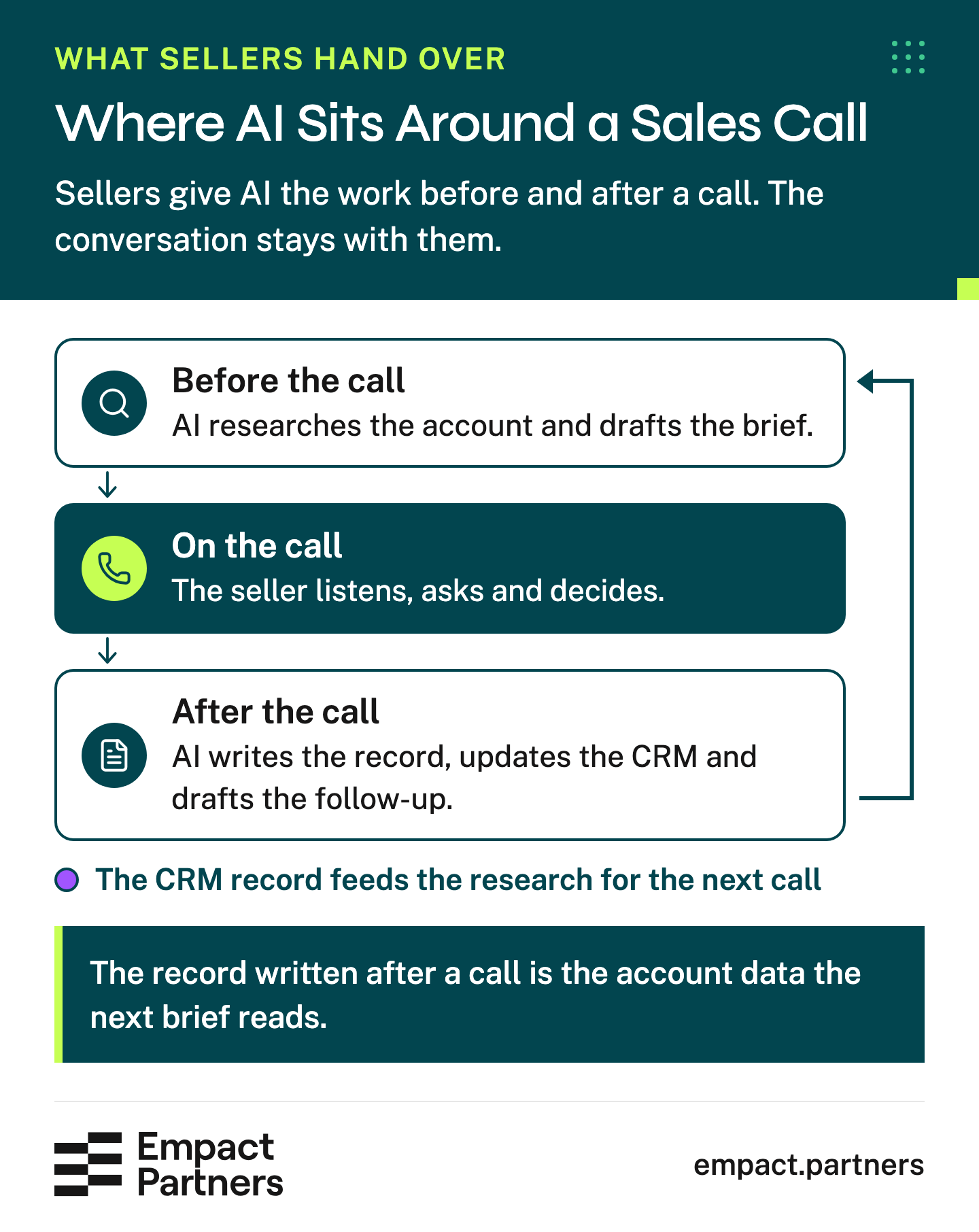
So a thin or stale record carries straight into the next brief, and the write-up after a call deserves the same care as the research before it.
Buyers back the split around the call. In Gartner’s survey of 645 B2B buyers, buyers were 39 percentage points more likely to say a sales rep understood their needs than to say GenAI did.10 So the hours AI saves are worth most when they go into the conversation itself. Practitioners on r/sales describe the two handovers that come up most often:
Tips from Reddit
How sellers hand over the work around a call
I use AI to record the meeting notes, which save into CRM, so I can focus on the chat and not note taking. Then I use the notes to draft a follow up reply, saving time on admin.
Research prospects ahead of calls. Claude will gather public procurement information about the company so I have an idea of what they’re buying now, and also research the people who will be on the call so I have some background going in.
If research before the call is the job you would hand over first, try the Account Research Agent on our site with one of your target accounts. Give it a website and an account, and it returns what the company does, its recent signals, its likely pains, who to contact and the opening line our prospecting agent would write. We run the full agent for partners, so this run is a free preview:
How Much Time AI Saves Sellers
Research and write-ups are what teams hand over, which makes time the next question. Gartner, which sells research rather than sales software, gives the most usable single figure:
- 4.8 hours a week saved for the average seller.3
- 72% of sales organizations report putting little of that time back into high-value selling.3
4.8 hours is more than half a working day each week. If almost three organizations in four let it drain into other work, the saving shows up in a survey long before it reaches the pipeline. Gartner’s organizations that saved time and put it back into selling were 2.2x more likely to beat their customer growth goals, so decide where the time goes before the agent arrives.3
Pipedrive’s users report a smaller and wider spread. Its question went to everyone using AI in sales or marketing, 439 people, so the base mixes the two jobs:
Hours a Week Saved by People Using AI in Sales or Marketing
Pipedrive 2025, 439 AI users in sales or marketing. Another 6% said it was hard to say
View the data
| Label | Value |
|---|---|
| None | 5% |
| Up to 2 hours | 36% |
| 3 to 5 hours | 31% |
| 6 to 10 hours | 14% |
| More than 10 hours | 8% |
36% save up to two hours a week and 31% save three to five, while 8% save more than ten.2 Salespeople alone report less, and 46% of them save up to two hours. The two sources measured different people in different ways, so time your own reps’ work before you plan around either figure.
The agreement shares run far higher than the hours. 84% of sales professionals in HubSpot’s survey say AI saves them time.6 Salesforce’s sellers expect agents to cut prospect research by 34% and email drafting by 36% once fully in place.1 Those are beliefs and expectations, so treat them as questions to put to your own team, and plan capacity on hours you have timed yourself.
When most sellers say AI saves them time and the hour counts come out small, I trust the hours. Ask your reps which task they no longer do by hand. That answer names the job that has moved, and the rest only feels lighter.
Anri-Cornel Maree on LinkedInOpens in a new tabThere is plenty of room to save. The average seller spends 40% of their time selling, by Salesforce’s count, so most of a rep’s week already goes to work no buyer sees.1
In Pipedrive’s 2026 survey of 1,000 US sales and marketing professionals, 38% spend most of their time logging calls, emails and meetings, while 11% count closing deals among their most frequent tasks. Asked which AI feature they want most, more name automated data entry than anything else, at 15%.11 So call logging is the other natural first job, next to research, for a meetings agent to take over.
We use a meetings agent on our own calls. It records every Empact meeting and writes the record and the follow-ups for the team, and it went live for the whole team on 22 October 2026. Across the 108 meetings it wrote up between then and 24 November, we measured the minutes from each call’s end to the filed record, so you can see what the handover looks like in practice:
The median was 18 minutes, and 78% of records were filed within the hour.5 On the 18 sales calls with prospects in that window, the median was 22 minutes, and 17 of the 18 came back with at least one follow-up to do, so the next step is already listed when a rep opens the record.
Eighteen calls is a small set. It measures speed and output, not hours saved, because nobody timed the notes we used to write by hand. It still means the write-up after a call is work an agent can deliver within the hour.
What Stops Sales Teams From Using AI
The hours come back only for teams that get AI running, so the next question is what gets in the way. Pipedrive asked people not yet using AI what stops them, and people already using it what worries them. On the items both questions share, the order flips:
What Stops Non-Users and What Worries Users of AI
Pipedrive 2025. First figure: non-users naming a blocker. Second: users naming a worry
View the data
| Label | Not using AI yet: what stops them | Using AI: what worries them |
|---|---|---|
| Connecting AI to existing systems | 41% | 25% |
| Data privacy | 22% | 41% |
| Trust in AI output | 17% | 37% |
| Security risks | 11% | 35% |
| Regulatory or compliance | 13% | 21% |
| Cost | 17% | 17% |
Integration stops 41% of non-users and worries 25% of users. Data privacy runs the other way, 22% against 41%, and so does trust in the output, from 17% to 37%.2 So the two groups name different problems. Among the items both questions share, people who have not started name connecting AI to their tools most often. People already using it more often worry about whether the output is right and safe to send.
The biggest single blocker sits outside the chart. 58% of non-adopters name lack of knowledge, and 19% name poor data quality.2 Both groups mix sales and marketing professionals, so treat the order as a rough guide to what a sales team should expect first.
Salesforce hears the same about data from teams that already use AI:
An agent that researches accounts from your CRM and enrichment data reads what your reps read, so a stale record comes back as a confident brief that is wrong. So clean the records an agent will read before you ask it to research from them.
Tool sprawl makes that worse. 79% of professionals in Pipedrive’s 2026 survey switch between tools to see one account whole, and 14% of those whose CRM has AI features never use them.11 That means an agent connected to only one of those tools sees the account in pieces too, and its brief misses whatever sits in the others. For some reps the blocker is simply permission. One account manager on r/sales:
r/sales
View threadIt’s not a flex or an attempt at a flex. I’m blocked by my company IT for any of that and what I do has access via zoominfo and other outlets for intel.
Apr 2026
Before arguing with a ban like that, find out what it protects. If the company has no rule yet on where sales data may go, writing that rule comes before choosing a tool.
Does AI Raise Revenue and Win Rates
The strongest claim in this research is about revenue, and it needs the hardest reading on this page. Gong compared teams across 7.1 million opportunities at 3,613 companies on its platform and surveyed 3,048 revenue leaders. Both results set teams that chose AI against teams that did not, so they show which teams use AI, not what AI did for them:
- 77% more revenue per rep at teams that use AI deeply than at teams that do not.4
- 65% more likely to raise win rates, for organizations that make AI a core part of their go-to-market strategy.4
A team that already sells well is also the team most likely to have the budget, the clean data and the managers to roll out AI. So part of that 77% is probably the team and not the tool, and nothing in the release separates the two.
The other studies share the same shape. Salesforce’s high performers are 1.7 times as likely to use agents for prospecting as its underperformers, so growing teams are the likelier users of prospecting agents, with no sign of which came first.1
Among Gartner’s chief sales officers (CSOs), those who give sellers AI next best actions are 2.6x more likely to report commercial growth, and those who train sellers on AI are 2.4x more likely to report strong revenue growth.10 Each is a comparison inside one survey, and none follows a team from before AI to after it, so none can tell you what AI would add to yours.
A team that uses AI more and earns more per rep may simply be the better-run team.
Gartner also asked about returns directly, and the answers split. 25% of sales organizations report a return of 50% or more on their AI spending, and 20% report a negative return of 50% or worse.3 So for every sales organization reporting a return of 50% or more, there is almost one reporting a loss of 50% or more, and 31% of CSOs name proving the return as a top challenge for 2026.12
McKinsey ranks marketing and sales first among the functions where respondents attribute revenue gains to AI, which means gains are reported there most often, and says nothing about how large they are.9
I would not budget for the 77%. Put an agent on one job, measure that job for a quarter and judge the revenue case on your own numbers. With a fifth of sales organizations reporting a negative return, a quarter of your own data is worth more than any vendor’s ratio.
Anri-Cornel Maree on LinkedInOpens in a new tabSo the honest answer on revenue is that the studies on this page have not shown it. In the ones that compare AI use with sales results, the two travel together, and none shows AI causing them. Treat any revenue promise as a claim to test against your own numbers.
Where AI Belongs in Your Sales Motion
Our take is that AI belongs around the sales call first and inside it last. Research before the call, the write-up and follow-up after it, and the CRM update are where the surveys agree, where sellers report the change, and where an agent’s output is easy for a rep to check.
Empact Partners would start with where your reps’ hours go, because the best first agent is the job around a call that eats the most of them. Once the week is mapped, we build that agent inside the tools your reps already use and train them to work with it. Every agent in our AI Agents workstream gets a named owner on your team. For a sales team, the candidates are jobs like these:
- Account research before a rep picks up the phone or writes the first email
- Lead enrichment, so each new lead reaches a rep with its company and role filled in
- Follow-up drafts written from the call record, for the rep to edit and send
- CRM updates, so the pipeline matches what reps heard on their calls
- The weekly sales report, drafted by an agent for a manager to check
If account research is the job you hand over first, our playbook takes a team through giving reps a sourced one-page brief before every sales call:
Before any of it, time two things on your own team: how long a rep spends researching one account, and how long a follow-up takes to leave after a call. Every number on this page belongs to someone else’s sample. Those two will be yours, and they are the two to watch once an agent takes the work.
Frequently Asked Questions
How many B2B sales teams use AI?
The share depends on the question asked. Salesforce counts 87% of sales organizations using some form of AI, HubSpot finds only 8% of reps using none, and Pipedrive finds 37% of sales professionals with AI built into their sales process. All three sell sales software, and HubSpot’s sample mixes B2B and B2C sellers.
For a B2B SaaS team asking whether AI is part of how it sells, Pipedrive’s stricter figure is the closer comparison, because it counts AI built into the sales process.
What do sales teams use AI for most?
Writing. In Pipedrive’s survey 74% of sales AI users write emails and messages with it, and in HubSpot’s, content for leads and for prospect outreach top the chart at around four in ten each.
In Pipedrive’s results, summarizing (56%) and preparing sales materials (46%) come next, then call summaries at 37% and prospect research at 35%. Salesforce counts 55% using AI for prospecting, a broader job than research. Forecasting and lead scoring sit near the bottom of Pipedrive’s results, at 10% and 13%.
How much time does AI save a salesperson?
Gartner puts the average at 4.8 hours a week. Pipedrive’s AI users in sales and marketing report a spread: 36% save up to two hours and 31% three to five, and among individual salespeople 46% save up to two hours.
The bigger question is where that time goes. Gartner found 72% of sales organizations put little of it back into selling, so a saving nobody plans for tends to vanish into internal meetings and admin.
Does AI increase win rates or revenue per rep?
None of the studies here shows that it does. Gong’s analysis of its own opportunity data finds 77% more revenue per rep at teams that use AI deeply, and its survey finds organizations that build AI into their go-to-market strategy 65% more likely to raise win rates. Both compare teams that chose AI with teams that did not, and better-run teams may simply be the ones adopting first.
Gartner’s answers split: 25% of sales organizations report a return of 50% or more on AI, and 20% a loss of 50% or more. Measure your own before and after.
Why do sales AI statistics disagree so much?
The surveys ask different people different questions. Some count any AI use and others count AI built into the process. Some ask leaders, others ask reps, and the samples run from field crews working door to door to enterprise revenue teams. Most of the surveys come from companies that sell sales software, and Gong’s revenue data comes from its own platform.
Check who was asked and exactly what before you compare two numbers, and never average them.
Are these statistics about B2B sales only?
Mostly not. HubSpot’s 2025 report covers B2B and B2C sellers together. SPOTIO’s sample is roughly a third B2B, a third B2C and a third both, and Salesforce, Pipedrive and Gong publish no B2B split at all. Gartner’s buyer survey is the one B2B-only source here.
Read the shares as sales teams in general. Where a split exists, it can be large: SPOTIO’s B2B field reps spent less of their time selling than its B2C reps.
What is the biggest blocker to using AI in sales?
For teams that have not started, it is know-how. 58% of Pipedrive’s non-adopters name lack of knowledge, and 41% name connecting AI to the systems they already run. For teams already using AI, the worries turn to data privacy, at 41%, and trust in the output, at 37%. Salesforce adds that 51% of sales leaders with AI say disconnected systems slow their AI work down.
Do small or large companies use more AI in sales?
The answer depends on what gets counted. In Pipedrive’s survey of mostly small firms, medium companies with 101 to 250 people lead at 44% and the largest trail at 30%. McKinsey counts organizations scaling AI agents in any function and finds large ones ahead, 40% against 22%.
Pipedrive’s finding holds for its own, mostly small, sample. McKinsey measures something else, so together they do not settle which size of company is further along in sales.
Should sales reps use AI during live calls?
The evidence points to keeping the conversation with the rep and putting AI before and after it. Gartner’s B2B buyers were 39 percentage points more likely to say a rep understood their needs than to say GenAI did. Sellers on Reddit describe the same division, handing notes and follow-ups to AI so they can listen to the person in front of them.
Recording and summarizing the call sits in between, since the seller keeps the conversation and gets the record afterwards.
Which sales task should a team hand to AI first?
Start with the work around the call. Pipedrive’s 35% researching prospects and 37% summarizing calls and drafting follow-ups put both among the common uses, and a rep can check the output before anything reaches a buyer.
Forecasting and lead scoring depend on clean CRM data, so they belong after the data work. Pick research or the call write-up, time it now, and give it to an agent for a quarter before you add the next.
Sources (12)
- Salesforce, "The Productivity Gap: New Survey Shows 9 in 10 Sellers Are Betting on AI and Agents To Help" (2026)↩1↩2↩3↩4↩5↩6↩7↩8↩9↩10↩11State of Sales report (7th edition), 3 February 2026, survey of 4,050 sales professionals in 22 countries, August to September 2025. Read 24 November 2026.
- Pipedrive, "State of Sales and Marketing 2025" (2026)↩1↩2↩3↩4↩5↩6↩7↩8↩9↩10↩11↩12↩13↩14↩15↩16↩17↩18↩19survey of 1,060 sales and marketing professionals in 82 countries. Read 24 November 2026.
- Gartner, "Survey Finds AI Saves Sellers Nearly 5 Hours Per Week, Yet 72% of Sales Organizations Fail to Reinvest Time in High-Value Activities" (2026)↩1↩2↩3↩4↩5↩619 May 2026, survey of 210 CSOs and senior sales leaders, January to February 2026. Read 24 November 2026.
- Gong, "New Gong Labs Research Finds AI Is Now a Trusted Decision-Maker in Revenue Teams" (2026)↩1↩2↩3↩4for the State of Revenue AI 2026 report, 4 December 2025, survey of 3,048 revenue leaders and 7.1 million opportunities at 3,613 companies. Read 24 November 2026.
- Empact Partners, "our meetings agent" (2026)Empact Partners' own data↩1↩2↩3the 108 Empact meetings it recorded between 22 October and 24 November 2026 (18 of them sales calls with prospects), minutes from each call’s calendar end to the filed record with its follow-ups, read from each record’s metadata. Read 24 November 2026.
- HubSpot, "’s 2025 State of Sales Report: What 1,000+ sales pros say about AI, buyer behavior, and growth" (2025)↩1↩2↩3↩4updated 9 September 2025, survey of 1,000 B2B and B2C sales professionals. Read 24 November 2026.
- SPOTIO, "The State of Field Sales in 2026: Revenue Up Despite Quota Misses" (2026)↩1↩2↩36 March 2026, 388 respondents with field sales teams (B2B, B2C and hybrid). Read 24 November 2026.
- PwC, "’s AI Agent Survey" (2025)↩116 May 2025, survey of 308 US executives, 22 to 28 April 2025. Read 24 November 2026.
- McKinsey & Company, "The state of AI in 2026: On the road to ROI" (2026)↩1↩225 August 2026, survey of 1,719 participants in 97 nations, May to June 2026. Read 24 November 2026.
- Gartner, "Survey Finds Sales Organizations That Provide AI-Enabled Next Best Actions Are 2.6x More Likely to Achieve Commercial Growth" (2026)↩1↩2↩320 May 2026, surveys of 227 CSOs and 645 B2B buyers, August to September 2025. Read 24 November 2026.
- Pipedrive, "The modern salesperson is becoming a data-entry clerk" (2026)↩1↩2CRM Trends Report 2026, 4 August 2026, survey of 1,000 US sales and marketing professionals, June 2026. Read 24 November 2026.
- Gartner, "Survey Shows 31% of Chief Sales Officers Cited Difficulty Proving ROI of AI-driven Tools as a Top Challenge for Sales Objectives in 2026" (2026)↩1Q&A, 19 May 2026, survey of 227 CSOs, August to September 2025. Read 24 November 2026.
Keep reading
Statistics 35 B2B Buyer Journey Statistics
B2B buyer journey statistics on shortlists, AI research and the discovery sources your sales reports miss.
Statistics 40 Reddit User Statistics
40 figures on how many people use Reddit, who they are, how long they stay, and the few communities where software buyers meet it.

Statistics 67 AI Usage Statistics
67 figures on how many people, workers and companies use AI, read for SaaS teams whose buyers already ask AI first.