
Your AI Leads Are Already Here, and Analytics Calls Them Direct
Buyers who get your name from an AI answer often type it or search for it, and analytics credits that last step. Ask them on your form.
 Teddy CipollaWith
 Vlad Shvets
On this page
Empact Newsletter
One email a month on what is working in AI search and SaaS go-to-market.
If the AI line in your analytics barely leaves zero, it hasn’t shown that AI sends you nothing. The buyers an AI answer sends you land under Direct and Organic Search, where that line can’t see them. Put a free-text “How did you first hear about us?” question on your signup or demo form this week. Then read a month of answers before anyone calls the channel empty.
A buyer who gets your name from an AI answer often has nothing of yours to click. So they type the name or search for it, and analytics credits that last step. That holds for any B2B software company the engines name, with a signup or demo form, and the only person the fix needs is whoever edits that form.
Empact Partners shows SaaS companies where their pipeline starts, in the RevOps reports we set up for them. Each week we also ask the AI engines our partners’ buyer questions through the Empact Panel, a tracker we built, and keep every answer.
More Than Half of AI Mentions Carry No Link to the Brand’s Site
The Empact Panel stores every answer with the brands it names and the pages it cites. So we can count how often an engine names a brand and gives the buyer no link to the vendor.
Across 13 of our partners’ panels in software categories, ChatGPT, Google AI Mode and Claude named the brands we track 1,522,376 times between 12 October and 24 November 2026. In 56.2% of those mentions, the answer gave the buyer nothing to click on that brand’s site.1
Most of the difference comes from the engine. ChatGPT links most of the brands it names, while Google AI Mode and Claude mostly don’t:
How Often Each AI Engine Names a Brand Without Linking to It
Share of brand mentions with no link to the brand’s own site, 13 partners’ panels in software categories (Claude in 4), 12 Oct to 24 Nov 2026
View the data
| Label | Value |
|---|---|
| Claude | 86.7% |
| Google AI Mode | 83.5% |
| ChatGPT | 25.7% |
The split shapes your report in two ways. The AI line in analytics mostly counts ChatGPT, the engine that links. And Google AI Mode, which leaves more than four mentions in five unlinked, sends even its clicks through Google, so they arrive as Google search.
The same gap shows on a single partner. This card compares how often the engines named one partner when its own pages were cited and when they weren’t, over 30 days and 111,815 answers:
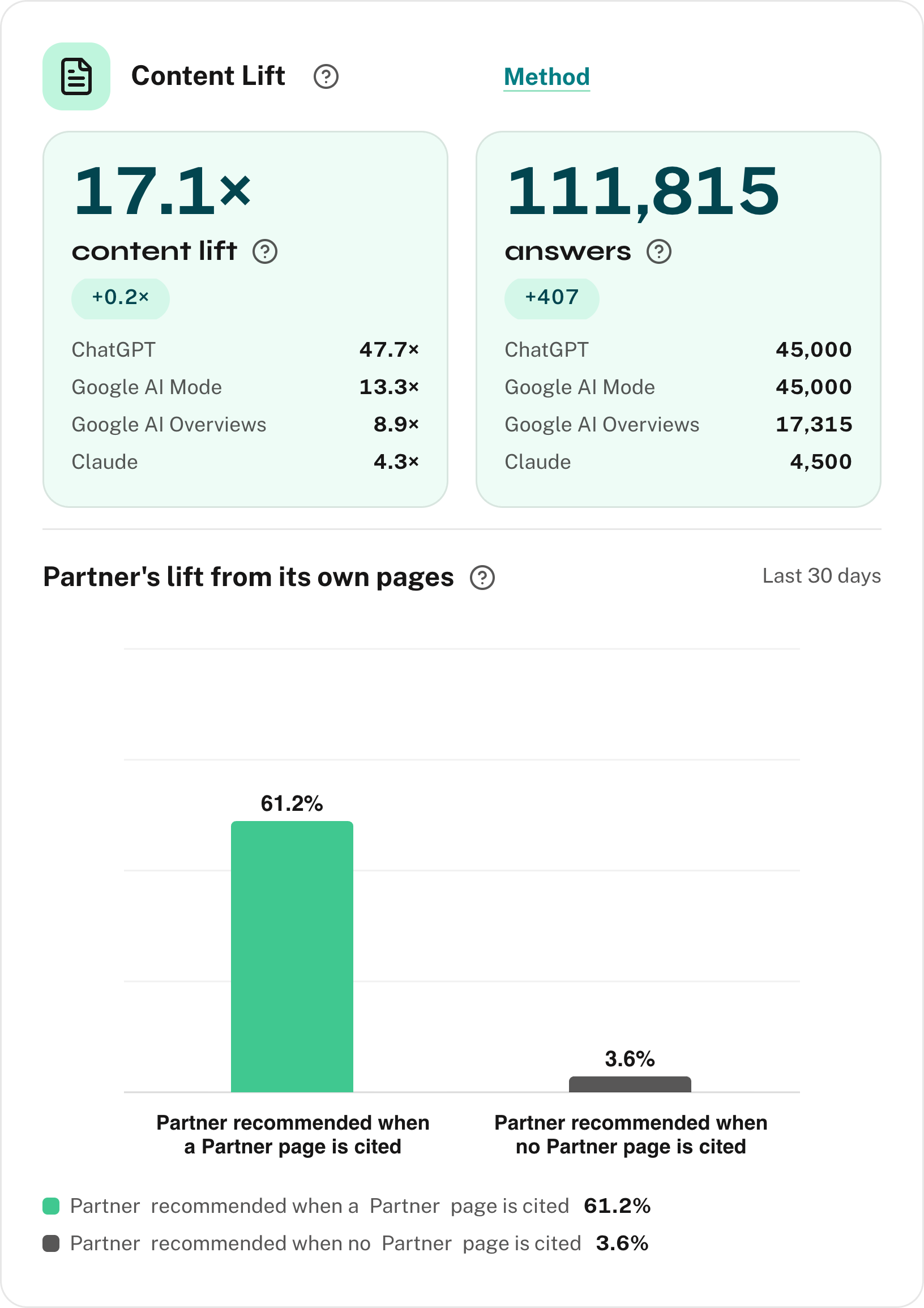
The bar on the right, for answers that cite none of the partner’s pages, looks like a rounding error until you count the answers behind it. 97,194 of the 111,815 answers cited none of the partner’s pages, and 3.6% of them still named it: 3,483 recommendations with no link. The left-hand bar holds 8,942 with one. So of the 12,425 times the engines named this partner, 28% gave the buyer the name and nothing to click.2
More than half the times an engine names a brand, nothing in the answer links to that brand’s site. Those buyers still reach the site. They type the name or search for it, and the report files them under two lines nobody questions. An AI line near zero counts clicks. It says nothing about how often a buyer saw your name on a shortlist.
 Teddy Cipolla on LinkedInOpens in a new tab
So the name reaches buyers without a link. The question for your report is where those buyers’ visits land.
Analytics Credits the Search Your Buyer Ran After the Answer
A buyer holding your name and no link still reaches your site. Analytics records how a visit arrived, never what sent it. A buyer who types your address or searches your name lands in Direct or Organic Search like any other visitor.
Even the clicks inside Google’s own answers lose the trail. Google reports visits from AI Overviews and AI Mode inside Search Console’s ordinary web search numbers, with no separate line for them.3 The visit reaches your site from Google’s results page, so analytics files it with every other Google click.
Set the ways in side by side, and only one of them can carry the engine’s name:
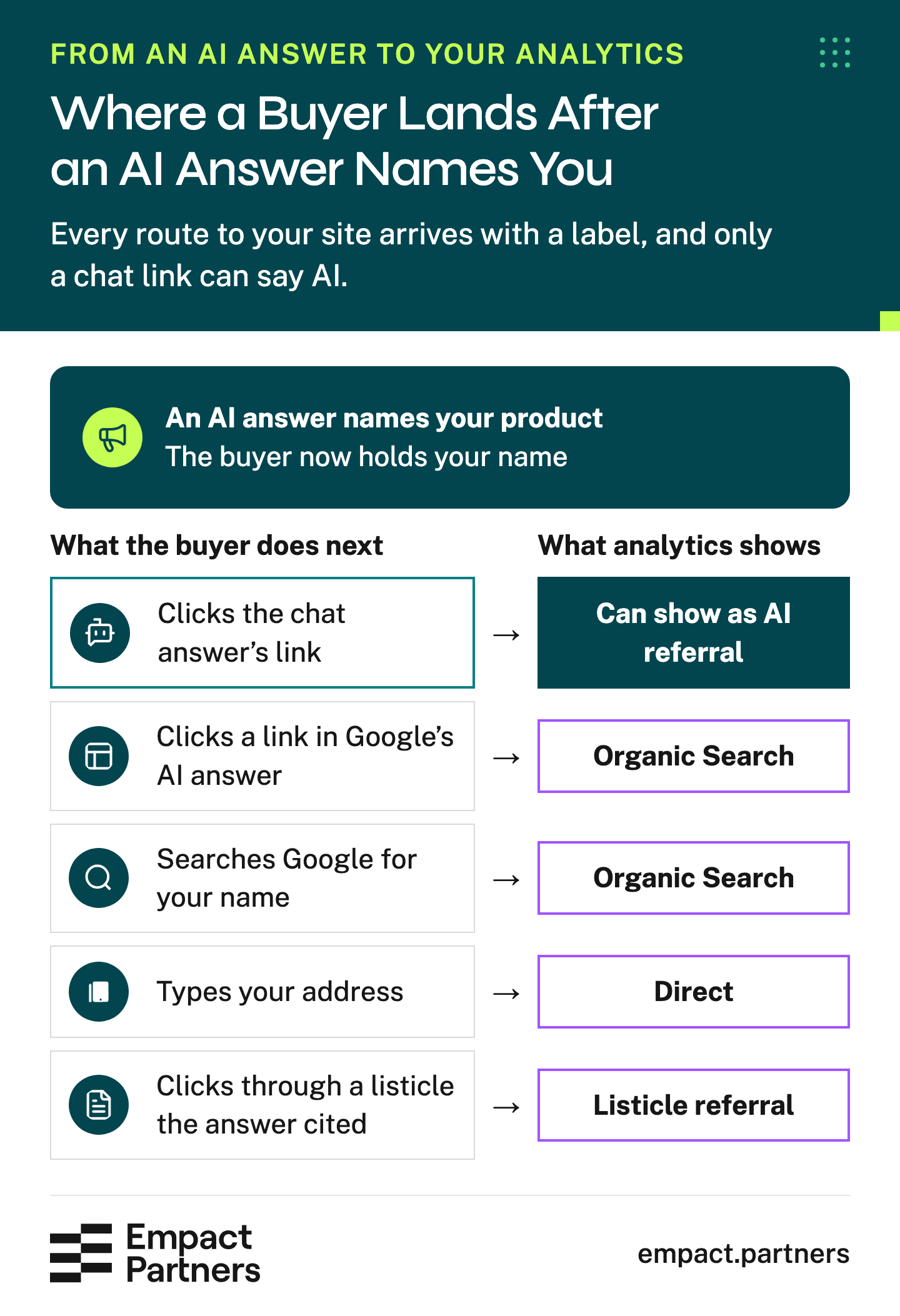
So the AI line sits near zero because it counts the one route that can keep the engine’s name. Buyers on every other route land in lines your report already treats as healthy.
Omniscient Digital, an organic-growth firm, compared what its leads wrote in an optional free-text field with HubSpot’s first-touch source, the first visit HubSpot recorded for each lead:4
That’s one company’s pipeline, and its field was optional, so it undercounts. It still matches the routes. The buyers were in the report the whole time, and only their own words said where the search began.
A report that says AI sends you nothing has only counted the buyers who clicked.
The only record of the step before that search is the buyer’s memory of it. The fair question is whether a memory is good enough to act on.
Isn’t a Self-Reported Source Too Noisy to Trust?
Buyers misremember. Given a dropdown, they pick the first option to get to the demo. Given a box, they type “Google” or “online.” Someone has to sort every answer each month, and a RevOps team that spent a year cleaning its attribution model is asked to trust a survey question.
Ruler Analytics, which sells attribution software, tested its own demo form in 2022. 72% of the answers were vague or blank. At one of its clients, 47% of first-option picks in a dropdown were wrong.5 That test ran before any buyer could name an AI engine, and it’s still the best case against the field.
All of that is true. The field is a coarse instrument, and it never belongs on a dashboard by itself. Before you add it, weigh what it records against what it costs your team:
Pros
- It records the step before the search, which no tracking can see
- It costs one form field and no new software
- A buyer who asked an AI tool for a shortlist tends to say so
Cons
- Many answers will be blank, vague or just “Google”
- Someone has to read and sort the answers every month
- A buyer may name the last thing they read instead of the first
Free text helps most with AI. The dropdown error Ruler measured needs a first option, and a free-text box has none. And buyers remember asking a chatbot for a shortlist, because they chose to do it: in Omniscient’s field, 189 of 213 answers named an engine.4
A coarse answer that names a real channel is still worth more than a precise report that can’t see it. Your attribution model measures clicks well, and the AI buyer’s first step wasn’t a click.
Read the answers beside two other numbers, and never alone: searches for your brand name in Search Console, and how often the engines name you. When all three rise in the same months, believe them over the AI line. When only the answers move, treat them as a lead to check, not a finding to report.
Teddy Cipolla on LinkedInOpens in a new tabThat reading takes a month of answers, which is why the field goes on the form now and the verdict on the channel waits.
Add the Question This Week and Read a Month of Answers Before You Decide
Setting up the field and sorting the answers takes an afternoon the first time, and none of it needs a consultant:
One month, three moves
This week.
Add the question to your signup or demo form as free text, worded with “first,” and put no hint under the box that names channels.
Through the month.
Keep every answer as the buyer typed it, on the contact record, next to the source your CRM recorded for that contact.
At the month’s end.
Sort the answers into categories you wrote down before reading them, so one month can’t redraw them. Then set the AI share beside branded searches and how often the engines name you.
Branded searches are already in Search Console. How often the engines name you usually isn’t recorded anywhere, and the form can’t tell you. A baseline you can trust takes about a week of asking the engines by hand:
We ask for the question before an AI-search or Reddit program starts. Leads are how that budget gets judged, and without the buyer’s own answer nobody can show what the work brought in. Then we set up the RevOps reporting in the CRM your team already uses, with the answers beside what the Empact Panel measures for the same buyers. The work includes:
- A question on your forms that asks new leads how they found you
- How the leads will be attributed, agreed before the program starts
- Pipeline and attribution reporting in the CRM your team already uses
- Your buyers’ questions in the Empact Panel, asked every week
- Each line of the report labeled with its dates and its source
Over that first month, the reading that matters is whether answers naming an AI tool climb in the same weeks as searches for your brand name. If they rise together, you have a case that the channel your report called empty is sending you buyers, and the next pipeline review gets a new line.
When the board asks what that line is worth, report it as pipeline rather than as visits.
Frequently Asked Questions
Should we treat all of our direct traffic as AI traffic?
No. Direct also collects existing customers typing your address, bookmarks, links opened from email apps and chat tools that drop the source, privacy settings and bots. The AI buyers sit inside it among everything else, and nothing in the traffic tells them apart.
The buyer’s answer separates them where analytics can’t, which is what the form question is for. Treat a rising direct line as a reason to ask, never as a count of AI leads.
Where do clicks from Google AI Mode and AI Overviews show up?
In Search Console they’re part of the ordinary web search traffic in the Performance report, by Google’s own documentation, with no separate filter for AI features. In analytics the visit arrives from Google’s results page, so it lands under Organic Search with every other Google click.
A buyer who found you in Google’s AI answer looks the same there as one who clicked a plain result. Only their own answer on the form tells the two apart.
Will buyers remember an AI answer by the time they sign up?
More often than they remember most sources, because asking a chatbot for a shortlist is a deliberate act. In the one published pipeline we read for this question, 189 of 213 free-text answers named an engine. Memory fades, so ask on the form rather than weeks later on the sales call. By then the buyer says whatever comes to mind first.
Keep the exact words too, since “a friend told me, then I asked ChatGPT” says more than any category.
What if most answers just say “Google”?
Then ask one more question. “Google” often means the branded search that followed the real first step, the very step this problem hides. The word “first” in the question pulls buyers back past yesterday’s search. On a few sales calls each month, ask buyers who wrote “Google” what they searched for.
If they still say a plain Google search after that, believe them for that month, and note it as the channel your report already counts correctly.
How long before the AI share is worth reporting?
Read the first month for what buyers say, and report a share only once a few dozen answers have come in, because a handful can swing it by half. Small teams can pool two or three months. Report the count beside the share every time, so nobody mistakes a handful of answers for a share of the pipeline. The direction over several months matters more than any single month’s number.
What if a month of answers names almost no AI tool?
Believe it for your category, then look upstream. Check whether the engines name you at all for the questions your buyers ask. If they rarely do, the channel is small because you’re missing from the answers, and a form can’t fix that.
If they name you often and nobody writes it down, check the question’s wording and where it sits on the form before you conclude the channel is empty. A visibility baseline settles which of the two you’re facing in about a week.
Does this work for demo requests as well as self-serve signups?
Yes, with the same question. A buyer requesting a demo is already asking for a conversation, so you can make the answer required without losing the lead.
With self-serve signups, put the question on the first page a new user sees after creating the account. Save both kinds of answer to the same contact field, so each month you read every new lead together, however they came in.
What should we tell the pipeline review before the answers come in?
Tell them the AI line counts only clicks from AI answers that kept the engine’s name. It misses buyers who typed your address or searched your name after an answer named you, and every click inside Google’s AI features.
Then give them a date, a month from now, when you’ll set the form answers beside branded searches. A dated plan holds up better in that room than a guess either way.
Can we see whether AI engines name us without waiting for leads?
Yes. Put your buyers’ own questions to the engines, with no brand named in them, and count how often you appear and which pages each answer cites. A hundred questions in two engines, each asked twice, gives a baseline in about a week. That number moves before leads do, and it tells you whether a quiet month of answers means the channel is small or you’re missing from it.
Does growth in branded search prove that AI is working?
Not on its own. Searches for your name also rise after launches, events, press coverage and sales pushes. You have a case for the board when branded searches, form answers naming an AI tool and the engines naming you all rise in the same months. If only one of them rises, you can’t rule out coincidence.
Sources (5)
- Empact Partners, "Empact Panel run behind our brand mentions statistics" (2026)Empact Partners' own data↩1↩2every tracked brand named in ChatGPT, Google AI Mode and Claude answers to 41,936 buyer questions with no brand in them, in 13 partners’ panels in software categories, 12 October to 24 November 2026, 1,522,376 mentions of 1,117 brands, read 25 November 2026.
- Empact Partners, "Empact Panel, Content Lift card for one partner’s panel, the 30 days to 24 November 2026" (2026)Empact Partners' own data↩1read 27 November 2026.
- Google Search Central, "AI features and your website" (2025)↩1
- Omniscient Digital, "First-Touch Attribution Captures 15% of Our AI-Sourced Leads" (2026)↩1↩2↩3
- Ruler Analytics, "Do You Need a ‘How Did You Hear About Us?’ Form Field?" (2022)↩1
Keep reading
RevOps How to See Which Signups Came From ChatGPT and Reddit
Signups from ChatGPT and Reddit land in analytics as Direct or Google. Add one form field, code the answers with Claude, report both.

RevOps How to See and Report the Pipeline AI Engines Send You
Buyers who find you in AI answers rarely click. Stamp each buyer’s own answer on the deal, then show the board those deals by both sources.
RevOps How to Calculate CAC by Channel from Closed-Won Deals
Ad platforms count form fills, not customers. Count CAC by channel from closed-won deals, for short self-serve and long sales-led cycles.