How to Calculate CAC by Channel from Closed-Won Deals
Ad platforms count form fills, not customers. Count CAC by channel from closed-won deals, for short self-serve and long sales-led cycles.
 Teddy CipollaWith
 Vlad Shvets
On this page
- Why the Ad Platform’s Cost per Conversion Is a Lead Cost
- How to Join Each Form Fill to the Company That Paid
- Read a Cohort’s CAC Only After Its Deals Have Had Time to Close
- Put Organic on the Same Cost Basis as Paid
- Credit Each Paying Company to One Channel
- The Table to Bring to the 2027 Budget Meeting
- Frequently Asked Questions
Empact Newsletter
One email a month on what is working in AI search and SaaS go-to-market.
Most 2027 budget decks will carry two columns that never meet. One comes from the ad platforms: conversions, and a cost per conversion of a few dollars or a few hundred. The other comes from the CRM: the companies that signed and paid this year. Nobody in the room can say which conversions became which companies, so the platform’s number wins by default.
This guide shows how to count customer acquisition cost (CAC) by channel from closed-won deals instead, for a short self-serve sales cycle and a long sales-led one. That is the acquisition number a channel budget should be set on, in place of the platform’s.
Empact Partners connects SaaS companies’ marketing and sales systems and sets up the RevOps reporting that shows which channel brought in each new paying company. For a budget meeting, that turns platform conversions into a cost per paying company.
Why the Ad Platform’s Cost per Conversion Is a Lead Cost
A conversion is whatever event you told the platform to count. For most B2B SaaS accounts that is a form fill, a demo request or a trial sign-up, because those happen within days of the click and the platform can see them. Nobody has paid anything yet. Divide the spend by those events and you get the price of a lead, whatever the report calls it.
The gap between that price and the cost of a paying company is easy to underestimate until you count it. Take a self-serve product with monthly plans and a 14-day trial. The example is made up, with round numbers, and the shrink it shows is the pattern to look for in your own records:
Scroll horizontally to see all columns when the table is wider than this page.
| Step | Count | What dropped out |
|---|---|---|
| Google Ads conversions in April (trial sign-ups) | 600 | |
| Distinct people | 540 | People who signed up twice |
| Distinct companies | 470 | Colleagues at the same company |
| Companies paying by 31 May | 52 | Trials that never paid |
| New paying companies | 43 | Seven companies already paying (a second team, which is expansion) and two refunds |
The platform reported $30 per conversion on $18,000 of media. Add the $4,000 of people and tools that exist only to run the channel, divide $22,000 by 43, and each new paying company cost about $512. The $30 is the price of a trial. The $512 is what each new customer cost, which is the acquisition number a budget meeting needs. Written as the definition this guide uses, which credits each company to the channel of its first form fill:
Counting to 43 is the hard part. It only works if every paying company can be traced back to the form fill that started it.
How to Join Each Form Fill to the Company That Paid
The source of a lead is recorded on the person, the contact record the form created. The money is recorded somewhere else: on the deal when sales closes it, and in billing when a self-serve customer pays by card. Channel CAC needs a line from the contact to the money, through the company in between, and in most CRMs that line breaks at a handoff.
In a sales-led motion it breaks when a rep creates the deal by hand from the company record and nothing copies the source across. In a self-serve motion there is often no deal at all. The purchase lands in the billing system, and unless something writes it back to the company in the CRM, the CRM never learns which sign-ups paid.
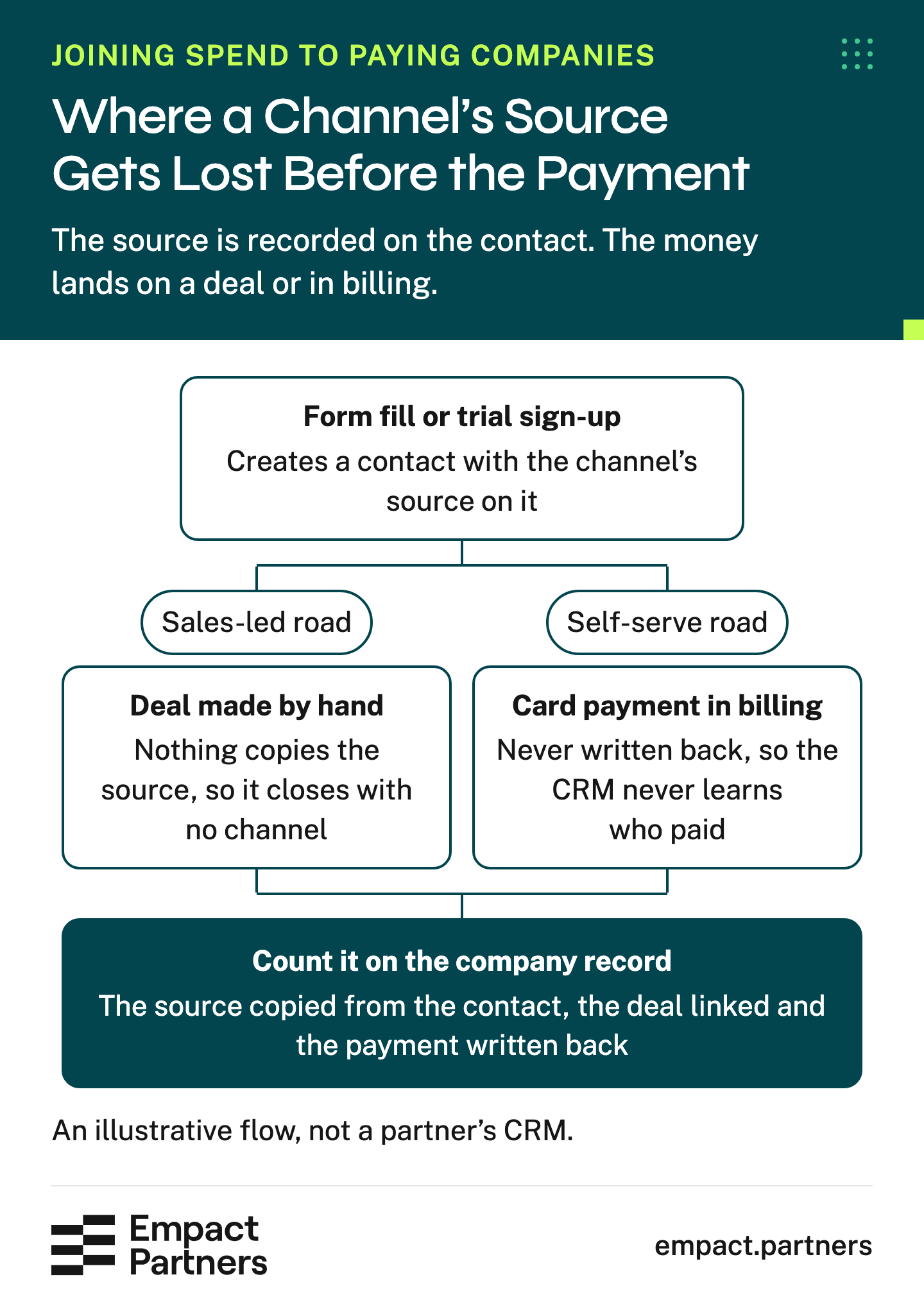
Both roads have to end on the company record, which is why the company is the unit you count. People sign up twice and change jobs. The company is what pays.
A HubSpot user on r/marketing answered someone whose purchases sat in an enterprise resource planning (ERP) system, the software finance keeps orders and invoices in. The reply puts the repair for both roads in two steps:
Tips from Reddit
Keeping the source attached to the money
My first suggestion is to set up some HubSpot workflows to copy contact source data to all related fields, and make sure everything is associated correctly (Contact to Company and Deal and Quote, etc).
You’ll need the ERP to tell HubSpot the revenue number - probably either create a custom property at the contact level or company level, or use something that already exists at the deal level, depending on how you’re using your CRM.
Copying the source puts the channel on the deal. It does not prove the deal was paid. A rep can mark a deal closed-won the day a contract goes out, and a company on a monthly plan can cancel before its first invoice clears.
In our own CRM at Empact Partners, a deal moves to won only on two pieces of evidence, such as a signed contract, a kickoff held or a payment received. That is our rule for marking a deal won. For channel CAC, also check that the company has made its first payment, or the denominator counts promises.
So before a company counts toward any channel, its records should pass four checks:
Before a company counts toward a channel
- The form fill that created its first contact carries a source, and the deal or the payment carries the same one
- Every contact is linked to the company, and every deal and payment to that company too
- The company appears in the CRM a single time, with duplicates merged before anyone counts
- A first payment received from the company, plus a won deal on the sales-led road, and no earlier payments from it
Merging is where cleanup does damage. Merge two contacts only when their email addresses match, and two companies only when their websites do. Anything less goes to a person who can read both records, because an automatic merge can wipe out part of a buyer’s history.
If you do not know how many duplicates your CRM holds, the agent below counts them from one export, along with missing fields and records nobody owns:
With the records joined, you know which companies paid and which channel each came from. You still do not know when to count them.
Read a Cohort’s CAC Only After Its Deals Have Had Time to Close
A cohort is the set of companies whose first form fill landed in the same month or quarter, set against what the channel cost in that period. The self-serve example settles fast. With a 14-day trial, it assumes nearly every April sign-up that will ever pay has paid by the end of May.
A sales-led cohort takes as long as your deals take to close, and reading it early gives the wrong answer.
Here is a made-up sales-led company on annual contracts, and the companies whose first form fill came from LinkedIn Ads between January and March 2026. The quarter cost $60,000, $45,000 of it media. The platform reported 240 form fills at about $188 each, from 150 companies, and they opened 60 opportunities. Read three times, the same cohort gives three different CACs:
Scroll horizontally to see all columns when the table is wider than this page.
| Read on | New paying companies | Expansion left out | Opportunities still open | CAC so far |
|---|---|---|---|---|
| 30 June 2026 | 2 | 0 | 41 | $30,000 |
| 30 September 2026 | 6 | 1 | 24 | $10,000 |
| 31 December 2026 | 11 | 1 | 9 | $5,455 |
Read in June, LinkedIn’s $30,000 makes it look like a channel to cut. By December its CAC is under a fifth of that, with nine opportunities still open.
A cohort read before its deals have closed prices a channel on the few deals it has won so far.
The opposite mistake is quieter. Divide this quarter’s spend by this quarter’s closed deals, and those deals belong to cohorts that started six months earlier. A channel you just cut can still look cheap for two more quarters.
How long to wait is your own number. Take last year’s won deals, measure the days from each company’s first form fill to its payment, and read a cohort once most deals like it would have closed. Until then, the row is provisional.
Once a cohort has had time to close, put its numbers into the calculator below. The media goes in ad spend, the people and tools in the other cost, and new customers takes only first-time paying companies, never sign-ups or trials. Add what a customer pays each month and your gross margin, and its payback tab shows how many months each channel’s companies take to earn their cost back:
Matching periods fixes the paid rows. Organic usually arrives at the meeting with no row at all.
Put Organic on the Same Cost Basis as Paid
Organic search has no media bill, so it often shows up with a tiny CAC or none, and finance discounts both. It still costs money, and most of it is already in finance’s records:
Scroll horizontally to see all columns when the table is wider than this page.
| Organic cost | Where finance has it |
|---|---|
| Writers, editors and designers | Invoices, or payroll for people on staff |
| Hours spent planning and briefing content | A share of those people’s salaries, by an estimate of their hours |
| SEO and content tools | The expense ledger |
| Outside help on the channel | Invoices |
Put those in the other cost for the same quarter, count the new paying companies whose first form fill came from organic search, and organic has the same row as LinkedIn.
The fair objection is timing. An article published two years ago still brings in sign-ups this quarter, and paid stops the day its budget does. Keep the older publishing out of the quarter’s cost. Write the quarter’s cost in the row and the months of publishing behind it in the table’s title, so the meeting sees both and nobody adjusts CAC by hand.
The row only exists if organic leads were tracked from the start. A Reddit or AI-search campaign judged on leads needs its attribution method agreed before it starts, and so does organic search. The method can be as simple as asking new sign-ups how they found you. Without one, work that brought in customers has nothing to show for it at the first review.
Credit Each Paying Company to One Channel
With a row for every channel, the meeting reaches the question it always reaches: which channel gets a company that touched three of them?
Take a paying company from the sales-led example. Its buyer first read a blog post from organic search in December without filling anything in. In January she clicked a LinkedIn ad and downloaded a guide, which created her contact. In March she clicked a Google ad on a search for the brand and requested a demo, which opened the deal. Four common rules credit that one company four ways:
Scroll horizontally to see all columns when the table is wider than this page.
| Credit rule | Where the company lands |
|---|---|
| First touch (first tracked visit) | Organic search |
| Last touch | Google Ads |
| Even split | A third each to LinkedIn Ads, organic search and Google Ads |
| First form fill (this guide’s rule) | LinkedIn Ads, from the January download that created her contact |
The company still counts once in the total. Only the credit each channel gets changes.
Pick a rule, write it down and keep it for every channel and every quarter, or CAC moves because the rule moved. For a budget decision, credit the whole company to the source of its first form fill, the one that created its first contact. It was set before anyone knew the company would pay, and it works the same on the self-serve road as on the sales-led one.
Multi-touch credit is useful for reading how buyers move between channels, but it splits companies into fractions. This guide credits whole companies, so every number in a budget row stands for companies finance can name. Whichever rule you pick has a limit worth saying out loud:
Keep a row for paying companies with no source recorded, and show its size. When it grows, find out why before trusting the other rows. Some forms never record a source, and some handoffs drop one, and either way a channel’s count is short.
The Table to Bring to the 2027 Budget Meeting
Put every channel’s cohort in one table, read on the same date, with the credit rule written in its title and a status beside each number. Take each cost from the ad invoices and the expense ledger finance already keeps, so a CFO can trace every row to the books. For the made-up sales-led company, the first-quarter cohorts read on 31 December look like this:
Scroll horizontally to see all columns when the table is wider than this page.
| Channel | Q1 2026 cost | New paying companies | CAC | Opportunities still open | Status |
|---|---|---|---|---|---|
| Organic search | $36,000 | 14 | $2,571 | 4 | Settled |
| Google Ads | $40,000 | 12 | $3,333 | 5 | Settled |
| LinkedIn Ads | $60,000 | 11 | $5,455 | 9 | Provisional |
| No source recorded | none | 6 | none | none | Fix the records |
Read it the way a CFO will, and start with the size of each row:
In this example the company’s search deals close within two quarters and its LinkedIn deals take longer, so organic and Google Ads have run their cycle and LinkedIn has not. Money can move between the settled rows once their sizes hold up and their payback has been checked. LinkedIn’s budget holds until its cohort settles, and that is the rule to hold to when a provisional row looks bad:
A cohort read before its deals could close mostly measures how fast you sell. Mark those rows provisional and keep them out of budget decisions until the sales cycle has run, because a three-month read of a nine-month cycle makes the channel that opens your largest deals look like the most expensive one.
 Teddy Cipolla on LinkedInOpens in a new tab
The six companies with no source are the most useful line on the page. They paid, and nobody can say which channel brought them in, either because a form never recorded a source or because a handoff dropped it. Recovering their sources may change every other row’s count and CAC.
Empact Partners would start with the handoffs this table depends on, between your sign-up forms, the CRM and billing, because that is where companies like those six lose their channel. The work covers:
What the RevOps work covers
- An audit of the data flows between your sign-up forms, the CRM and billing, handoff by handoff
- Duplicates merged on matching email addresses and websites, with anything less left to a person
- A written note of how your sales and finance teams each count a won deal, and the CRM matched to finance’s books deal by deal
- The CAC rows produced inside the CRM you already run, each paying-company count taken from the deal records by a written rule
If sales and finance still argue over the deal numbers underneath these rows, the playbook below shows how to build the weekly view of win rate, cycle length, conversion and forecast they can both work from:
Once the join holds, the same company records can carry each company’s later payments as well as its first. Then they show which channel’s companies are still paying a year later, the payback and retention view a budget meeting asks for after CAC. A channel with a higher CAC can turn out to be the better buy when its companies stay.
Frequently Asked Questions
What is the difference between blended CAC and channel CAC?
Blended CAC divides all sales and marketing cost by all new paying companies in a period. It mixes cohorts, which is fine for a trend line: it tells finance whether acquisition is getting cheaper overall, and nothing has to be attributed. Read it with care after a budget cut, since deals from older cohorts can flatter it for a quarter or two.
Channel CAC splits both sides by channel, so it needs every paying company traced to a source. Report both. A blended number that looks healthy can hide a channel that costs three times the others.
Is CAC the same as cost per acquisition in Google Ads?
Only if the conversion you count in Google Ads is a new paying company and the costs match, which is rare. The platform divides media alone, while channel CAC adds the people and tools the channel needs. Most accounts count a form fill, a demo request or a trial, so the platform’s cost per acquisition is a cost per lead.
Importing closed-won deals back into the platform gets it closer, but the platform still sees only its own clicks. CAC by channel is counted in your CRM and billing, where every channel’s paying companies sit side by side.
What costs go into one channel’s CAC?
Everything that exists only because of that channel in the period: the media, the tools, an outside team running it, and the share of salaries spent on it.
Costs every channel shares, such as the CRM or a sales manager, either go into blended CAC only or get split by a rule you write down once and keep. What matters is that paid and organic are loaded the same way, so the comparison is fair.
Do expansion deals count toward channel CAC?
No. A paying company that buys more seats, a second product or a plan for another team is expansion, and it belongs in its own report. Count it as a new paying company and a channel that mostly reaches existing customers looks cheap.
Check the company record before you count a deal: if the company was already paying you when the deal opened, leave it out of every channel’s denominator.
How do self-serve purchases get into the count if they never become CRM deals?
Write each payment back to the company record in the CRM, from the billing system, matched on the company’s domain or a customer number you store in both.
Once the payment sits on the company, it can be joined to the contact whose sign-up carried the source. Without that write-back, a self-serve CRM shows trials and never paying companies, and every channel’s CAC is a guess.
How long should we wait before reading a cohort’s CAC?
As long as most of your deals take to close. Measure it on last year’s won deals, from the first form fill to the payment, and read a cohort once that much time has passed since it ended. A self-serve product with a 14-day trial can read a monthly cohort a few weeks later. A product sold on annual contracts may need three quarters.
Until then, show the row as provisional. Measure the cycle again every year, since it moves when pricing or the sales team changes.
What if a paying company has no source recorded?
Count it in a row of its own and show it in every report. Never spread those companies across the other channels in proportion, because that hides the leak and inflates every row equally.
Then find where the source was lost: a deal created by hand, a form that writes no source field, or a payment never matched to its company. A shrinking no-source row is the clearest sign the join is improving.
Can a company count toward two channels?
Not under the rule this guide uses. Each paying company counts once, in one channel, under one rule written down before the quarter starts.
You can still report which other channels touched it as a separate influenced view, which helps when the budget meeting asks what an awareness channel does. Keep that view apart from CAC so nobody adds the two together and counts the same company twice.
Where do sales salaries go in channel CAC?
Into the channel whose leads they work, when a rep works only that channel’s leads.
When the sales team works every channel, split its cost by each channel’s share of opportunities in the period. Or leave it in blended CAC and say so under the table. Either choice is defensible. Changing it between quarters is not, because every channel’s CAC moves for a reason that has nothing to do with the channel.
Which channel gets more budget when two have a similar CAC?
The one whose companies pay back faster and stay longer. Put each channel’s settled CAC beside what its companies pay each month and how many are still paying a year on. A channel with a slightly higher CAC can still be the better buy when its companies sign larger contracts or leave less often.
The calculator’s payback tab takes a channel’s CAC with what a customer pays each month and your gross margin, and returns the months it takes to earn the cost back. Bring CAC, payback and retention to the budget meeting side by side.
Keep reading
RevOps HubSpot vs Salesforce: Pick the CRM Your Team Can Keep Clean
Choose by who will run the CRM each week and what your deals need, then count what AI agent calls will cost on each.

RevOps 6 Best B2B Event Marketing Platforms for Hosts and Exhibitors
Six event platforms for B2B teams that host events or exhibit at trade shows, judged by what reaches the CRM and how soon.

RevOps How to See and Report the Pipeline AI Engines Send You
Buyers who find you in AI answers rarely click. Stamp each buyer’s own answer on the deal, then show the board those deals by both sources.