5 Best CPQ Tools for SaaS Subscription and Usage Pricing
Five CPQ tools for SaaS teams, compared by the CRM each one needs and what happens when a usage deal changes mid-contract.
 Leon ClaassenWith
 Vlad Shvets
On this page
Empact Newsletter
One email a month on what is working in AI search and SaaS go-to-market.
Configure, price, quote (CPQ) software turns a deal into a priced quote and carries its terms into the contract, renewal and invoice. SaaS deals now mix usage, credits and minimum spend commitments that change mid-contract, and a CPQ that loses those changes leaves finance fixing renewals by hand. Salesforce CPQ is also closed to new buyers 1.
Empact Partners judges a CPQ by what it writes back after the quote is signed. We run AI-driven RevOps for SaaS companies, connecting the CRM, billing and product data their revenue reports are built on.
We reviewed the five below on 23 November 2026, from vendor pages, prices, G2 and Reddit. Each answers two questions differently: which CRM holds the contract, and whether billing runs with the quote. Conga sells two CPQs since buying the B2B arm of PROS in February 2026 3, and its Smart CPQ is left out because Conga aims it at manufacturers 4.
Scroll horizontally to see all columns when the table is wider than this page.
| Tool | Best for | CRM it quotes in | Where billing runs | Where an amended deal lands | Published price |
|---|---|---|---|---|---|
| Salesforce Revenue Cloud | Salesforce teams leaving Salesforce CPQ | Salesforce | Revenue Cloud Billing, sold separately | Standard Salesforce quotes, orders and assets | $150 or $200 per user a month, billed annually |
| Nue | Salesforce SaaS teams with usage and hybrid deals | Salesforce | In Nue, with invoices kept in Salesforce | Standard Salesforce objects | From $90 per user a month |
| DealHub | HubSpot and Dynamics teams that want quote and billing together | HubSpot, Salesforce or Dynamics 365 | In DealHub, usage billing on its Scale tier | Synced back to the CRM deal | Priced on request |
| Hyperline | Smaller SaaS and AI companies that bill on usage | HubSpot or Attio, Salesforce from Growth | Hyperline is the billing system | A Hyperline subscription, with status on the CRM deal | $299 a month plus 0.7% of revenue processed |
| Conga Advantage CPQ | Salesforce enterprises whose deals run on negotiated contracts | Salesforce | Conga Billing, sold separately | Salesforce, beside Conga contracts and orders | $5,400 per user for 36 months |
Salesforce Revenue Cloud
Best for: Salesforce teams leaving Salesforce CPQ that want catalog, quotes, assets and billing on the CRM platform itself.
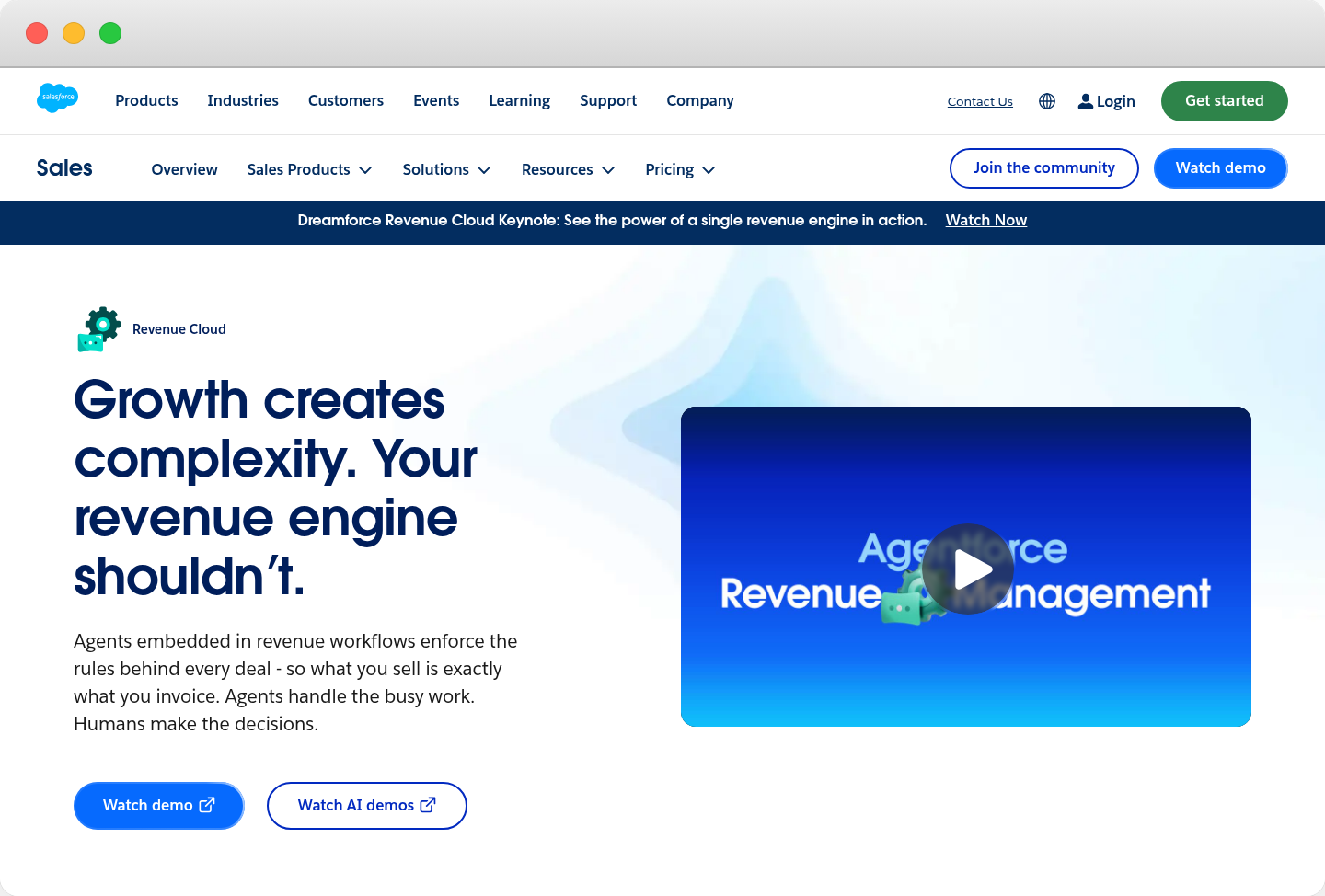
Revenue Cloud is Salesforce’s quote-to-cash suite, and Revenue Cloud Advanced is the successor Salesforce names for Salesforce CPQ. It covers catalog, pricing, quotes, contracts, orders, assets, amendments and renewals inside the Salesforce core 1. Salesforce also calls it Agentforce Revenue Management, the name many G2 reviewers use.
For SaaS pricing, the difference that matters sits in Salesforce’s own comparison. Salesforce CPQ handled one-time and subscription deals with limited consumption. Revenue Cloud Advanced handles one-time, subscription, consumption and hybrid deals, and every product sold becomes an asset the team can follow through each amendment and renewal 1.
The catch is the move itself. Salesforce describes a different architecture and says CPQ objects, custom fields and pricing scripts do not map directly. It puts a typical migration at three to six months from discovery to go-live 1. Usage rating, the invoicing engine and collections sit in Revenue Cloud Billing, a separate product priced on request 1 2.
Pricing
- Revenue Cloud Growth: $150 per user a month, billed annually, for quoting and the configurator, order capture and subscriptions.
- Revenue Cloud Advanced: $200 per user a month, billed annually, adding contracts and orders, consumption and invoicing, and AI and analytics.
- Revenue Cloud Billing: priced on request and sold separately, for usage rating, the invoicing engine and an accounting subledger.
- Terms: an annual contract on every edition.
Integrations
- CRM: Salesforce only. Quotes, orders, contracts and assets are standard Salesforce records 1.
- Billing: Revenue Cloud Billing handles usage rating, invoicing, payments and collections when you buy it alongside Advanced 1.
- Reports: assets record what each subscriber owns and has consumed, so renewal and lifecycle reports run in Salesforce once the existing book has been moved onto assets 1.
Pros and cons
Revenue Cloud keeps the whole deal on Salesforce, and the price of that is a rebuild:
Pros
- The named successor to Salesforce CPQ, with no forced migration for current users
- Consumption and hybrid deals in the Advanced edition
- Quotes and assets kept as standard Salesforce records
Cons
- A new implementation, with CPQ objects and scripts that do not carry over
- Usage rating and collections sit in Revenue Cloud Billing, sold separately
- No route for a team whose CRM is HubSpot
What users say about Salesforce Revenue Cloud
Users like having price and quote in one process, and the complaints are about reporting and the migration:
The useful part is that product, price, and quote can live in one process. We do not have to rebuild the same discount logic in a spreadsheet for every deal.
Principal evangelist at a small businessSep 2026 Out-of-the-box reporting for complex billing scenarios can also sometimes feel rigid, requiring custom data models or extra overhead to get the exact analytics needed
Lead developer at a hospital and health care enterpriseSep 2026 r/revops
View threadRevenue cloud does integrate with everything now, but it was not a smooth ride, and I’m still cleaning up issues from now over 16 months later.
Nov 2026
The official successor to Salesforce CPQ
Salesforce’s end-of-sale page answers the question most buyers arrive with. Companies on Salesforce CPQ keep their licenses, can add users and renew, and get support, with no end-of-life date set. New product work goes to Revenue Cloud Advanced, and about 15% of its buyers came from Salesforce CPQ, by Salesforce’s count 1.
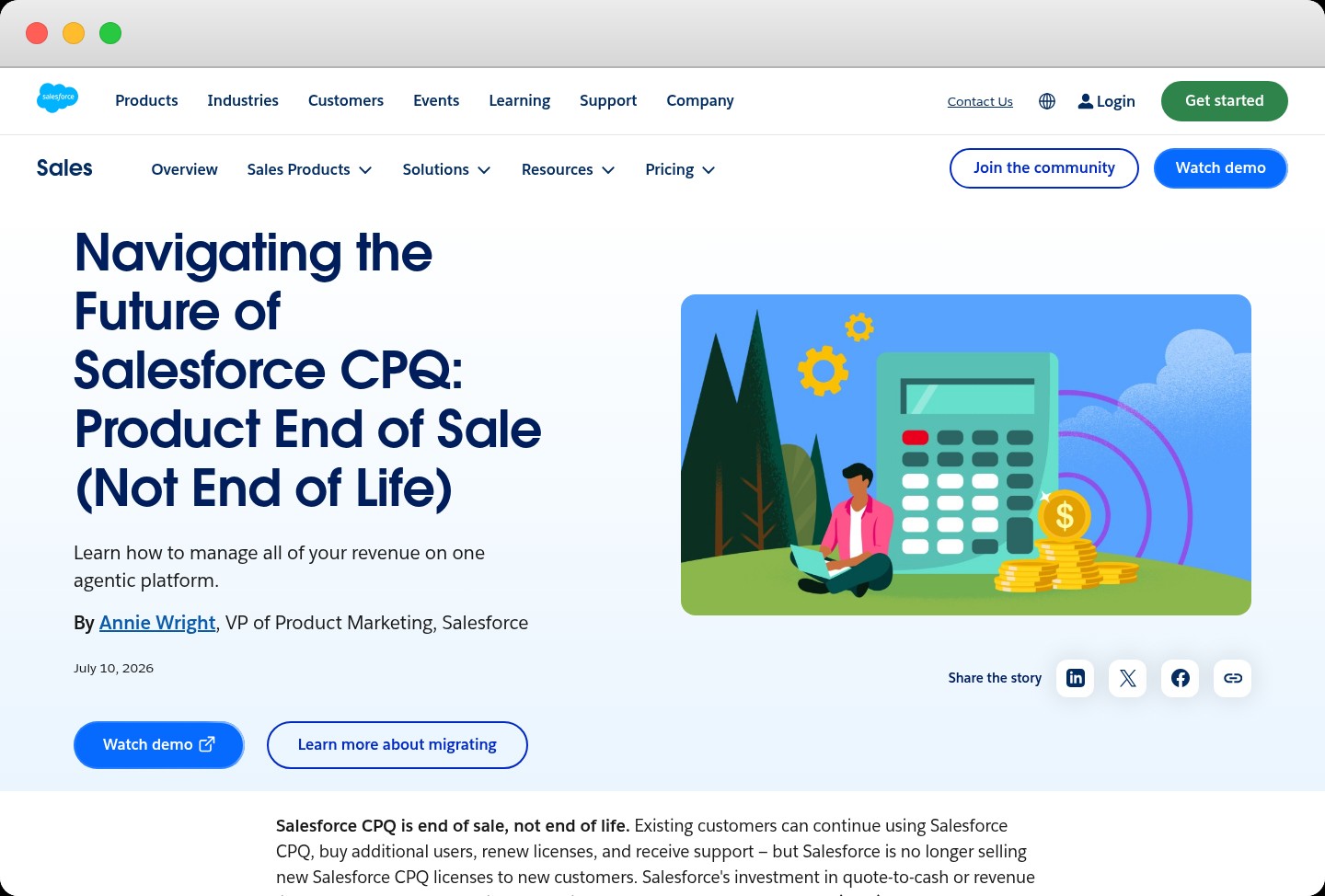
Revenue Cloud is the only tool here whose vendor documents a path off Salesforce CPQ, partner tooling included. The move is still not small, and a team on Salesforce CPQ has time to compare it with the others.
Verdict: buy Revenue Cloud if Salesforce is your system of record and you want quotes, assets and billing on the platform, with Advanced and Billing in the budget. Treat the move off Salesforce CPQ as a new build. We would move every live subscription onto assets before go-live, or renewal reports start from half the book. Skip it on HubSpot, or if no one can own the catalog.
Nue
Best for: SaaS teams on Salesforce whose deals mix seats, usage, credits and commits, with billing in the same app.
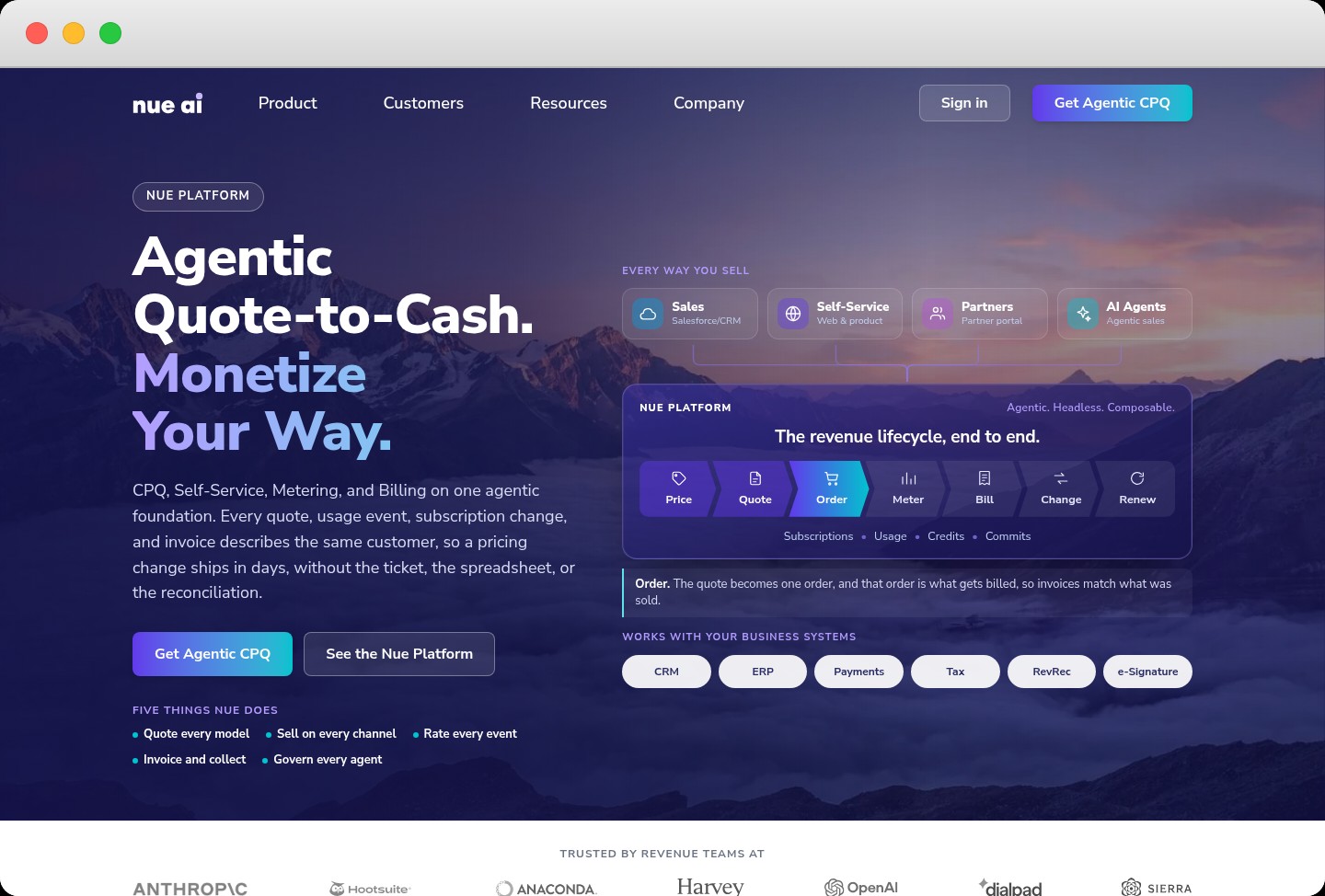
Nue is a quote-to-cash platform built inside Salesforce for SaaS pricing. It puts CPQ, self-service checkout, usage metering and billing on one data model, so a quote, a usage event and an invoice describe the same deal 7. Reps build quotes inside Salesforce, and amendments, upgrades, co-terming and renewals run through the same pricing rules 8.
Its strength is the hybrid SaaS deal. One quote can carry a recurring platform fee, metered usage on tiers and milestone services, and those terms flow into billing schedules without being keyed in again. Invoices with recurring fees, usage, one-time items and prepaid credits are created in Nue and kept in Salesforce 8 9.
Nue starts from Salesforce, and users notice. One G2 reviewer found its fields on standard objects hard to read, and two others describe implementations running longer than planned, one adding that advanced features need Apex skills 11. Nue publishes one price, a starting figure on its AppExchange page, and its own site has no pricing page 10.
Pricing
- Starting price: $90 per user a month, the lowest price on Nue’s Salesforce AppExchange page.
- Platform and modules: quoted by Nue’s sales team, with no pricing page on Nue’s own site.
Integrations
- CRM: Salesforce. Nue works with standard Salesforce objects and adds pricing, billing and subscription features on top 9.
- Billing: included, with usage, commits and prepaid credits billed from the quote’s terms and invoices kept in Salesforce 7 9.
- Reports: invoices, payments and revenue metrics sit beside the sales data, so Salesforce reports and flows can use them 9.
Pros and cons
Nue gives a Salesforce team one system from usage quote to invoice, and it asks for Salesforce skills in return:
Pros
- Usage tiers, credits and commits on the same quote as seats
- Billing and invoices inside Salesforce, with no separate billing tool
- Amendments and renewals governed by the same pricing rules
Cons
- Built Salesforce first, with a thinner HubSpot integration by one user’s account
- Long implementations and Apex needs in G2 reviews
- A starting price only, with everything else quoted
What users say about Nue
Users credit Nue with handling reseller billing and mid-contract changes, and they flag its field names and the CRM it assumes:
Nue is easily able to support our reseller motion significantly improving our billing and collections process with that channel of the business.
Revenue operations lead at a mid-market companyOct 2025 Certain fields that populate on standard objects like Delta CMRR on the Opportunity Product cannot be relabeled and it’s not obvious what the field represents.
Lead Salesforce architect at a mid-market companyJun 2025 r/SaaS
View threadNue handles complex usage tiers and is built for SaaS pricing models. Weakness is its sfdc first and the Hubspot integration is genuinely thinner than it sounds in the sales conversion (imo).
Jun 2026
Pricing rules written in plain language
Changing a price is where many CPQ setups stall, because the rule lives in custom code only an admin can touch. Nue’s Price Builder AI takes a discount, ramp or usage tier described in a sentence and compiles it into a rule. It flags conflicts with existing rules and deploys the rule without a developer 8.
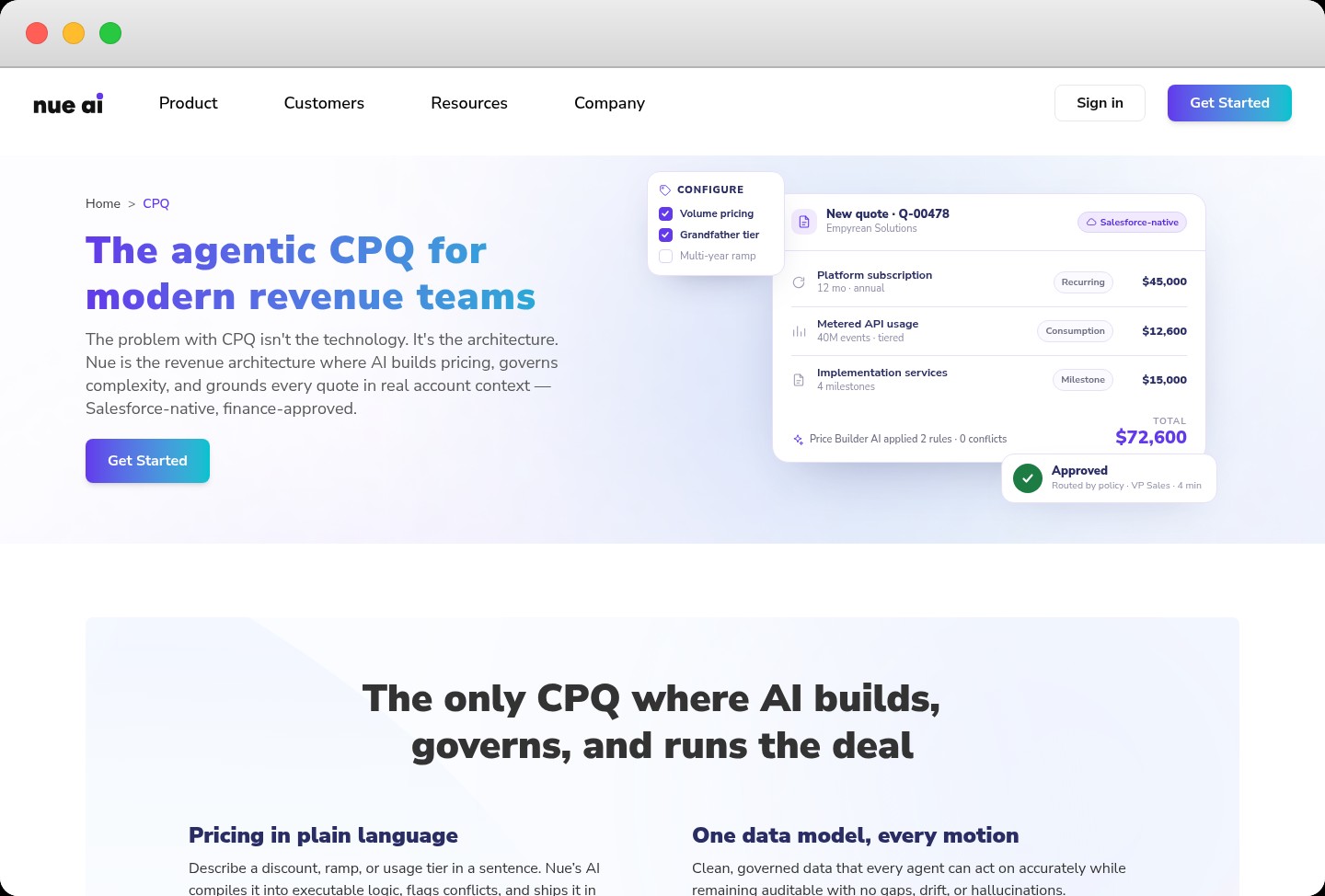
Ask for that exact quote in the trial, with a recurring fee, tiered usage and services on one document. Then have a rule changed in a sentence and watch a mid-term tier change go through it.
Verdict: buy Nue if you sell on Salesforce, your deals mix seats with usage, credits or commits, and you want quote, billing and invoices in one app. Give the implementation more time than the proposal says. Nue writes revenue fields onto the opportunity, so we would document each one before a pipeline report uses it. Skip it on HubSpot.
DealHub
Best for: HubSpot and Dynamics teams, or teams keeping their CRM options open, that want quote, subscription and billing in one product.
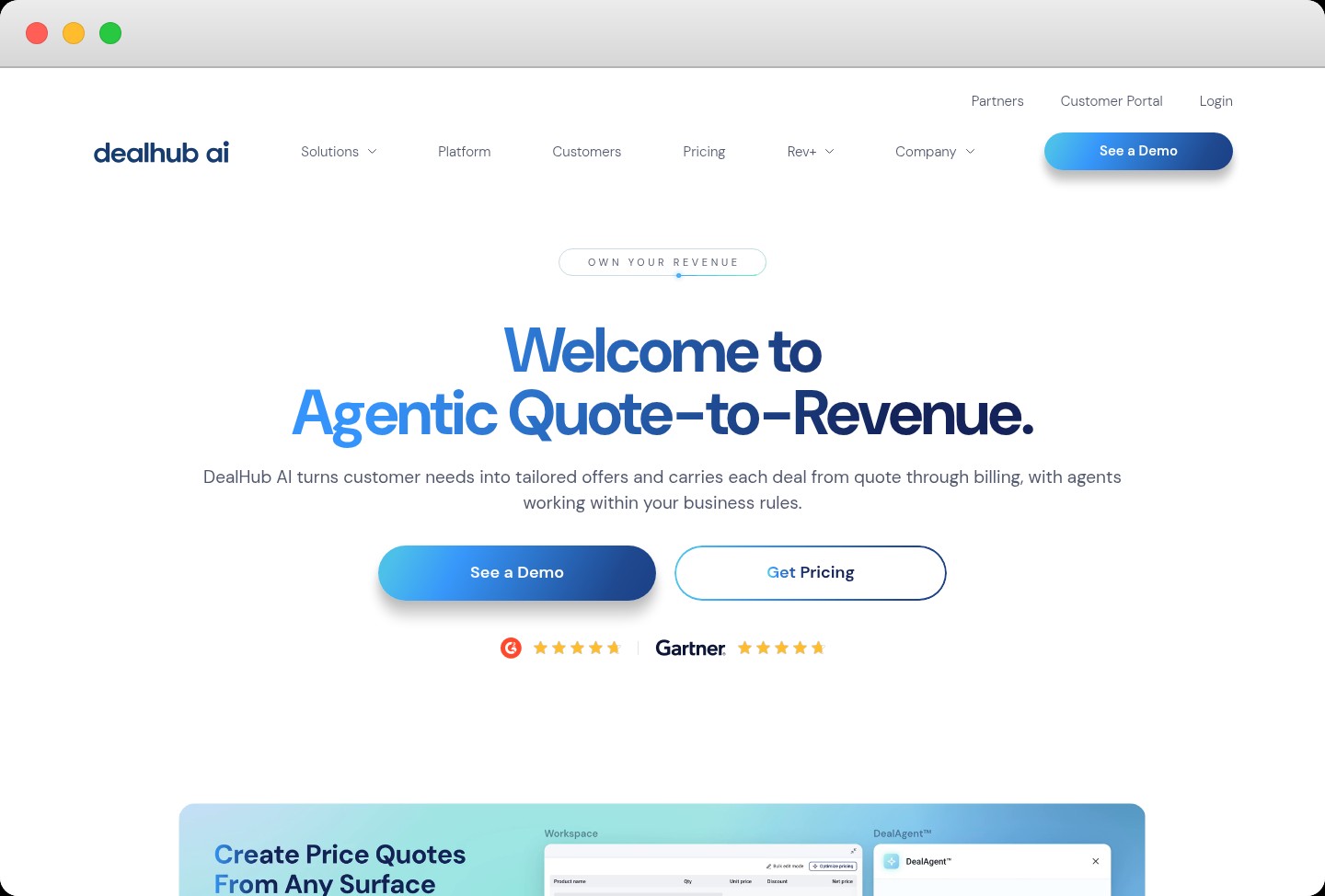
DealHub, now sold as DealHub AI, connects CPQ, contracts, a buyer-facing DealRoom, subscription management, billing and revenue recognition on one data model. It works with Salesforce, HubSpot and Microsoft Dynamics 365. The CRM stays the source of truth for companies and opportunities, and quote, contract and billing data syncs back to it 12.
DealHub quotes subscription, consumption and hybrid deals, with usage credits, minimum commits and overages, from one price book. Its page says the quoted commit carries into the order form, each amendment, the billing schedule and revenue recognition without being typed again 12. RevOps admins own the pricing and approval rules.
DealHub publishes no price, and its pricing page shows usage and consumption billing only on the Scale tier 13. Reviewers also report a learning curve, and one describes the API connection as needing a separate playbook to maintain.
Pricing
- Growth: priced on request, for CPQ, contracts, the DealRoom and subscription management, with usage, tiered and fixed pricing in the price book.
- Scale: priced on request, adding invoicing, usage and consumption billing, dunning, multiple currencies and entities, and revenue recognition.
- Add-on: headless API quoting, on either tier.
Integrations
- CRM: Salesforce, HubSpot and Microsoft Dynamics 365, with deal data synced back to the CRM 12 14.
- Billing: DealHub’s own billing on Scale, plus finance systems (ERPs) such as NetSuite, QuickBooks, Sage Intacct, Xero and Priority 12.
- Reports: monthly and annual recurring revenue forecasting, cohort analysis and churned revenue inside DealHub, with the synced deal fields open to CRM reports 13.
Pros and cons
DealHub fits whichever of HubSpot, Salesforce or Dynamics 365 you run, and the cost of that flexibility is configuration work and an unpublished price:
Pros
- Works with HubSpot, Salesforce and Dynamics 365
- Quote, subscription and billing on one data model
- Pricing and approval rules owned by RevOps admins
Cons
- No published price at any tier
- Usage and consumption billing only on the Scale tier
- Approved quotes cannot be edited, by one reviewer’s account
What users say about DealHub
A user who has tried several tools calls it the most HubSpot-native, and G2 reviewers point at quote edits and the API:
r/SaaS
View threadDealhub is the most Hubspot native of the bunch. Billing and quoting sit in the same system that should fix the tally problem at the source.
Jun 2026 My biggest complaint about dealhub is that you can't edit approved quotes, which makes it so you end up duplicating a quote 4/5 times
Deal strategy lead at a mid-market companyNov 2026 The api connectivity is limited and requires a separate playbook which doubles your implementation and maintenance overhead.
RevOps manager at an enterpriseJul 2026
A quoted commit that carries into billing
Usage deals go wrong when the commit agreed on the quote gets typed again into billing, slightly differently. DealHub’s subscription billing page makes the opposite promise: signed quotes become recurring, usage-based or hybrid billing on the same data model, with amendments, renewals and invoicing automated from them 15.
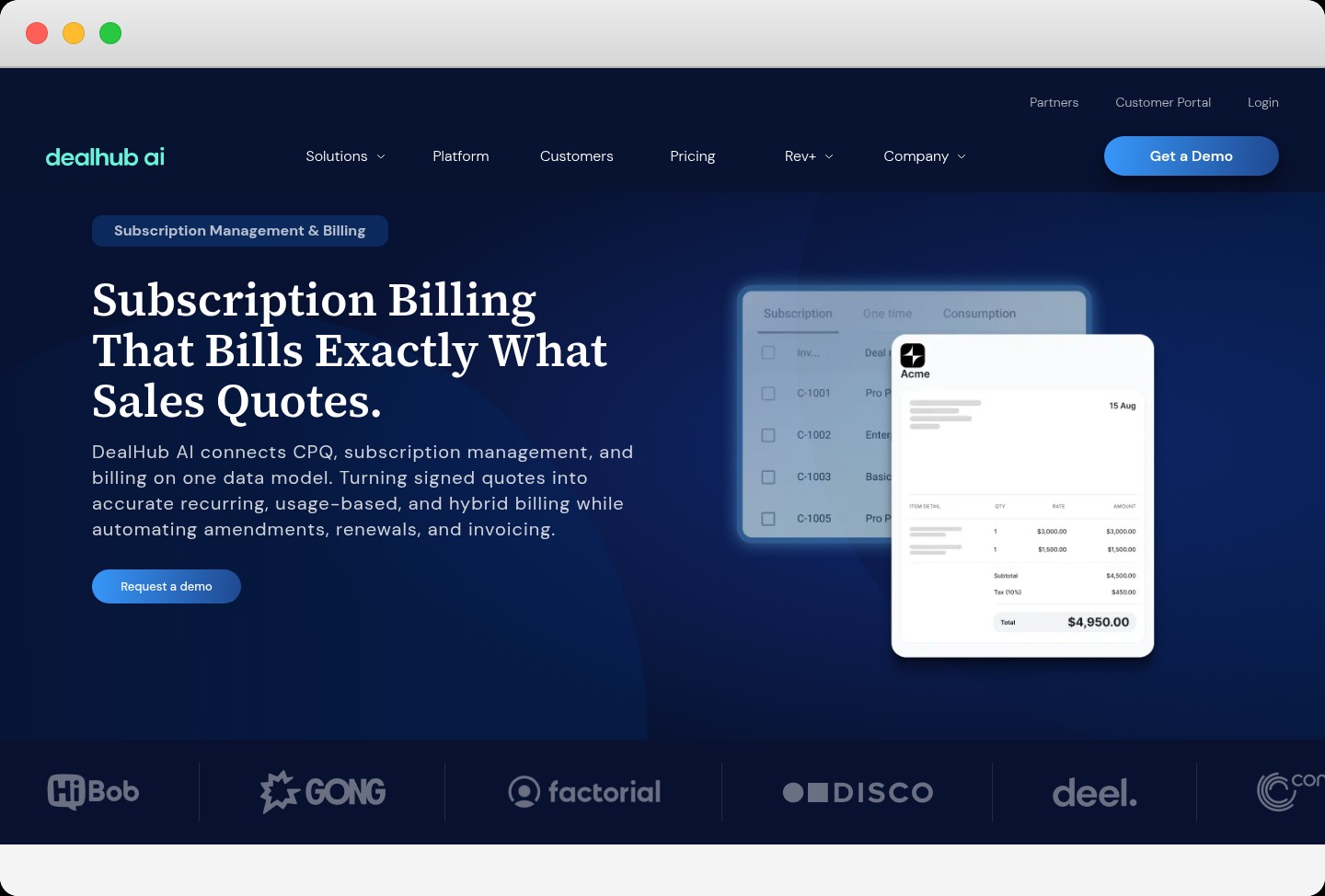
That promise depends on the Scale tier, where usage billing lives. If you will keep NetSuite or Stripe for invoicing instead, the handoff fields become the thing to test.
Verdict: buy DealHub if your CRM is HubSpot or Dynamics, or may change, and you want quote, subscription and billing in one product. Budget for Scale if usage is invoiced. We would map which fields write back to the CRM deal before go-live, since your reports and alerts read them. Skip it if your deal desk edits approved quotes often, or wants a price before any call.
Hyperline
Best for: smaller SaaS and AI companies that sell credits, tokens or metered usage and want quote, subscription and invoice in one tool.
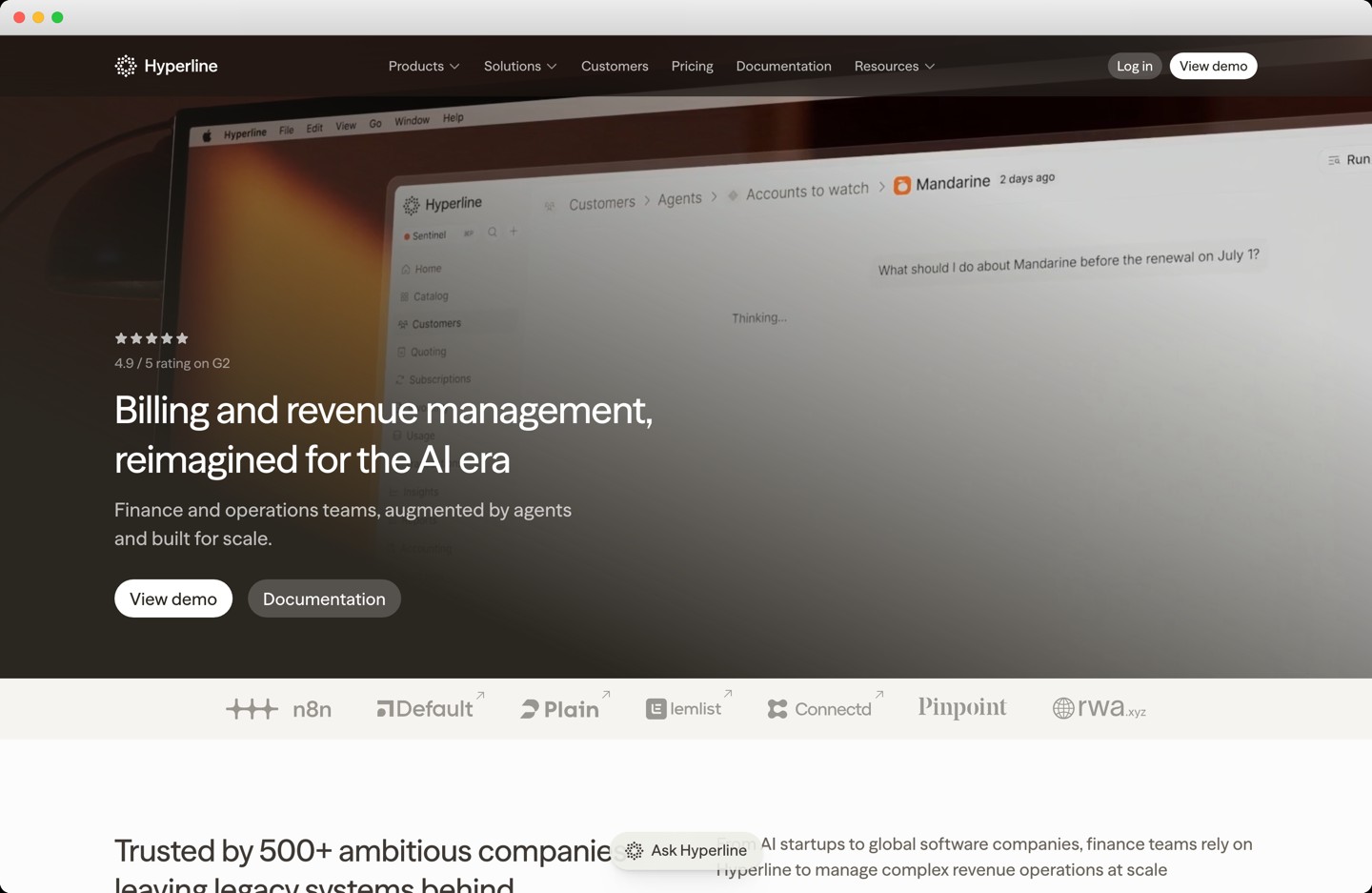
Hyperline is a billing platform with CPQ inside it, built for usage-based SaaS and AI companies. It runs quote, signature, subscription, invoicing, collections and revenue recognition on one contract. It meters usage in real time and keeps prepaid credits and tokens on a credit ledger that draws down as they are used 16.
Billing first is the right order for credits and tokens. Reps quote inside Salesforce, HubSpot or Attio, add metered products, credits and tokens next to seats, and the signed quote becomes the subscription with nothing keyed into billing again 16. Usage streams through its API or syncs from BigQuery, Snowflake and Postgres.
The entry plan leaves out the pricing this tool is best at. Launch, the one priced plan, covers subscriptions, quotes and invoicing. Usage-based and hybrid pricing and Salesforce start on Growth, which is priced on request, and NetSuite needs Scale 17. One G2 reviewer also finds quote building less flexible than billing.
Pricing
- Launch: $299 a month plus 0.7% of revenue processed, up to $2M in annual revenue and 100 active subscriptions, with quotes, e-signature, invoicing and dunning.
- Growth: priced on request, for $2M to $20M in annual revenue and up to 1,000 subscriptions, adding usage-based and hybrid pricing, revenue recognition, multiple currencies and Salesforce.
- Scale: priced on request, above $20M in annual revenue, adding multi-entity consolidation, advanced approvals and NetSuite.
Integrations
- CRM: HubSpot and Attio on every plan, Salesforce from Growth. A widget in the CRM builds the quote, and a closed deal creates the subscription 17 18.
- Billing: Hyperline is the billing system, collecting through Stripe, Adyen, GoCardless, Mollie or Airwallex rather than processing payments itself 16.
- Reports: advanced reporting and revenue recognition from Growth, and billing status visible on the CRM deal 16 17.
Pros and cons
Hyperline is the billing-first choice, strongest when the invoice is harder than the quote:
Pros
- A published entry price
- Credits, tokens and metered usage on the quote, drawn down in billing
- Collections and revenue recognition in the same tool
Cons
- Usage pricing and Salesforce start on Growth, priced on request
- The Launch fee grows with revenue processed
- Quote building less flexible than billing, by one reviewer’s account
What users say about Hyperline
Sales and finance users like the speed from quote to invoice, and the complaints are about quote building and dates:
I can put together a quote for a prospect quickly, without depending on finance or ops, which speeds up our deal cycle.
Head of sales at a mid-market companyAug 2026 I also find the tool lacks flexibility and ease of use when it comes to creating quotes.
Finance and admin manager at a company of 50 or fewerOct 2026 the 2 levels of dates in quote signature / contract start often leads to mistakes.
Verified user in computer software at a small businessSep 2026
A signed quote that becomes the subscription
The handoff from sales to billing is where usage deals pick up errors, and Hyperline removes it. Its CPQ builds the quote in the CRM, routes approvals, collects the signature and turns the signed deal into the subscription that billing runs on 16.
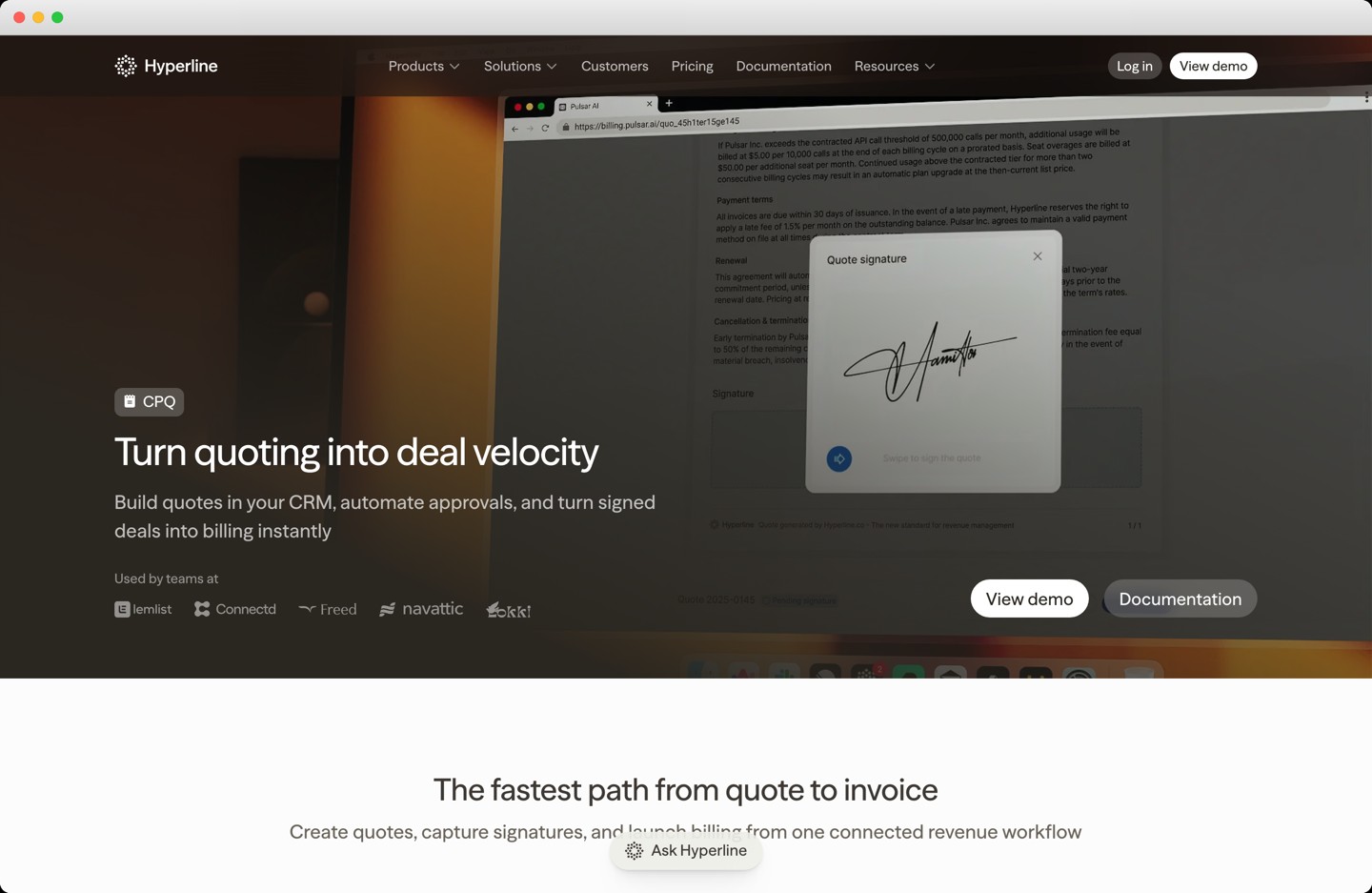
Put the reviewer’s warning about two dates into your trial. Sign a quote with a future contract start, then check which date the first invoice uses.
Verdict: buy Hyperline if you are a smaller SaaS or AI company selling credits, tokens or metered usage and want quote, subscription and invoice in one place. Plan on Growth, where usage pricing and Salesforce start. We would tie each deal and its subscription to one company record before building renewal reports. Skip it if complex quotes are the hard part.
Conga Advantage CPQ
Best for: enterprises on Salesforce whose quotes depend on negotiated contracts and asset based renewals.
Advantage CPQ, formerly Apttus CPQ, is the Salesforce-native one of Conga’s two CPQs. It installs as a managed package, uses asset-based ordering for renewals and mid-term amendments, and hands quotes to Conga’s contract lifecycle management (CLM) product 4 6. Conga pitches it to technology, healthcare and services companies 4.
Its depth shows in the contract work. Renewals, co-terminations, swaps and changes run against the assets a buyer already holds, and Conga Billing handles mixed billing on the same data model when you buy it 5. Reviewers who run it inside Salesforce credit it with keeping quotes consistent.
The knock is weight. By users’ accounts, implementation and ongoing configuration need a dedicated admin. Billing is a separate purchase, and the PROS deal left Conga selling two CPQs, so a proposal has to name which one it covers 3 4.
Pricing
- Amazon Web Services (AWS) Marketplace: $5,400 per user for a 36-month contract, about $150 per user a month, the one price Conga publishes for Advantage CPQ.
- Private offer: a custom quote through AWS Marketplace or Conga’s sales team.
- Billing: Conga Billing, priced separately.
Integrations
- CRM: Salesforce, as a native managed package. Conga says Conga Integrations can sync it with Dynamics or SAP, and it can run outside Salesforce on the Conga platform 4 6.
- Billing: Conga Billing, with asset-based ordering carrying renewals and amendments into invoicing 5.
- Reports: quotes, contracts and orders sit in Salesforce beside the opportunity, where forecast and renewal reports read them 6.
Pros and cons
Advantage CPQ is built for contract-heavy enterprise deals on Salesforce, and it needs a dedicated admin to run:
Pros
- Asset-based ordering for renewals and mid-term amendments
- A direct handoff from quote to Conga CLM
- A native app inside Salesforce
Cons
- Two Conga CPQ products to tell apart in every proposal
- Billing sold separately
- Heavy implementation and ongoing configuration
What users say about Conga Advantage CPQ
Users value having quoting inside Salesforce, and the sharpest complaints are about the interface and the upkeep:
Because it works inside Salesforce, everything stays in one place and is easy for reps to use.
Consultant at an enterpriseJan 2026 The whole system looks like it was built in the 1990s. Sometimes it feels like we’re back to using Windows 95.
Verified user in market research at a mid-market companyNov 2026 r/SaaS
View threadConga covers everything you need including amendments and renewal logic but is implementation heavy, needs dedicated resource to run it, ongoing configuration isn't light, also costs are on the higher side
Jun 2026
Asset-based ordering on the Salesforce data model
A renewal that starts from the original quote ignores every change since, and someone fixes it by hand. Asset-based ordering keeps a record of what each buyer holds now, so a renewal or amendment starts from the current position. Conga’s own comparison gives that feature, and the Salesforce data model, to Advantage CPQ rather than Smart CPQ 4.
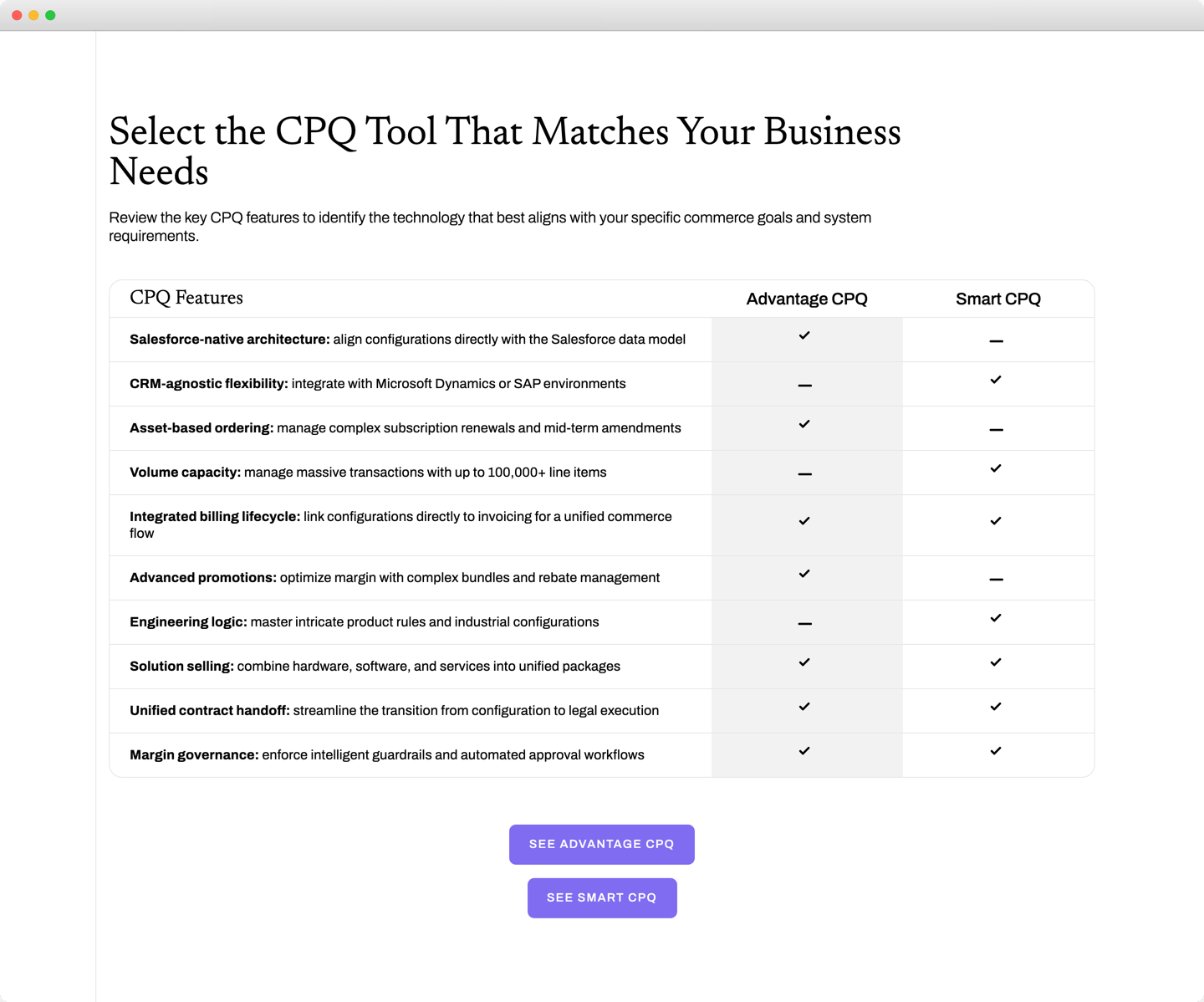
Use the same table in your evaluation. If the proposal you receive is for Smart CPQ, it was written for a different buyer.
Verdict: buy Advantage CPQ if you sell on Salesforce, your deals run on negotiated contracts and you run or plan Conga CLM, with an admin to keep the rules current. With two CPQs under one owner, we would write the product name and its roadmap into the order form. Skip it if you have no admin to spare, or if your CRM is HubSpot.
How to Choose a CPQ by Your CRM and Pricing Model
The CRM you quote in narrows the five fastest. On HubSpot the choice is DealHub or Hyperline, decided by which half of the deal is harder, the quote or the invoice. Dynamics leaves DealHub and Attio leaves Hyperline. On Salesforce all five stay, and your deals decide:
- Leaving Salesforce CPQ: Revenue Cloud, with Revenue Cloud Billing if usage is rated there.
- Usage-heavy deals: Nue, with billing in the same app.
- Negotiated enterprise contracts: Conga Advantage CPQ, with Conga CLM.
The next question is where billing will run. Each vendor here sells billing that shares records with the quote, but many teams keep Stripe or NetSuite for invoicing, and that changes what can go wrong with an amendment:
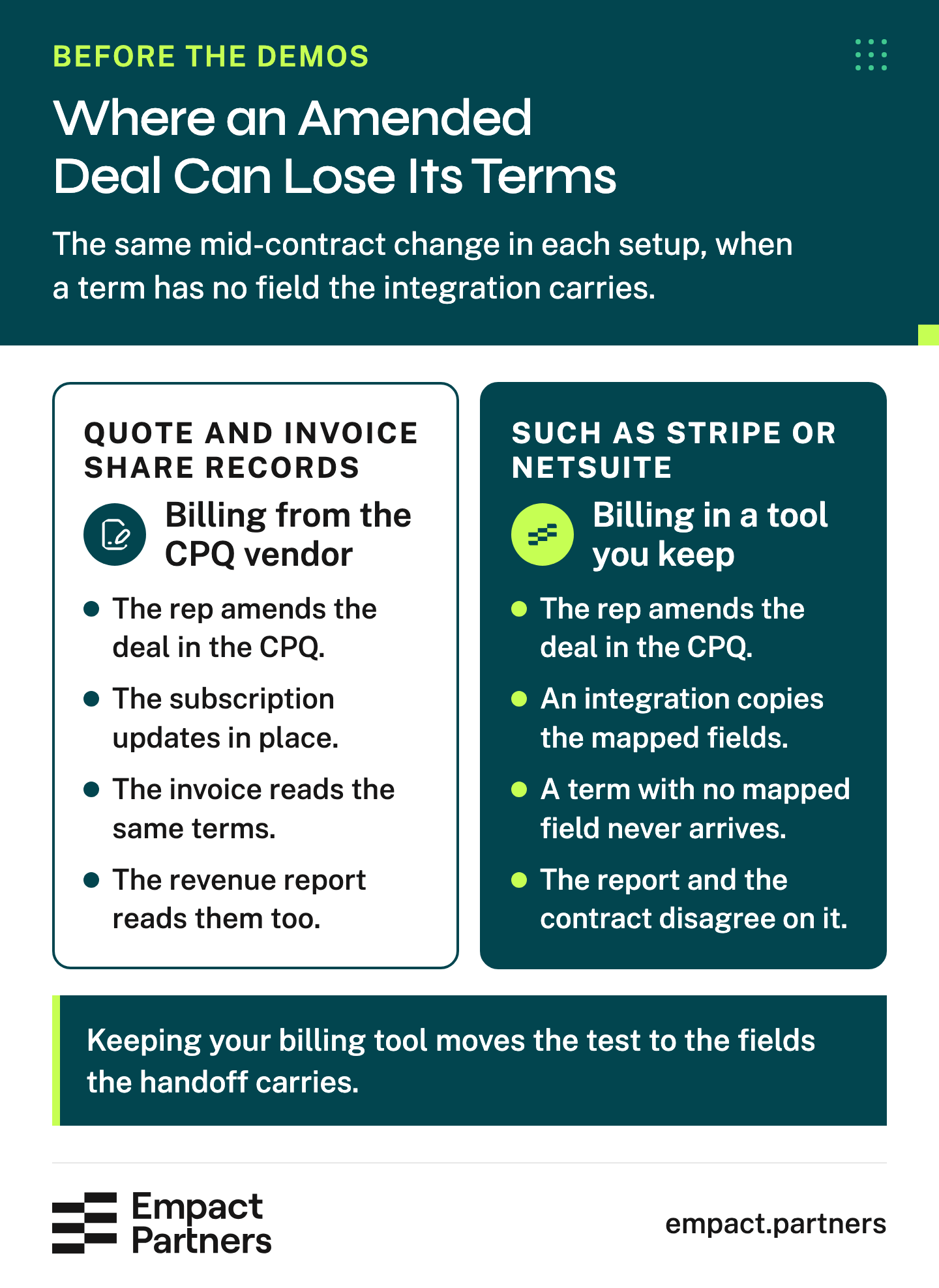
Keeping your billing tool is a fair choice, and it makes the handoff the thing to buy for. Write down every term your contracts use, such as the usage unit, the rollover rule and the overage timing, and check that each has a field the integration carries. If your pricing rules still live in spreadsheets, none of the five fixes that, so write the rules down first.
Every tool here writes to CRM records, so the state of those records decides whether your reports can trust the CPQ. Our free CRM Health Report reads one spreadsheet export of your CRM, ranks the duplicates, blank fields and stale or ownerless deals to clean first, then deletes the file. It previews the agent we build into partners’ CRMs to check each new record:
Take One Amended Deal Into Every Demo
A demo built on a new quote proves the easy part. Usage deals go wrong later, when the deal changes halfway through and the change has to reach the renewal, the invoice and the report finance reads. This is the test we would run on every vendor here, with your own deal:
Pick your hardest live deal.
Choose one with usage or credits, a discount above your approval limit and a change already made mid-contract.
Have each vendor build it live.
The approval rule goes in too, set up by their team during the trial.
Amend it halfway through the term.
Add seats or move a usage tier, then check the prorated line.
Renew it.
The renewal should start from what the deal holds today, amendment included.
Open the CRM record and the report.
The amended values belong in fields on the deal, and the change should appear in the revenue view finance reads.
The vendor whose tool carries that change from step three to step five is the one to shortlist, whatever its first quote looked like:
Choose a CPQ by how it handles a mid-contract change to a usage deal.
RevOps people on Reddit who have run these evaluations land on the same habits:
Tips from Reddit
What RevOps teams test in a CPQ demo
Take that exact 16% discount plus config change deal into every demo and make each vendor run it live, including the approval and what lands in SAP afterward.
Instead i would test whether my team can handle exceptions without opening IT tickets every time
Approvals bouncing through slack, meaning the quote reaching billing is already wrong half the time.
All of that assumes the contract terms already live somewhere a tool can read them:
A usage term that lives only in the PDF cannot reach billing or the renewal. Put every term your contracts use into a field before you compare tools, because carrying those fields is the job you are buying.
 Leon Claassen on LinkedInOpens in a new tab
We would run that test on your own hardest deal, next to the audit every partnership starts with: your stack, and how deal data moves between the CRM, billing and the product. Together they show where your data breaks before anything is signed. The work covers:
- The audit of your stack and data flows, before anything is connected
- Your CRM, billing and product data connected, so every team reads the same numbers
- Your CRM cleared of duplicates and enriched where fields are missing
- Alerts and automated pipeline reports in the CRM you already use
- A named senior GTM consultant who owns the work and joins your calls
With amended deals reaching the CRM intact, the weekly revenue numbers can be built on them. Teddy Cipolla’s playbook, How to Build a Revenue Dashboard Your Team Opens Every Week, shows how to build that weekly view for sales and finance:
Whichever tool wins, keep the demo deal. Run it again a month after go-live, through the amendment and the renewal, and set the report beside the contract. When they match, the CPQ is doing the job you bought it for.
Frequently Asked Questions
Can we still buy Salesforce CPQ?
No, not as a new buyer. Salesforce stopped selling new Salesforce CPQ licenses and calls it end of sale, not end of life. Companies already on it keep their licenses, can add users and renew, and still get support, and Salesforce has announced no end-of-life date. New feature work goes to Revenue Cloud Advanced, which Salesforce names as the successor.
Is moving from Salesforce CPQ to Revenue Cloud an upgrade?
Treat it as a new implementation. Revenue Cloud Advanced sits in the Salesforce core, while Salesforce CPQ is a managed package with its own objects. Salesforce says those objects and pricing scripts do not map directly and puts a typical migration at three to six months. Plan the move of live subscriptions onto assets as its own workstream.
Which CPQ works best with HubSpot?
DealHub and Hyperline are the two here that quote inside HubSpot. DealHub suits complex quotes with billing in the same product, and Hyperline suits teams whose hard part is usage billing, with HubSpot and Attio on every plan. Revenue Cloud runs only on Salesforce, and Nue and Advantage CPQ are built around it, so on HubSpot they bring a CRM decision with them.
Do quoting and billing need to run in the same system?
Not always, but every handoff between them is a chance for terms to change. For seats and plans, a CPQ that writes clean fields to your billing tool works. Once usage, credits or commits are involved, something must rate usage against the contract, so buy CPQ and billing together or test the handoff with an amended deal first.
What should a CPQ demo for usage pricing include?
Your own hardest deal, built live with your approval rule. Then ask the vendor to amend it halfway through the term, renew it, and show where the amended values land in the CRM and in the revenue report. A demo that only builds a new quote skips the part that goes wrong. Write the scenario down and send the same one to every vendor.
How much does CPQ software cost?
On 23 November 2026, published prices ran from $90 per user a month for Nue to $200 for Revenue Cloud Advanced, billed annually. Advantage CPQ was $5,400 per user for 36 months on AWS Marketplace, and Hyperline’s Launch plan $299 a month plus 0.7% of revenue processed. DealHub publishes no price, and usage billing sits on custom tiers at DealHub and Hyperline.
Can a CPQ handle prepaid credits and minimum commits?
Some can, and they differ in where the balance lives. Nue, DealHub and Hyperline put credits, commits and overages on the quote and bill against them in the same product, and Hyperline keeps a credit ledger that draws down as usage arrives. Revenue Cloud needs Revenue Cloud Billing for usage rating. Ask each vendor to draw a commit down across an amendment.
Which Conga CPQ fits a SaaS company?
Advantage CPQ, in most cases. Conga’s own comparison gives Advantage CPQ the Salesforce data model and asset-based ordering for renewals and amendments, the features a subscription business leans on. Smart CPQ, the former PROS product, is the CRM-agnostic option Conga aims at manufacturers and distributors. Ask every proposal to name the product it prices.
How long does a CPQ implementation take?
Implementation time depends on the catalog, the integrations and how much contract history moves. Salesforce puts a typical Revenue Cloud migration at three to six months, and DealHub says it deploys in weeks. Reviews that explain longer projects point to complicated price books and bundles, so simplify the rules and clean the CRM data before the build starts.
Where should usage data live before it reaches billing?
In the product or the data warehouse that records it, with the contract terms in the CPQ. Billing needs the usage rated against those terms. Hyperline and Nue meter usage themselves, and Hyperline can sync it from BigQuery, Snowflake or Postgres. Whatever the route, pick one record of usage, so finance and sales never argue over two counts.
Who should own the CPQ after go-live?
Someone in RevOps who owns the catalog and the pricing rules, with finance signing off any change that touches billing. Reviewers of Revenue Cloud and Conga describe rule upkeep as ongoing work, and DealHub hands pricing and approval rules to admins. If nobody can take that job, pick the simplest tool that fits your pricing and keep the catalog small.
Should we clean the CRM before a CPQ goes live?
Yes, at least the records the CPQ will write to. Every tool here writes amended values to a deal or opportunity. A duplicate company can leave the amendment on one record and the renewal on another, and an ownerless deal has nobody checking either. Fix duplicates and missing owners before go-live, before the CPQ copies them into every quote.
Sources (18)
- Salesforce, "CPQ Not End of Life: What End of Sales Means" (2026)↩1↩2↩3↩4↩5↩6↩7↩8↩9
- Salesforce, "Revenue Cloud Pricing" (2026)↩1
- Conga, "Completes Acquisition of PROS B2B Business" (2026)↩1↩2
- Conga, "CPQ software solutions to power profitable growth" (2026)↩1↩2↩3↩4↩5↩6
- Conga, "Advantage CPQ on AWS Marketplace" (2026)↩1↩2
- Conga, "Advantage CPQ on Salesforce AppExchange" (2026)↩1↩2↩3
- Nue, "Agentic Quote-to-Cash" (2026)↩1↩2
- Nue, "CPQ" (2026)↩1↩2↩3
- Nue, "Unifying Revenue Operations in Salesforce" (2026)↩1↩2↩3↩4
- Nue, "on Salesforce AppExchange, pricing" (2026)↩1
- G2, "Nue reviews" (2026)↩1
- DealHub, "Agentic Quote-to-Revenue Platform" (2026)↩1↩2↩3↩4
- DealHub, "AI pricing" (2026)↩1↩2
- DealHub, "HubSpot CRM integration" (2026)↩1
- DealHub, "Subscription management and billing" (2026)↩1
- Hyperline, "Usage-based billing and quote-to-cash" (2026)↩1↩2↩3↩4↩5
- Hyperline, "Pricing" (2026)↩1↩2↩3
- Hyperline, "Connect HubSpot to Hyperline" (2026)↩1
Keep reading
RevOps What Your CRM Needs When Your SaaS Moves Upmarket
Bigger deals stall on people your CRM never recorded. Put every buying role on the deal, and flag one-person deals past discovery.

RevOps 5 RB2B Alternatives, Matched to Why You’re Switching
Five RB2B alternatives matched to why teams leave it, from visitors outside the US and EU consent rules to alerts nobody acts on.

RevOps How to See Which Signups Came From ChatGPT and Reddit
Signups from ChatGPT and Reddit land in analytics as Direct or Google. Add one form field, code the answers with Claude, report both.