60 Recruiting and HR Software AI Search Statistics
60 figures on how HR software buyers research and which pages ChatGPT and Google AI Mode cite for recruiting and HR software.
 Sinead HovelmeierWith
 Vlad Shvets
On this page
- Highlights
- How HR Software Buyers Start Their Shortlist
- Which Pages AI Answers Cite for Recruiting and HR Software
- How Many Recruiting and HR Brands an AI Answer Names
- Who Writes the Roundups Behind the Answers
- Where Review Sites, Analysts and Reddit Show Up
- What a Category Baseline Shows Before You Pick a Lever
- Frequently Asked Questions
Empact Newsletter
One email a month on what is working in AI search and SaaS go-to-market.
Ask ChatGPT for the best recruiting software for a growing team and the answer names a handful of products, then cites the pages it read to choose them. Across the two HR-tech categories we track, 95.3% of those answers cite a vendor’s own website and 4.5% cite a review site.2 So most of the pages those answers cite were written by vendors.
Buyers describe their research the other way round. In G2’s 2026 survey, 43% of B2B software buyers said review sites shape their shortlist, more than any source except the chatbot itself.1 If you sell recruiting or HR software, set the two side by side before you decide which pages to work on. The figures that follow show which sources the engines cite in two HR-tech categories, and which ones buyers say they use.
Highlights
- 51% of B2B software buyers say a chatbot, not Google, is usually where their research starts, up from 29% in 2025.1
- 95.3% of ChatGPT answers to recruiting and HR software questions cite a vendor’s own site, and so do 87.8% of Google AI Mode’s.2
- 4.5% of ChatGPT answers cite a review site such as G2 or Capterra, against 9.2% on Google AI Mode.2
- 68.1% of AI Mode answers cite a “best tools” roundup or comparison page, and 60.2% of those pages sit on vendors’ own sites.2
- 0.2% of ChatGPT answers cite Reddit or another forum, against 12.1% on Google AI Mode.2
- 90% of regretful HR buyers say they would buy on vendor information alone.5
Put together, these figures describe a gap. Buyers say independent sources such as review sites, analysts and peers shape their shortlist. Yet most of the pages cited in HR-tech answers were written by vendors.
Empact Partners sees this gap in the HR-tech categories it tracks for partners. Our job is to get a SaaS product named in AI answers, and in HR tech that starts with choosing which cited pages to work on.
How HR Software Buyers Start Their Shortlist
G2 surveyed 1,076 B2B software buyers in March 2026, and 71% of them rely on AI chatbots at some point in their research.1 G2 runs review sites, so its findings about review sites come from an interested party. Asked which sources influence the vendors that make their shortlist, buyers answered:
- 54% name AI chatbots, the most common answer.1
- 43% name software review sites, the second.1
- 36% name analyst firms, and 36% the vendor’s own website.1
- 33% name peers and colleagues, and 30% independent forums.1
What B2B Software Buyers Say Shapes Their Shortlist
G2, 1,076 B2B software buyers, March 2026, self-reported. G2 runs review sites
colleagues33%
portal20%
View the data
| Label | Value |
|---|---|
| AI chatbots | 54% |
| Software review sites | 43% |
| Analyst firms | 36% |
| Vendor website | 36% |
| Peers and colleagues | 33% |
| Independent forums | 30% |
| Thought leadership | 28% |
| Internal supplier portal | 20% |
| Vendor salesperson | 19% |
Apart from the vendor’s own website, every source after the chatbot sits outside the vendor, whether a reviewer, an analyst, a peer or a forum. The chatbot ranks above all of them, so what matters to a vendor is which of those sources the chatbot itself cites.
The same survey shows what an answer can do to a deal. 69% of buyers chose a different vendor than they had planned because of what a chatbot told them, and 33% bought from a vendor they had never heard of.1 So a rival you never meet in a sales cycle can reach the shortlist through an answer you never saw.
Being named also lends credit: 85% think more highly of a vendor an AI answer cites.1 Gartner, an analyst with no review site to sell, asked 645 B2B buyers about a recent purchase of any kind in August and September 2025, including how they check what AI tells them:
Gartner counted any use of AI during a purchase, among an average of seven information sources, where G2’s 71% counts reliance at any point in research.3 The two surveys asked different groups different questions, so read 45% and 71% as two measures, not one trend.
How buyers ask matters as much as whether they ask. A third open with a category question and almost as many with a competitor’s name:1
What Software Buyers Ask an AI Chatbot First
G2, 1,076 B2B software buyers, March 2026, type of their first prompt
or process22%
View the data
| Label | Value |
|---|---|
| A category | 33% |
| A competitor | 31% |
| Requirements or process | 22% |
| The ecosystem | 9% |
| Budget | 6% |
Our own count below reads answers to unbranded questions, the kind with no vendor named in them, so its figures describe what a buyer sees before naming any vendor.
G2’s buyers also know the answers slip: 64% meet inaccuracies a few times a month or more.1 So buyers check what an answer tells them.
HR buyers fit this pattern closely. Capterra, which G2 also owns, asked US software buyers in December 2025 how they use reviews, and the HR buyers among them answered:
So HR buyers who read reviews use generative AI as well, and few of them count an AI summary of the reviews among what persuades them. An HR purchase takes 4.45 months on average, and 51% of HR respondents were disappointed with at least one recent software purchase.4 Over four and a half months, a buyer has time to check what any one answer said.
Capterra’s regret study links regret to where buyers got their information. 28% of buyers who regretted a software purchase pointed to an HR system, and 90% of regretful HR buyers say they would buy on vendor information alone.5 Buyers whose purchases worked out were 52% more likely to build their shortlist with review and comparison sites.5
An HR buyer who has been burned by a demo once lets the chatbot draft the shortlist and the reviews decide who stays on it. If most of your reviews come from companies far bigger than your buyers, that second step works against you, however well the first one went.
 Sinead Hovelmeier on LinkedInOpens in a new tab
Recruiting teams, one of the buyers of this software, are also where HR uses AI most. The Society for Human Resource Management (SHRM) surveyed 1,908 HR professionals in December 2025 and found AI used most in recruiting (27% of organizations), ahead of HR technology at 21%.6 39% have AI in their HR function at all, and 56% do not formally measure whether it pays.6
Gartner found 88% of HR leaders report no significant business value from AI tools yet.7 A buyer who has spent on AI and seen little proof of value has good reason to ask for proof, and the next question is where an AI answer finds it.
Which Pages AI Answers Cite for Recruiting and HR Software
Such independent pages are scarce in the AI answers we track. The Empact Panel, our own tracker of AI answers, holds every weekly answer and citation for two HR-tech categories we follow for partners: recruiting software, and employer of record and global payroll.
For this count we classed every page ChatGPT and Google AI Mode cited for 5,575 US buyer questions with no brand in them, by the site it sits on and by its title. The answers come from each category’s latest weekly collection, 19 and 24 November 2026, and every figure is the average of the two categories.2
Nearly every answer cites something: 99.5% of ChatGPT’s and 98.7% of AI Mode’s. A ChatGPT answer that cites anything carries 9.5 citations on average, against 2.6 on AI Mode, and 19.9% of ChatGPT’s citations are bare links to products it names, titled only “website”, “Official website” or “Visit” and the brand.2 We leave those product links out and compare the pages that supply each answer:
Where AI Answers on HR Software Get Their Sources
Answers citing each kind of site, two HR-tech categories, US, Empact Panel, Nov 2026
roundup sites52.1%17.7%
and reference19%5%
View the data
| Label | ChatGPT | Google AI Mode |
|---|---|---|
| Vendor websites | 95.3% | 87.8% |
| Independent roundup sites | 52.1% | 17.7% |
| Government, legal and reference | 19% | 5% |
| Analyst firms | 5.5% | 0.6% |
| Publications | 5.5% | 4.2% |
| Review sites | 4.5% | 9.2% |
| Reddit and forums | 0.2% | 12.1% |
Vendor sites top the chart on both engines, in both categories: 95.3% of ChatGPT answers and 87.8% of AI Mode answers cite at least one.2 A vendor here is any company selling software or services, not only the best-known names in the category. Vendor sites also take 72.0% of ChatGPT’s content citations and 68.0% of AI Mode’s, so roughly seven pages in ten behind an answer belong to someone with something to sell.2
The sources buyers rank highest sit near the bottom. Review sites reach 4.5% of ChatGPT answers and 9.2% of AI Mode’s, analyst pages 5.5% and 0.6%, Reddit and other forums 0.2% and 12.1%.2 For a vendor deciding where to spend, that means the pages behind an HR-tech answer are mostly pages some vendor controls.
The vendor sites cited are not only the category leaders’. The sites of the brands we track in each category, the partner and its main rivals, reach 79.2% of ChatGPT answers but 51.5% of AI Mode answers.2 Other vendors’ sites reach 77.2% and 65.6%.2 On AI Mode, vendors outside the tracked brands reach more answers than the tracked brands’ own sites, in both categories.
I wouldn’t plan HR-tech AI search work from one engine’s answers. ChatGPT leans on the main brands’ sites and the independent roundups. AI Mode cites review sites and Reddit threads more often, and reaches past the category leaders to other vendors’ pages. Find out which engine your buyers use first, then work on the pages that engine reads.
Sinead Hovelmeier on LinkedInOpens in a new tabHow Many Recruiting and HR Brands an AI Answer Names
Those pages feed a short set of names. An answer names 4.0 of a category’s tracked brands on average on ChatGPT and 3.6 on Google AI Mode.2 The Panel counts only the brands it tracks, the partner and its main rivals, so the count is a floor.
How Many Main Brands an HR Software Answer Names
Answers by tracked brands named, two HR-tech categories, US, Empact Panel, Nov 2026
View the data
| Label | ChatGPT | Google AI Mode |
|---|---|---|
| None | 12.6% | 10.4% |
| One | 8.6% | 7.7% |
| Two | 9.3% | 10.7% |
| Three | 13.6% | 18.4% |
| Four | 16.7% | 20.4% |
| Five | 13.8% | 14.5% |
| Six or more | 25.4% | 17.9% |
One ChatGPT answer in four names six or more of them (25.4%), and about one in nine names none (12.6% on ChatGPT, 10.4% on AI Mode).2 The answers that name none of the tracked brands are worth reading one by one, since they may name a smaller rival or recommend no product at all. The count worth tracking for your own company is the share of your buyers’ questions in which you are named.
Who Writes the Roundups Behind the Answers
Many of the pages behind those names were written to rank tools. A page whose title promises a ranking, a comparison or alternatives (“10 best”, “compared”, “vs”) shows up in two thirds of answers on both engines:
These pages are 23.8% of ChatGPT’s content citations and 39.6% of AI Mode’s.2 The title test misses roundups that do not announce themselves, so both shares are floors and the real weight of roundups in an HR answer is higher. Who publishes them matters for what you can do about them, and the two engines split differently:
Who Publishes the Roundups AI Answers Cite
Roundup pages cited, by the site they sit on, two HR-tech categories, Nov 2026
roundup sites41.4%15.3%
View the data
| Label | ChatGPT | Google AI Mode |
|---|---|---|
| Vendors’ own sites | 51% | 60.2% |
| Independent roundup sites | 41.4% | 15.3% |
| Review sites | 2.7% | 7.4% |
| Everything else | 4.9% | 17.1% |
On Google AI Mode, 60.2% of the roundup pages it cites sit on vendors’ own sites, more than half in both categories.2 ChatGPT draws far more on independent roundup sites than AI Mode does, editorial and affiliate sites that sell nothing of their own. They host 41.4% of the roundup pages ChatGPT cites (vendors host 51%), 52.1% of its answers cite one, and on comparison questions that rises to 71.3%.2
A vendor’s own roundup can shape an AI answer about its rivals.
A “best ATS” page on a vendor’s blog is written by a company with a product in the race, and the engine cites it as a source all the same. For a recruiting-software company that cuts both ways. Your rivals’ roundups appear in answers about your category. The same kind of page on your own site is a lever you control, and a fair one is more useful to the buyer who checks it.
The independent roundups ChatGPT reads are the other half of the job. They take an editor’s yes rather than your own publishing, which is the work of mention building. We wrote down how to get onto both kinds, beginning where your rivals are named and you are not:
Where Review Sites, Analysts and Reddit Show Up
Set side by side, the sources buyers name and the sources the engines cite rank very differently. The two columns measure different things, a share of buyers and a share of answers, so read each row across:
Scroll horizontally to see all columns when the table is wider than this page.
| Source | Buyers who say it shapes their shortlist | Answers citing it, ChatGPT / AI Mode |
|---|---|---|
| Review sites | 43% | 4.5% / 9.2% |
| Analyst firms | 36% | 5.5% / 0.6% |
| Forums and Reddit | 30% | 0.2% / 12.1% |
| Vendor websites | 36% | 95.3% / 87.8% |
Measured by citations, review sites, analysts and forums are the under-served part of HR tech. Buyers rank them high, the engines cite them in a small share of answers, and vendor pages fill the space. Independent roundups are the exception on ChatGPT, which cites them in 52.1% of answers.2
Review sites do better on Google AI Mode when the question compares tools, at 11.6% of those answers.2 They still matter to the buyer who checks the shortlist, as Capterra’s HR buyers show, but these engines seldom cite them. Analyst pages show up a little on ChatGPT and hardly at all on AI Mode, whatever buyers say about analysts. Reddit splits the engines most sharply, and on AI Mode its share rises for comparison and price questions:
On Google AI Mode, Reddit and other forums turn up in about one answer in eight. A thread where recruiters compare tools is the kind I’d write for, in a community that already argues about the category, and I’d leave ChatGPT out of that plan until it starts citing them.
Sinead Hovelmeier on LinkedInOpens in a new tabIf your buyers use Google AI Mode, Reddit marketing is a real lever in HR tech. If they live in ChatGPT, it barely shows.
What a Category Baseline Shows Before You Pick a Lever
So which lever comes first depends on which engine your buyers use and which pages it cites for their questions. The averages above cover two categories, and yours may differ.
When a recruiting or HR-tech company works with us, we put its own buyers’ questions to both engines first and start on whichever kind of page those answers cite most. In our Generative Engine Optimization work, that can mean writing fair comparison pages for its own site, pitching the independent roundups ChatGPT reads, or joining Reddit threads where recruiters compare tools.
Before choosing among them, measure your own category. A useful baseline holds:
- Your buyers’ questions, written with no brand in them, for each kind of buyer you sell to
- Each engine scored apart, because ChatGPT and Google AI Mode cite different pages
- Every cited page’s publisher, so you know which pages you can edit and which you have to earn
- Cited roundups that miss you, so you know which ones name rivals and skip you
Sorting the cited pages by publisher matters, because each publisher calls for a different job:
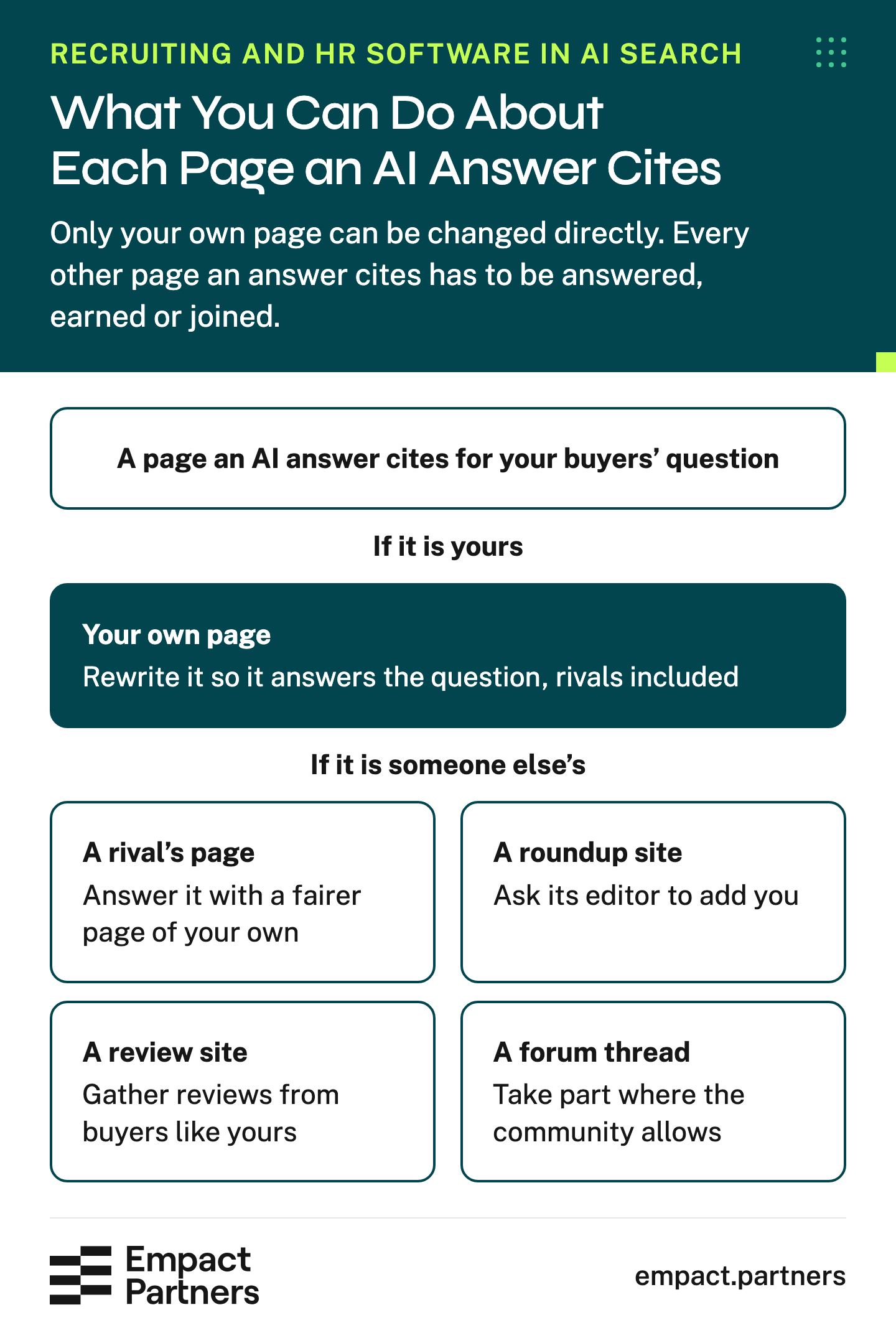
That is why the baseline counts the cited roundups that miss you. They are the pages where you ask an editor to add you, and our standing reports show which of them began to name the product.
For a first read of your own category, the AI Visibility Report writes 100 questions from your website, asks both engines, and shows which brands each names and which pages it cites:
After the baseline, watch the share of answers that name you on each engine, and beside it the share of the cited pages that name you, in whichever kind your baseline showed matters most. The first is the result you want, and the second is the part you can act on every week.
Frequently Asked Questions
Do HR software buyers use ChatGPT to find vendors?
Many use an AI chatbot. In G2’s March 2026 survey, 71% of B2B software buyers rely on AI chatbots at some point in their research, and 51% start with a chatbot more often than with Google. Gartner’s broader survey, which covered every kind of B2B purchase, found that 45% used generative AI.
For HR software specifically, Capterra found that 53% of HR buyers who rely on reviews also consult generative AI. Expect your buyers to meet your category in a chat answer before they reach your site, and to check what it told them afterwards.
Which sources does ChatGPT cite for recruiting software questions?
Mostly vendors’ own sites. In our November 2026 count across two HR-tech categories, 95.3% of ChatGPT’s answers cited a vendor’s site and 52.1% cited an independent roundup site. Government, legal and reference pages appeared in 19%, mostly in answers about employer of record and global payroll.
Review sites appeared in 4.5% and Reddit or other forums in 0.2%. About a fifth of ChatGPT’s citations are bare links to the products it names, which we leave out of the source mix.
Does Google AI Mode cite different pages from ChatGPT?
Yes, and fewer of them: 2.6 citations per answer that cites anything, against 9.5 on ChatGPT. AI Mode cites review sites twice as often (9.2% of answers) and Reddit or forums in 12.1%, where ChatGPT almost never does.
On AI Mode, the sites of vendors outside a category’s tracked brands reach 65.6% of answers against 51.5% for the tracked brands. Score the two engines apart, because one can name you while the other skips you entirely.
Do G2 and Capterra reviews help an HR-tech company show up in AI answers?
They help with the buyer more than with the engine. Review sites appear in 4.5% of ChatGPT’s answers and 9.2% of AI Mode’s in our count, and in 11.6% of AI Mode answers to comparison questions.
Buyers still use them: 71% of HR buyers who read reviews compare products with them. Keep your profiles current and reviewed by companies the size of your buyers, but do not expect reviews alone to put you in the answer.
Are “best ATS” roundups still worth writing for AI search?
On Google AI Mode, yes: 60.2% of the roundup pages it cites for HR software sit on vendors’ own sites, so a comparison on your blog can become a source. Write it to help a buyer choose, with your rivals described honestly, because the buyer who clicks through will judge it like any vendor page.
ChatGPT cites independent roundup sites far more often than AI Mode does, so a page of your own covers only half the job. The other half is earning a place on those editors’ pages, one pitch at a time.
Is Reddit worth the effort for recruiting software?
It depends on the engine. Reddit and forums appear in 12.1% of Google AI Mode answers in our count, and 15.7% for questions about price, but in 0.2% of ChatGPT’s.
If your buyers use Google AI Mode, threads where recruiters compare tools are worth the work. Join communities that already discuss your category, follow each one’s rules, and bring up your product only if the thread is asking for one.
How many brands does an AI answer name for HR software?
About four of a category’s main brands per answer: 4.0 on ChatGPT and 3.6 on AI Mode in our count, which tracks only the partner and its main rivals. A quarter of ChatGPT answers name six or more.
Around one answer in nine names none of them. Read those answers one by one before you count them as an opening, since they may recommend no product at all.
Do analyst reports like Gartner’s get cited in AI answers?
Rarely, in HR tech. Analyst pages appear in 5.5% of ChatGPT answers and 0.6% of AI Mode answers in our count, although 36% of buyers in G2’s survey say analyst firms shape their shortlist.
Analyst coverage still helps with an enterprise buying committee that reads the reports itself. On this evidence, it is an uncommon route into an AI answer.
How do we measure our AI visibility in an HR-tech category?
Write the category questions your buyers ask, with no brand in them, and put the same set to ChatGPT and Google AI Mode. Record which brands each answer names and which pages it cites, then repeat the set on a fixed schedule so a real change stands out from the week-to-week drift.
Begin with the cited roundups where your rivals appear and you do not. Those are the pages you can act on first.
How long before this work shows up in AI answers?
Plan in quarters. Getting named on a cited roundup takes an editor’s decision, and a Reddit thread takes time to earn its place in a community. AI search work takes months before momentum shows.
Measure the pages and the answers separately. A roundup that adds you is a result in itself, and an answer that names you is another.
What does working with Empact Partners on HR-tech AI search look like?
An audit and a roadmap come first, owned by a senior GTM consultant who joins your calls. What the roadmap puts first in HR tech depends on which engine your buyers use, since ChatGPT and Google AI Mode cite such different pages.
Sources (7)
- G2, "The Answer Economy: How AI Search Is Rewiring B2B Software Buying" (2026)↩1↩2↩3↩4↩5↩6↩7↩8↩9↩10↩11↩12↩13AI Search Insight Report, 15 April 2026: 1,076 B2B software decision makers, global online survey, March 2026; G2 runs software review sites, self-reported. Read 25 November 2026.
- Empact Partners, "our own Empact Panel run" (2026)Empact Partners' own data↩1↩2↩3↩4↩5↩6↩7↩8↩9↩10↩11↩12↩13↩14↩15↩16↩17↩18↩19↩20↩21↩22↩23↩24every page ChatGPT and Google AI Mode cited in 9,054 answers to 5,575 unbranded US buyer questions in two HR-tech categories (recruiting software; employer of record and global payroll), collections of 19 and 24 November 2026, classed by site and page type; each figure averaged over the two categories. Read 25 November 2026.
- Gartner, "Survey Finds 69% of B2B Buyers Turn to Sales Reps to Validate AI-Generated Insights" (2026)↩1↩220 May 2026: 645 B2B buyers, August to September 2025, self-reported. Read 25 November 2026.
- Capterra, "AI vs. HR Software Reviews: What SMBs Should Consider When Selecting HR Tools" (2026)↩1↩224 March 2026: 2026 Reviews Preferences Survey, 1,588 US software buyers, December 2025, and 2026 Software Buying Trends Survey, 3,385 respondents in 11 countries, August 2025; Capterra is a review site, self-reported. Read 25 November 2026.
- Capterra, "’s 2025 Tech Trends Report: Where Regretful HR Software Purchases Go Wrong" (2024)↩1↩2↩318 November 2024: 3,500 respondents in nine countries, August 2024, self-reported. Read 25 November 2026.
- SHRM, "The State of AI in HR" (2026)↩1↩231 March 2026: 1,908 HR professionals, December 2025, self-reported. Read 25 November 2026.
- Gartner, "Survey Shows 88% of HR Leaders Say Their Organizations Have Not Realized Significant Business Value from AI Tools" (2025)↩128 October 2025, self-reported. Read 25 November 2026.
Keep reading
Statistics 40 YouTube AI Citation Statistics
40 figures on how often ChatGPT, Google AI Mode and Claude cite YouTube for software buyers, and whose videos they pick.

Statistics 40 Reddit Google Search Visibility Statistics
40 figures on how much of Google’s software searches Reddit holds, and why AI Mode cites Reddit on other questions than Google ranks it.

Statistics 47 Keyword Search Volume Accuracy Statistics
47 figures on how far keyword volumes stray from Google’s own count, and how much search demand sits below them, measured on our site.