Is Your SaaS a Fit for Content-Led Growth? The Four Checks
Content-led growth fits SaaS companies whose buyers find vendors on their own. Four checks tell you if yours do, and what to fund if not.
 Sharné McDonaldWith
 Vlad Shvets
On this page
- The Four Checks to Run Before You Fund Content
- Do Your Buyers Come Looking for a Vendor?
- Who to Measure Your Content Against
- Where Content-Led Growth Fails Even With a Good Product
- What a Funding Round or a Hiring Plan Tells You
- What to Fund When Your Sales Model Fails the Test
- What Passing All Four Checks Commits You To
- How We Decide Whether to Take On Content Work
- Frequently Asked Questions
Empact Newsletter
One email a month on what is working in AI search and SaaS go-to-market.
Content-led growth works for some SaaS companies and wastes a year at others, and how the company sells decides which, long before anyone sets a budget. Buyers who go looking for help with a problem can find you, again and again, for years. Buyers your sales team already knows don’t need an article to find you.
If your round has just closed and a board member has told you every SaaS company should be doing content, settle this before you sign anything. Get it wrong and you pay for four quarters of articles. Then comes the board meeting where nobody can point at a deal the work brought in.
Empact Partners gets SaaS companies found by the buyers searching for what they solve, through content marketing written with their own experts. Before we take that work on, we check whether those buyers would ever come looking.
The Four Checks to Run Before You Fund Content
The checks ask how your company sells, never what it can spend, and each one has an answer already sitting in your own records:
- Recurring B2B software. Do businesses pay you a subscription for software, even very small ones? Look in your billing system.
- Buyers across countries, reading English. Are your customers spread over several countries, and do they read in English? Check where your invoices go.
- Buyers who come looking. Did your last deals start with the buyer finding you, or with your team finding them? Read the first touch on recent wins in your CRM.
- Rivals you can name. Can you name the few companies your buyer weighs you against? Ask whoever lost your last few deals.
The first two take minutes. A subscription matters because content is slow. A customer who keeps paying for years can repay a channel that took two quarters to find them. A one-person company paying for your software counts as a business buyer here (the founder running payroll from a laptop is still a buyer, and often a loyal one).
The second check is a proxy. English reaches the largest pool of software buyers searching in one language, so the same article keeps finding readers in many markets at once. A company selling into one country in its own language can still publish if enough buyers there search in that language. Check that demand before content leads the budget.
The third and fourth checks decide most of it, and founders misread both of them in both directions.
Do Your Buyers Come Looking for a Vendor?
Content-led growth is a bet on buyers you can’t name yet. They search for a problem or ask an AI engine about it, and they decide who could solve it before they speak to anyone. In 6sense’s 2026 survey of 4,611 B2B buyers, the selection phase before anyone contacts a seller took roughly 60% of a 10.3-month buying cycle. The vendor a group favored by the end of it won 82% of the time.1
Buyers like these are the ones content reaches. In the articles we wrote for Feathery, a no-code form builder, readers could try the product inside almost every post, with no signup and no sales rep. Feathery’s organic traffic grew more than 300% in 16 months.
So the third check is whether content should lead the finding of your buyers. The quickest way to answer it is a question for whoever runs sales: can you name every company that will buy from you next year? If the honest answer is yes, because your revenue sits in a handful of large accounts your team already works, content can’t find anyone new for you.
When your sales team can already name every company that will buy from you next year, content’s job is helping close those deals.
Those buyers still read about you. A buying committee at a large account researches you before the first meeting and passes your case studies around after it. Content has a real job there too. It just enters the deal at a different point:
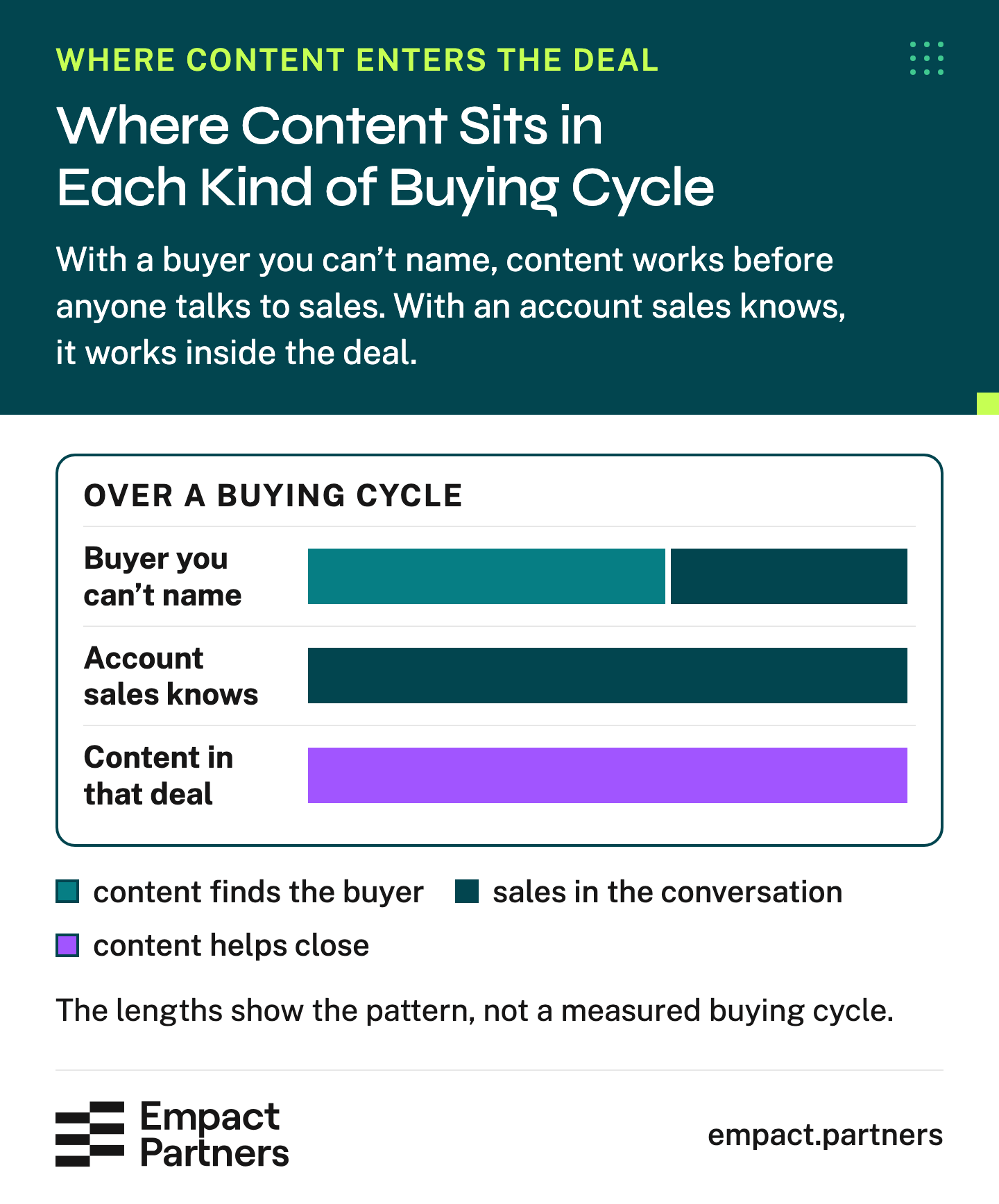
So the first job is judged by the buyers who arrive on their own, and the second by whether the deals it touches move faster. The check also gets misread the other way. A founder looks up the category name, finds almost nobody searching for it, and decides content can’t work. Buyers rarely search for a category they have never heard of, and two marketers in an r/b2bmarketing thread on exactly that worry said where the searches go instead:
Tips from Reddit
What marketers on Reddit say about categories nobody searches for
I doubt no one is googling the problem. It’s more likely that you haven’t pinned down how they’re asking the question.
Nobody searches for a solution they don’t know exists, but they do search the problem.
A category with no search volume passes the third check when its buyers search the problem in their own words. A company whose deals start with a request for proposals, sent to vendors the buyer already knows, does not.
Who to Measure Your Content Against
A buyer who comes looking compares you with someone, and the fourth check is whether you know who. Benchmark your content against the few companies competing for the same buyer. The category leader with the biggest budget is the wrong yardstick, because the vendors AI answers name for a buyer’s questions stay few however big the category gets.
Our own statistics on SaaS category competition show how few. We picked 110 software categories on G2 and, on 28 October, put three buying questions for each to ChatGPT and Google AI Mode. Then we counted the vendors named in the nine answers each category got.
In every size band, from small categories (a median of 35 products listed) to crowded ones (569), the median category’s answers named about 14 vendors, and about five came up in at least half of them:
Vendors a Buyer Meets in AI Answers, by Category Size
Median category per size band: 110 G2 software categories, 28 Oct 2026
View the data
| Label | Different vendors named across nine answers | Vendors named in at least half the answers |
|---|---|---|
| Under 50 products | 14 | 4 |
| 50 to 249 products | 14 | 5 |
| 250 or more products | 14 | 5 |
A handful of names is a benchmark a SaaS company can study. You can read what each of them publishes, see which buyer questions it answers and find where it gets quoted. The category leader’s whole library is too big to study that way. Chasing it is how a content budget ends up on topics no buyer was ever going to read from you.
Our Empact Panel shows the same field from another side. It stores a reply from ChatGPT, Google AI Mode and Claude to each question a partner’s buyers would ask, refreshed every week. One of its scores is share of voice, how much of the talk about brands in those answers goes to one brand, with extra weight for being named early. In one partner’s category, no brand comes close to owning the field:
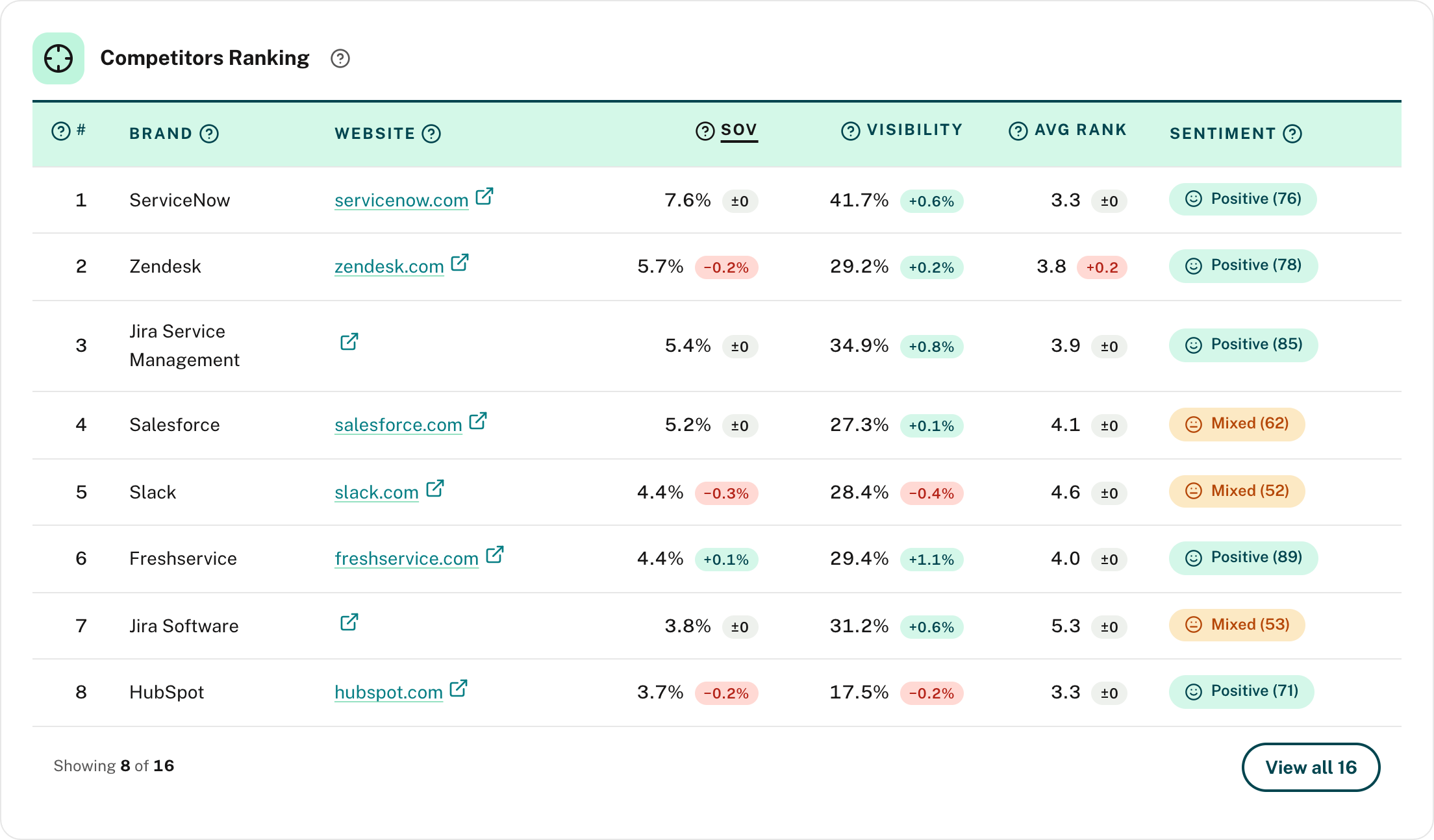
A field where the leader holds that little is one a smaller company can study and compete in, so a crowded category is not a misfit. Failing the fourth check means you can’t name the few rivals your buyer weighs you against, and that is a positioning problem to fix before anyone writes a word. An article aimed at every buyer in a category competes with every name in it at once.
The quickest way to put names on your field is to let an agent find the rivals from your website and show you what they rank for that you don’t:
Where Content-Led Growth Fails Even With a Good Product
Three kinds of company fail even with a good product. The first fails the third check outright, and the other two can pass every check and still fail. Each one changes what the money should do this year:
Scroll horizontally to see all columns when the table is wider than this page.
| Where it fails | What you see | What to do this year |
|---|---|---|
| A handful of very large contracts | Deals arrive through requests for proposals, procurement and introductions, and sales can name every prospect | Fund the material your sales team sends and the outbound that opens doors |
| No patience for quarters | The plan has to show pipeline by the next board meeting | Fund sales-led work now and start content when you can commit for quarters |
| A team new to inbound | Leadership expects leads from the first articles and judges them in month two | Reset that expectation before the first article ships |
The first is structural. In a category built on a handful of very large contracts, procurement starts from suppliers it already knows. A formal request decides the rest. An article rarely gets a vendor into that room. A reference from an earlier customer, an introduction or a well-timed email usually does.
The second is patience. Content pays back in quarters, and a company not ready to invest that long should not start, because a crowded SaaS market won’t return fast traffic from a handful of posts. Feathery’s growth took 16 months, and the people on Reddit who have counted their own posts describe the same wait:
Tips from Reddit
What people on Reddit say about how long organic takes
expecting paying customers from organic channels within a few months is unrealistic, my friend. It’s not a push channel.
86 posts. 4 drive ~70% of organic signups. 2 came straight from support ticket phrasing. First meaningful traffic around month 7.
The third is a team that has never run inbound and expects leads from the first articles. At one partner with no inbound experience, the marketing lead first wanted articles under 500 words. We kept explaining why longer pieces rank and get quoted, and the same lead later published a long-form piece of their own. Resetting that expectation is part of the work.
What a Funding Round or a Hiring Plan Tells You
Most founders hear the content pitch right after a round closes or a hiring plan is approved, and both say something real. Read them as timing signals, never as fit. Money means the work can be paid for, and a new hire means someone can run it. Neither changes how your buyers find a vendor, whether the company is venture-funded or bootstrapped.
Timing moves, and our own sales record shows how much. Across our consultancy’s own sales conversations, read in full in October, “not now” came up 50 times. One of those 50 ended in a lost deal, and half came from companies that are or were our partners. The right business model in the wrong month is a later start, and the wrong business model is the same misfit after the next round.
Founders often hear the same advice from a board member and a vendor in the same month, and it sounds stronger for being said twice. The question that settles it sits in the CRM: how did your last ten customers first reach you? If your sales team found most of them, the year of content budget belongs to the deals that team is working.
 Sharné McDonald on LinkedInOpens in a new tab
What to Fund When Your Sales Model Fails the Test
Failing the third check, the one about how buyers find you, moves the money to the work that wins accounts your team can already name. Failing the second or the fourth points somewhere else first: test the demand in your market, or settle whom you compete with. For a company that sells to accounts it can name, the money goes here:
- Messaging. Positioning and messaging settled once, so the site, the deck and every rep tell the same story about the product.
- Sales material. Case studies, a research report or an eBook, written for a named account’s buying committee and sent by the rep who owns the deal.
- Outbound. Outbound emails timed to a change at the account, when a sales leader has just joined, a product has just launched or the company is moving into another country.
- Clean data. One set of data for marketing, sales and product, with alerts on which accounts and deals to act on, the job of RevOps.
Lative shows what that looks like early on. It was a seed-stage company with no website, no blog and a new idea called Growth Efficiency when we started working together in 2022. We helped define its core messaging and wrote a 15-page eBook from interviews with its team and its users.
The eBook gave Lative’s sales and business development teams researched material to work with, and within 12 months the company generated more than 100 leads.
Content still has a place in a sales-led budget like that, aimed at accounts your team already knows and judged by whether those deals move. A company that passes all four checks is buying something different.
What Passing All Four Checks Commits You To
Passing commits you to a slow channel and to somebody whose job it is. This month you can run the checks, put names on your few rivals and write down the problems your buyers search for in their own words. The publication itself takes quarters, because its articles are written with your experts, improved after they ship and judged on what they bring in.
If you pass, the playbook I wrote for this build is where your team starts:
Judge the publication on two things once it is running. The first is sign-ups and demo requests from buyers your team had never heard of. The second is whether AI answers to your buyers’ questions begin to mention you alongside those rivals. If neither moves after several quarters, go back to the third check first. Better articles can’t fix a buyer who never comes looking.
How We Decide Whether to Take On Content Work
We judge fit by how a company sells before we look at its budget. Before we take on content work we ask the questions in these checks, and a partnership then starts with an audit and a roadmap. For a company that passes, the work looks like this:
- A senior GTM consultant who owns the work, joins your calls and signs off every article
- Your rivals named, and what they publish read beside what you publish
- First topics taken from the problems your buyers search for, in their own words
- Your product learned in depth, and every article written with your own experts
- Published articles reworked when the questions or the answers around them change
- Standing reports on how the articles perform, and a first step with every recommendation
- A plan in quarters, judged on the sign-ups and demo requests from buyers you didn’t know
For a company that fails the third check, the honest recommendation is the sales-led work above. Content can come later, when the market or the business model changes.
Frequently Asked Questions
Does content marketing work for enterprise SaaS?
Whether it works depends on how the deals start more than on the size of the customer. Enterprise buyers research a great deal before they talk to a vendor, so content that answers their questions earns its keep.
When the revenue sits in a few very large contracts won through formal requests and introductions, content works best as material for deals already in progress. Think case studies, a research report or a briefing for the executive who signs. Judge that content by whether those deals move, never by its traffic.
How long does content-led growth take to bring pipeline?
Plan in quarters. Articles take months to rank and to get quoted in AI answers, and the first sign-ups tend to come from a small share of what you publish.
In the meantime, watch which pieces bring readers who stay and which ones your sales team starts sending to prospects. A plan that has to show pipeline by the next board meeting is a reason to start with sales-led work. Come back to content once the company can commit to it for a year or more.
Is our category too crowded for content to work?
Rarely. In our run of 110 software categories, the vendors AI answers named stayed at about 14 whether a category listed a few dozen products or several hundred.
The crowd you compete with is the handful of names your buyer meets, so study what those companies publish and answer the buyer questions they leave alone. A crowded category where you can’t name a single rival is a positioning problem first.
Should we start content right after raising a round?
Start if you pass the four checks and can commit for quarters, and the round makes that easier. Money answers whether you can pay for the work.
A round doesn’t answer whether your buyers find vendors on their own, and that answer is the same before and after the money lands. If the round comes with a promise to show results by the next board meeting, the company is the one that can’t wait quarters. If you fail a check, the round goes further on messaging, sales material and outbound.
Does content work if we sell in one country or one language?
It can, with a smaller pool of readers and a longer wait. English reaches buyers across many countries, so one article keeps finding new readers for years.
In a single market and its own language there are fewer searches to win, so plan content alongside outbound and partnerships. Write first about the problems buyers in that market describe in their own words. If you expand into English-speaking markets later, add English content then, built on the product stories you already have.
What should a sales-led SaaS company fund instead of content?
The work that wins accounts your team can already name. That usually means messaging everyone uses, material a rep can send to a buying committee, outbound timed to a change at the account, and clean data that tells sales where to act.
Content written for those deals belongs in the budget. Content written to be found by strangers can wait until the business model changes.
How do we find out whether our buyers find vendors on their own?
Look at your last ten to twenty wins and write down how each one started: a search, an AI answer, a referral, an event, an outbound email or a formal request.
Then ask new customers on the first call how they first heard of you, and record where buyers first heard of you in the CRM instead of trusting the source field. Count only the deals where you can tell, because a source field full of “direct” tells you nothing. If most deals began with the buyer reaching you, the third check passes.
Can a company with a few large customers still use content?
Yes, as part of selling. A research report on the buyer’s industry, case studies a champion can forward and a briefing for the executive who signs all help a deal move.
What that content should never carry is a traffic target. The people you need are already in your pipeline, and there are only a few of them, so measure it by whether the deals it touches move faster or close more often.
Should we hire a content writer or bring in a consultancy?
Decide after the checks. If you pass, the choice between hiring a content writer or a consultancy comes down to who brings the product knowledge, the expert interviews and the editing, and whether one hire can cover all three.
A writer can produce the articles. Product knowledge and access to your experts make them worth reading, so staff that part first. If you fail, neither hire fixes the business model, and the budget does more on sales-led work.
Does content work before product-market fit?
Usually not as the main channel. Before product-market fit you need fast feedback from conversations with buyers, and content takes too long to tell you anything.
Once you know who buys and why, those conversations become your best topics, written in the words buyers used about their own problem. The questions prospects asked on their first calls make a better topic plan than any keyword tool.
Sources (2)
- 6sense, "Research Finds That Vendors Need to Be Known and Preferred Before the Buying Journey Begins" (2026)↩1Global B2B Buyer Experience Report, 4,611 recent B2B buyers. Read 23 November 2026.
- Empact Partners, "SaaS Category Competition Statistics and AI Shortlists" (2026)Empact Partners' own data↩1our AI answer run of 28 October 2026, 110 G2 software categories in three size bands, three unbranded buying questions each, ChatGPT asked twice and Google AI Mode once, US English, 989 answers. Re-checked 23 November 2026.
Keep reading
Content Marketing How to Find an Original Angle for Your SaaS Content
Decide which crowded topics deserve an article, what evidence makes them useful, and when to narrow the question or skip it.
Content Marketing Start With Expert Interviews Before You Launch a SaaS Podcast
Decide whether a podcast fits your SaaS team, who owns the work, and how expert interviews become useful buyer content.

Content Marketing Turn SaaS Expert Interviews Into Content Your Buyers Use
Choose what to reuse from expert interviews, who approves it, and which channels deserve your SaaS team's time.