When Should a SaaS Company Start Investing in SEO?
Start once your sales calls keep surfacing the same buyer questions. What that trigger means at seed, at Series A and for a second product.
 Samantha SpiroWith
 Vlad Shvets
On this page
- The Trigger Is a Set of Questions You Can Write Down
- What to Fund While the Questions Are Still Moving
- How the Timing Differs at Seed, Series A and a Second Product
- What It Looks Like When Rivals Already Hold the Answers
- When Content Beyond Sales Support Earns Its Budget
- How We Run SEO From the Questions Your Team Hears
- Frequently Asked Questions
Empact Newsletter
One email a month on what is working in AI search and SaaS go-to-market.
Fund SEO once you can write down the questions buyers ask before they buy, taken from your own sales calls and email threads, and those questions have started to repeat. For a first product, launch day is usually too early, because every page would be a guess about a buyer you haven’t met.
Waiting until a rival’s pages answer those questions puts you behind. Your pages then compete for a place against theirs, on Google and in the AI answers buyers trust. Get the timing wrong one way and you pay for a year of articles nobody needed. Get it wrong the other way and you start every page against someone already holding the spot.
Empact Partners plans the SEO of SaaS companies around the problems their sales teams hear, so buyers searching Google or asking an AI engine find pages that answer their own questions.
The Trigger Is a Set of Questions You Can Write Down
The trigger is a written set of buyer questions, because those questions decide which pages and mentions are worth paying for. A question buyers keep asking before they buy is a candidate for a page on your site. It also has pages and threads already ranking for it, where a mention of your product reaches the same buyer.
Many of these questions show little or no search volume in a keyword tool, and that is no reason to skip them. A question with almost no search volume is still worth covering when the people asking it are about to buy.
A tool’s volume is an estimate of how often a phrase is searched. Your sales calls tell you which phrases come from buyers. Each of those questions then sets the target for a page on your site, for a mention on the pages that rank for it and for the threads where buyers ask it:
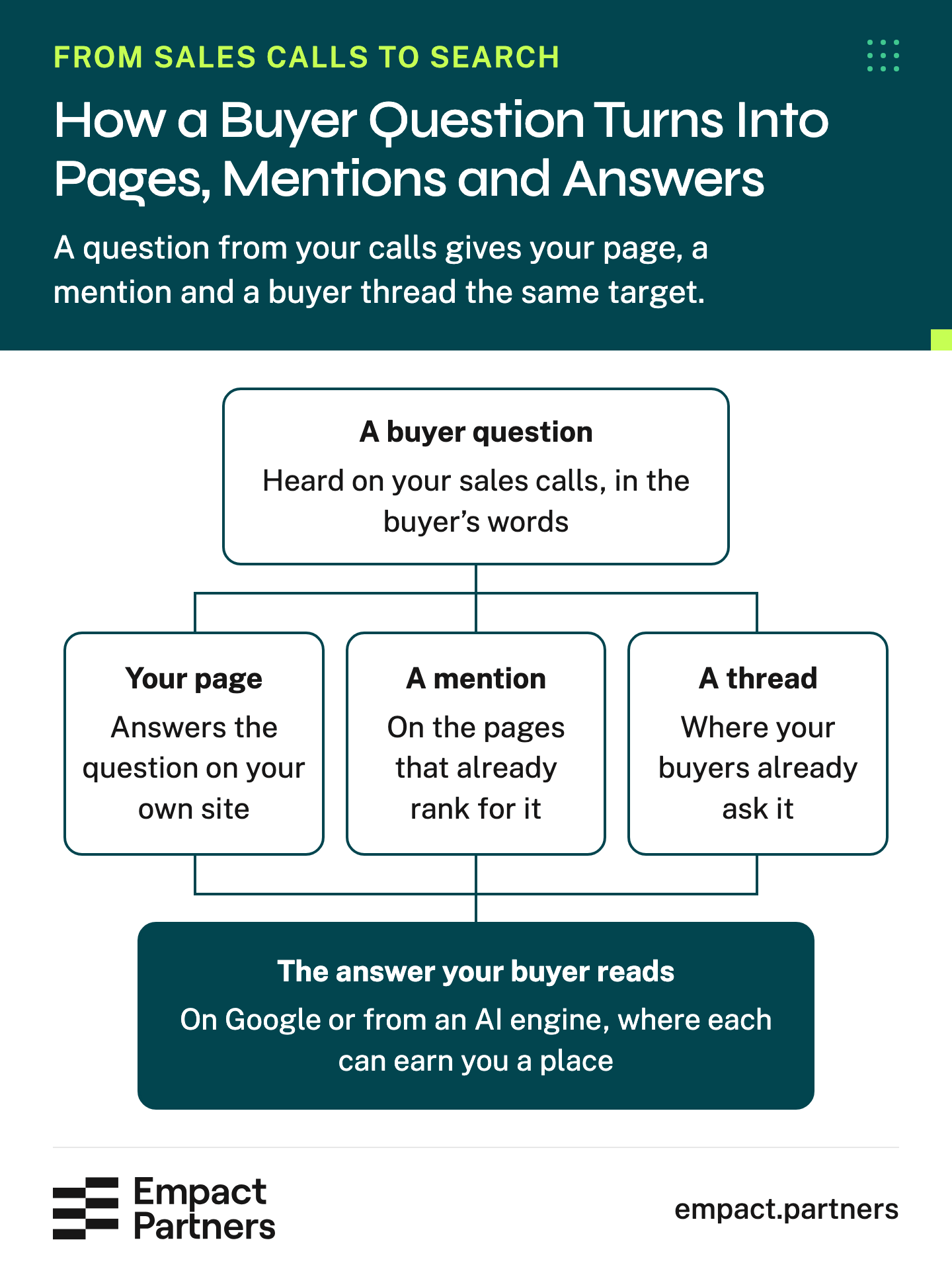
Without the question, none of the three has a target, and a page written before you have the questions is a guess however well it is written.
Founder-led sales lasts longer than many founders plan for. Kyle Poyar and Maja Voje asked 300 software GTM leaders how they win customers for their 2026 State of B2B GTM survey. Founder-led sales was the main way for 44% of companies below $1M in annual recurring revenue, and still the second most common between $1M and $10M.1
For those companies, the founder’s calls and inbox are where the questions are. You have reached the trigger when all four of these are true, and you can check each one against your own inbox this week:
- Questions in their words. You can fill a page with questions buyers asked before they bought, without opening a keyword tool.
- Repeats across buyers. Buyers who never met each other ask the same few questions, in similar words.
- The questions that decide. You can say which questions came right before a buyer signed, and which were curiosity.
- Their name for the problem. You know what buyers call the problem before they hear the name of your category.
Founders argue about the timing from both ends. One side says blog posts are a distraction until you know who the product is for, and before the questions repeat, it is right. The other side says selling call by call hits a ceiling, because a call stops bringing buyers when it ends and a page does not. Once the questions repeat, that side is right.
SEO is worth funding once the questions on your sales calls repeat, because those questions tell you which pages to write.
Until you can write the questions down, the budget belongs to the work that produces them.
What to Fund While the Questions Are Still Moving
Before the questions repeat, fund the work that makes them visible. Get on every sales call you can. Write down the words buyers use for their problem and the objections that stall a deal. Answer the questions buyers already ask in the communities they read, in your own name, and mention the product only where it helps the person asking.
Settle what you say about the product at the same time. The words buyers use on those calls are the raw material for your positioning and messaging. A company that has not settled its message rewrites every early page once it does.
What waits is anything that needs scale before it pays: pillar pages, internal-link structures, articles aimed at your category’s broadest terms, and traffic targets. A site with a handful of posts gives a link structure nothing to connect, and the broad terms belong to companies with years of pages behind them.
How the Timing Differs at Seed, Series A and a Second Product
The trigger is the same at every stage. What changes is who in the company hears the questions, and that decides where you collect them and what they pay for first:
Scroll horizontally to see all columns when the table is wider than this page.
| Stage | Who hears the questions | What they pay for first | One of our partners at this stage |
|---|---|---|---|
| Seed, founder still selling | The founder, on every call and in every thread | Pages that answer the narrow questions buyers repeat, and mentions where those buyers already read | Lative: no website in 2022, so we began with its messaging and an eBook from interviews, and it generated 100+ leads within 12 months |
| Series A, a sales team | Reps, in call notes, lost deals and support tickets | Comparison and alternative pages, and the pages already close to Google’s first page | The Taiwanese software maker KDAN, which we helped scale from Series A to Series B: monthly organic traffic from 30K to 90K+ in two years, with its own team answering questions on Quora |
| A second product from an established company | The parent company’s sales and support teams, when the buyer overlaps | Pages for the new buyer’s questions on the new domain, from launch | DottedSign, launched by KDAN on its own domain: we built its blog from scratch, and it grew from zero to 80K visits a month in three years |
Series A is where founders lose the questions without noticing. The founder stops hearing every call, and the questions move into reps’ notes and lost-deal reasons that nobody reads for content.
Our published record at this stage is one partnership, so read the Series A row as one company’s path. Collecting the questions from the sales team is the part that transfers to yours, and it is the step I would check first:
The middle row is the one founders get wrong. After the first sales hires, buyers ask the same questions, but often nobody writes them down anymore. Before you fund a page at Series A, ask each rep for the last five questions a buyer asked before signing. If nobody can name them, the SEO budget is about to pay for guesses.
 Samantha Spiro on LinkedInOpens in a new tab
A second product can reach the trigger on launch day, because the parent company may already hear the new buyer’s questions on its own calls. The new domain still earns its standing in search from nothing, however large the company behind it, which is why the DottedSign row is measured in years.
Once you have the questions, the next thing worth knowing is which searches near them your site could win soon, and what kind of page each would need:
What It Looks Like When Rivals Already Hold the Answers
Our record cannot show what waiting cost any one company, but it can show the market a late starter walks into. Every week, our Empact Panel asks Claude, ChatGPT and Google AI Mode the questions a partner’s buyers ask, and stores each reply.
We counted, for eleven of our partners that sell B2B software, how many of their buyers’ questions got answers naming at least one rival and never the partner. The count covers each panel’s latest weekly collection, 16 to 23 November 2026: 31,563 questions and 64,216 answers.
In the median panel, rivals alone appeared in the answers to 76.9% of questions:
Buyer Questions Whose Answers Name a Rival and Not the Partner
Eleven Empact partners selling B2B software, Empact Panel, 16 to 23 Nov 2026
View the data
| Label | Value |
|---|---|
| Partner A | 98.3% |
| Partner B | 88.3% |
| Partner C | 87.2% |
| Partner D | 84.4% |
| Partner E | 77.9% |
| Partner F | 76.9% |
| Partner G | 59.5% |
| Partner H | 46.9% |
| Partner I | 34.5% |
| Partner J | 33.8% |
| Partner K | 27.7% |
For most of these companies, a buyer who asks the engines gets a shortlist that leaves them out, although every one of them sells a product buyers pay for. The chart cannot say why, or when anyone started. Its bottom bar matters too: Partner K itself appears in the answers to nearly two thirds of its buyers’ questions, so rivals do not hold every market.
On Google, even the climb with no rival in the way is slow. Across the 40-plus companies that Grow and Convert, a content marketing company, writes for, a post took a little over a year on average to reach the first page.3 A page written after a rival’s climbs against a page already holding the spot. Nobody we know of has measured that climb inside AI answers.
So the late company is not shut out, but its job changes from answering first to winning a place back in each answer. That means pages for narrower questions the rivals left alone, and mentions on the sources those answers quote. It is slower work than answering a question nobody holds yet.
When Content Beyond Sales Support Earns Its Budget
Everything so far is content that supports the sale: a page for each question buyers ask before buying, the comparisons they request and the objections your reps answer. Content beyond that, a publication with its own readers, earns its own budget later. Three things have to be true first:
- The question pages exist. You have pages for most of the questions your team hears on calls, and your reps send them to buyers.
- Strangers arrive through them. People your team never contacted start booking demos and signing up after reading them.
- The plan can wait quarters. A publication pays back over quarters, and the company does not need it to show results this quarter.
Whether content-led growth suits your company at all is a separate question. How your buyers find vendors settles it, whatever your stage.
Once content earns budget beyond the sales pages, the harder question is how to split the search money between Google and AI answers, and this playbook works through that split:
Until then, every article you pay for should answer a question a buyer asked your team.
How We Run SEO From the Questions Your Team Hears
If you can’t tell which side of the trigger you’re on, that is where Empact Partners would start. We would take the questions your sales team heard this quarter and decide, in writing, which of them deserve a page now. The work looks like this:
- Your sales questions first. A named senior GTM consultant owns the work and is on your calls, and the problems your sales team hears go into the keyword research before search volume does.
- A call on every search. A consultant decides in writing whether to write for it now, aim narrower, wait or pass. The agent behind our Keyword Opportunity Report keeps the research under each decision current.
- A roadmap before any calendar. The work opens with an audit and a roadmap, so no page gets a date before anyone has heard your buyers.
- Each question worked three ways. A page on your site, mentions on the pages that rank and get cited, and Reddit threads where buyers ask, for Google and the AI engines.
- Reports on those questions. Regular reports show whether your pages perform and whether AI answers name you for your buyers’ questions, and every recommendation comes with a first step.
- A plan in quarters. New question pages take months to rank and to be quoted in AI answers, and the plan says so from the start.
Once the first pages ship, watch one number: how many of your buyers’ questions get answers that include you. What our record cannot settle is whether a company that starts at the trigger beats one that starts a year later. The Panel shows where partners stand today, not how they got there, so that part of the case stays our judgment.
Frequently Asked Questions
Is it too early for SEO before product-market fit?
Usually, yes. Before product-market fit, the questions buyers ask change from one month to the next, because you are still learning who buys and why. Pages written in that period answer questions your next buyers may never ask.
Spend that time on calls, on writing down the words buyers use and on answering questions in the communities they read. The exception is a narrow question you already hear on every call. A page for that one is worth writing now.
How many sales conversations does it take before the questions count as known?
There is no fixed number. You know the questions when new calls stop adding questions and start repeating ones you already wrote down. Keep a running document and add every question after each call, with the buyer’s own words.
When new calls mostly repeat questions already in that document, you are past the trigger. How many calls that takes depends on how alike your buyers’ problems are.
Should we wait until we pass $1M in annual recurring revenue?
No. Revenue tells you that buyers pay, not whether you know what they ask before paying. Founder-led sales was still the second most common way to win customers between $1M and $10M in the 2026 State of B2B GTM survey.1 Many companies pass that line with the questions still in the founder’s head.
A company at a few hundred thousand in revenue whose calls repeat the same questions is ready. A company at several million whose reps never write a question down is not.
Can a SaaS company start SEO on launch day?
For a first product, rarely, because nobody has heard a buyer’s questions yet. Get the technical basics right at launch, so search engines can reach and read the site, and leave the content plan for later.
A second product is different when the parent company already sells to the same buyer. Its sales and support teams may already hear the questions, and then the content can start at launch. The new domain still has to earn its standing in search from zero.
What if a competitor already owns the answers to our buyers’ questions?
You are not shut out, but the work is slower. Find the narrower questions the rival’s pages leave alone, and write the best page on each. Then earn mentions on the pages the AI answers already cite, so the next answer has a reason to name you.
In our count of eleven partners, four appear in the answers to more than half of their buyers’ questions. Rivals holding the answers is where a market stands today, and it can change.
How long does SEO take to bring buyers once we start at the trigger?
Plan in quarters. Grow and Convert found that its posts took a little over a year on average to reach Google’s first page.3 DottedSign’s blog took three years to go from zero to 80K visits a month.
Before the traffic arrives, watch whether pages written from your sales questions start to rank and appear in AI answers to those questions. Judge the program by the buyers it brings who never spoke to your team before they booked a demo.
Do AI answers change when a SaaS company should start SEO?
AI answers raise the cost of waiting. Buyers put the same questions to ChatGPT and Google AI Mode that decide your pages, and the replies name only a few vendors. In the 2026 State of B2B GTM survey, 39% of respondents called AI search a core channel, up 11 points in a year, and 51% said the same of SEO.1
The trigger stays the same. A rival that AI answers already name is one more name your pages have to earn a place beside.
Who should collect buyer questions once we have a sales team?
Someone in marketing should own the set, and the reps should feed it. Ask reps to log the questions a buyer asks before buying in the CRM, next to the deal, in the buyer’s words. Read lost-deal reasons and support tickets for the same thing every month.
The founder can still join some calls, but the set should not depend on them. Keep it in one shared document, because the same questions later tell you what to track in AI answers.
What should an early SEO budget pay for?
Pages for the questions your calls repeat, a few mentions where your buyers already read, and the technical basics that let search engines reach the site. Leave traffic targets, pillar pages and broad category terms for later.
As the company grows, the split changes toward the pages already close to the first page and the mentions AI answers cite. How a growing SaaS company should split its SEO budget is a later decision, once the question pages exist.
Should we hire an SEO person or work with a consultancy first?
Decide after you have the questions. Before that, neither has much to work from, and the founder’s calls are the research. Once the questions repeat, the choice comes down to who can turn them into pages and mentions on Google and in AI answers, and who measures what follows.
The trade-offs of hiring in-house or outsourcing SEO depend on how much of that your team can own. One hire rarely covers the research, the writing and the mentions at once.
Sources (3)
- Kyle Poyar and Maja Voje, "What’s working in B2B GTM in 2026" (2026)↩1↩2↩3Growth Unhinged, 14 October 2026: the 2026 State of B2B GTM report, 300 software GTM leaders surveyed in September 2026. Read 24 November 2026.
- Empact Partners, "Empact Panel count" (2026)Empact Partners' own data↩1the buyer questions of 11 partner panels in B2B software, each panel’s latest weekly collection, 16 to 23 November 2026, 31,563 questions and 64,216 answers from ChatGPT, Google AI Mode and Claude, sorted by whether the answers named the partner, a rival only or no tracked brand. Read 24 November 2026.
- Grow and Convert, "How Long Does It Take to Rank on the First Page of Google?" (2026)↩1↩2an analysis of first-page rankings across more than 40 companies it writes for. Read 24 November 2026.
Keep reading
SEO Who Should Own AI Search When You Already Run SEO
Already run SEO? Keep AI search under the same owner and report each AI engine apart. What 500 buyer questions show, and when to hire.
SEO How Should a SaaS Company Split Its SEO Budget?
Decide what your SaaS search budget should fund first: website fixes, relevant mentions, community work or better measurement.
SEO Should Your SaaS Hire an SEO or Outsource the Work?
One SEO generalist can’t run technical work, content, mentions, and Reddit. Name the owner of the roadmap and the pipeline number first.