63 B2B Marketing Channel Statistics
63 figures on the channels B2B teams use, credit and fund, sorted by which were measured and which were only said in a survey.
 Garith PriorWith
 Vlad Shvets
On this page
Empact Newsletter
One email a month on what is working in AI search and SaaS go-to-market.
Software companies call 5.5 channels core this year, up from five a year earlier, and last year’s survey counted another 5.5 running as experiments.1 When next year’s budget is due, a longer line-up feels like the safer plan. Most of the figures that put a channel in that plan, though, are what marketers said in a survey about what they use, like or mean to fund.
Very few figures measure anything directly, and one of those is ours. We counted the pages cited in AI answers to B2B software buyers’ questions across eleven partner panels. In the median panel, 87.8% of ChatGPT answers with sources pointed to a software vendor’s own website, against 0.2% that pointed to LinkedIn.2 So it pays to know which kind of number put each channel in the plan, and the figures below are sorted by that.
Highlights
- 5.5 core channels per software company in 2026, up from five in 2025.1
- 68.3% of B2B product firms added channels over the past three years, and 6.3% cut back.3
- 30.2% of B2B marketers name website, blog and SEO a top channel for return, more than any other, by their own report.4
- 64% of B2B marketers plan to put more into their website through 2026, ahead of events and email at 59% each.5
- 33.2% of ad budgets at 177 B2B SaaS companies went to Google Search in the first half of 2025, measured in their own accounts.6
- 87.8% of ChatGPT answers with sources cite a vendor’s own website in our median panel, against 0.2% that cite LinkedIn.2
Read side by side, these figures measure different things and still point the same way. HubSpot’s respondents use and credit website, blog and SEO more than any other channel. More of Demand Gen Report’s respondents plan to raise website spending than spending on any other channel, and vendor websites are what AI answers cite most. LinkedIn is everywhere in the surveys and rare in the answers.
And most teams keep adding channels, each one repeating the company’s message to a new audience, which leaves every channel harder to judge.
Empact Partners helps SaaS companies decide what to say before they decide where to say it, writing the positioning and messaging behind their website and sales story. Every channel repeats that message, so a muddled one costs more with each channel added.
The Channels B2B Teams Say Are Core
Growth Unhinged and GTM Strategist surveyed 300 software go-to-market leaders in September 2026. The largest group, 35%, ran companies with $1 million to $10 million in annual recurring revenue, so the answers describe young companies more than large ones. Asked which channels are core to how they win business, they answered:
- 62% say network and introductions is core, the most common answer.1
- 51% say SEO is core.1
- 50% say LinkedIn posting by founders and employees is core.1
- 39% say AI search is core, up 11 points on 2025, the largest rise of any channel in the survey.1
Channels Software GTM Teams Call Core in 2026
Growth Unhinged and GTM Strategist, 300 software GTM leaders, Sept 2026, self-reported
introductions62%
founders and employees50%
View the data
| Label | Value |
|---|---|
| Network and introductions | 62% |
| SEO | 51% |
| LinkedIn posting by founders and employees | 50% |
| AI search | 39% |
A core channel here is one a team counts on, which is not the same as one shown to pay. The sample also leans early-stage, which may be why introductions top it.
Read the chart as a prompt to look at competition. Half these respondents post on LinkedIn and work on SEO, so a team adding either should check how crowded its own category already is there. The most common experiments show where the crowd goes next: signal-based outbound at 50% and AI search at 41%.1
HubSpot’s State of Marketing survey, a vendor’s poll of more than 1,500 marketers, asked the question in plainer terms and got a different top three. Website, blog and SEO are used by 48.4% of B2B marketers, email by 39.3% and organic social media by 38.6%.4 Different people answered different questions, so neither ranking is wrong. Both tell you what is popular, and popularity alone does not show whether a channel brings in customers who pay.
The Channels B2B Marketers Say Return the Most
The obvious next question is which of these channels pay back, and the answers here come from the same kind of survey. HubSpot asked its B2B respondents to name their top channels by return:
Each figure is the share of marketers who picked a channel. Nobody in the survey reports a revenue figure, so 30.2% means about three in ten respondents put website, blog and SEO among their top channels for return. It does not mean the website pays 30.2% back.
Growth Unhinged’s scorecard asks the same thing in its own way and rates network and introductions first and small in-person events second, without printing a number for either.1 Demand Gen Report asked a different group whether they can check such judgments. In its 2025 benchmark, 57% of B2B marketers said they actively measure campaign attribution, 33% expected to within a year and 10% had no plans to.5
Better measurement of what demand generation returns was a top-three priority for 52%.5 The groups differ, but the caution carries over. A top-return pick from a team without attribution rests on judgment alone.
A top-return share tells you which channels your peers believe pay. Your own answer needs two numbers, the revenue from a channel’s closed deals in your CRM and what the channel cost. Get both before that belief moves money in your plan.
 Garith Prior on LinkedInOpens in a new tab
Planned spending is the next kind of evidence, and it is still what marketers said.
Where B2B Marketers Planned to Spend in 2026
Demand Gen Report asked B2B marketers which channels they plan to put more money into to drive leads into pipeline through 2026. Three pulled ahead:
- 64% chose the website.5
- 59% chose in-person events and trade shows.5
- 59% chose email, with account-based advertising and retargeting at 47% and online ads and social posts at 42%.5
Channels B2B Marketers Plan to Fund More Through 2026
Demand Gen Report, 2025 benchmark survey, share choosing each channel, self-reported
and trade shows59%
and retargeting47%
social posts42%
View the data
| Label | Value |
|---|---|
| Website | 64% |
| In-person events and trade shows | 59% |
| 59% | |
| Account-based advertising and retargeting | 47% |
| Online ads and social posts | 42% |
The website leads a question about pipeline, which is the right instinct for a SaaS team, because most digital channels send buyers there. Events at 59% is the line to watch. A meeting at an event happens away from any tracked click, so events are hard to trace to revenue, and they keep coming back below.
The CMO Survey, run by Duke University, Deloitte and the American Marketing Association, shows how planned growth compares with the year before. B2B product companies put 7.03% of their overall budget into marketing, and B2B services companies 9.20%.3
Over the 12 months to January 2026, B2B product firms cut overall marketing spend by 0.19% and grew digital spend by 4.13%. For the next 12 months they planned 5.44% more overall and 9.37% more in digital, with traditional advertising slightly down at -0.32%.3 So last year’s extra money went to digital while the total stood still.
B2B Product Firms' Spending Change, Done and Planned
The CMO Survey 2026, mean change, US B2B product companies, self-reported
View the data
| Label | Past 12 months | Planned, next 12 months |
|---|---|---|
| Overall marketing | -0.19% | 5.44% |
| Digital marketing | 4.13% | 9.37% |
The planned digital rise is more than double the rise these companies delivered the year before. An expectation is not spending, so budget from what your team spent and measured last year, and use the survey as context rather than a target.
Paid budgets are growing while worries about waste stay high. EMARKETER (a market research company) surveyed B2B marketers in 2025 for Demandbase, which sells account-based advertising, and 64.9% of respondents said their ad budget grew that year. In the same survey 58.0% called ad waste a significant issue, and 52.4% put the share of their spend wasted on the wrong companies at 16% to 45%.7 So a growing ad budget is no sign that the channel pays.
Gartner’s 2026 spend survey of 401 marketing chiefs, mostly from billion-dollar companies, found awareness and conversion taking 62.6% of media spend.8 It warned that less mature teams may be over-investing in the channels easiest to measure and automate.8 A channel you can measure, in the sense a budget needs, is one whose deals you can see in your CRM, and the channel reporting the most clicks may not be one of them.
The Channels ABM Teams Use to Reach Their Accounts
One group of B2B teams already concentrates its channels on purpose. Account-based marketing (ABM) means choosing the companies you want and marketing to them by name instead of waiting for leads. Demand Gen Report’s 2025 ABM survey found 71% of B2B marketers running it, up four points, with 23% more planning to start.9 Asked which channels they use to reach their target accounts, they answered:
Scroll horizontally to see all columns when the table is wider than this page.
| Channel | Use it now | Plan to add it |
|---|---|---|
| 92% | 5% | |
| In-person events | 72% | 23% |
| Account-based advertising | 59% | 26% |
| Outbound teleprospecting | 56% | 22% |
| Direct mail | 38% | 26% |
| Personalized website content | 34% | 37% |
Email is the channel almost every ABM team already runs, and in-person events at 72% is the figure that should make a SaaS lead look twice. The CMO Survey found 47.4% of B2B services firms and 33.3% of B2B product firms opening new face-to-face channels, so firms in both groups are adding in-person channels.3
Personalized website content is where the most teams are still heading, with 37% planning to add it against 34% using it today.9 These teams also say ABM works: nearly 65% report it meeting or exceeding their company’s expectations, yet proving its return was the most common challenge, named by 47% of respondents.9 So read the 65% as satisfaction and not as a return.
How Search and Social Feed Pipeline
Two sources here measure instead of asking. One is HockeyStack, an attribution platform that published spend and conversion data from 177 B2B SaaS companies using its software. The other is our own count of which channels AI answers cite. Both have limits worth knowing before a budget leans on them. HockeyStack’s sample is companies that buy attribution software, and our count measures citations in AI answers, not visits or revenue.
Where 177 SaaS companies’ ad money went
These companies spent about $240 million on ads in the first half of 2025, and 33.2% of ad budgets went to Google Search.6 Its share rose from 31.3% in the first quarter to 35.3% in the second, so search took a bigger slice as the half went on.6
LinkedIn took 16.8% of the half-year’s spend, third behind search and other referral traffic.6 The moves from one quarter to the next show where these teams shifted money:
Share of Ad Spend by Channel, Q1 to Q2 2025
HockeyStack, 177 B2B SaaS companies, measured in their ad accounts
traffic30.5%23.7%
View the data
| Label | Q1 2025 | Q2 2025 |
|---|---|---|
| Google Search | 31.3% | 35.3% |
| Other referral traffic | 30.5% | 23.7% |
| 15.4% | 18.2% | |
| Events | 4.4% | 5.8% |
On LinkedIn the share grew from 15.4% to 18.2%, and events went from 4.4% to 5.8%. Other referral traffic, the referral and syndication programs, lost the most, falling from 30.5% to 23.7%.6 For a SaaS plan, that means the measured money moved toward search and LinkedIn.
HockeyStack also ranked channels by how well their leads moved from marketing-qualified to closed. Referral, review sites, partner marketing and email converted best. Google Search sat in the middle, and LinkedIn landed with the awareness channels, strong at reaching buyers and weaker at converting them.6 A channel can open a deal that another channel closes, so a plan should trace the first touch as well as the last.
Because these companies use attribution software, the report ties their ad spend to the deals it attributed, which is what makes it useful here. If you run paid channels, work out each one’s return the same way before you set next year’s plan, with the revenue it brought in and what it cost:
Which channels AI answers cite
Search now includes the AI answers buyers read before they visit anyone’s site, so a channel plan should know which channels those answers draw on. Our Empact Panel stores each week’s answers to our partners’ buyer questions on ChatGPT, Google AI Mode and Claude, with the pages they cite.
For this article we sorted the pages cited in 63,016 answers from eleven B2B software panels, collected between 17 and 23 November 2026, by the channel each page sits on. Almost every answer cited at least one page, and each share below is of those answers, the median across the eleven panels:
- 87.8% of ChatGPT answers with sources cited a software vendor’s own website, and 50% of Google AI Mode answers did.2
- 10.9% of AI Mode answers cited Reddit, against 0.1% of ChatGPT’s.2
- 7.7% of AI Mode answers cited a software review site, and 3.7% of ChatGPT’s.2
- 0.8% of AI Mode answers cited LinkedIn and 0.2% of ChatGPT’s, while YouTube reached 1.6% and 0.1%.2
AI Answers Citing Each Channel, Median of 11 Panels
Empact Panel, software buyer questions, 17-23 Nov 2026, answers citing sources
own websites87.8%50%
review sites3.7%7.7%
View the data
| Label | ChatGPT | Google AI Mode |
|---|---|---|
| Software vendors' own websites | 87.8% | 50% |
| Software review sites | 3.7% | 7.7% |
| 0.1% | 10.9% | |
| YouTube | 0.1% | 1.6% |
| 0.2% | 0.8% |
The vendor share is a floor, because vendors a panel does not track count among other sites, and Claude ran in only two of the panels that week, too few to report. For a channel plan the reading is direct. The vendor’s own website is what AI engines cite most for these questions, so a clear, current website serves two audiences, the visitors who read it and the engines that cite it.
LinkedIn, core for half of software GTM teams, barely appears in these answers, and our study of how often AI answers cite LinkedIn shows the rate swinging widely with the kind of question asked. That does not make LinkedIn a bad channel. It means LinkedIn has to be judged on what its posts and ads start, such as meetings and opportunities, and not on AI citations.
LinkedIn took 16.8% of the ad spend HockeyStack measured, yet in our median panel it showed up in 0.8% of AI Mode answers with sources. Both can be true at once. Count the meetings and deals LinkedIn posts and ads start, and count the deals that pass through your website, whatever first brought the buyer. One score for both hides what each does.
Garith Prior on LinkedInOpens in a new tabHow Many Channels a SaaS Team Can Measure
The measured data shows money and AI citations gathering in a few channels: search took a third of ad spend, and vendor websites dominate the answers. The next question is how many channels a team can judge well, and most teams are moving the other way.
In the CMO Survey, 68.3% of B2B product firms said they increased the number of channels they use over the past three years, and 6.3% said they decreased it. Among B2B services firms, 44.7% added channels.3
In HubSpot’s survey, which mixes B2B and B2C marketers, the largest group, 44.8% of respondents, sets aside 10% to 20% of its annual budget to test new channels.4 Testing is healthy. The trouble starts when a test never ends. A team running 5.5 core channels plus experiments has a lot of lines to tie to closed deals, so check how many your CRM can trace today.
The rule we would give a SaaS team is short. Fund the channels whose deals you can see in your own CRM, from first touch to close, and review them each quarter. Run everything else as a test with a budget, a measure and an end date. On that date, look at the deals the test opened or helped close against what it cost, and decide whether it earns a line:
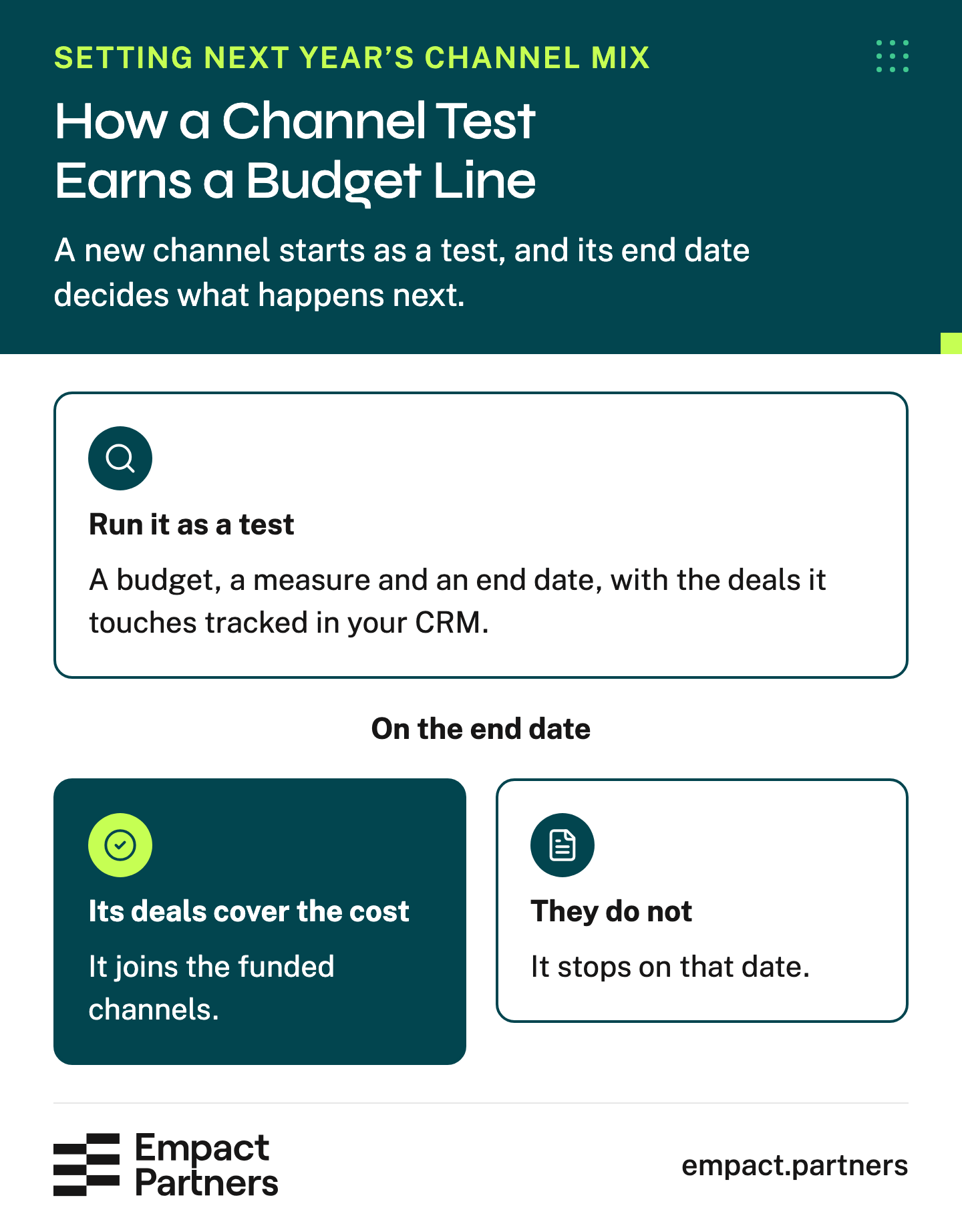
A test that pays its way joins the funded channels, and one that does not stops on the date, so the plan never carries a line nobody has judged. Someone on your team has to own that call and make it when the date arrives.
A channel plan built on a muddled message pays for the muddle again in every channel it adds.
A long line-up has a second cost. Every channel describes your company again, in a post, an ad, a profile or a review listing, and those descriptions drift apart. When two channels describe the company in contradictory ways, such as who it is for or what it does, a gap in their results may come from the message rather than the channel.
A buyer can also meet two versions of your company before the first call. The AI answers in our count cite vendor websites and review sites far more often than LinkedIn, so in our sample those are the descriptions buyers meet most often through AI answers. To see where your website, LinkedIn and review-site descriptions disagree, run the free preview of the audit agent we run in full for partners:
If we were working on your channel plan, we would start with an audit of how data moves between your tools and your CRM, because it shows which channels you can trace to deals today. Then, in our RevOps work, we set up pipeline and attribution reporting in the CRM you already have, so every channel is judged on the deals it touches.
Alongside it, as part of our Brand Marketing work, we write the messaging framework with people inside and outside your company and carry it into a website audit and conversion work. Between them, the two workstreams cover:
- The data audit, showing which channels your CRM can trace to deals
- Pipeline and attribution reporting in your current CRM, channel by channel
- The messaging framework, written with people inside and outside your company
- The website, audited for how clearly it carries that message and how well it converts
The message is the part you can start on before any channel decision. If you would like to draft it yourself, we wrote down how to build the one page your sellers, writers and AI tools can start from:
Next quarter, check the first-touch source on every deal you close and work out the share that names a channel. If that share falls while your channel count rises, the plan has outgrown your ability to judge it, so hold every open test to its measure and end date before adding another.
Frequently Asked Questions
What are the most used B2B marketing channels?
The answer depends on who is asked. HubSpot’s 2026 survey puts website, blog and SEO first among B2B marketers at 48.4%, then email at 39.3% and organic social media at 38.6%.
Growth Unhinged’s survey of software go-to-market leaders ranks network and introductions first at 62%, then SEO at 51% and LinkedIn posting by founders and employees at 50%. Both surveys are self-reported and both measure adoption. A common channel may also be a crowded one in your category, so check before you plan to stand out in it.
Which B2B marketing channel has the best ROI?
None of the surveys cited here measures return. HubSpot’s B2B respondents most often name website, blog and SEO as a top channel for return, picked by 30.2%, followed by email and paid social.
HockeyStack measured 177 SaaS companies and found the leads from referral, review sites, partner marketing and email converting best. Your own answer sits in your CRM. Compare the channels whose closed deals you can trace with what each one cost you.
How much of its budget does a B2B company spend on marketing?
In The CMO Survey’s 2026 breakout, marketing accounts for 7.03% of the overall company budget at B2B product companies and 9.20% at B2B services companies. The base is the company budget, which is a different base from revenue.
The survey covers US companies of every size and sector, so neither figure is a target for a SaaS company. Treat them as sector averages to compare against, then size each channel by what it returns.
Is LinkedIn worth it for B2B SaaS?
For reaching people, often yes. Half of the software GTM leaders Growth Unhinged surveyed call LinkedIn posting core, and LinkedIn took 16.8% of the ad spend HockeyStack measured.
For showing up in AI answers, far less. In the median panel of our November 2026 count, LinkedIn appeared in 0.2% of ChatGPT’s answers with sources and 0.8% of Google AI Mode’s. Fund LinkedIn for the conversations and meetings it starts, and measure it on those.
Should a SaaS team spend more on events next year?
Many plan to. In Demand Gen Report’s survey 59% plan more spending on in-person events and trade shows, and 72% of ABM teams already use them. At the companies HockeyStack measured, events rose from 4.4% to 5.8% of ad spend.
Events are also hard to trace to revenue, because the meeting happens away from any tracked click. Spend more only if every meeting booked there is logged against its company in the CRM. Count meetings with buyers rather than badge scans.
How many marketing channels should a B2B SaaS company run?
As many as you can measure, plus a few dated tests. Software companies call 5.5 channels core on average, and 68.3% of B2B product firms added channels over three years.
A team whose CRM traces deals to three channels should fund those three. It can test one or two more with a budget and an end date, which beats spreading the same money across six channels it cannot judge.
How do you measure the return on a marketing channel?
For a paid channel, divide the revenue it brought in by what it cost. That ratio is return on ad spend, and its break-even point is one divided by your gross margin, so the thinner your margin, the higher the ratio a channel needs to pay for itself.
For organic channels, record the first touch on every deal in your CRM and compare each channel’s closed revenue with what it cost, including the people working on it. Agree on the method before a campaign starts, even if it is one question on your demo form about where a lead heard of you. Without it, nobody can credit the channel that worked.
Which channels work best for account-based marketing?
Among ABM practitioners in Demand Gen Report’s 2025 survey, 92% use email, 72% in-person events, 59% account-based advertising and 56% outbound teleprospecting.
Nearly 65% say their program meets or beats expectations, but proving its return was the top challenge, named by 47%. We would pair email to every target company with in-person meetings for the few closest to buying, and log each meeting against its company, because that is where measurement tends to break.
Do AI answers change which channels matter?
AI answers raise the value of the website and the review sites. In the median panel of our November 2026 count, vendors’ own sites appeared in 87.8% of the ChatGPT answers that cited sources, and review sites in 3.7%.
The engines differ, too. On the same basis Google AI Mode cited Reddit in 10.9% of its answers against 0.1% for ChatGPT, and AI search is now core for 39% of software GTM leaders. Check which engine your buyers use before you decide where an AI-search budget goes.
What does working with Empact Partners on a channel plan look like?
A named senior GTM consultant owns the partnership and is on the calls. For a channel plan, the dashboards we set up in your CRM show pipeline and attribution by channel, so you can see what each one brings in.
Sources (9)
- Growth Unhinged (Kyle Poyar) and GTM Strategist (Maja Voje), "What’s working in B2B GTM in 2026" (2026)↩1↩2↩3↩4↩5↩6↩7↩8↩914 October 2026, on the 2026 State of B2B GTM report: 300 software GTM leaders surveyed in September 2026, self-reported. Read 24 November 2026.
- Empact Partners, "our own Empact Panel run" (2026)Empact Partners' own data↩1↩2↩3↩4↩5↩6↩7every page cited in 63,016 answers ChatGPT, Google AI Mode and Claude gave to the buyer questions of eleven B2B software partner panels, collections of 17 to 23 November 2026, classed by channel; medians across panels. Read 24 November 2026.
- The CMO Survey (Duke University’s Fuqua School of Business, Deloitte and the American Marketing Association), "Firm and Industry Breakout Report" (2026)↩1↩2↩3↩4↩5↩6↩7308 US marketing leaders, January 2026, pp. 121, 127, 130 and 160, self-reported. Read 24 November 2026.
- HubSpot, "The top marketing channels of 2026, according to marketers" (2026)↩1↩2↩3↩4State of Marketing 2026, updated 19 January 2026: 1,500+ marketers worldwide, a vendor’s survey, self-reported. Read 24 November 2026.
- Demand Gen Report, "2025 Demand Generation Benchmark Survey" (2025)↩1↩2↩3↩4↩5↩6↩7June 2025, self-reported. Read 24 November 2026.
- HockeyStack Labs, "B2B SaaS Marketing Performance Report: H1 2025" (2026)↩1↩2↩3↩4↩5↩6↩727 May 2026: 177 B2B SaaS companies and about $240 million in ad spend, measured platform data. Read 24 November 2026.
- EMARKETER and Demandbase, "Waste to ROI" (2025)↩1B2B Advertising Survey report, 2025: 231 respondents, January 2025, commissioned by Demandbase, self-reported. Read 24 November 2026.
- Gartner, "Marketing Survey Finds Awareness and Conversion Account for 62.6% of Total Media Spend" (2026)↩1↩28 June 2026, on the 2026 CMO Spend Survey of 401 marketing leaders, self-reported. Read 24 November 2026.
- Demand Gen Report, "2025 Account-Based Marketing Benchmark Survey" (2025)↩1↩2↩3October 2025, self-reported. Read 24 November 2026.
Keep reading
Statistics 81 AI in B2B Sales Statistics
81 figures on AI in B2B sales: teams hand it writing and research, save a few hours a week, and no source proves a revenue lift.

Statistics 44 Perplexity Citation Statistics
Perplexity citation statistics to help B2B SaaS teams decide what to measure and which search work to fund.
Statistics 49 B2B Content Marketing Statistics for Budget Decisions
B2B content marketing statistics on revenue, AI productivity and buyer questions to help SaaS leaders decide what to fund.