


SEO is not dead, and your retainer report is half the reason it looks that way. The report says the rankings held. The board says search stopped bringing pipeline. Both are true: your buyers still search, and more of that searching now ends in an answer that names three or four companies before anyone clicks a result.
Search engine optimization became Search Everywhere Optimization: the same job of being found where a buyer looks, done in more places. The box is still Google, and it is also ChatGPT, Google AI Mode, a Reddit thread and the “best X” roundup those engines read.
ChatGPT and Google AI Mode do not list pages. They search for the buyer, read what the web says about you and write the shortlist themselves. For B2B software bought after a search, a team that stops optimizing has not escaped SEO. It has stopped working where its buyers now decide.
.png)
Read this knowing who wrote it. Empact Partners works inside B2B software companies’ marketing teams as their go-to-market consultancy, and since 2020 it has made those companies findable on the web.
Today it specializes in AI engine optimization, getting a software company named in the answers ChatGPT and Google AI Mode write, because that is where being found happens now.
We sell this work, so weigh the verdict accordingly. It costs us something as well: if your SEO vendor already reports how often the engines name you, keep them.
An AI Engine Searches for Your Buyer, Then Writes One Answer
What changed is who does the reading. A results page handed the buyer ten links and left the reading to them. An AI engine reads on the buyer’s behalf, and by the time the buyer sees anything, the shortlist is already written.
Between the question and the answer the engine runs a sequence, and every step moves a piece of the old work somewhere new:
- The question arrives whole. The buyer types something like “an onboarding tool for a 200-person company already on Slack, live within a month”. No keyword with a search volume sits in that sentence; the constraints are the query.
- The engine runs the searches. Google describes AI Mode as breaking a question into subtopics and issuing many searches at once on the user’s behalf, and calls it query fan-out. OpenAI says ChatGPT’s search runs on third-party search providers, alongside content from its own partners.
- Only pages it can fetch are in the pool. Google’s own documentation says a page has to be indexed and eligible for a snippet in Search before AI Overviews or AI Mode can show it as a source, and that nothing technical is required beyond that. An unindexed page never enters the comparison.
- It reads passages, not pages. The engine pulls the paragraphs that answer each sub-question and stitches them together, so a page wins a sentence of the answer rather than a position on a list.
- It names a few companies and cites who agreed. The answer recommends a handful of brands and lists the sources behind them: vendors’ own pages, the “best X” roundups, review profiles, Reddit threads and videos.
- The answer changes every time. Another run, another person, another country, another shortlist. One screenshot proves nothing, so the honest measure is the share of many answers that name you.
Put those steps side by side and the work splits in two. The first half is the floor: the engine has to be able to fetch your page, and the page has to answer the question the way the buyer asks it. The second half is the naming, which the engine decides from what other sites say about you as much as from what you say.
Generative Engine Optimization, GEO, is our name for that second half, and our formula for it is plain: GEO = UGC + Mentions. The reviews, threads and comments your users write, plus the roundups and articles other sites publish about you, decide whether ChatGPT and Google AI Mode recommend you.

.png)
None of this retired Google. It still sent 89.94% of the clicks search engines handed to websites in September 2026, by StatCounter’s count, so the new work adds to the Google work and never replaces it.
Search Engine Optimization and Search Everywhere Optimization Share One Floor
The two disciplines differ in where the work happens and in what the report counts. They do not differ in the floor: in both, the page has to be indexed, crawlable and answering the search.
| Search engine optimization | Search Everywhere Optimization | |
|---|---|---|
| The job | Get a page ranked on Google | Get the company named wherever a buyer asks, Google included |
| The surfaces worked | Your own site | Your own site, plus the roundups, review profiles, community threads and videos in your category |
| What decides it | Your pages and the links pointing at them | Your pages, read together with what other sites say about you |
| The floor | Indexed, crawlable, answering the search | Indexed, crawlable, answering the search, in every index an engine reads |
| The unit of research | A keyword and its monthly volume | A buyer’s whole question, constraints included |
| What the report leads with | Rankings, domain rating, sessions | Share of answers per engine, and the sources behind them |
| When it pays | When someone clicks the result | Often before anyone clicks, when your name gets typed into Google later |
Everything we built for Linearity and flair sat on that floor. Linearity’s monthly organic traffic went from 0 to 250K+ sessions, and flair’s grew 1600% in three years, with more than 500 links from sites at DR 40 or above earned in the first two. Both were Google results, and Search Everywhere Optimization keeps that work exactly as it was.
What Search Everywhere Optimization adds is the work off your site, and at Empact Partners that is where the SEO work hands off to the GEO work. Existing Article Outreach, EAO, is our method for getting a partner’s product into the software roundups that rank on Google and that the engines quote when they answer.
A retainer that still reports only rankings, domain rating and sessions is measuring a smaller share of your buyer’s search every quarter, even when every number on it goes up.
We Paid for SEO, Did It Well, and It Stopped Paying
That objection is fair, and our own record makes the strongest version of it. One partner of ours, a B2B software company, ran a technically clean site and a content program that did everything the old scoreboard asked. The traffic it was built to bring never came, and that was before Google’s AI Mode had rolled out widely.
We drew the conclusion inside the consultancy in 2025. Keyword rankings and domain rating stopped being the numbers a report should lead with. A ranking says a page can be found, and the buyer had stopped needing to find the page.
So our technical audits still open where they always did: the sitemap, index coverage, the robots file and the redirects. We check them in Bing’s webmaster tools as well as Google Search Console, because the answer engines do not all read from one index.
There is a duller reason the old work keeps paying. Pages on Google’s first page tend to get cited in AI answers because good pages rank, and the engines read the same good pages. No engine knows your domain rating. It knows whether your page answered the question.
Found and Named Are Different Numbers
We measure this with Qvery, our sister company, so discount the recommendation accordingly and judge the numbers on their method. Qvery asks ChatGPT and Google AI Mode the same set of category questions every day and records which companies each answer names and which pages it cites.
For one B2B software partner, the engines named it in 1.5% of answers in January 2026 and in 17.7% of answers by August, on the same category questions both months.
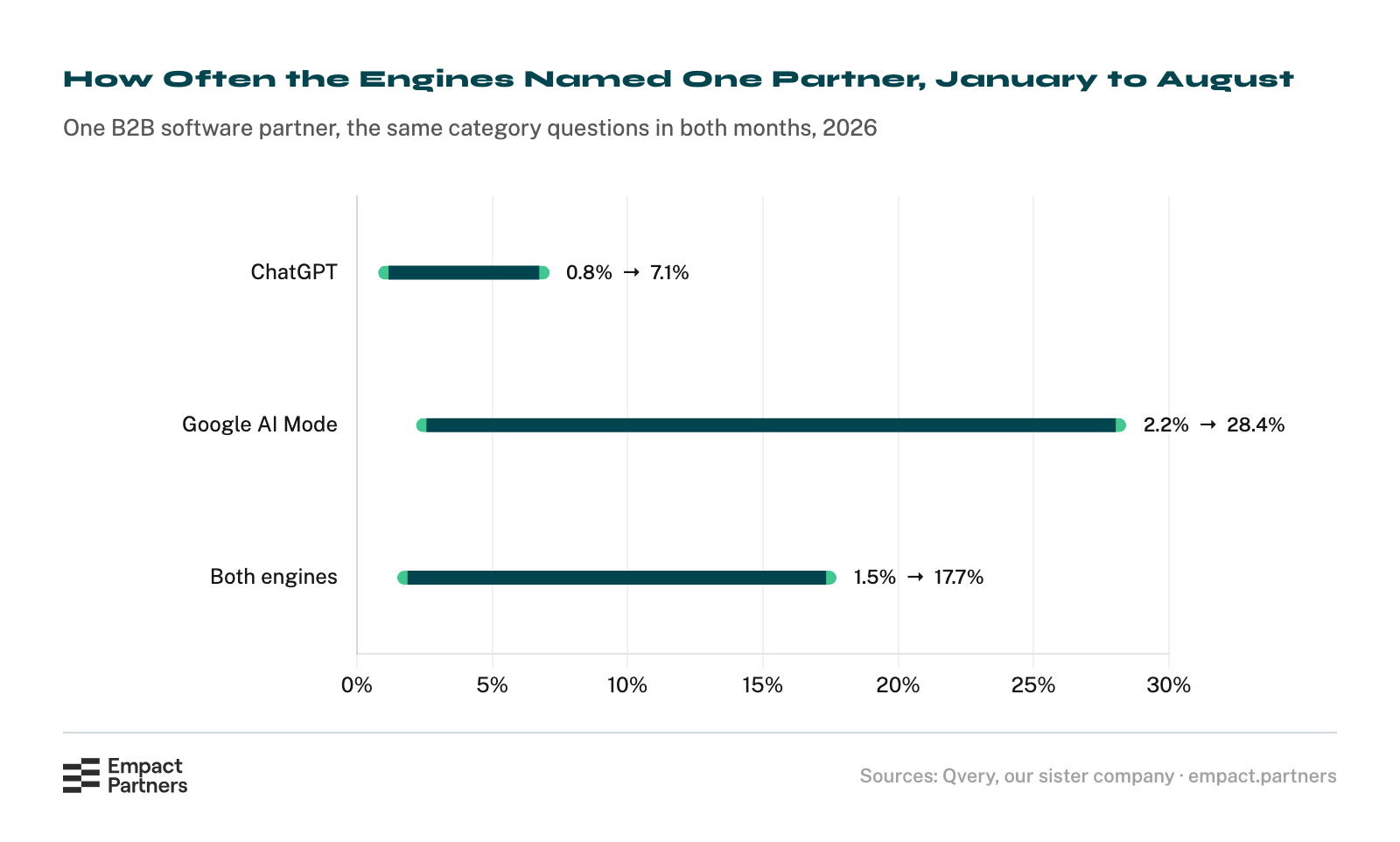
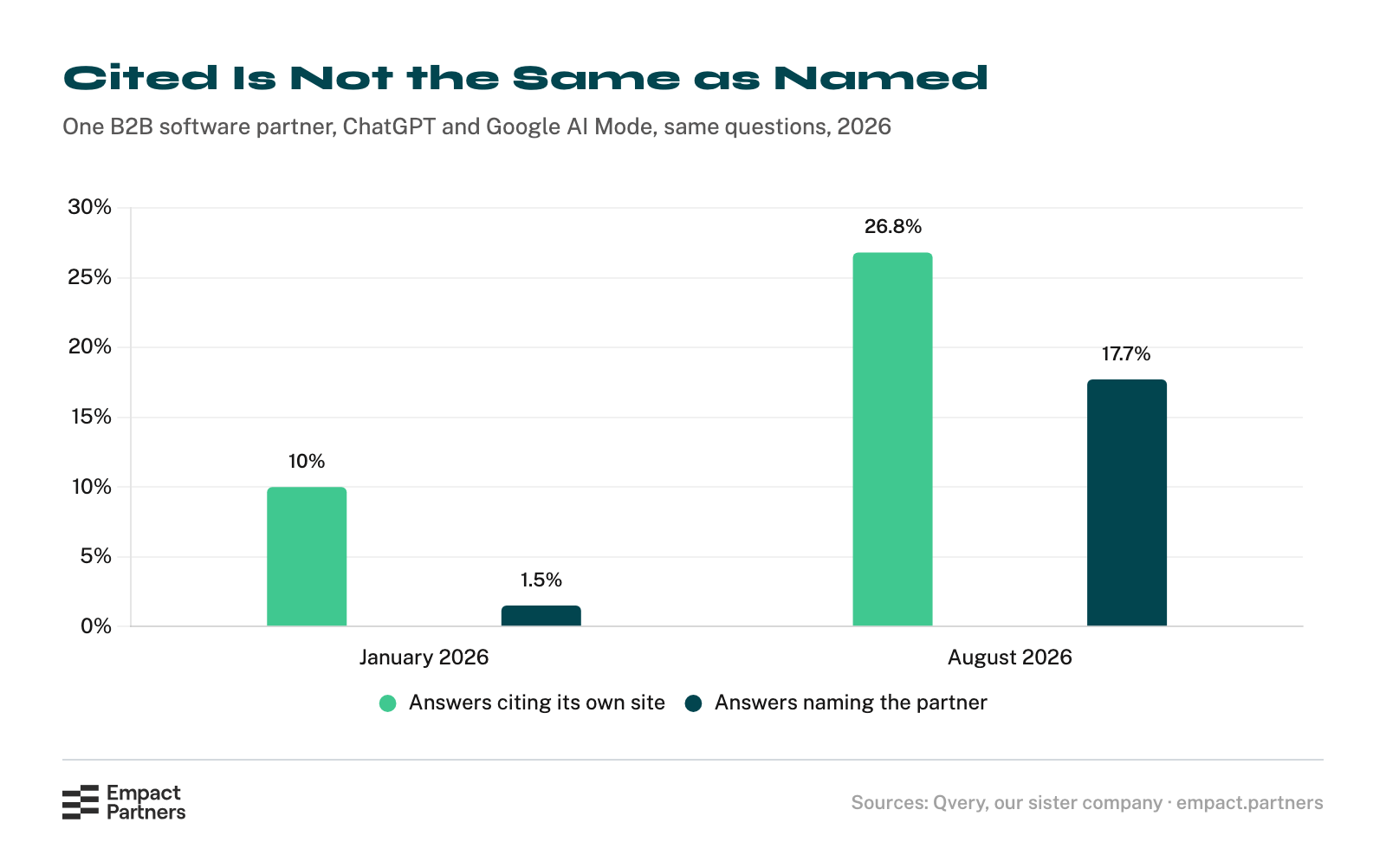
In January, ChatGPT cited the partner’s own pages in about one answer in six and named the partner in fewer than one in a hundred. The engines could find the site. They had no reason to recommend the company.
Between January and August two kinds of work ran side by side. The partner’s pages were rebuilt around the questions its buyers ask, which is the floor. And we got the partner into the “best X” roundups in its category, which is the naming half.
The roundups were the naming half because that is where the engines look. In the software answers Qvery collected this year, Google AI Mode had a listicle among its sources in at least 87.2% of cited answers.
By August, close to nine in ten answers that named the partner also cited its own site. We cannot split the rise between the two halves of the work, and we do not try. What the January numbers rule out is the version where the site alone was enough.
An SEO partnership with us is built on that split now. It opens with an audit that lists the surfaces your buyers ask on and the pages the engines cite for your category, and it checks the floor first.
Then the SEO and GEO workstreams run on one roadmap, with a senior consultant on the calls. The report leads with how often each engine names you, and the work is planned in quarters.
Keep the Retainer and Rewrite What It Reports
So do not cancel the SEO retainer. Rewrite what it has to report, and judge the vendor on whether they can produce it:
Rankings and domain rating can sit at the bottom of that report, checked once a month. If your vendor cannot produce the top half, that is the part of SEO that is dead.
If you need help with AI engine optimization, pick a time on my calendar, and we will work out together whether Empact Partners should be the one getting your company named in those answers.


